A brief history of twin pushers
Bob Angel
I would arbitrarily choose circa 1910 as the time when powered model building got well underway in the US. Rubber motors dominated while lightweight gasoline engines were slowly developing. Samuel Langley flew an engine-powered model in the late 1800s, but it used a steam engine and its success was limited.
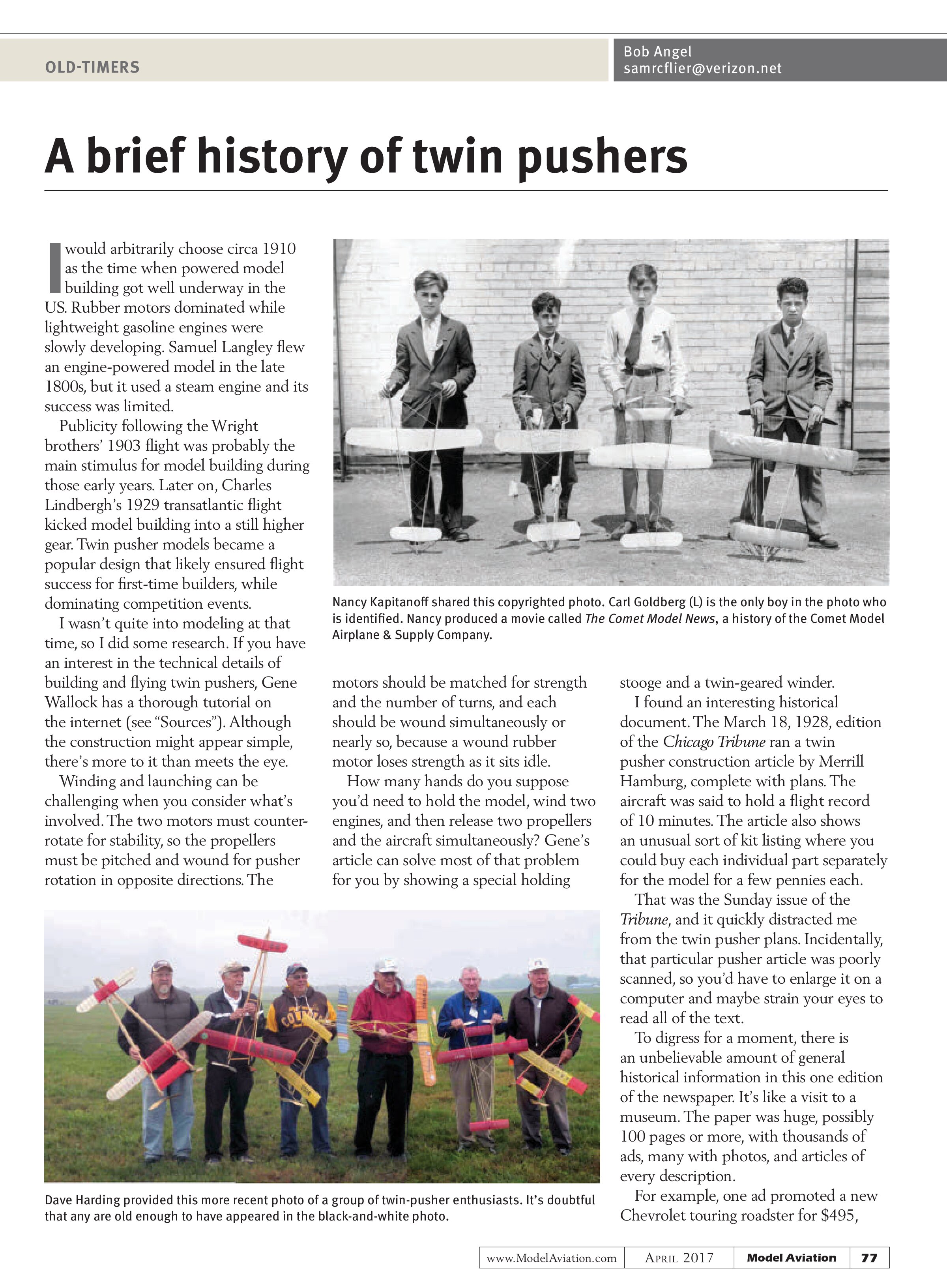
Publicity following the Wright brothers’ 1903 flight was probably the main stimulus for model building during those early years. Later on, Charles Lindbergh’s 1929 transatlantic flight kicked model building into a still higher gear. Twin pusher models became a popular design that likely ensured flight success for first-time builders, while dominating competition events.
I wasn’t quite into modeling at that time, so I did some research. If you have an interest in the technical details of building and flying twin pushers, Gene Wallock has a thorough tutorial on the internet (see “Sources”). Although the construction might appear simple, there’s more to it than meets the eye.
Winding and launching can be challenging when you consider what’s involved. The two motors must counter-rotate for stability, so the propellers must be pitched and wound for pusher rotation in opposite directions. The

motors should be matched for strength and the number of turns, and each should be wound simultaneously or nearly so, because a wound rubber motor loses strength as it sits idle.
How many hands do you suppose you’d need to hold the model, wind two engines, and then release two propellers and the aircraft simultaneously? Gene’s article can solve most of that problem for you by showing a special holding stooge and a twin-geared winder.

I found an interesting historical document. The March 18, 1928, edition of the Chicago Tribune ran a twin pusher construction article by Merrill Hamburg, complete with plans. The aircraft was said to hold a flight record of 10 minutes. The article also shows an unusual sort of kit listing where you could buy each individual part separately for the model for a few pennies each.
That was the Sunday issue of the Tribune, and it quickly distracted me from the twin pusher plans. Incidentally, that particular pusher article was poorly scanned, so you’d have to enlarge it on a computer and maybe strain your eyes to read all of the text.
To digress for a moment, there is an unbelievable amount of general historical information in this one edition of the newspaper. It’s like a visit to a museum. The paper was huge, possibly 100 pages or more, with thousands of ads, many with photos, and articles of every description.
For example, one ad promoted a new Chevrolet touring roadster for $495,
while a floor cabinet radio would go for almost half of that. Be warned—if you open the link to that newspaper (see “Sources”), make sure that you have some time to spare.

Back to business! After the twin pushers had enjoyed a good run, Vernon Boehle was credited with demonstrating that a single-motor, single-fuselage model could compete and even outdo the twin pushers, so sometime in the 1930s, the twin pushers began to be replaced by single-motor tractor designs.
But the pushers didn’t completely go away. Today they have made a comeback, with a cultlike following among Old-Timer (OT) fliers.
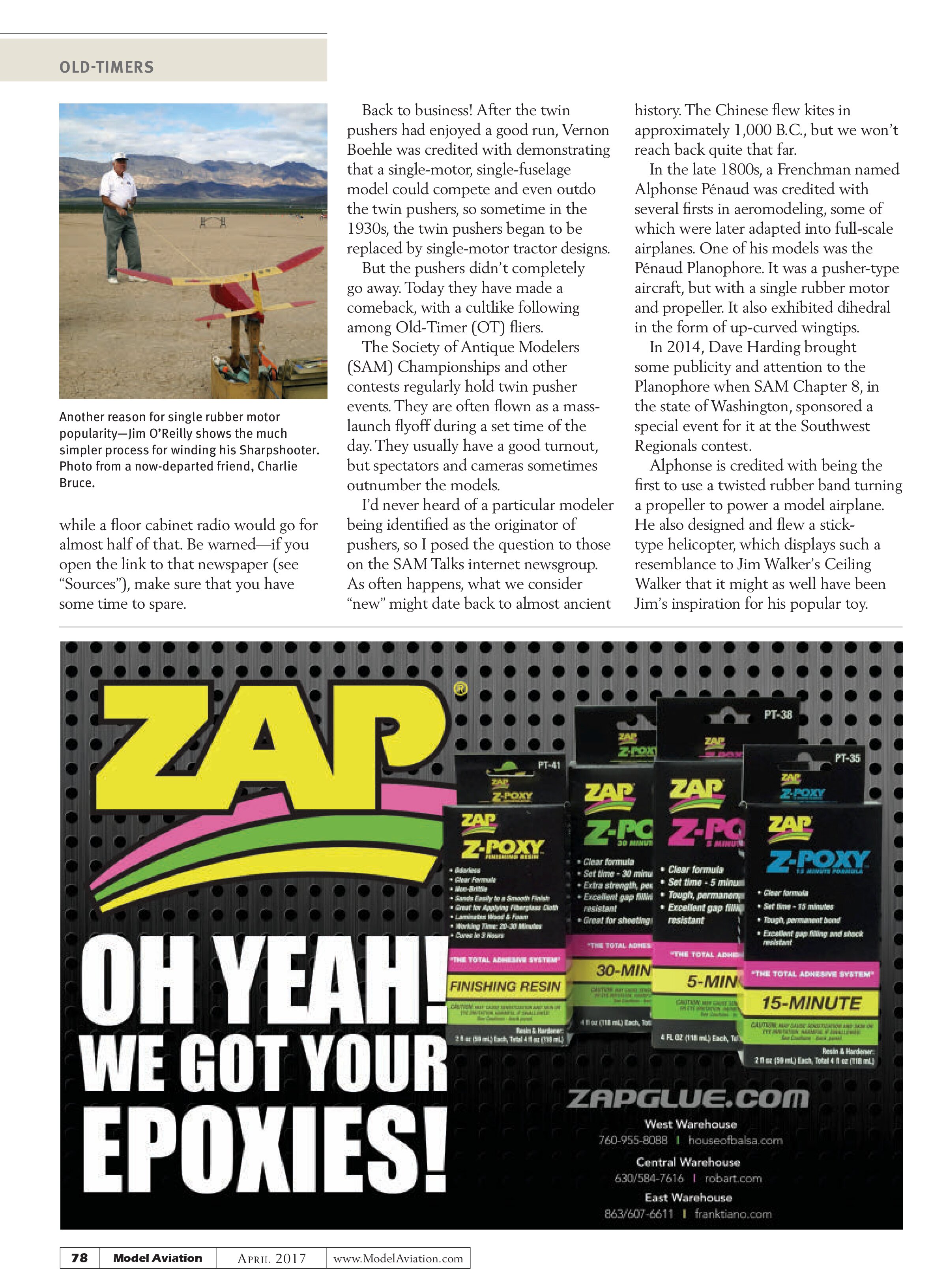
The Society of Antique Modelers (SAM) Championships and other contests regularly hold twin pusher events. They are often flown as a mass-launch flyoff during a set time of the day. They usually have a good turnout, but spectators and cameras sometimes outnumber the models.
I’d never heard of a particular modeler being identified as the originator of pushers, so I posed the question to those on the SAM Talks internet newsgroup. As often happens, what we consider “new” might date back to almost ancient history. The Chinese flew kites in approximately 1,000 B.C., but we won’t reach back quite that far.
In the late 1800s, a Frenchman named Alphonse Pénaud was credited with several firsts in aeromodeling, some of which were later adapted into full-scale airplanes. One of his models was the Pénaud Planophore. It was a pusher-type aircraft, but with a single rubber motor and propeller. It also exhibited dihedral in the form of up-curved wingtips.
In 2014, Dave Harding brought some publicity and attention to the Planophore when SAM Chapter 8, in the state of Washington, sponsored a special event for it at the Southwest Regionals contest.
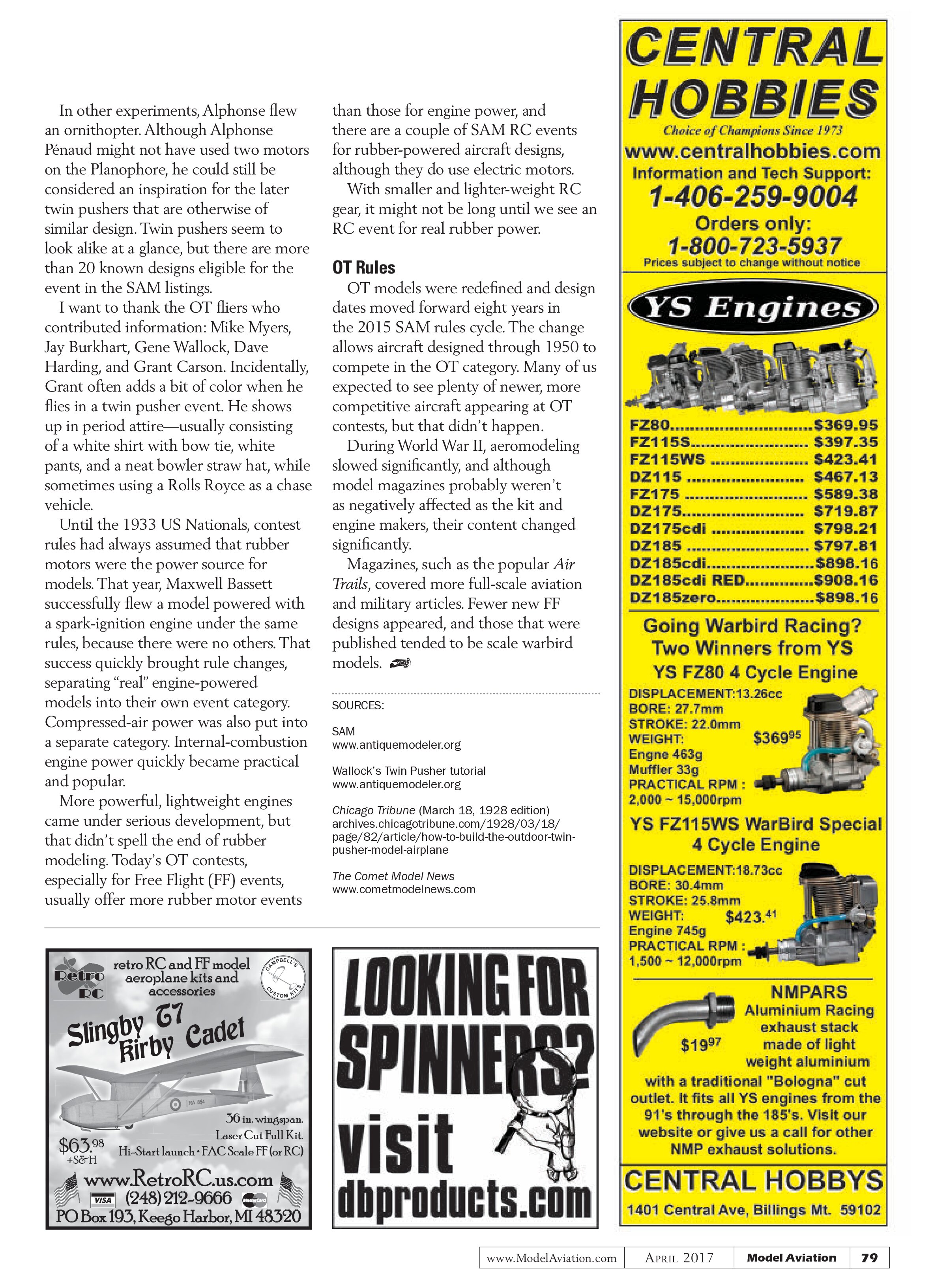
Alphonse is credited with being the first to use a twisted rubber band turning a propeller to power a model airplane. He also designed and flew a stick-type helicopter, which displays such a resemblance to Jim Walker’s Ceiling Walker that it might as well have been Jim’s inspiration for his popular toy.
In other experiments, Alphonse flew an ornithopter. Although Alphonse Pénaud might not have used two motors on the Planophore, he could still be considered an inspiration for the later twin pushers that are otherwise of similar design. Twin pushers seem to look alike at a glance, but there are more than 20 known designs eligible for the event in the SAM listings.
I want to thank the OT fliers who contributed information: Mike Myers, Jay Burkhart, Gene Wallock, Dave Harding, and Grant Carson. Incidentally, Grant often adds a bit of color when he flies in a twin pusher event. He shows up in period attire—usually consisting of a white shirt with bow tie, white pants, and a neat bowler straw hat, while sometimes using a Rolls Royce as a chase vehicle.
Until the 1933 US Nationals, contest rules had always assumed that rubber motors were the power source for models. That year, Maxwell Bassett successfully flew a model powered with a spark-ignition engine under the same rules, because there were no others. That success quickly brought rule changes, separating “real” engine-powered models into their own event category. Compressed-air power was also put into a separate category. Internal-combustion engine power quickly became practical and popular.
More powerful, lightweight engines came under serious development, but that didn’t spell the end of rubber modeling. Today’s OT contests, especially for Free Flight (FF) events, usually offer more rubber motor events than those for engine power, and there are a couple of SAM RC events for rubber-powered aircraft designs, although they do use electric motors.
With smaller and lighter-weight RC gear, it might not be long until we see an RC event for real rubber power.
OT Rules
OT models were redefined and design dates moved forward eight years in the 2015 SAM rules cycle. The change allows aircraft designed through 1950 to compete in the OT category. Many of us expected to see plenty of newer, more competitive aircraft appearing at OT contests, but that didn’t happen.
During World War II, aeromodeling slowed significantly, and although model magazines probably weren’t as negatively affected as the kit and engine makers, their content changed significantly.
Magazines, such as the popular Air Trails, covered more full-scale aviation and military articles. Fewer new FF designs appeared, and those that were published tended to be scale warbird models.
SOURCES:
Wallock’s Twin Pusher tutorial
www.antiquemodeler.org
Chicago Tribune (March 18, 1928 edition)
archives.chicagotribune.com/1928/03/18/page/82/article/how-to-build-the-outdoor-twin-pusher-model-airplane
The Comet Model News
www.cometmodelnews.com