New beginner AMA event for Indoor FF
by Don Slusarczyk
don@donsrc.com

The 2017-2018 Indoor Free Flight (FF) rules are currently available on the AMA website and include a new event that was passed by the Indoor FF Contest Board. P-18 (Event 227) is a provisional event intended for newcomers with little to no modeling experience who want to try Indoor FF.
Quickly reading the adopted rules, the P-18 aircraft is defined as a monoplane with a maximum wingspan of 18 inches and a maximum chord of 4.5 inches. The stabilizer has a maximum wingspan of 9 inches and a maximum chord of 3.5 inches. The overall length is not to exceed 18 inches and the maximum hook-to-hook distance is 10 inches.
These rules are similar to Limited Pennyplane, but P-18 has a few additional rules geared toward a beginner. The minimum weight without rubber is 7.5 grams, and the propeller must be an unmodified, commercially available unit with a 6-inch maximum diameter. The model can also only be covered with tissue or

plastic shopping bag material.
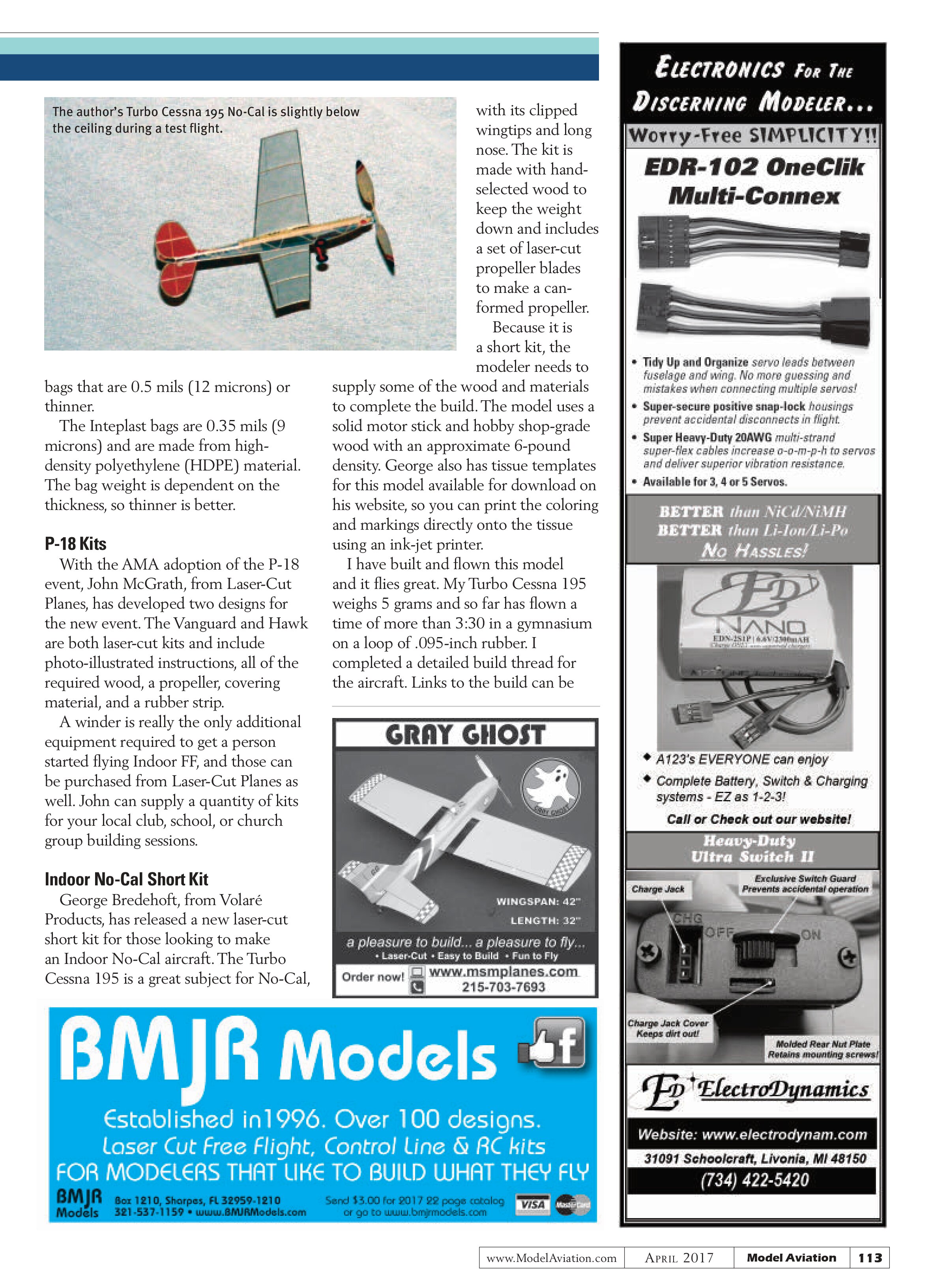
The plastic shopping bag material restriction might seem unusual at first, but the plastic bags in the produce section of grocery stores are quite thin and actually weigh less than tissue paper. The bags at my local grocery store are 12 x 20 inches and approximately 2.05 grams per bag, which calculates to 0.43 grams per 100 square inches—comparable to lightweight condenser paper and roughly half the weight of Esaki tissue.
After some research, I found the bags are made by Inteplast and are 9 microns thick. The 12 x 20-inch bags come in rolls of 875 bags per roll and can be bought from online retailers such as
Amazon or online restaurant suppliers. This specific bag is sold in a case of four rolls, which is 3,500 bags at a cost of approximately $40/case, making each bag slightly more than 1¢ each. At that price, it is quite affordable for anyone wanting to start flying Indoor FF. Yes, 3,500 bags is a lot of covering material, but if you split a case with a few other modeling buddies, you have enough material for many years of building.
Other brands and sizes of produce bags are available in single-roll quantities from places such as Amazon. Just be sure to verify the bag thickness when you are searching. Bags such as this are often measured in mils—1 mil is .001-inch thick or 25.4 microns. You want

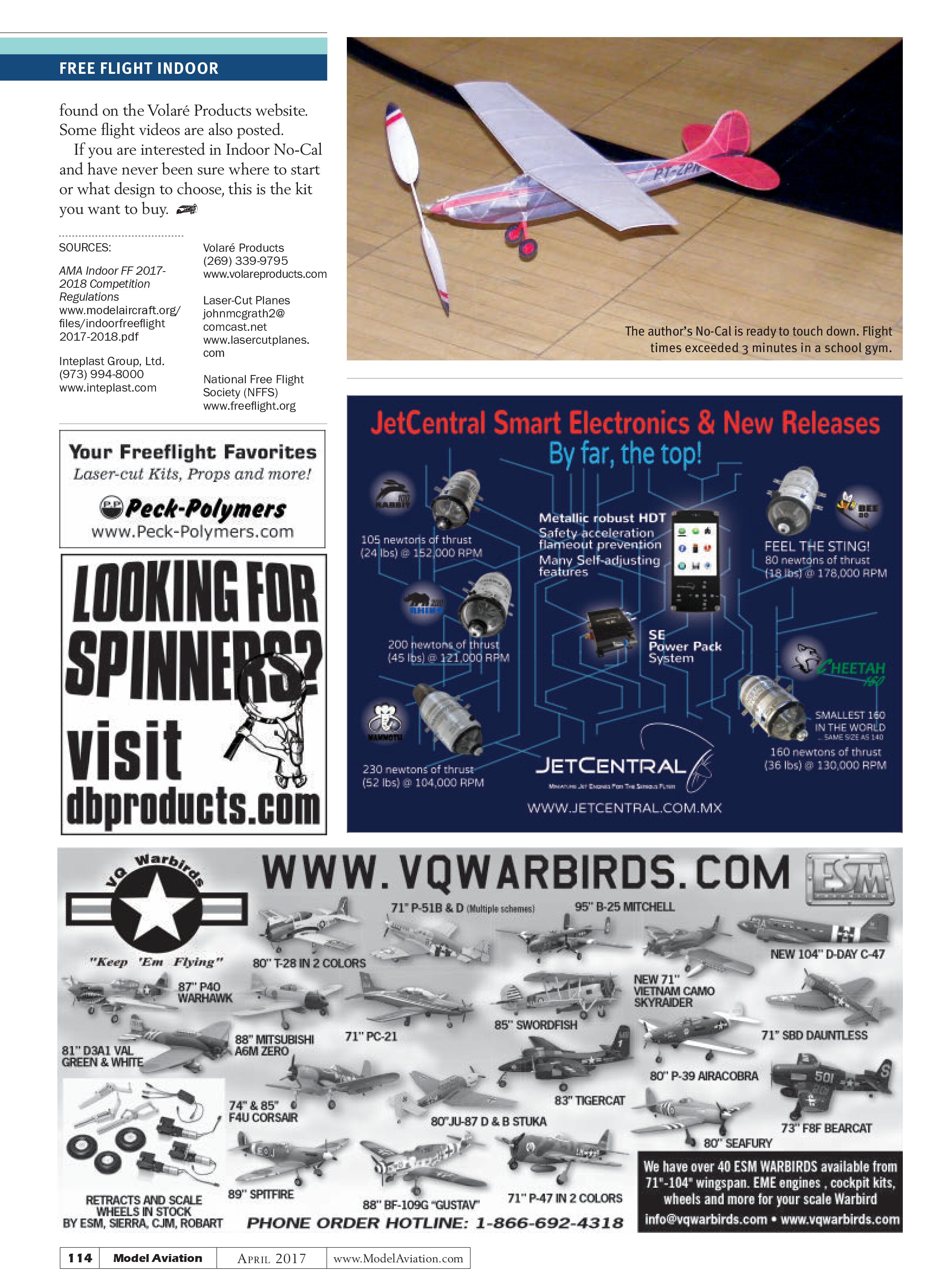
With its clipped wingtips and long nose. The kit is made with hand-selected wood to keep the weight down and includes a set of laser-cut propeller blades to make a can-formed propeller. Because it is a short kit, the modeler needs to supply some of the wood and materials to complete the build. The model uses a solid motor stick and hobby shop-grade wood with an approximate 6-pound density. George also has tissue templates for this model available for download on his website, so you can print the coloring and markings directly onto the tissue using an ink-jet printer.
I have built and flown this model and it flies great. My Turbo Cessna 195 weighs 5 grams and so far has flown a time of more than 3:30 in a gymnasium on a loop of .095-inch rubber. I completed a detailed build thread for the aircraft. Links to the build can be

bags that are 0.5 mils (12 microns) or thinner.
The Inteplast bags are 0.35 mils (9 microns) and are made from high-density polyethylene (HDPE) material. The bag weight is dependent on the thickness, so thinner is better.
P-18 Kits
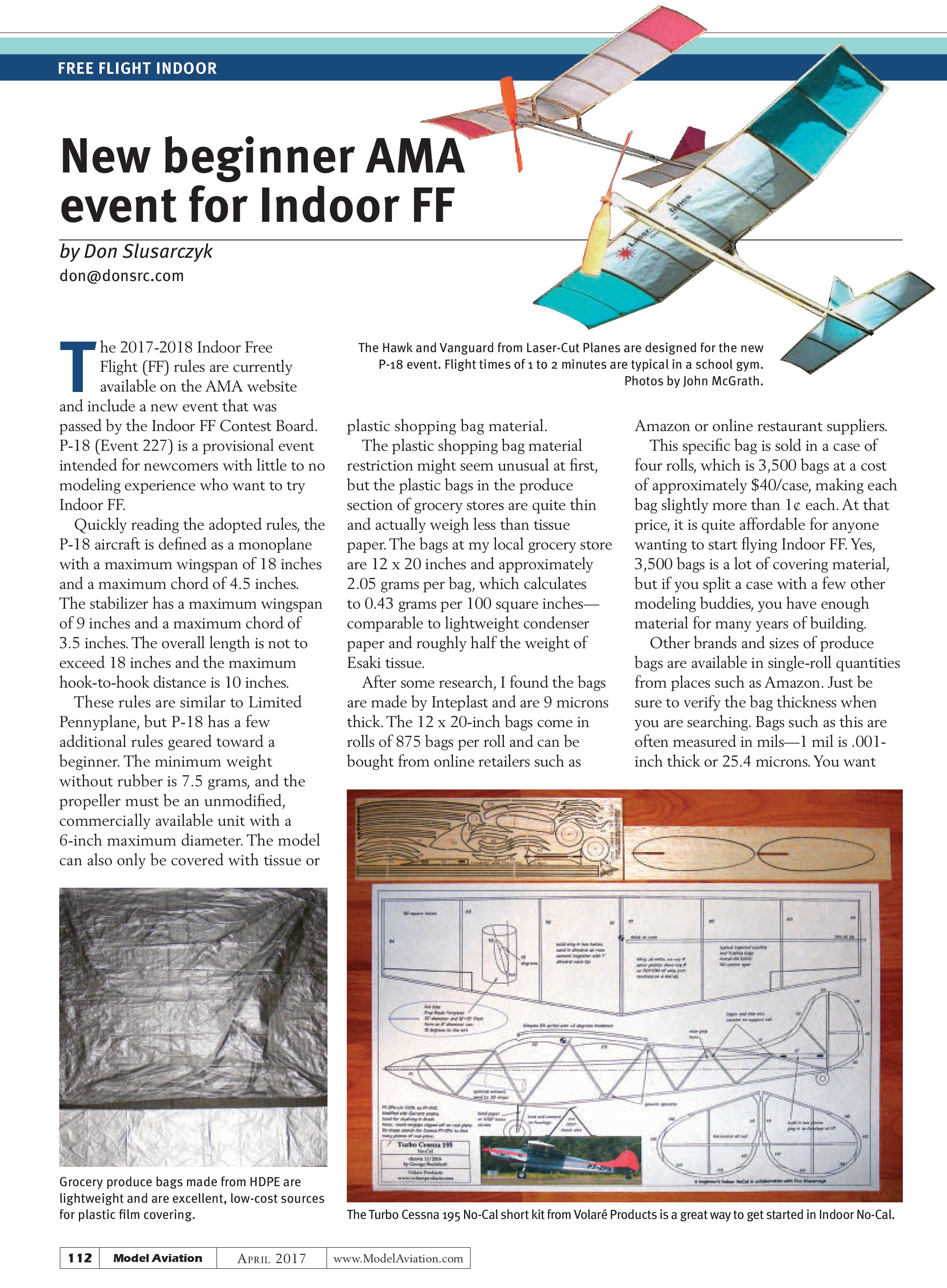
With the AMA adoption of the P-18 event, John McGrath, from Laser-Cut Planes, has developed two designs for the new event. The Vanguard and Hawk are both laser-cut kits and include photo-illustrated instructions, all of the required wood, a propeller, covering material, and a rubber strip.
A winder is really the only additional equipment required to get a person started flying Indoor FF, and those can be purchased from Laser-Cut Planes as well. John can supply a quantity of kits for your local club, school, or church group building sessions.
Indoor No-Cal Short Kit
George Bredehoft, from Volaré Products, has released a new laser-cut short kit for those looking to make an Indoor No-Cal aircraft. The Turbo Cessna 195 is a great subject for No-Cal,
found on the Volaré Products website. Some flight videos are also posted. If you are interested in Indoor No-Cal and have never been sure where to start or what design to choose, this is the kit you want to buy.
SOURCES:
AMA Indoor FF 2017-2018 Competition Regulations
www.modelaircraft.org/files/indoorfreeflight2017-2018.pdf
Inteplast Group, Ltd.
(973) 994-8000
www.inteplast.com
Volaré Products
(269) 339-9795
www.volareproducts.com
Laser-Cut Planes
johnmcgrath2@comcast.net
www.lasercutplanes.com
National Free Flight Society (NFFS)
www.freeflight.org