Focal Point
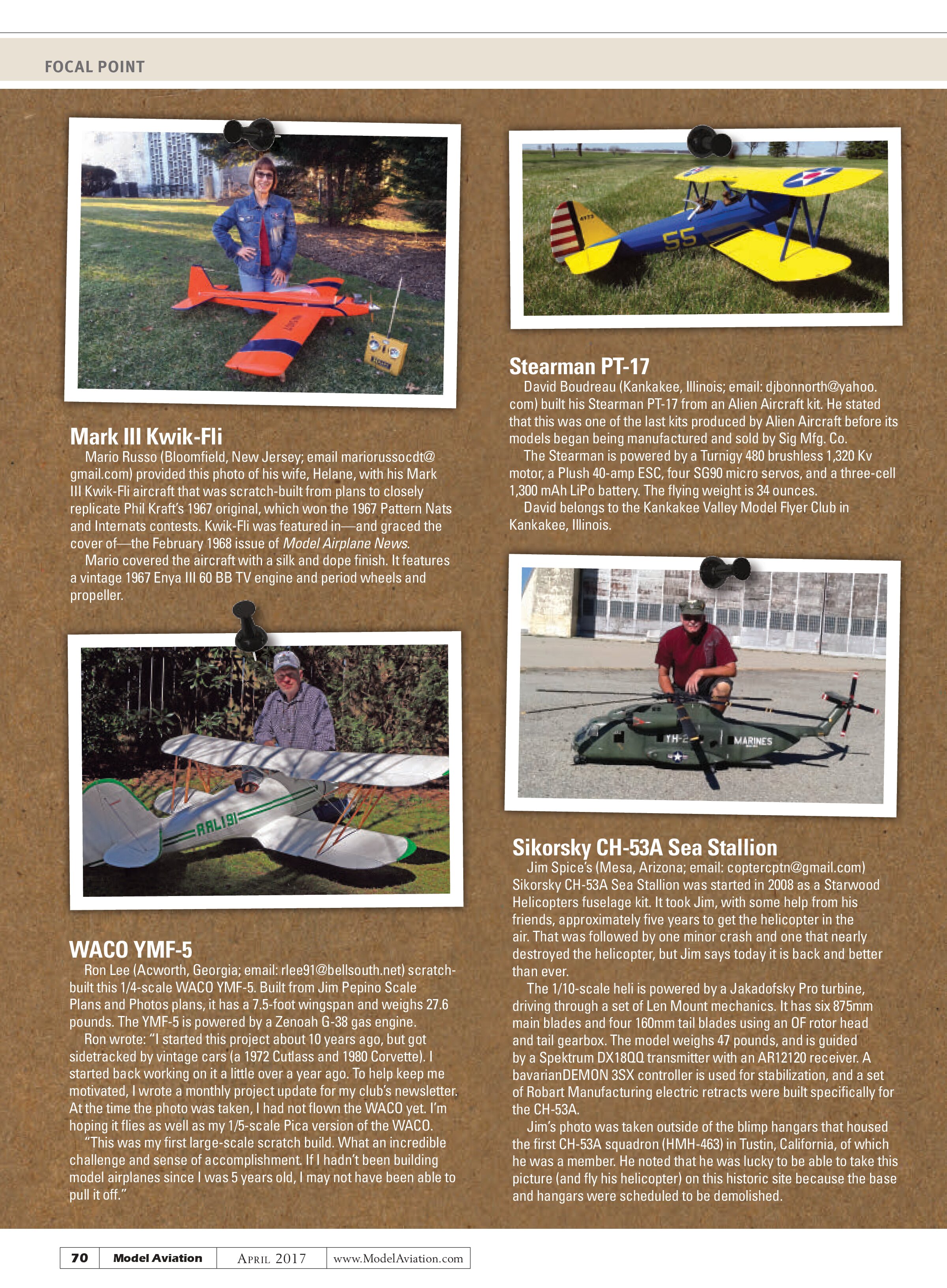
Mark III Kwik-Fli
Mario Russo (Bloomfield, New Jersey; email mariorussocdt@gmail.com) provided this photo of his wife, Helane, with her Mark III Kwik-Fli aircraft that was scratch-built from plans to closely replicate Phil Kraft’s 1967 original, which won the 1967 Pattern Nats and Internats contests. Kwik-Fli was featured in—and graced the cover of—the February 1968 issue of Model Airplane News.
Mario covered the aircraft with a silk and dope finish. It features a vintage 1967 Enya III 60 BB TV engine and period wheels and propeller.

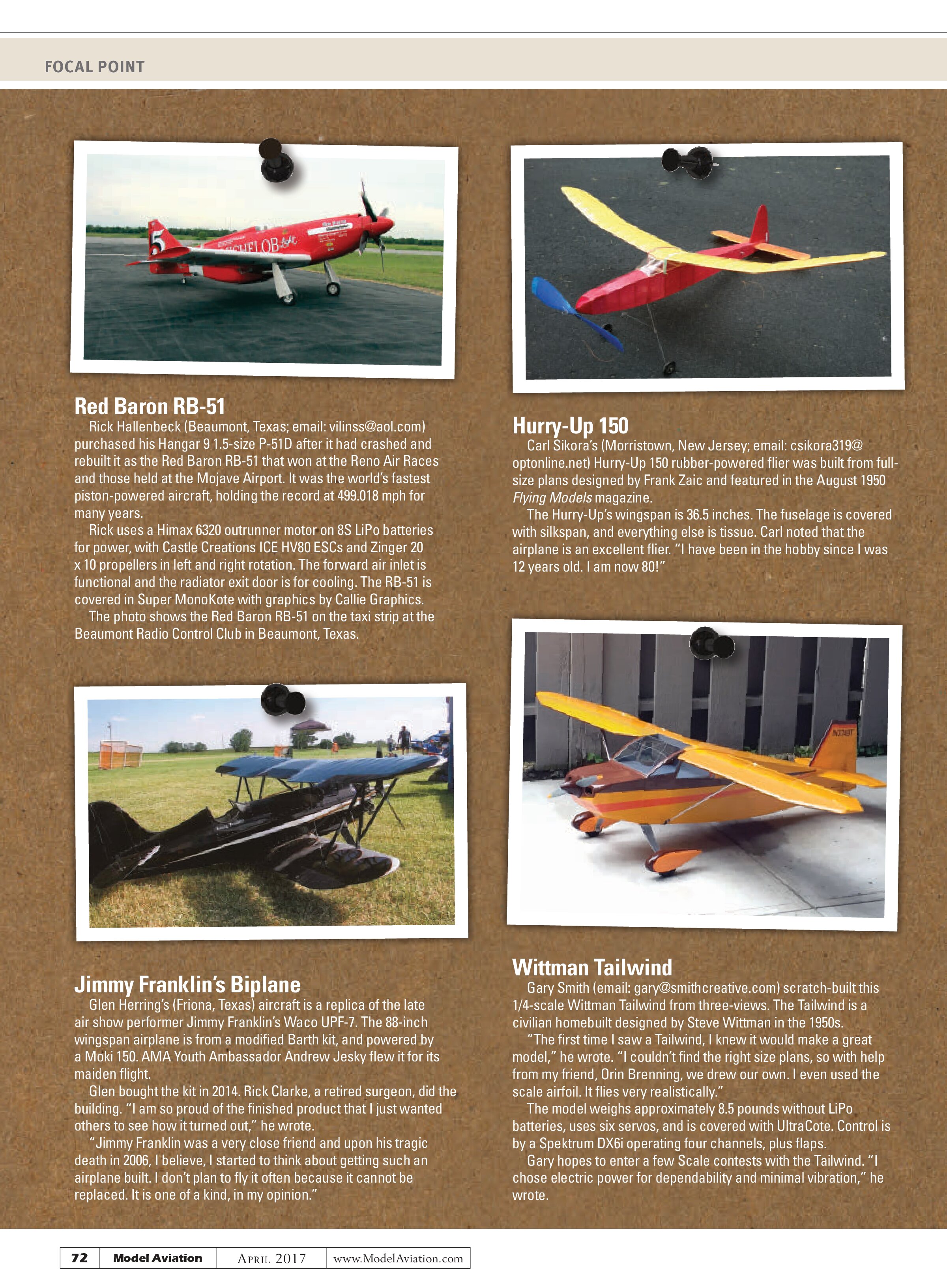
WACO YMF-5
Ron Lee (Acworth, Georgia; email: rlee91@bellsouth.net) scratch-built this 1/4-scale WACO YMF-5. Built from Jim Pepino Scale Plans and Photos plans, it has a 7.5-foot wingspan and weighs 27.6 pounds. The YMF-5 is powered by a Zenoah G-38 gas engine.
Ron wrote: “I started this project about 10 years ago, but got sidetracked by vintage cars (a 1972 Cutlass and 1980 Corvette). I started back working on it a little over a year ago. To help keep me motivated, I wrote a monthly project update for my club’s newsletter. At the time the photo was taken, I had not flown the WACO yet. I’m hoping it flies as well as my 1/5-scale Pica version of the WACO.
“This was my first large-scale scratch build. What an incredible challenge and sense of accomplishment. If I hadn’t been building model airplanes since I was 5 years old, I may not have been able to pull it off.”

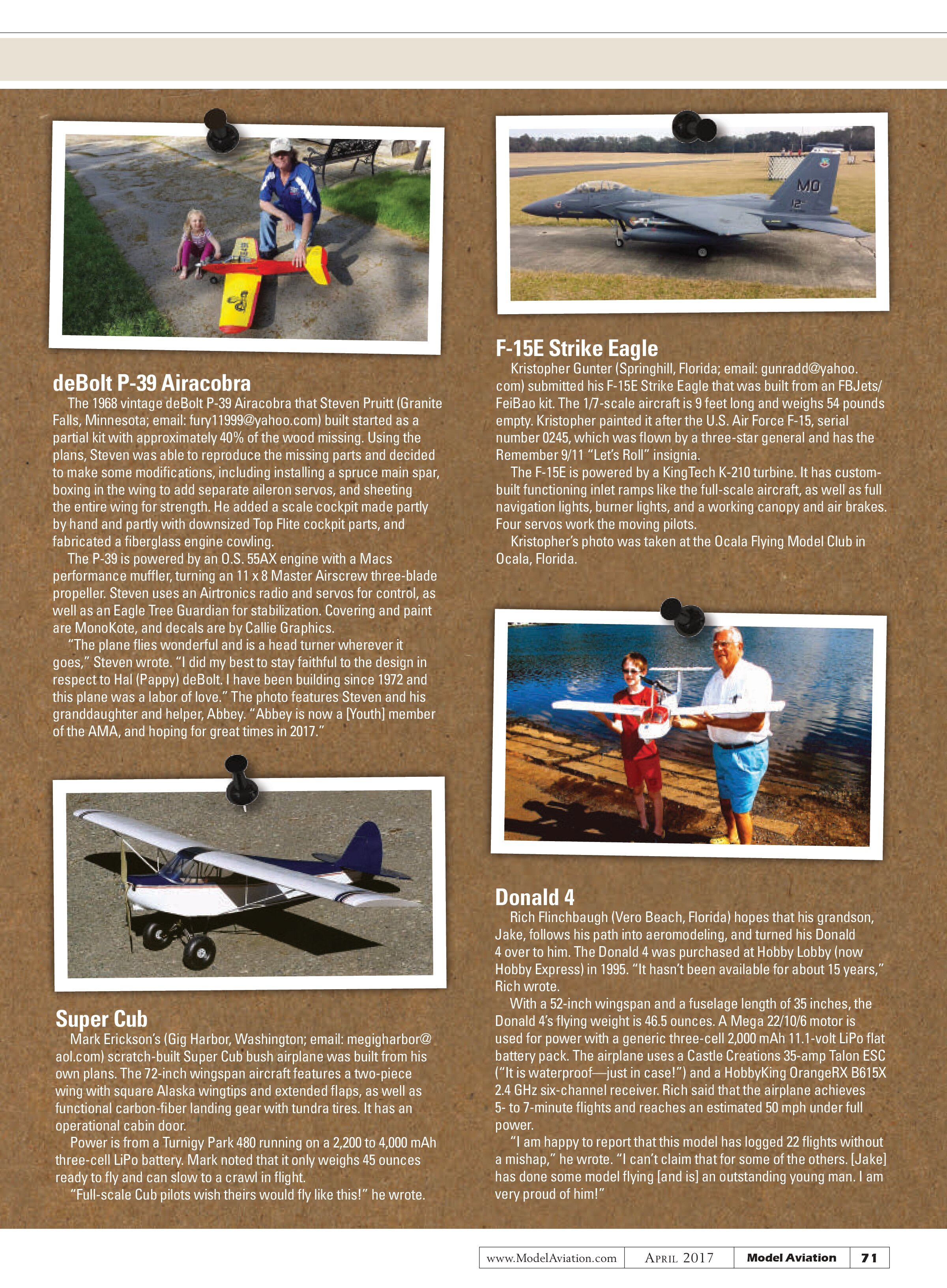
Stearman PT-17
David Boudreau (Kankakee, Illinois; email: djbonnorth@yahoo.com) built his Stearman PT-17 from an Alien Aircraft kit. He stated that this was one of the last kits produced by Alien Aircraft before its models began being manufactured and sold by Sig Mfg. Co.
The Stearman is powered by a Turnigy 480 brushless 1,320 Kv motor, a Plush 40-amp ESC, four SG90 micro servos, and a three-cell 1,300 mAh LiPo battery. The flying weight is 34 ounces.
David belongs to the Kankakee Valley Model Flyer Club in Kankakee, Illinois.

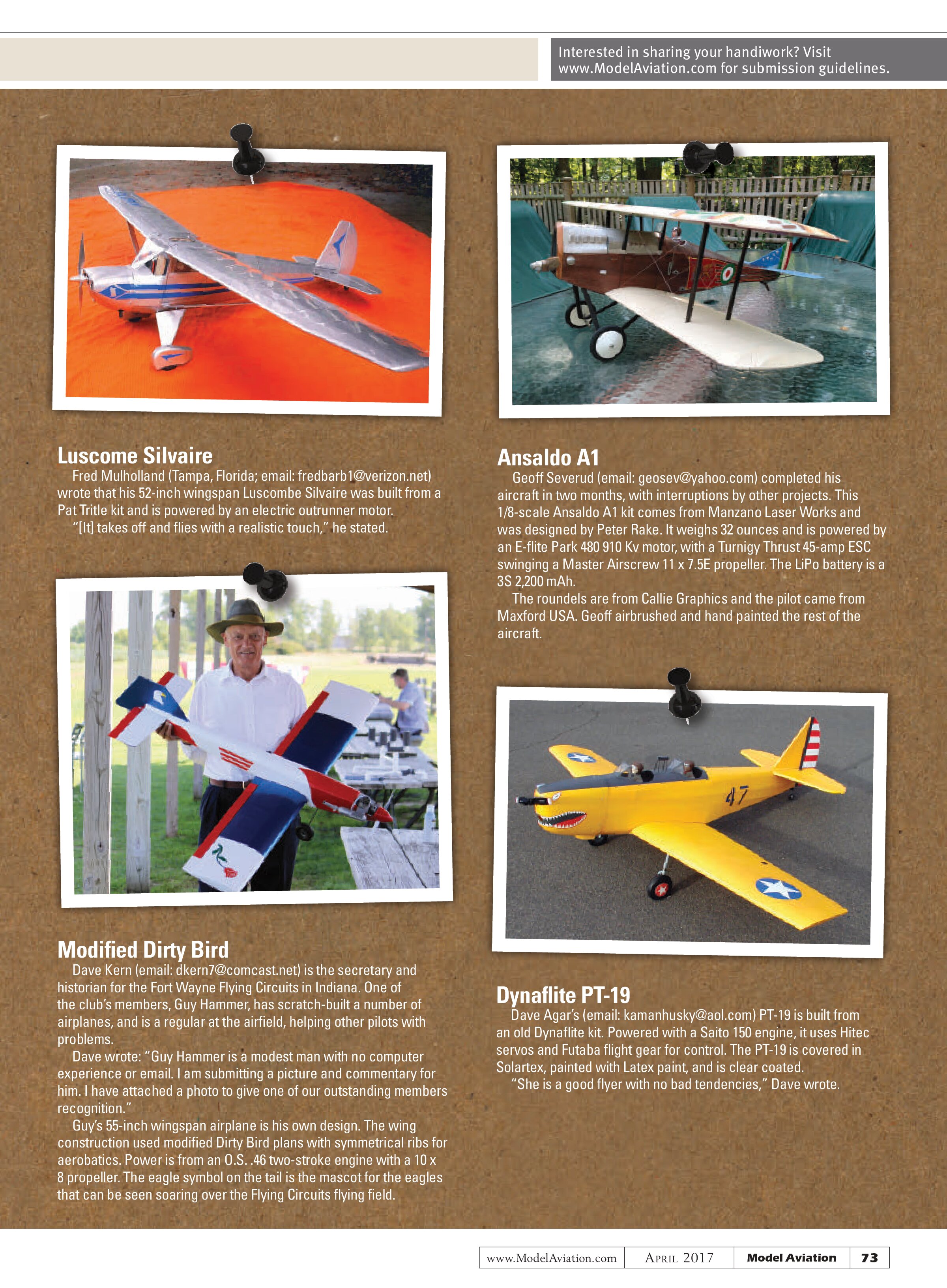
Sikorsky CH-53A Sea Stallion
Jim Spice’s (Mesa, Arizona; email: coptercptn@gmail.com) Sikorsky CH-53A Sea Stallion was started in 2008 as a Starwood Helicopters fuselage kit. It took Jim, with some help from his friends, approximately five years to get the helicopter in the air. That was followed by one minor crash and one that nearly destroyed the helicopter, but Jim says today it is back and better than ever.
The 1/10-scale heli is powered by a Jakad ofsky Pro turbine, driving through a set of Len Mount mechanics. It has six 875mm main blades and four 160mm tail blades using an OF rotor head and tail gearbox. The model weighs 47 pounds, and is guided by a Spektrum DX18QQ transmitter with an AR12120 receiver. A bavarianDEMON 3SX controller is used for stabilization, and a set of Robart Manufacturing electric retracts were built specifically for the CH-53A.
Jim’s photo was taken outside of the blimp hangars that housed the first CH-53A squadron (HMH-463) in Tustin, California, of which he was a member. He noted that he was lucky to be able to take this picture (and fly his helicopter) on this historic site because the base and hangars were scheduled to be demolished.

deBolt P-39 Airacobra
The 1968 vintage deBolt P-39 Airacobra that Steven Pruitt (Granite Falls, Minnesota; email: fury11999@yahoo.com) built started as a partial kit with approximately 40% of the wood missing. Using the plans, Steven was able to reproduce the missing parts and decided to make some modifications, including installing a spruce main spar, boxing in the wing to add separate aileron servos, and sheeting the entire wing for strength. He added a scale cockpit made partly by hand and partly with downsized Top Flite cockpit parts, and fabricated a fiberglass engine cowling.
The P-39 is powered by an O.S. 55AX engine with a Macs performance muffler, turning an 11 x 8 Master Airscrew three-blade propeller. Steven uses an Airtronics radio and servos for control, as well as an Eagle Tree Guardian for stabilization. Covering and paint are MonoKote, and decals are by Callie Graphics.
“The plane flies wonderful and is a head turner wherever it goes,” Steven wrote. “I did my best to stay faithful to the design in respect to Hal (Happy) deBolt. I have been building since 1972 and this plane was a labor of love.” The photo features Steven and his granddaughter and helper, Abbey. “Abbey is now a [Youth] member of the AMA, and hoping for great times in 2017.”

Super Cub
Mark Erickson’s (Gig Harbor, Washington; email: megigharbor@aol.com) scratch-built Super Cub bush airplane was built from his own plans. The 72-inch wingspan aircraft features a two-piece wing with square Alaska wingtips and extended flaps, as well as functional carbon-fiber landing gear with tundra tires. It has an operational cabin door.
Power is from a Turnigy Park 480 running on a 2,200 to 4,000 mAh three-cell LiPo battery. Mark noted that it only weighs 45 ounces ready to fly and can slow to a crawl in flight.
“Full-scale Cub pilots wish theirs would fly like this!” he wrote.

F-15E Strike Eagle
Kristopher Gunter (Springhill, Florida; email: gunradd@yahoo.com) submitted his F-15E Strike Eagle that was built from an FBJets/FeiBao kit. The 1/7-scale aircraft is 9 feet long and weighs 54 pounds empty. Kristopher painted it after the U.S. Air Force F-15, serial number 0245, which was flown by a three-star general and has the Remember 9/11 “Let’s Roll” insignia.
The F-15E is powered by a KingTech K-210 turbine. It has custom-built functioning inlet ramps like the full-scale aircraft, as well as full navigation lights, burner lights, and a working canopy and air brakes. Four servos work the moving pilots.
Kristopher’s photo was taken at the Ocala Flying Model Club in Ocala, Florida.

Donald 4
Rich Flinchbaugh (Vero Beach, Florida) hopes that his grandson, Jake, follows his path into aeromodeling, and turned his Donald 4 over to him. The Donald 4 was purchased at Hobby Lobby (now Hobby Express) in 1995. “It hasn’t been available for about 15 years,” Rich wrote.
With a 52-inch wingspan and a fuselage length of 35 inches, the Donald 4’s flying weight is 46.5 ounces. A Mega 22/10/6 motor is used for power with a generic three-cell 2,000 mAh 11.1-volt LiPo flat battery pack. The airplane uses a Castle Creations 35-amp Talon ESC (“It is waterproof—just in case!”) and a HobbyKing OrangeRX B615X 2.4 GHz six-channel receiver. Rich said that the airplane achieves 5- to 7-minute flights and reaches an estimated 50 mph under full power.
“I am happy to report that this model has logged 22 flights without a mishap,” he wrote. “I can’t claim that for some of the others. [Jake] has done some model flying [and is] an outstanding young man. I am very proud of him!”

Red Baron RB-51
Rick Hallenbeck (Beaumont, Texas; email: vilinss@aol.com) purchased his Hangar 9 1.5-size P-51D after it had crashed and rebuilt it as the Red Baron RB-51 that won at the Reno Air Races and those held at the Mojave Airport. It was the world’s fastest piston-powered aircraft, holding the record at 499.018 mph for many years.
Rick uses a Himax 6320 outrunner motor on 8S LiPo batteries for power, with Castle Creations ICE HV80 ESCs and Zinger 20 x 10 propellers in left and right rotation. The forward air inlet is functional and the radiator exit door is for cooling. The RB-51 is covered in Super MonoKote with graphics by Callie Graphics.
The photo shows the Red Baron RB-51 on the taxi strip at the Beaumont Radio Control Club in Beaumont, Texas.

Jimmy Franklin’s Biplane
Glen Herring’s (Friona, Texas) aircraft is a replica of the late air show performer Jimmy Franklin’s Waco UPF-7. The 88-inch wingspan airplane is from a modified Barth kit, and powered by a Moki 150. AMA Youth Ambassador Andrew Jesky flew it for its maiden flight.
Glen bought the kit in 2014. Rick Clarke, a retired surgeon, did the building. “I am so proud of the finished product that I just wanted others to see how it turned out,” he wrote.
“Jimmy Franklin was a very close friend and upon his tragic death in 2006, I believe, I started to think about getting such an airplane built. I don’t plan to fly it often because it cannot be replaced. It is one of a kind, in my opinion.”

Hurry-Up 150
Carl Sikora’s (Morristown, New Jersey; email: csikora319@optonline.net) Hurry-Up 150 rubber-powered flier was built from full-size plans designed by Frank Zaic and featured in the August 1950 Flying Models magazine.
The Hurry-Up’s wingspan is 36.5 inches. The fuselage is covered with silkspan, and everything else is tissue. Carl noted that the airplane is an excellent flier. “I have been in the hobby since I was 12 years old. I am now 80!”

Wittman Tailwind
Gary Smith (email: gary@smithcreative.com) scratch-built this 1/4-scale Wittman Tailwind from three-views. The Tailwind is a civilian homebuilt designed by Steve Wittman in the 1950s.
“The first time I saw a Tailwind, I knew it would make a great model,” he wrote. “I couldn’t find the right size plans, so with help from my friend, Orin Brenning, we drew our own. I even used the scale airfoil. It flies very realistically.”
The model weighs approximately 8.5 pounds without LiPo batteries, uses six servos, and is covered with UltraCote. Control is by a Spektrum DX6i operating four channels, plus flaps.
Gary hopes to enter a few Scale contests with the Tailwind. “I chose electric power for dependability and minimal vibration,” he wrote.

Luscombe Silvaire
Fred Mulholland (Tampa, Florida; email: fredbarb1@verizon.net) wrote that his 52-inch wingspan Luscombe Silvaire was built from a Pat Tritle kit and is powered by an electric outrunner motor.
“[It] takes off and flies with a realistic touch,” he stated.

Modified Dirty Bird
Dave Kern (email: dkern7@comcast.net) is the secretary and historian for the Fort Wayne Flying Circuits in Indiana. One of the club’s members, Guy Hammer, has scratch-built a number of airplanes, and is a regular at the airfield, helping other pilots with problems.
Dave wrote: “Guy Hammer is a modest man with no computer experience or email. I am submitting a picture and commentary for him. I have attached a photo to give one of our outstanding members recognition.”
Guy’s 55-inch wingspan airplane is his own design. The wing construction used modified Dirty Bird plans with symmetrical ribs for aerobatics. Power is from an O.S. .46 two-stroke engine with a 10 x 8 propeller. The eagle symbol on the tail is the mascot for the eagles that can be seen soaring over the Flying Circuits flying field.

Ansaldo A1
Geoff Severud (email: geosev@yahoo.com) completed his aircraft in two months, with interruptions by other projects. This 1/8-scale Ansaldo A1 kit comes from Manzano Laser Works and was designed by Peter Rake. It weighs 32 ounces and is powered by an E-flite Park 480 910 Kv motor, with a Turnigy Thrust 45-amp ESC swinging a Master Airscrew 11 x 7.5E propeller. The LiPo battery is a 3S 2,200 mAh.
The roundels are from Callie Graphics and the pilot came from Maxford USA. Geoff airbrushed and hand painted the rest of the aircraft.

Dynaflite PT-19
Dave Agar’s (email: kamanhusky@aol.com) PT-19 is built from an old Dynaflite kit. Powered with a Saito 150 engine, it uses Hitec servos and Futaba flight gear for control. The PT-19 is covered in Solartex, painted with Latex paint, and is clear coated.
“She is a good flyer with no bad tendencies,” Dave wrote.

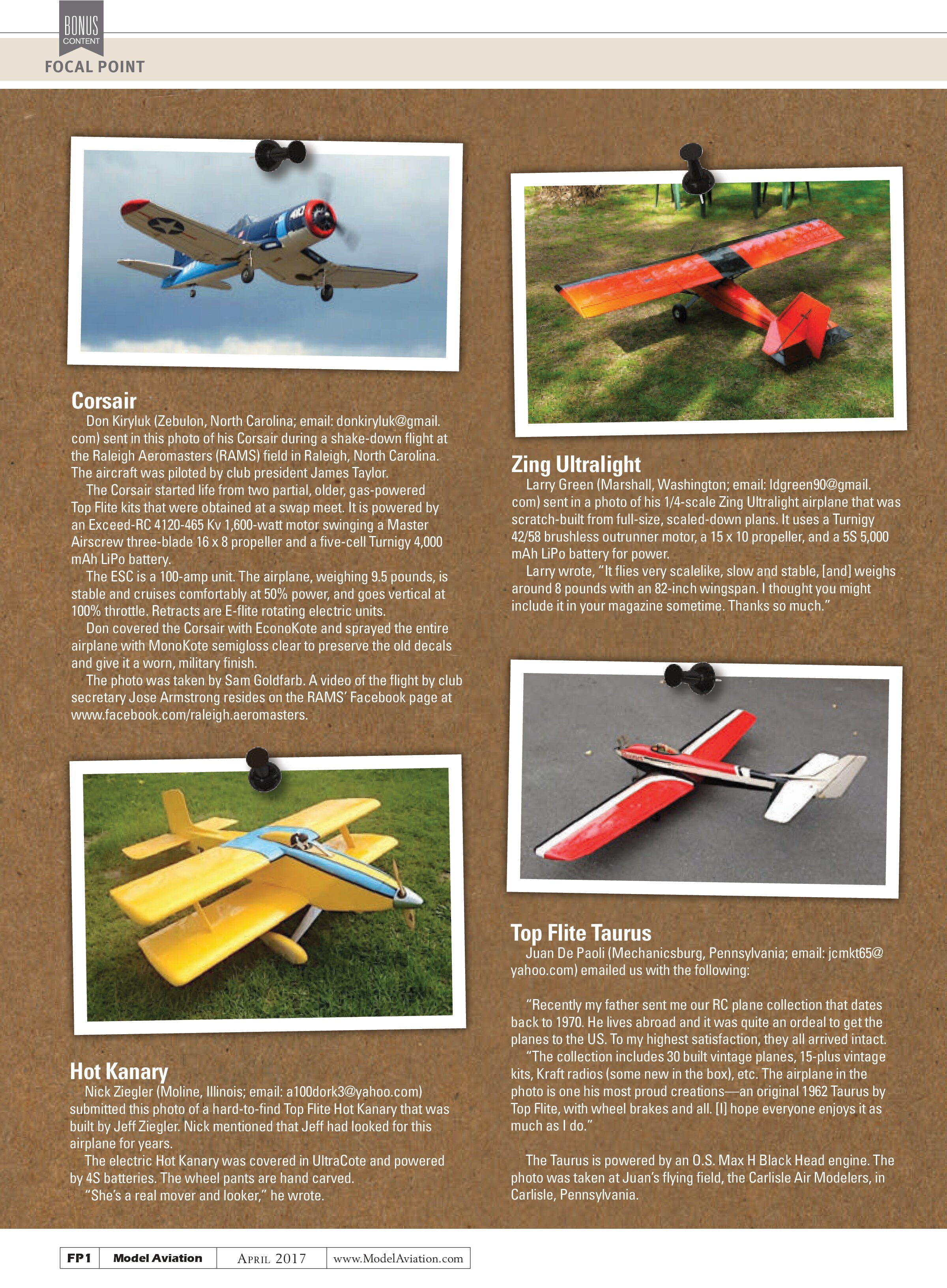
Corsair
Don Kiryluk (Zebulon, North Carolina; email: donkiryluk@gmail.com) sent in this photo of his Corsair during a shake-down flight at the Raleigh Aeromasters (RAMS) field in Raleigh, North Carolina. The aircraft was piloted by club president James Taylor.
The Corsair started life from two partial, older, gas-powered Top Flite kits that were obtained at a swap meet. It is powered by an Exceed-RC 4120-465 Kv 1,600-watt motor swinging a Master Airscrew three-blade 16 x 8 propeller and a five-cell Turnigy 4,000 mAh LiPo battery.
The ESC is a 100-amp unit. The airplane, weighing 9.5 pounds, is stable and cruises comfortably at 50% power, and goes vertical at 100% throttle. Retracts are E-flite rotating electric units.
Don covered the Corsair with EconoKote and sprayed the entire airplane with MonoKote semigloss clear to preserve the old decals and give it a worn, military finish.
The photo was taken by Sam Goldfarb. A video of the flight by club secretary Jose Armstrong resides on the RAMS’ Facebook page at www.facebook.com/raleigh.aeromasters.

Hot Kanary
Nick Ziegler (Moline, Illinois; email: a100dork3@yahoo.com) submitted this photo of a hard-to-find Top Flite Hot Kanary that was built by Jeff Ziegler. Nick mentioned that Jeff had looked for this airplane for years.
The electric Hot Kanary was covered in UltraCote and powered by 4S batteries. The wheel pants are hand carved.
“She’s a real mover and looker,” he wrote.

Zing Ultralight
Larry Green (Marshall, Washington; email: ldgreen90@gmail.com) sent in a photo of his 1/4-scale Zing Ultralight airplane that was scratch-built from full-size, scaled-down plans. It uses a Turnigy 42/58 brushless outrunner motor, a 15 x 10 propeller, and a 5S 5,000 mAh LiPo battery for power.
Larry wrote, “It flies very scalelike, slow and stable, [and] weighs around 8 pounds with an 82-inch wingspan. I thought you might include it in your magazine sometime. Thanks so much.”

Top Flite Taurus
Juan De Paoli (Mechanicsburg, Pennsylvania; email: jcmkt65@yahoo.com) emailed us with the following:
“Recently my father sent me our RC plane collection that dates back to 1970. He lives abroad and it was quite an ordeal to get the planes to the US. To my highest satisfaction, they all arrived intact. The collection includes 30 built vintage planes, 15-plus vintage kits, Kraft radios (some new in the box), etc. The airplane in the photo is one his most proud creations—an original 1962 Taurus by Top Flite, with wheel brakes and all. [I] hope everyone enjoys it as much as I do.”
The Taurus is powered by an O.S. Max H Black Head engine. The photo was taken at Juan’s flying field, the Carlisle Air Modelers, in Carlisle, Pennsylvania.

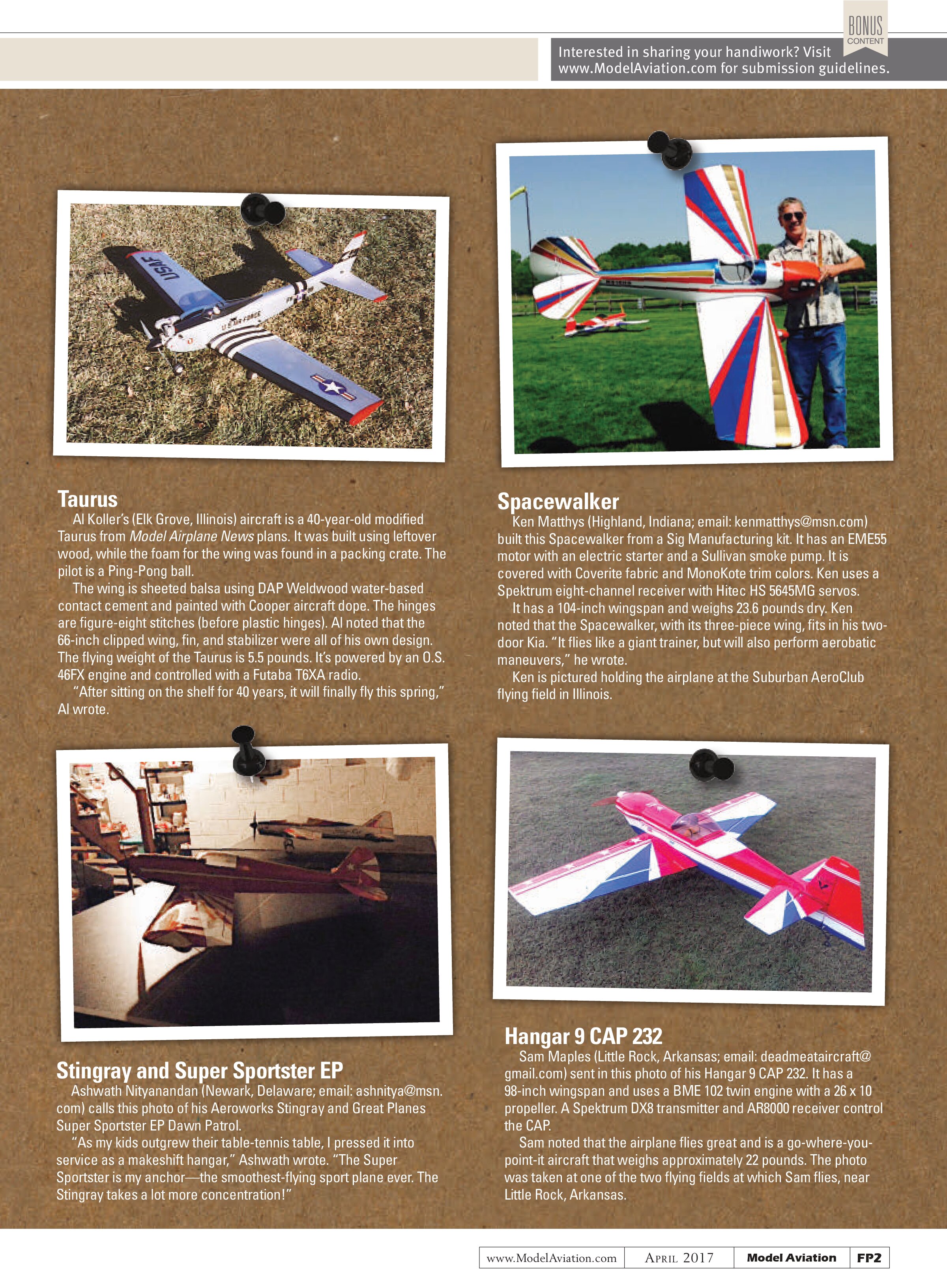
Taurus
Al Koller’s (Elk Grove, Illinois) aircraft is a 40-year-old modified Taurus from Model Airplane News plans. It was built using leftover wood, while the foam for the wing was found in a packing crate. The pilot is a Ping-Pong ball.
The wing is sheeted balsa using DAP Weldwood water-based contact cement and painted with Cooper aircraft dope. The hinges are figure-eight stitches (before plastic hinges). Al noted that the 66-inch clipped wing, fin, and stabilizer were all of his own design. The flying weight of the Taurus is 5.5 pounds. It’s powered by an O.S. 46FX engine and controlled with a Futaba T6XA radio.
“After sitting on the shelf for 40 years, it will finally fly this spring,” Al wrote.

Stingray and Super Sportster EP
Ashwath Nityanandan (Newark, Delaware; email: ashniya@msn.com) calls this photo of his Aeroworks Stingray and Great Planes Super Sportster EP Dawn Patrol.
“As my kids outgrew their table-tennis table, I pressed it into service as a makeshift hangar,” Ashwath wrote. “The Super Sportster is my anchor—the smoothest-flying sport plane ever. The Stingray takes a lot more concentration!”

Spacewalker
Ken Matthys (Highland, Indiana; email: kenmatthys@msn.com) built this Spacewalker from a Sig Manufacturing kit. It has an ENE55 motor with an electric starter and a Sullivan smoke pump. It is covered with Coverite fabric and MonoKote trim colors. Ken uses a Spektrum eight-channel receiver with Hitec HS 5645MG servos.
It has a 104-inch wingspan and weighs 23.6 pounds dry. Ken noted that the Spacewalker, with its three-piece wing, fits in his two-door Kia. “It flies like a giant trainer, but will also perform aerobatic maneuvers,” he wrote.
Ken is pictured holding the airplane at the Suburban AeroClub flying field in Illinois.

Hangar 9 CAP 232
Sam Maples (Little Rock, Arkansas; email: deadmeataircraft@gmail.com) sent in this photo of his Hangar 9 CAP 232. It has a 98-inch wingspan and uses a BME 102 twin engine with a 26 x 10 propeller. A Spektrum DX8 transmitter and AR8000 receiver control the CAP.
Sam noted that the airplane flies great and is a go-where-you-point-it aircraft that weighs approximately 22 pounds. The photo was taken at one of the two flying fields at which Sam flies, near Little Rock, Arkansas.