Electric Carrier project, part three
by Dick Perry
tailhooker@comcast.net
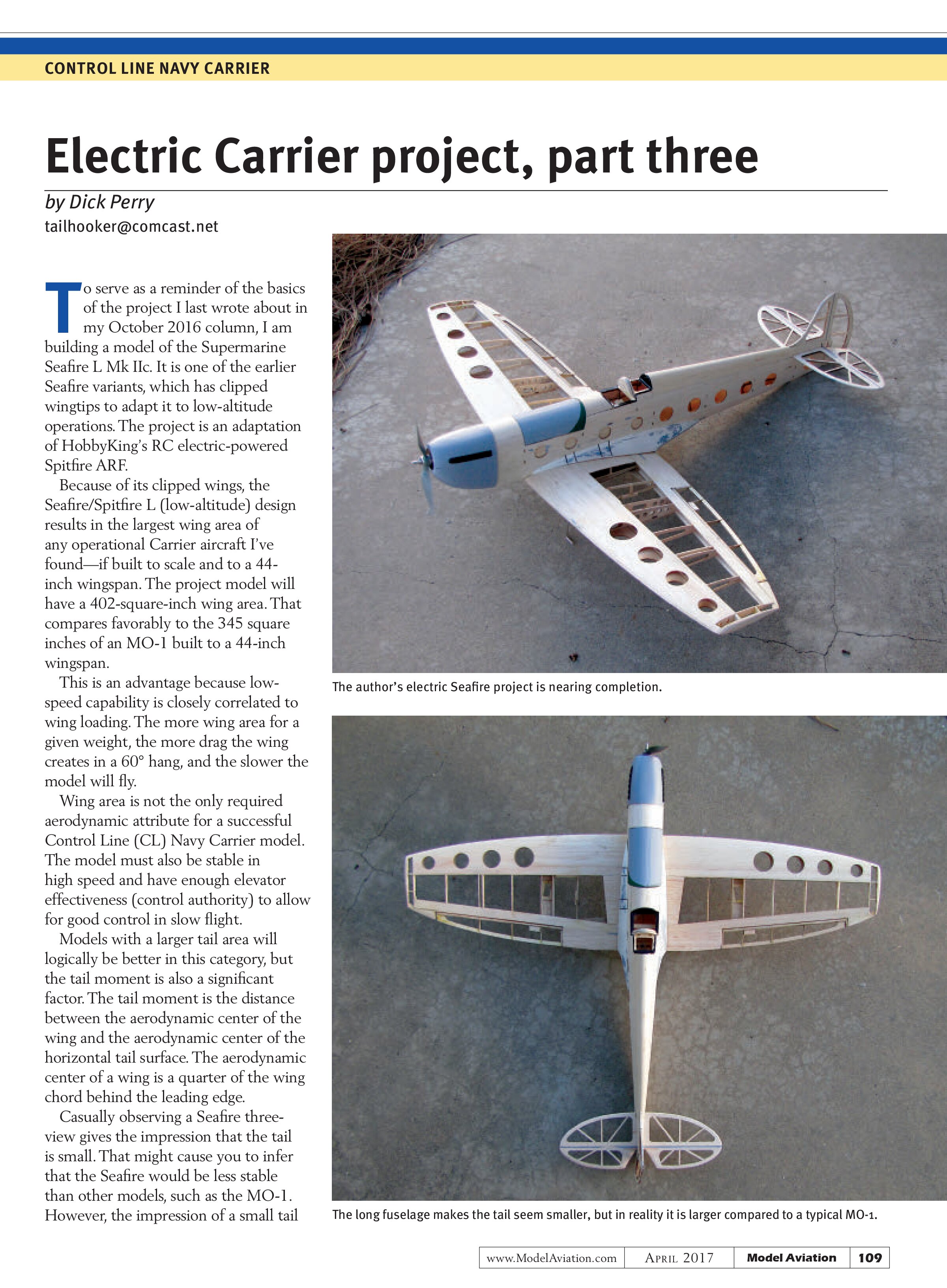
To serve as a reminder of the basics of the project I last wrote about in my October 2016 column, I am building a model of the Supermarine Seafire L Mk IIc. It is one of the earlier Seafire variants, which has clipped wingtips to adapt it to low-altitude operations. The project is an adaptation of HobbyKing’s RC electric-powered Spitfire ARF.
Because of its clipped wings, the Seafire/Spitfire L (low-altitude) design results in the largest wing area of any operational Carrier aircraft I’ve found—if built to scale and to a 44-inch wingspan. The project model will have a 402-square-inch wing area. That compares favorably to the 345 square inches of an MO-1 built to a 44-inch wingspan.
This is an advantage because low-speed capability is closely correlated to wing loading. The more wing area for a given weight, the more drag the wing creates in a 60° hang, and the slower the model will fly.
Wing area is not the only required aerodynamic attribute for a successful Control Line (CL) Navy Carrier model. The model must also be stable in high speed and have enough elevator effectiveness (control authority) to allow for good control in slow flight.
Models with a larger tail area will logically be better in this category, but the tail moment is also a significant factor. The tail moment is the distance between the aerodynamic center of the wing and the aerodynamic center of the horizontal tail surface. The aerodynamic center of a wing is a quarter of the wing chord behind the leading edge.
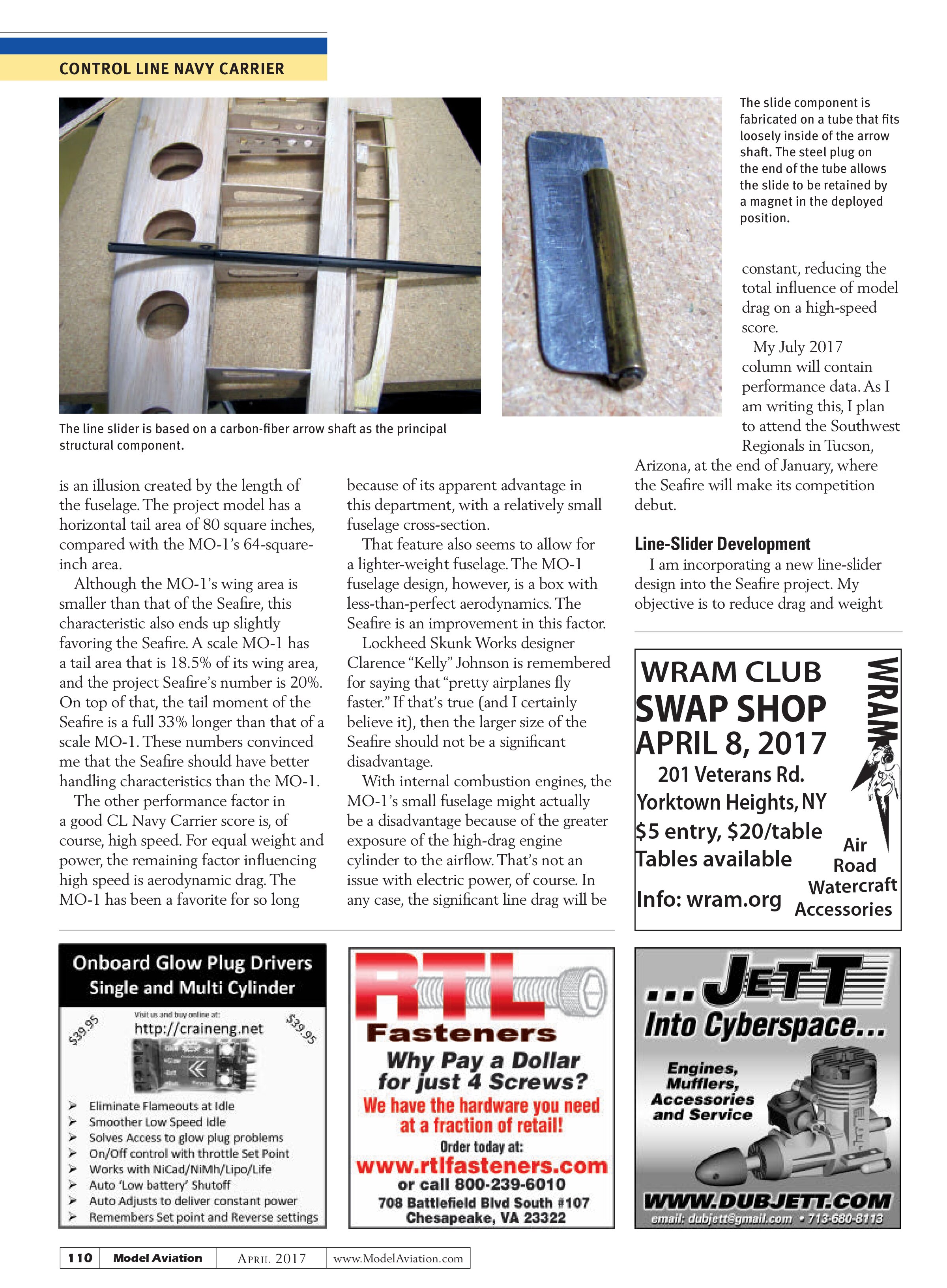
Casually observing a Seafire three-view gives the impression that the tail is small. That might cause you to infer that the Seafire would be less stable than other models, such as the MO-1. However, the impression of a small tail


is an illusion created by the length of the fuselage. The project model has a horizontal tail area of 80 square inches, compared with the MO-1’s 64-square-inch area.
Although the MO-1’s wing area is smaller than that of the Seafire, this characteristic also ends up slightly favoring the Seafire. A scale MO-1 has a tail area that is 18.5% of its wing area, and the project Seafire’s number is 20%. On top of that, the tail moment of the Seafire is a full 33% longer than that of a scale MO-1. These numbers convinced me that the Seafire should have better handling characteristics than the MO-1.
The other performance factor in a good CL Navy Carrier score is, of course, high speed. For equal weight and power, the remaining factor influencing high speed is aerodynamic drag. The MO-1 has been a favorite for so long because of its apparent advantage in this department, with a relatively small fuselage cross-section.
That feature also seems to allow for a lighter-weight fuselage. The MO-1 fuselage design, however, is a box with less-than-perfect aerodynamics. The Seafire is an improvement in this factor.
Lockheed Skunk Works designer Clarence “Kelly” Johnson is remembered for saying that “pretty airplanes fly faster.” If that’s true (and I certainly believe it), then the larger size of the Seafire should not be a significant disadvantage.
With internal combustion engines, the MO-1’s small fuselage might actually be a disadvantage because of the greater exposure of the high-drag engine cylinder to the airflow. That’s not an issue with electric power, of course. In any case, the significant line drag will be

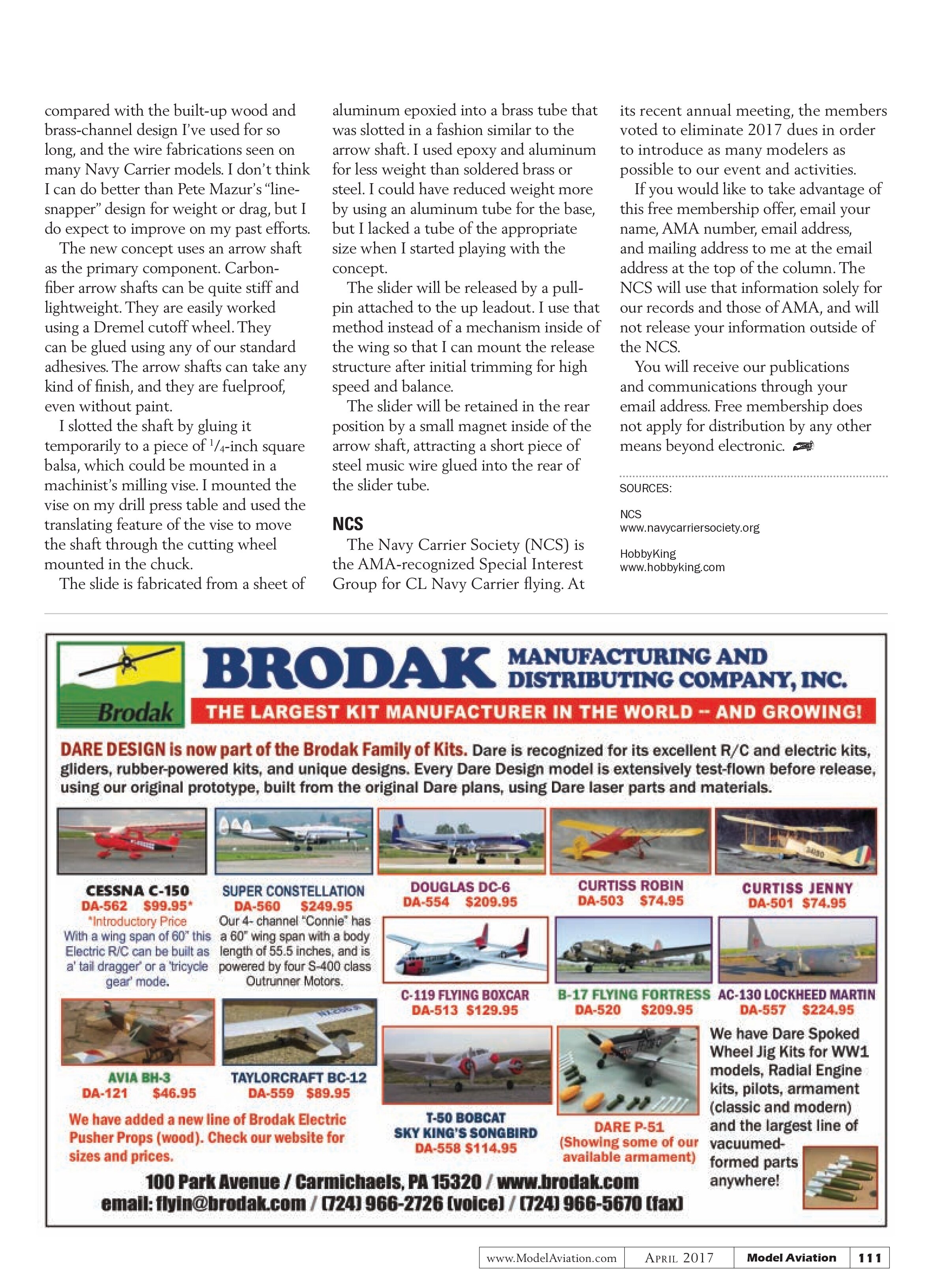
The line slider is based on a carbon-fiber arrow shaft as the principal structural component.

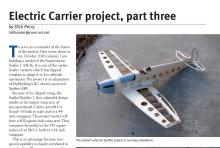
The slide component is fabricated on a tube that fits loosely inside of the arrow shaft. The steel plug on the end of the tube allows the slide to be retained by a magnet in the deployed position.
compared with the built-up wood and brass-channel design I’ve used for so long, and the wire fabrications seen on many Navy Carrier models. I don’t think I can do better than Pete Mazur’s “line-snapper” design for weight or drag, but I do expect to improve on my past efforts.
The new concept uses an arrow shaft as the primary component. Carbon-fiber arrow shafts can be quite stiff and lightweight. They are easily worked using a Dremel cutoff wheel. They can be glued using any of our standard adhesives. The arrow shafts can take any kind of finish, and they are fuelproof, even without paint.
I slotted the shaft by gluing it temporarily to a piece of ¼-inch square balsa, which could be mounted in a machinist’s milling vise. I mounted the vise on my drill press table and used the translating feature of the vise to move the shaft through the cutting wheel mounted in the chuck.
The slide is fabricated from a sheet of aluminum epoxied into a brass tube that was slotted in a fashion similar to the arrow shaft. I used epoxy and aluminum for less weight than soldered brass or steel. I could have reduced weight more by using an aluminum tube for the base, but I lacked a tube of the appropriate size when I started playing with the concept.
The slider will be released by a pull-pin attached to the up leadout. I use that method instead of a mechanism inside of the wing so that I can mount the release structure after initial trimming for high speed and balance.
The slider will be retained in the rear position by a small magnet inside of the arrow shaft, attracting a short piece of steel music wire glued into the rear of the slider tube.
Line-Slider Development
I am incorporating a new line-slider design into the Seafire project. My objective is to reduce drag and weight constant, reducing the total influence of model drag on a high-speed score.
My July 2017 column will contain performance data. As I am writing this, I plan to attend the Southwest Regionals in Tucson, Arizona, at the end of January, where the Seafire will make its competition debut.
NCS
The Navy Carrier Society (NCS) is the AMA-recognized Special Interest Group for CL Navy Carrier flying. At its recent annual meeting, the members voted to eliminate 2017 dues in order to introduce as many modelers as possible to our event and activities.
If you would like to take advantage of this free membership offer, email your name, AMA number, email address, and mailing address to me at the email address at the top of the column. The NCS will use that information solely for our records and those of AMA, and will not release your information outside of the NCS.
You will receive our publications and communications through your email address. Free membership does not apply for distribution by any other means beyond electronic.
SOURCES:
HobbyKing
www.hobbyking.com