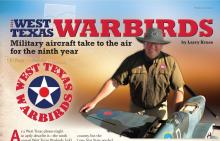
2016 WEST TEXAS WARBIRDS
Military aircraft take to the air for the ninth year
By Larry Kruse

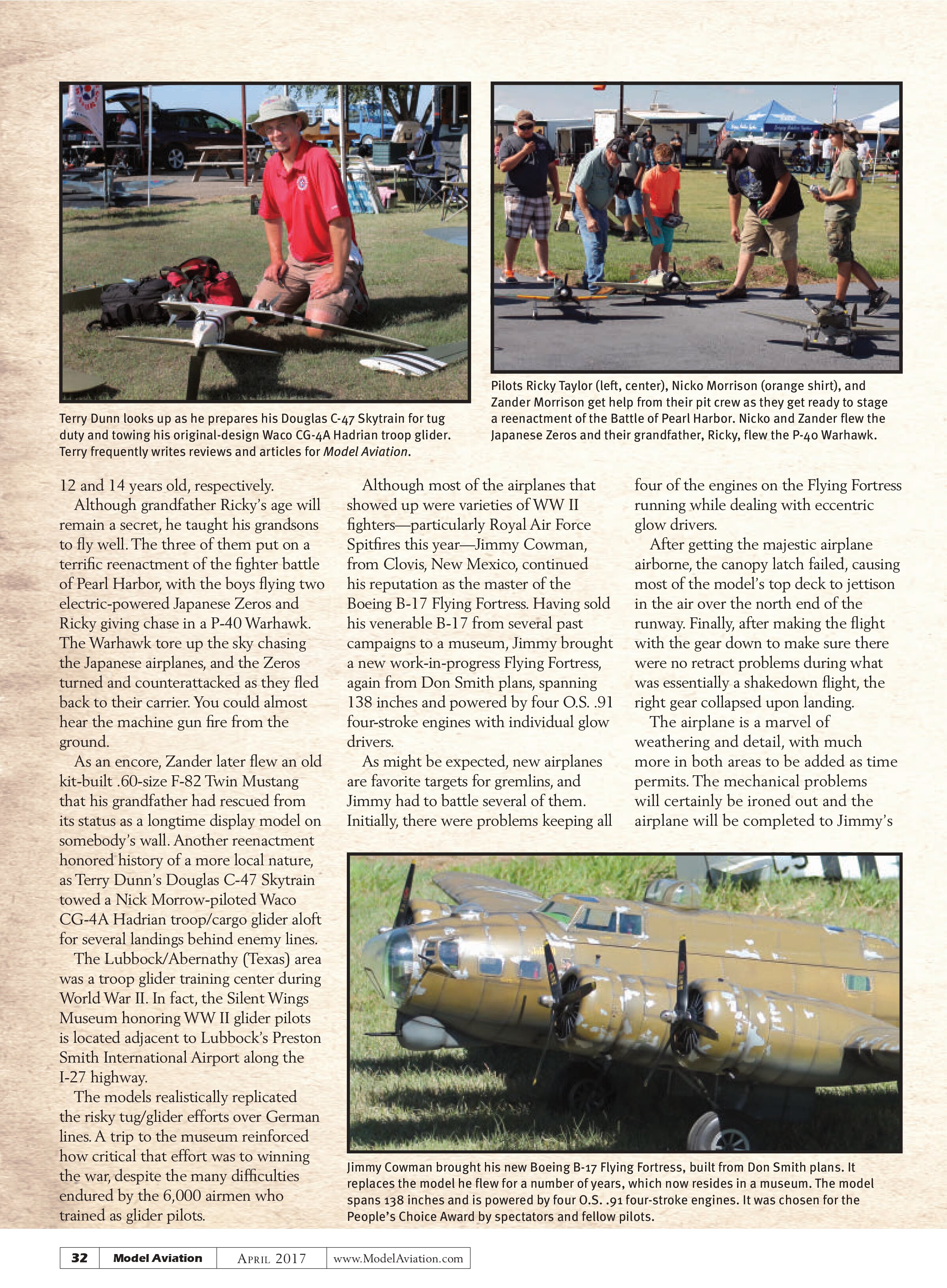
As a West Texas phrase might so aptly describe it—the ninth annual West Texas Warbirds, held August 26-28, 2016, went off without a hitch. The site is located roughly 20 minutes north of Lubbock, Texas, at the Abernathy Municipal Airport, where the host, Wings Miniature Aircraft Society, welcomed modelers to blue skies, light breezes, and puffy white clouds on Friday, the first day of the three-day event.
Pilots from Texas and neighboring states brought more than 100 military aircraft of all sizes to enjoy the hospitality and the broad and endless runway of the Abernathy airport.
Bryan McLarty, the originator of the first event back in 2007, said of its beginnings, “All of this started not long after our club had to relocate to the Abernathy Municipal Airport in 2006. I had just been elected club president and as young, eager, and full of ambition as a new club officer can be.
“One of my first decisions as president was to put together a survey and take the pulse of the membership. Overwhelmingly, I found out that the majority of our guys were into Scale or had Scale interests. The military aspect of this really interested me. Now I knew that warbird events had already seen some great successes all over the country, but the Lone Star State needed something more.”
The result, now named West Texas Warbirds, has had success since its inception, but Bryan, the contest director (CD) of the event since it began, said, “The most fun I’ve had is meeting new people, sharing this wonderful hobby with fellow modelers, and introducing so many spectators to the excitement of model warbirds! This is a social activity above all else.”
Bryan is quick to praise his fellow club members, especially Les Morrow and Doug Harmon, for doing the heavy lifting, and he credits Tom Wagner, the man on the microphone who emcees and adds period music to the ambience, with making the last weekend in August special for everyone.
As more modelers arrived on Friday, most spent time preparing their airplanes for the next day’s spectators, putting up trim flights or tuning engines that had become cranky in the higher altitude. For some modelers, the 3,200-foot altitude of the Texas high plains meant balkier starting and different needle valve settings than they were accustomed to.
Additionally, there were several new multicylinder radial and two-cylinder inline gas engines teaching their owners how they wanted to be treated. Several called out “dead stick!” as the learning process continued, but those flights generally ended up back on the runway.
Friday’s perfect weather, with a light breeze right down the runway, was replaced Saturday with partly cloudy skies and an acceptable crosswind from the southwest that most fliers successfully negotiated.
Safety checks of each airplane before its first flight and the sequencing of takeoffs and landings were handled by rotating air bosses from the host club, allowing everyone to fly in a relaxed and unregimented fashion with no waiting before taking to the air.
The variety of airplanes spanned the full fixed-wing gamut, ranging from turbine and electric ducted-fan jets, multiengine bombers, Giant Scale fighters, and troop gliders on tow. The modelers’ age range was also wide.
One of the highlights of the day was Ricky Taylor and his grandsons, Nicko and Zander Morrison. The two boys are


12 and 14 years old, respectively.
Although grandfather Ricky’s age will remain a secret, he taught his grandsons to fly well. The three of them put on a terrific reenactment of the fighter battle of Pearl Harbor, with the boys flying two electric-powered Japanese Zeros and Ricky giving chase in a P-40 Warhawk. The Warhawk tore up the sky chasing the Japanese airplanes, and the Zeros turned and counterattacked as they fled back to their carrier. You could almost hear the machine gun fire from the ground.
As an encore, Zander later flew an old kit-built .60-size F-82 Twin Mustang that his grandfather had rescued from its status as a longtime display model on somebody’s wall. Another reenactment honored history of a more local nature, as Terry Dunn’s Douglas C-47 Skytrain towed a Nick Morrow-piloted Waco CG-4A Hadrian troop/cargo glider aloft for several landings behind enemy lines.
The Lubbock/Abernathy (Texas) area was a troop glider training center during World War II. In fact, the Silent Wings Museum honoring WW II glider pilots is located adjacent to Lubbock’s Preston Smith International Airport along the I-27 highway.
The models realistically replicated the risky tug/glider efforts over German lines. A trip to the museum reinforced how critical that effort was to winning the war, despite the many difficulties endured by the 6,000 airmen who trained as glider pilots.
Although most of the airplanes that showed up were varieties of WW II fighters—particularly Royal Air Force Spitfires this year—Jimmy Cowman, from Clovis, New Mexico, continued his reputation as the master of the Boeing B-17 Flying Fortress. Having sold his venerable B-17 from several past campaigns to a museum, Jimmy brought a new work-in-progress Flying Fortress, again from Don Smith plans, spanning 138 inches and powered by four O.S. .91 four-stroke engines with individual glow drivers.
As might be expected, new airplanes are favorite targets for gremlins, and Jimmy had to battle several of them. Initially, there were problems keeping all four of the engines on the Flying Fortress running while dealing with eccentric glow drivers.
After getting the majestic airplane airborne, the canopy latch failed, causing most of the model’s top deck to jettison in the air over the north end of the runway. Finally, after making the flight with the gear down to make sure there were no retract problems during what was essentially a shakedown flight, the right gear collapsed upon landing.
The airplane is a marvel of weathering and detail, with much more in both areas to be added as time permits. The mechanical problems will certainly be ironed out and the airplane will be completed to Jimmy’s

meticulous expectations.
None of these things kept Saturday’s spectators from voting it the well-deserved People’s Choice award, adding to the impressive number of times Jimmy’s B-17s have walked away with the top award at this event, as well as numerous others where the sheer magnitude of his effort and outstanding execution have overwhelmed all other entries.
Mentioning Saturday’s spectators gets at the heart of the event’s purpose, which is, as CD Bryan noted, “… to share the rich history of aviation in our own way.” At noon on Saturday, pilots are asked to bring one or two of their airplanes to the site’s taxiway for display and viewing by those who came to watch and learn. Modelers then have an opportunity to visit with the spectators, answer questions about their models, and show off unique features that might not be apparent to the casual onlooker.
Given time to learn about the airplanes in a close and personal fashion, both spectators and fliers have an opportunity to vote on their favorite airplanes in several categories: People’s Choice, Best Scale Flight, Best WW II Aircraft, and Best Modern Aircraft.
Additionally, there is one other award called the CD’s Choice, subjectively awarded for a unique, unusual, or particularly outstanding effort on the part of one of the pilots. The 2016 award went to Bob


SPONSORS
Horizon Hobby
Hobbico
RTL Fasteners
Cal-Grafx
Bob Smith Industries
Kyosho USA
Callie Graphics
Tru-Turn
Dynamic Balsa
Sig Manufacturing
Balsa USA
WINNERS
Jimmy Cowman..... Boeing B-17 Flying Fortress ..... People’s Choice Award
Greg Pulcini.......... Bubble-top P-47........................ Best Scale Flight
John Hunt............. Razorback P-47........................ Best WW II Aircraft
Moh Ayoub............ MiG-17 turbine.......................... Best Modern Aircraft
Bob McFadden....... Fokker Dr.I............................... CD’s Choice Award


McFadden, from Blair, Oklahoma, for the outstanding flight performance of his Magnum .91-powered Fokker Dr.I triplane.
Not only was the Fokker Dr.I the only World War I model present at the 2016 event, but Bob put it through its paces, replicating the agility of the full-scale aircraft flown by Baron Manfred von Richthofen that made it such a legendary adversary for the Allied fighters, and he still managed to land safely in the tricky crosswinds.
Sunday, the event’s third day, was essentially a wrap-up for both the pilots and the hosts. Rain threatened as the field decorations were taken down. Goodbyes were said, and memories were taken home as thoughts of next year’s 10th anniversary of West Texas Warbirds began to germinate.
Bryan and the other members of the Wings Miniature Aircraft Society can look back on the 2016 event with pride and look forward to 10 years of sharing aviation history this year at the end of August on the high plains of Texas.
—Larry Kruse
aircats@att.net
SOURCES:
West Texas Warbirds
www.westtexaswarbirds.com