With this ring, I thee weld
Dave Gee
safetycolumn@cs.com

Gotta Have a Plan
Those of us who build our own models know that using a tried-and-true design by a skilled aerodynamicist can save a lot of trouble. There’s nothing like a good set of plans from which to build. A model built from proven plans will likely be a safer aircraft than what an amateur designer (such as I) could produce. Perhaps you have some specific project in mind, a famous model from long ago, or an obscure aircraft from a discontinued kit? For anyone seeking model plans, the AMA Plans Service is like having a super power. Your telephone call will be answered by a kindred-spirited modeler who knows the plans collection inside and out. He’ll quickly locate the drawing you want, and usually says, “Wow, she’s a real beauty.” Sometimes there might be a special offer, such as a second print for half price. Finding the rare construction drawing you seek, and then it’s on sale? That’s just icing on the cake!
AMA Benefits
This veers away from safety topics a bit, but I wanted to plug a couple of other fun things that AMA offers. Not everyone knows that AMA Life Members get free access to the digital edition of Model Aviation magazine. You can see the next issue long before it arrives in mailboxes and enjoy links and videos that enhance the content. Free is my favorite flavor, so I enjoy this perk. It’s not free, but for a small fee you can choose a nonnumerical AMA number. I have endless fun with mine. Every time I call the AMA Headquarters, we do the same comedy routine:
“Hello, this is Dave.
“Hi Dave, what’s your AMA number?
“It’s Dave.
“Yes, hi Dave. What’s your AMA number please?
Proving that typing is possible with only nine operable fingers, I received an email from Kimberly Lindstrom:
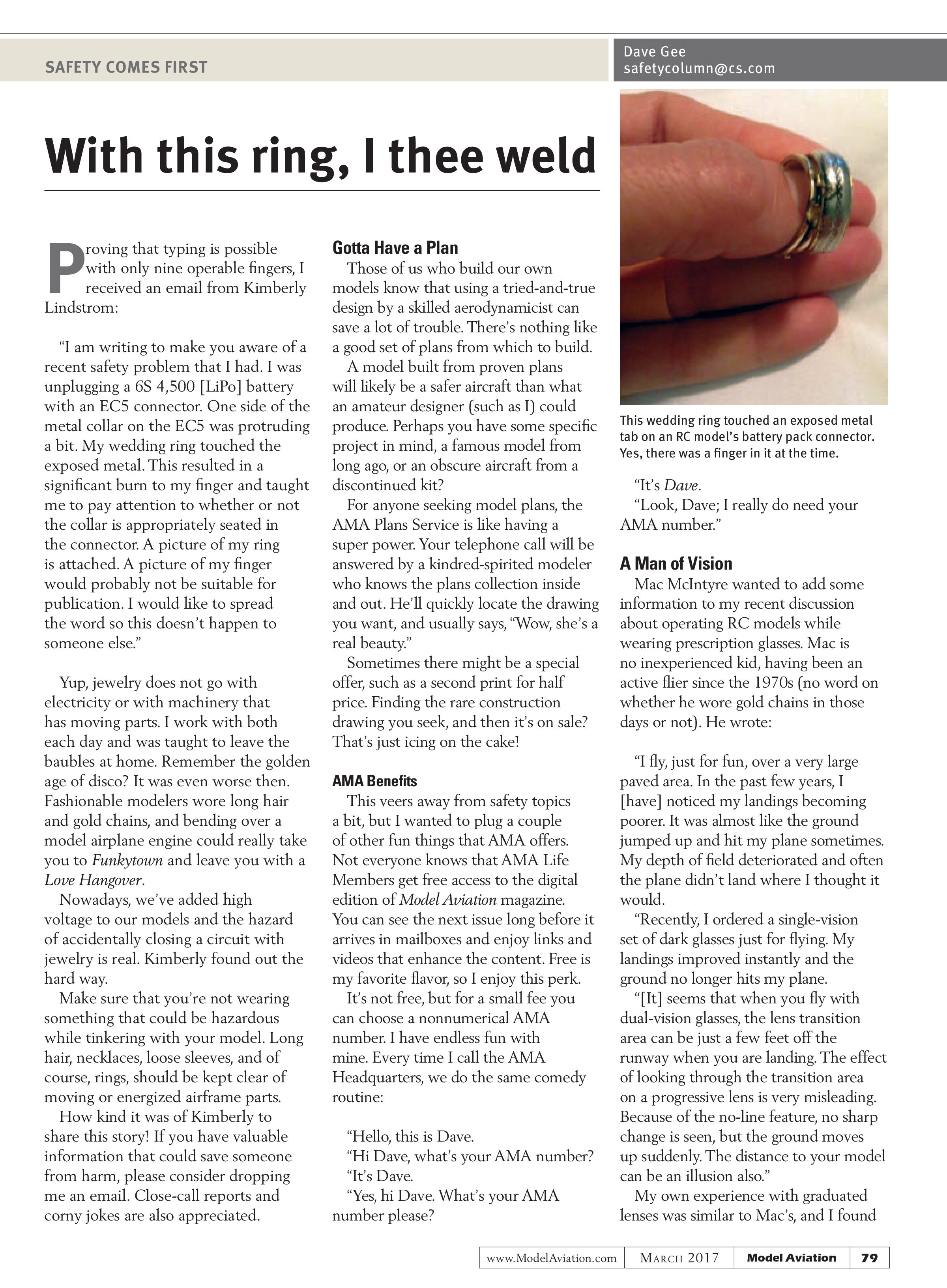
“I am writing to make you aware of a recent safety problem that I had. I was unplugging a 6S 4,500 [LiPo] battery with an EC5 connector. One side of the metal collar on the EC5 was protruding a bit. My wedding ring touched the exposed metal. This resulted in a significant burn to my finger and taught me to pay attention to whether or not the collar is appropriately seated in the connector. A picture of my ring is attached. A picture of my finger would probably not be suitable for publication. I would like to spread the word so this doesn’t happen to someone else.”
Yup, jewelry does not go with electricity or with machinery that has moving parts. I work with both each day and was taught to leave the baubles at home. Remember the golden age of disco? It was even worse then. Fashionable modelers wore long hair and gold chains, and bending over a model airplane engine could really take you to Funkytown and leave you with a Love Hangover.
Nowadays, we’ve added high voltage to our models and the hazard of accidentally closing a circuit with jewelry is real. Kimberly found out the hard way.
Make sure that you’re not wearing something that could be hazardous while tinkering with your model. Long hair, necklaces, loose sleeves, and of course, rings, should be kept clear of moving or energized airframe parts.
How kind it was of Kimberly to share this story! If you have valuable information that could save someone from harm, please consider dropping me an email. Close-call reports and corny jokes are also appreciated.
This wedding ring touched an exposed metal tab on an RC model’s battery pack connector. Yes, there was a finger in it at the time.
“It’s Dave.
“Look, Dave; I really do need your AMA number.”
A Man of Vision
Mac McIntyre wanted to add some information to my recent discussion about operating RC models while wearing prescription glasses. Mac is no inexperienced kid, having been an active flier since the 1970s (no word on whether he wore gold chains in those days or not). He wrote:
“I fly, just for fun, over a very large paved area. In the past few years, I [have] noticed my landings becoming poorer. It was almost like the ground jumped up and hit my plane sometimes. My depth of field deteriorated and often the plane didn’t land where I thought it would.
“Recently, I ordered a single-vision set of dark glasses just for flying. My landings improved instantly and the ground no longer hits my plane.
“[It] seems that when you fly with dual-vision glasses, the lens transition area can be just a few feet off the runway when you are landing. The effect of looking through the transition area on a progressive lens is very misleading. Because of the no-line feature, no sharp change is seen, but the ground moves up suddenly. The distance to your model can be an illusion also.”
My own experience with graduated lenses was similar to Mac’s, and I found


that separate glasses for close and far viewing suited me better. Thousands of satisfied trifocal users likely feel differently, but these matters are subjective.
Use what works best for you and makes you the safest pilot that you can be. I find that I’m at my safest when watching someone else fly, wearing glasses or not.
Kids and Models
Not everyone is cut out to work with aeromodeling newcomers, especially youngsters. I’m glad that so many of us enjoy it. Otherwise, our sport would have died out long ago. Aspiring pilots must learn (and be taught) how to safely handle and operate models. There are hazards that an inexperienced person wouldn’t expect.
From a safety standpoint, teaching someone how to handle and fly gas and electric-powered RC aircraft is more challenging than rubber-powered models.
Is it tougher to work with kids or adults in this context? Close supervision is needed for any would-be pilot, but my experience is that kids might be easier to teach than grownups. I think that the youngsters absorb safety rules more easily because they spend all day at school in learning mode. Adults are more likely to be overconfident and not wait for instructions.
On the other hand, a kid will casually ask me for a turn with the transmitter, assuming that his or her video game experience will suffice for taking over an RC aircraft in flight. Feelings are hurt when the child is gently told that he or she needs instruction and practice first. This eagerness to risk someone else’s model is seldom seen in an adult newcomer.
I’ve witnessed experienced RC instructors at work and they maintain careful vigilance the whole time that a student is near a model. This is the way to go—letting the newcomer do the tasks with a guiding hand close by for protection.
If you work with new modelers, please offer your opinion about kids vs. adults. Which age group is easier to instruct in the safety department? In a future column, I’ll share the various responses and the bits of wisdom that come in.
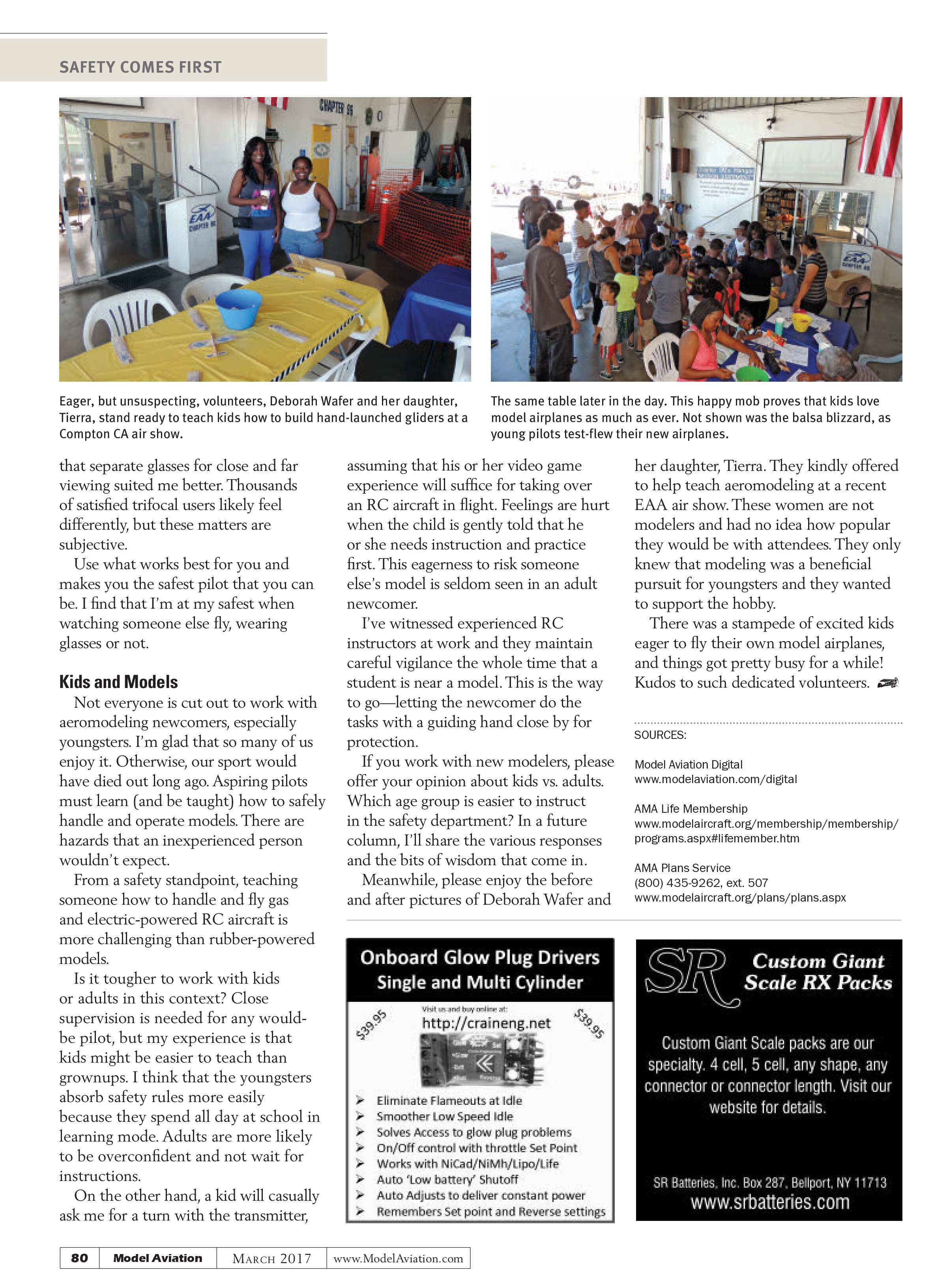
Meanwhile, please enjoy the before and after pictures of Deborah Wafer and her daughter, Tierra. They kindly offered to help teach aeromodeling at a recent EAA air show. These women are not modelers and had no idea how popular they would be with attendees. They only knew that modeling was a beneficial pursuit for youngsters and they wanted to support the hobby.
There was a stampede of excited kids eager to fly their own model airplanes, and things got pretty busy for a while! Kudos to such dedicated volunteers.
SOURCES:
Model Aviation Digital
www.modelaviation.com/digital
AMA Life Membership
www.modelaircraft.org/membership/membership/programs.aspx#lifemember.htm
AMA Plans Service
(800) 435-9262, ext. 507
www.modelaircraft.org/plans/plans.aspx