Contest landings without a sudden stop
by Gordon Buckland
gordon@gatorf3b.com
There is probably no more of a contentious subject in RC Soaring than the landing task that was adopted for most contests worldwide. The lawn dart-style approach to scoring landing points with an RC sailplane doesn’t seem right, particularly from the viewpoint of full-scale glider pilots. Terry Edmonds flies both full-scale and RC gliders, and has developed an interesting alternative worthy of consideration. Here is Terry’s idea for a less-abrupt landing task that requires considerable skill to consistently score points.
Throughout the history of RC Soaring competition, the landing task has evolved from a simple, large, in-or-out circle to measuring down to a few inches of a given point. The latter encourages what is commonly called a “dork landing.”
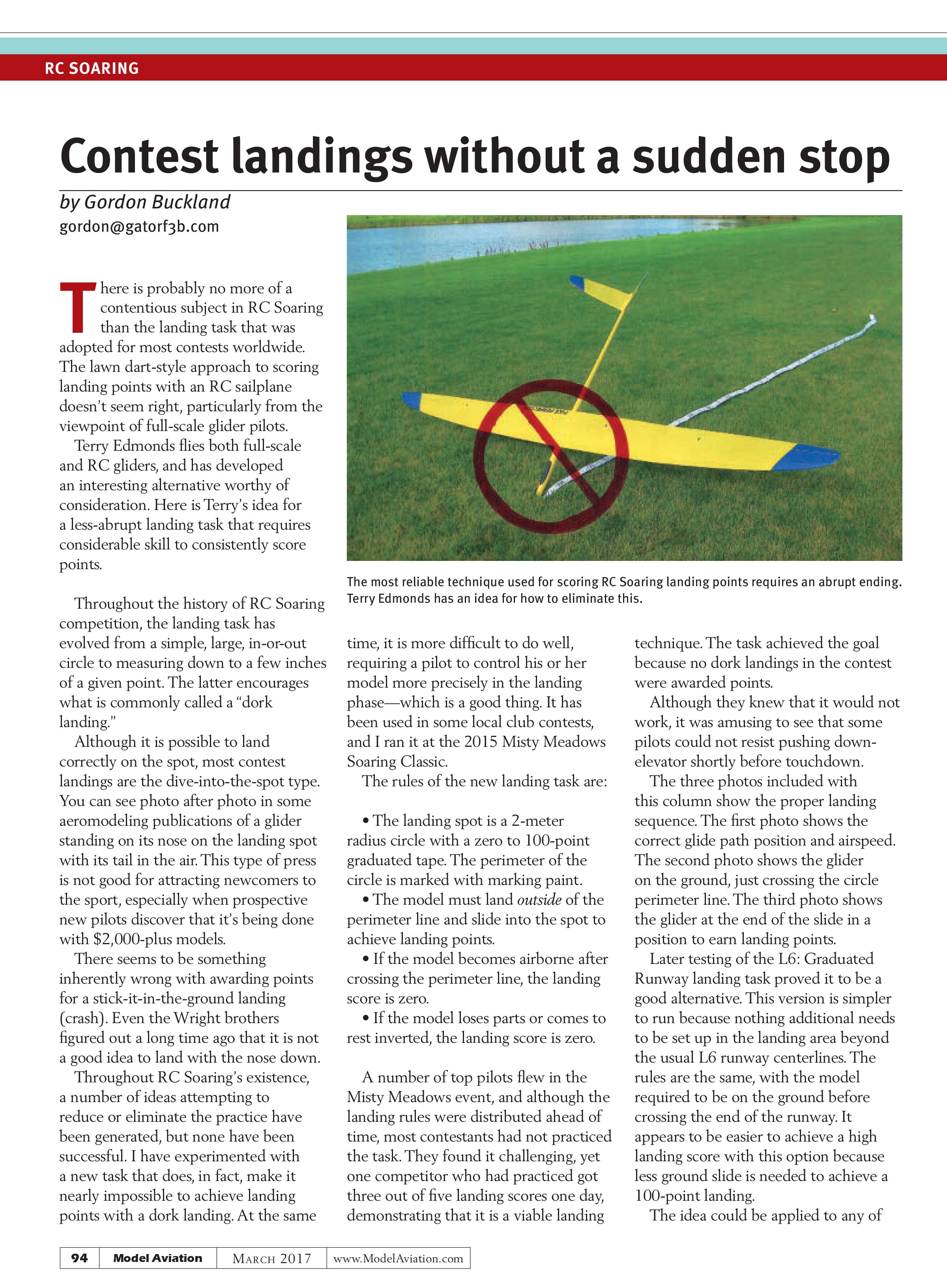
Although it is possible to land correctly on the spot, most contest landings are the dive-into-the-spot type. You can see photo after photo in some aeromodeling publications of a glider standing on its nose on the landing spot with its tail in the air. This type of press is not good for attracting newcomers to the sport, especially when prospective new pilots discover that it’s being done with $2,000-plus models.
There seems to be something inherently wrong with awarding points for a stick-it-in-the-ground landing (crash). Even the Wright brothers figured out a long time ago that it is not a good idea to land with the nose down.
Throughout RC Soaring’s existence, a number of ideas attempting to reduce or eliminate the practice have been generated, but none have been successful. I have experimented with a new task that does, in fact, make it nearly impossible to achieve landing points with a dork landing. At the same time, it is more difficult to do well, requiring a pilot to control his or her model more precisely in the landing phase—which is a good thing. It has been used in some local club contests, and I ran it at the 2015 Misty Meadows Soaring Classic.
The rules of the new landing task are:
- The landing spot is a 2-meter radius circle with a zero to 100-point graduated tape. The perimeter of the circle is marked with marking paint.
- The model must land outside of the perimeter line and slide into the spot to achieve landing points.
- If the model becomes airborne after crossing the perimeter line, the landing score is zero.
- If the model loses parts or comes to rest inverted, the landing score is zero.
A number of top pilots flew in the Misty Meadows event, and although the landing rules were distributed ahead of time, most contestants had not practiced the task. They found it challenging, yet one competitor who had practiced got three out of five landing scores one day, demonstrating that it is a viable landing technique. The task achieved the goal because no dork landings in the contest were awarded points.
Although they knew that it would not work, it was amusing to see that some pilots could not resist pushing down-elevator shortly before touchdown.
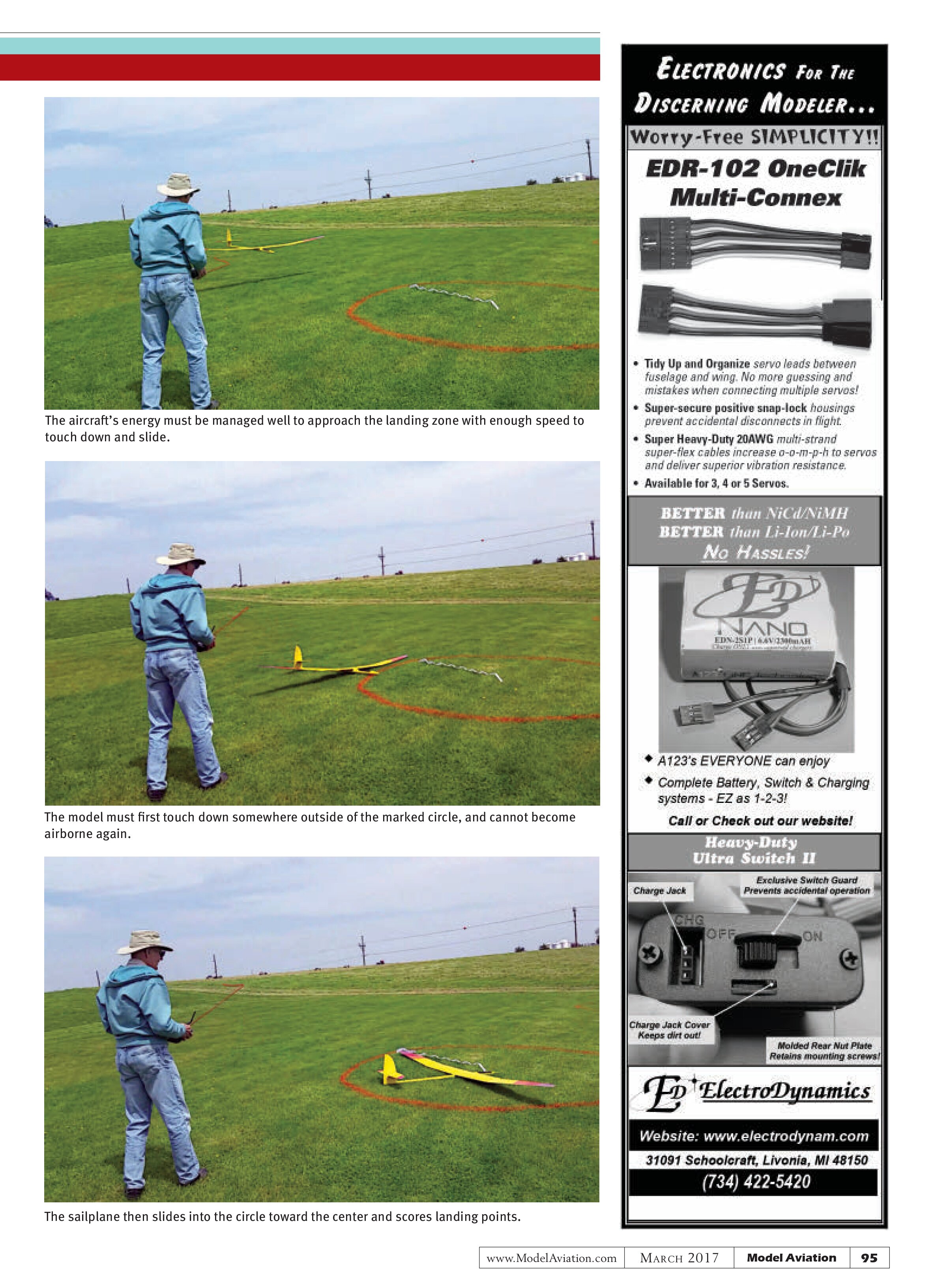
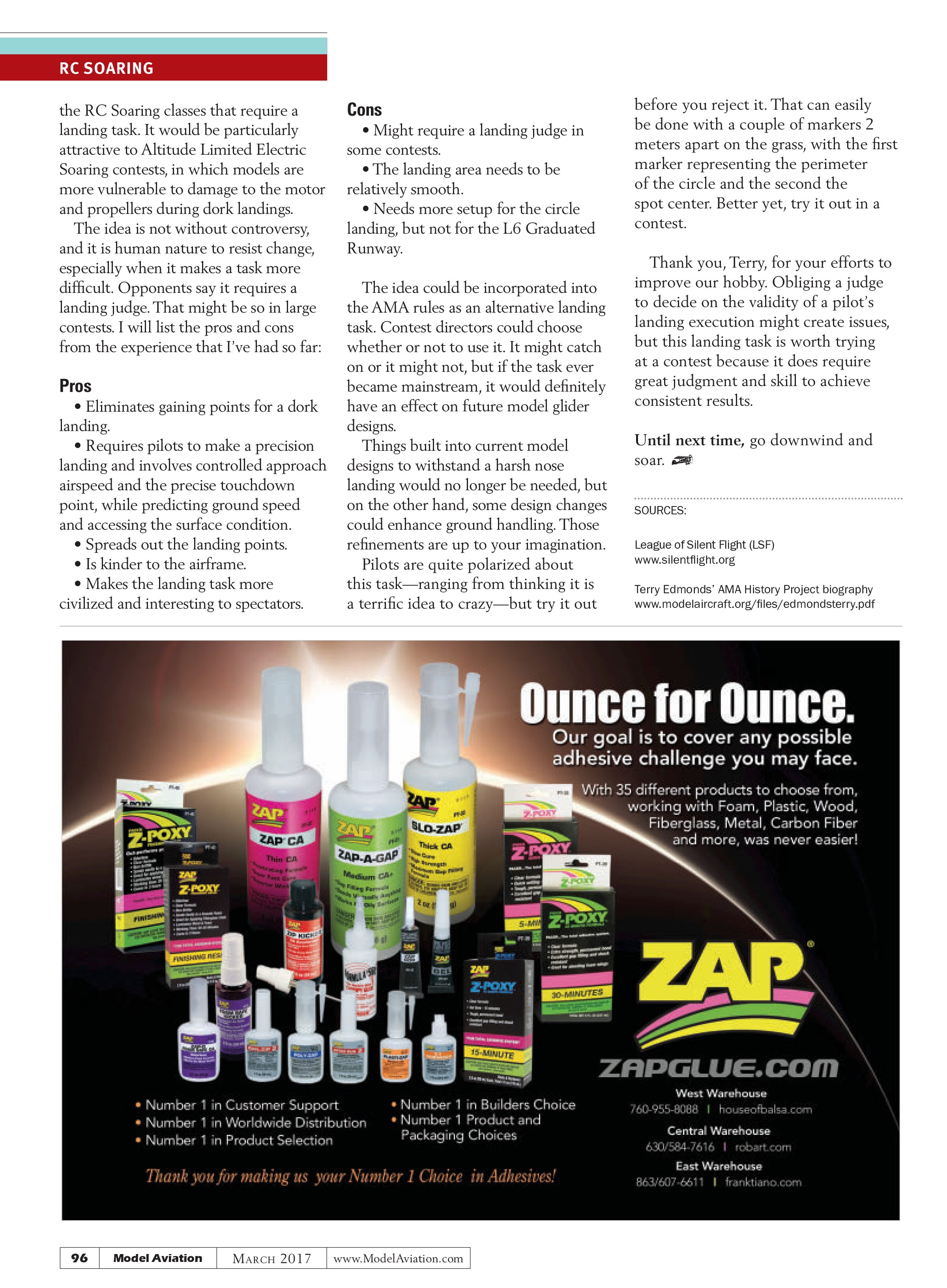
The three photos included with this column show the proper landing sequence. The first photo shows the correct glide path position and airspeed. The second photo shows the glider on the ground, just crossing the circle perimeter line. The third photo shows the glider at the end of the slide in a position to earn landing points.
Later testing of the L6: Graduated Runway landing task proved it to be a good alternative. This version is simpler to run because nothing additional needs to be set up in the landing area beyond the usual L6 runway centerlines. The rules are the same, with the model required to be on the ground before crossing the end of the runway. It appears to be easier to achieve a high landing score with this option because less ground slide is needed to achieve a 100-point landing.
The idea could be applied to any of


the RC Soaring classes that require a landing task. It would be particularly attractive to Altitude Limited Electric Soaring contests, in which models are more vulnerable to damage to the motor and propellers during dork landings.
The idea is not without controversy, and it is human nature to resist change, especially when it makes a task more difficult. Opponents say it requires a landing judge. That might be so in large contests. I will list the pros and cons from the experience that I’ve had so far:
Pros
- Eliminates gaining points for a dork landing.
- Requires pilots to make a precision landing and involves controlled approach airspeed and the precise touchdown point, while predicting ground speed and accessing the surface condition.
- Spreads out the landing points.
- Is kinder to the airframe.
- Makes the landing task more civilized and interesting to spectators.
Cons
- Might require a landing judge in some contests.
- The landing area needs to be relatively smooth.
- Needs more setup for the circle landing, but not for the L6 Graduated Runway.
The idea could be incorporated into the AMA rules as an alternative landing task. Contest directors could choose whether or not to use it. It might catch on or it might not, but if the task ever became mainstream, it would definitely have an effect on future model glider designs.
Things built into current model designs to withstand a harsh nose landing would no longer be needed, but on the other hand, some design changes could enhance ground handling. Those refinements are up to your imagination.
Pilots are quite polarized about this task—ranging from thinking it is a terrific idea to crazy—but try it out before you reject it. That can easily be done with a couple of markers 2 meters apart on the grass, with the first marker representing the perimeter of the circle and the second the spot center. Better yet, try it out in a contest.
Thank you, Terry, for your efforts to improve our hobby. Obliging a judge to decide on the validity of a pilot’s landing execution might create issues, but this landing task is worth trying at a contest because it does require great judgment and skill to achieve consistent results.
Until next time, go downwind and soar.
SOURCES:
League of Silent Flight (LSF)
www.silentflight.org
Terry Edmonds’ AMA History Project biography
www.modelaircraft.org/files/edmondsterry.pdf