Troubleshooting
Chris Mulcahy
cspaced@gmail.com
One thing I think we can all agree upon is that some of the most minor issues can wreak havoc with our helicopters. Electrical problems or an out-of-balance machine can leave us scratching our heads for weeks while we try to find the source of the problem. What we sometimes perceive as an electrical issue can actually turn out to be a mechanical problem, and vice versa. There never seems to be any rhyme or reason to it until you finally figure it out (the whole “it-was-in-the-last-place-I-looked” kind of thing).
I had an interesting issue recently. In my case, it turned out to be a mechanical problem that behaved like an electrical issue. My Synergy E5s was behaving strangely. At a lower head speed, the helicopter behaved fine, but once I switched into idle-up mode with a higher head speed, the heli started experiencing some strange “ticks” of the tail. The tail would suddenly twitch, without command, in either direction. There was no regularity to it and it appeared quite random.
Each time I took the helicopter out, I played with its gyro settings for hours on end, trying to get it dialed in, but to no avail. After talking with a friend about it and showing him what the helicopter was doing in flight, he wisely asked me a question.
He wanted to know what tape I had used to secure my gyro sensor. I replied that I had used the tape that came with it, but upon closer inspection, it turned out that I had actually used another kind of foam tape. The tape I used was not working as well as the stock tape, so that was number one on the list of things to fix.
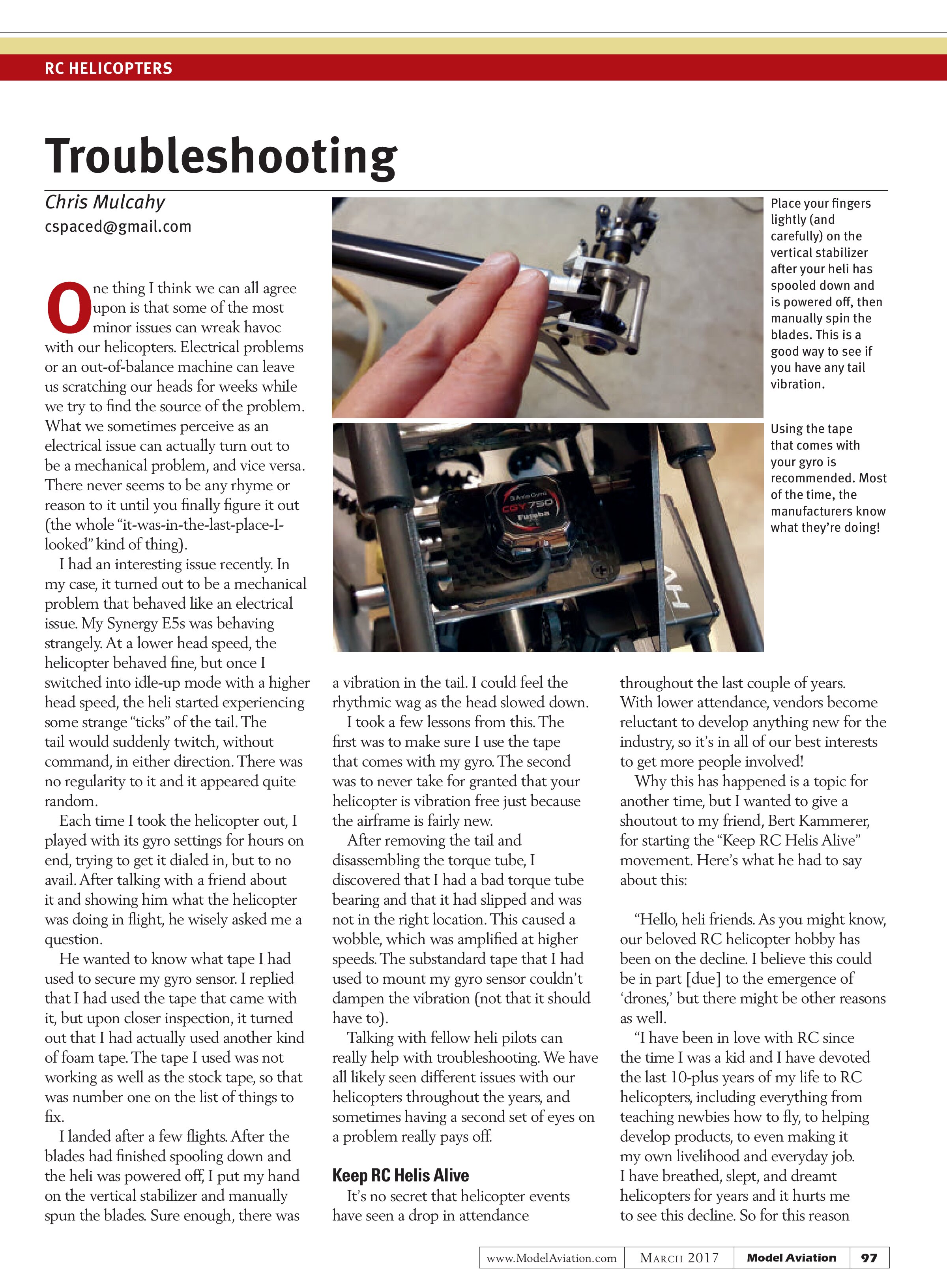
I landed after a few flights. After the blades had finished spooling down and the heli was powered off, I put my hand on the vertical stabilizer and manually spun the blades. Sure enough, there was


a vibration in the tail. I could feel the rhythmic wag as the head slowed down.
I took a few lessons from this. The first was to make sure I use the tape that comes with my gyro. The second was to never take for granted that your helicopter is vibration free just because the airframe is fairly new.
After removing the tail and disassembling the torque tube, I discovered that I had a bad torque tube bearing and that it had slipped and was not in the right location. This caused a wobble, which was amplified at higher speeds. The substandard tape that I had used to mount my gyro sensor couldn’t dampen the vibration (not that it should have to).
Talking with fellow heli pilots can really help with troubleshooting. We have all likely seen different issues with our helicopters throughout the years, and sometimes having a second set of eyes on a problem really pays off.
Keep RC Helis Alive
It’s no secret that helicopter events have seen a drop in attendance throughout the last couple of years. With lower attendance, vendors become reluctant to develop anything new for the industry, so it’s in all of our best interests to get more people involved!
Why this has happened is a topic for another time, but I wanted to give a shoutout to my friend, Bert Kammerer, for starting the “Keep RC Helis Alive” movement. Here’s what he had to say about this:
“Hello, heli friends. As you might know, our beloved RC helicopter hobby has been on the decline. I believe this could be in part [due] to the emergence of ‘drones,’ but there might be other reasons as well.
“I have been in love with RC since the time I was a kid and I have devoted the last 10-plus years of my life to RC helicopters, including everything from teaching newbies how to fly, to helping develop products, to even making it my own livelihood and everyday job. I have breathed, slept, and dreamt helicopters for years and it hurts me to see this decline. So for this reason

I propose starting a new movement, #KeepRCHelisAlive!
“How? Simple. Some of you saw that we attended a very large full-scale air show in South Florida [in early November]. There was no ulterior motive for this—we simply did it to help promote the hobby! Let’s start promoting by engaging people, teaching new pilots, talking about helis, and doing everything in our power to keep our RC helis alive!
“I am reaching out to everyone: pros, advanced, and beginners alike. If you have a passion for this great hobby and you don’t want to see it slip away, share it with people to spark their interest.
“We have developed a brand image and a hashtag for this movement. We encourage you to use it to help promote this movement. Tag your heli photos with #KeepRCHelisAlive, talk to people and share your passion at events that you attend, [or] put the logo on your website. Do whatever you can to help spread the word.”
Bert has some logos available for everyone to use (see the link in “Sources”), so download them, post them on social media, and let everyone know how much you love helicopters! Show a friend, show a stranger, show someone in your family, or show anyone who will listen! It’s amazing what can be accomplished when everyone works together.
Sources:
International Radio Controlled Helicopter Association (IRCHA)
www.ircha.org
#KeepRCHelisAlive
www.bkdesignsllc.com/category-s/1838.htm