“Armchair” RC flier built from famous design

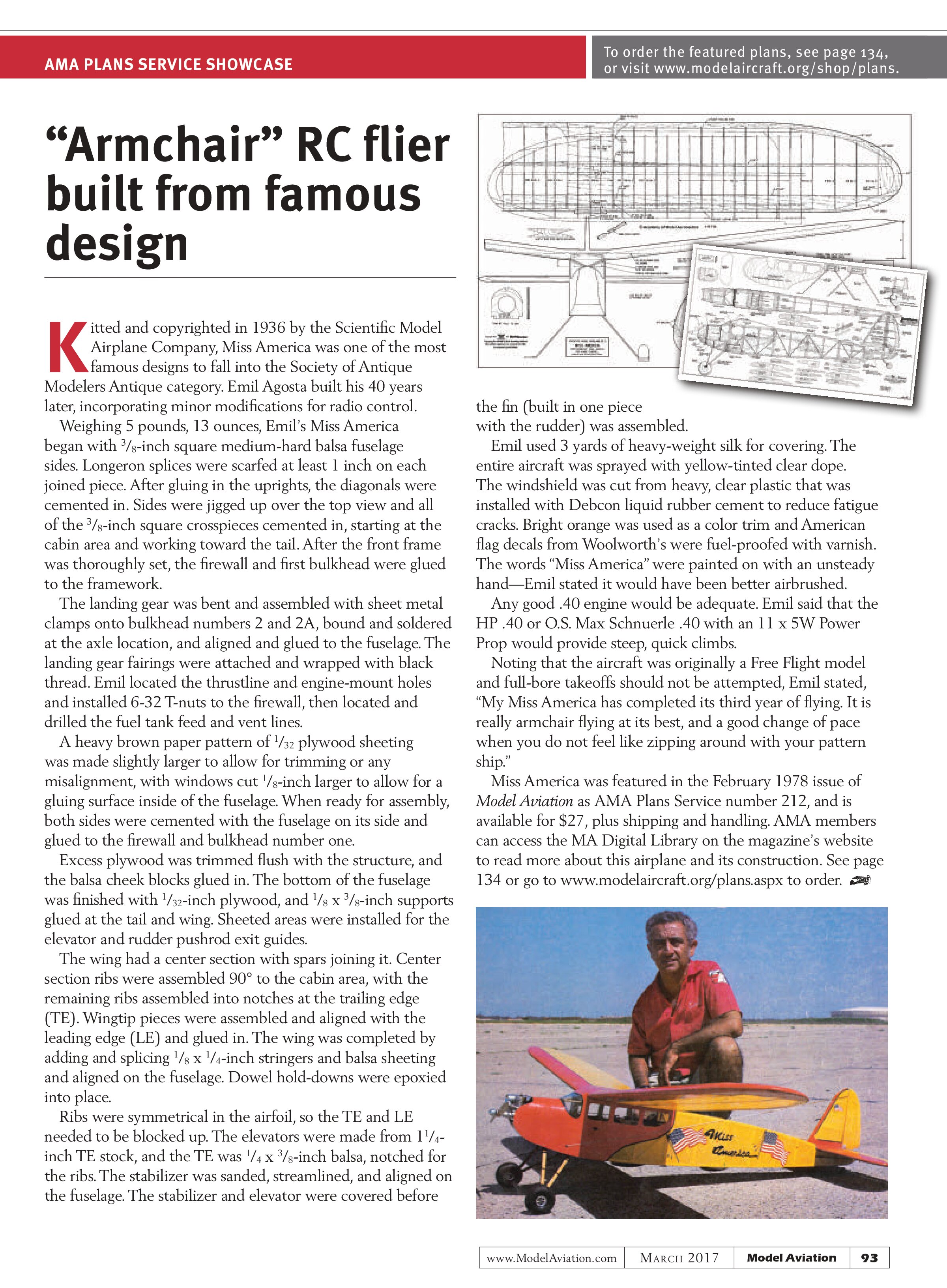
Kitted and copyrighted in 1936 by the Scientific Model Airplane Company, Miss America was one of the most famous designs to fall into the Society of Antique Modelers Antique category. Emil Agosta built his 40 years later, incorporating minor modifications for radio control.
Weighing 5 pounds, 13 ounces, Emil’s Miss America began with ⅜-inch square medium-hard balsa fuselage sides. Longeron splices were scarfed at least 1 inch on each joined piece. After gluing in the uprights, the diagonals were cemented in. Sides were jigged up over the top view and all of the ⅜-inch square crosspieces cemented in, starting at the cabin area and working toward the tail. After the front frame was thoroughly set, the firewall and first bulkhead were glued to the framework.
The landing gear was bent and assembled with sheet metal clamps onto bulkhead numbers 2 and 2A, bound and soldered at the axle location, and aligned and glued to the fuselage. The landing gear fairings were attached and wrapped with black thread. Emil located the thrustline and engine-mount holes and installed 6-32 T-nuts to the firewall, then located and drilled the fuel tank feed and vent lines.
A heavy brown paper pattern of ¹⁄₃₂ plywood sheeting was made slightly larger to allow for trimming or any misalignment, with windows cut ⅛-inch larger to allow for a gluing surface inside of the fuselage. When ready for assembly, both sides were cemented with the fuselage on its side and glued to the firewall and bulkhead number one.
Excess plywood was trimmed flush with the structure, and the balsa cheek blocks glued in. The bottom of the fuselage was finished with ¹⁄₃₂-inch plywood, and ⅛ x ⅜-inch supports glued at the tail and wing. Sheeted areas were installed for the elevator and rudder pushrod exit guides.
The wing had a center section with spars joining it. Center section ribs were assembled 90° to the cabin area, with the remaining ribs assembled into notches at the trailing edge (TE). Wingtip pieces were assembled and aligned with the leading edge (LE) and glued in. The wing was completed by adding and splicing ⅛ x ¼-inch stringers and balsa sheeting and aligned on the fuselage. Dowel hold-downs were epoxied into place.
Ribs were symmetrical in the airfoil, so the TE and LE needed to be blocked up. The elevators were made from 1¼-inch TE stock, and the TE was ¼ x ⅜-inch balsa, notched for the ribs. The stabilizer was sanded, streamlined, and aligned on the fuselage. The stabilizer and elevator were covered before the fin (built in one piece with the rudder) was assembled.
Emil used 3 yards of heavy-weight silk for covering. The entire aircraft was sprayed with yellow-tinted clear dope. The windshield was cut from heavy, clear plastic that was installed with Debcon liquid rubber cement to reduce fatigue cracks. Bright orange was used as a color trim and American flag decals from Woolworth’s were fuel-proofed with varnish. The words “Miss America” were painted on with an unsteady hand—Emil stated it would have been better airbrushed.
Any good .40 engine would be adequate. Emil said that the HP .40 or O.S. Max Schnuerle .40 with an 11 x 5W Power Prop would provide steep, quick climbs.
Noting that the aircraft was originally a Free Flight model and full-bore takeoffs should not be attempted, Emil stated, “My Miss America has completed its third year of flying. It is really armchair flying at its best, and a good change of pace when you do not feel like zipping around with your pattern ship.”
Miss America was featured in the February 1978 issue of Model Aviation as AMA Plans Service number 212, and is available for $27, plus shipping and handling. AMA members can access the MA Digital Library on the magazine’s website to read more about this airplane and its construction. See page 134 or go to www.modelaircraft.org/plans.aspx to order.