NFSS One-Design
by Gene Smith
grwhiskey@brightok.net

It’s time to put something on the building board for the National Free Flight Society (NFFS) One-Design Nats event. I mentioned the Witch Hawk 500 in my January 2017 column. Here is some information regarding the Zingo.
In approximately 1970, Tom Hutchinson designed the Zingo for FAI competition. It was a success, setting an Open class AMA record in FAI, placing third at the 1970 Nats, and earning a spot on the 1973 USA Free Flight (FF) team. Published in the August 1972 issue of Flying Models, the Zingo had a 60-inch wingspan and a wing area of 440 square inches—perfect for a .15 engine.
The 1972 FAI rules required a 26.3-ounce flying weight for this size model; therefore, Tom elected to “beef-up” the structure using ⅛-inch balsa ribs and some spruce spars. BMJR Models considered using a lighter-weight structure for the NFFS One-Design, but found the weight savings to be less than an ounce. The One-Design event allows any NFFS-approved Nostalgia Class A engine and does not have a minimum weight requirement.
BMJR offers a Zingo kit, and plans are available from the NFFS and the AMA Plans Service.

Tartar
Three years ago, George Voss got back into FF after a hiatus of many years. One of his heroes back in the day was Red Johnson, designer of the Tartar, a past NFFS Gas Model of the Year. As a tribute to Red, George updated the design for A/B and C/D Classic. He did a nice job with the design and the build.
Initial test flights look promising. George has been serving the RC community under the name Soaring Specialties. He now produces laser-cut short kits for several FF designs, including the Super Tart, Robert Dunham II’s Stampede, Jays Bird, Mexi-Boy 275, and the Long Shot for Unlimited Rubber.
As I write this in early December 2016, a Stampede 470 is on my building board. I hope to have a picture of it in a future column. The rib set and plans came from George. Robert has been flying the Stampede on the contest circuit for a couple of years, with good results.
Contact George at the email address listed in “Sources” for details on his products and services.
FAC Nats Neighbors
My wife and I pitched our tent by John Houk and the “Houk Family Fliers” at the Flying Aces Club (FAC) Nats last summer. John’s sons, John and Mark, were there, as well as Mark’s son, Owen.

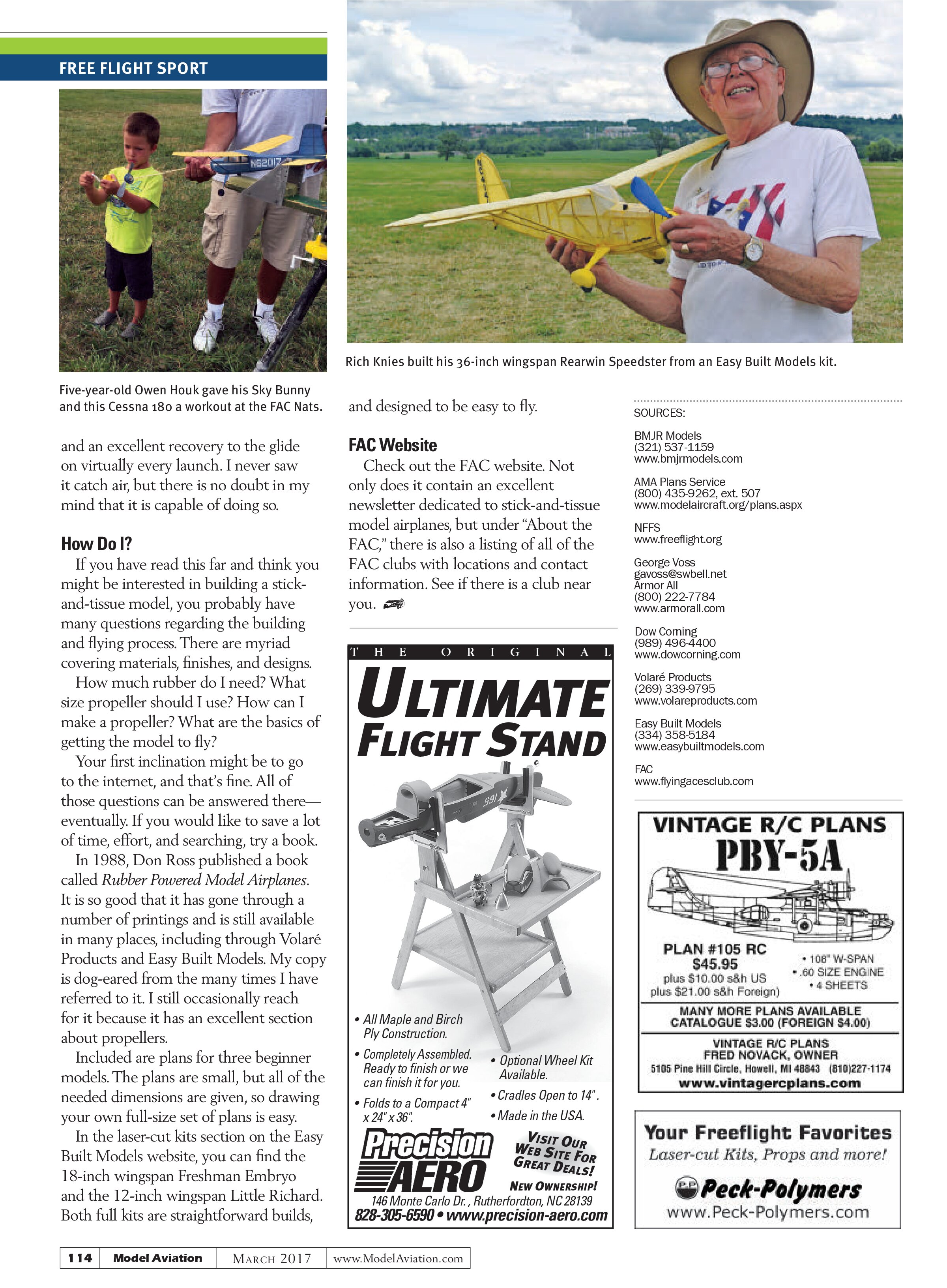
Five-year-old Owen is quite a character and was as busy as he could be on Wednesday, winding and flying a Sky Bunny and a Guillows Cessna 180. He also added some humorous critiques of other fliers’ performances, such as “That model is no good. It circles too much and spirals.” I guess you had to be there …
Our other neighbors at the FAC Nats were Rich Knies and his wife, Connie. Rich returned to the hobby only in the past couple of years, but he already has an impressive fleet of models. His best flier was a 36-inch wingspan Rearwin Speedster built from an Easy Built Models kit. It rewarded Rich with several nice flights.
The Rearwin used three 40-inch loops of ³⁄₁₆ rubber and a 10-inch propeller. Performance would be better with more rubber and a 12- or 13-inch propeller, but it’s sometimes good to enjoy the nice, gentle flight provided by a less-potent power train. It also makes for an easier chase!
Rich asked about rubber lubricant. He was using castor oil as he did in his youth. The problem is that castor oil spatters and stains the tissue on the aircraft. Now we use silicone such as what is found in Armor All spray or Dow Corning Molykote 33 low-temperature bearing grease. Both lubricate well and don’t spatter.
F-4 Phantom
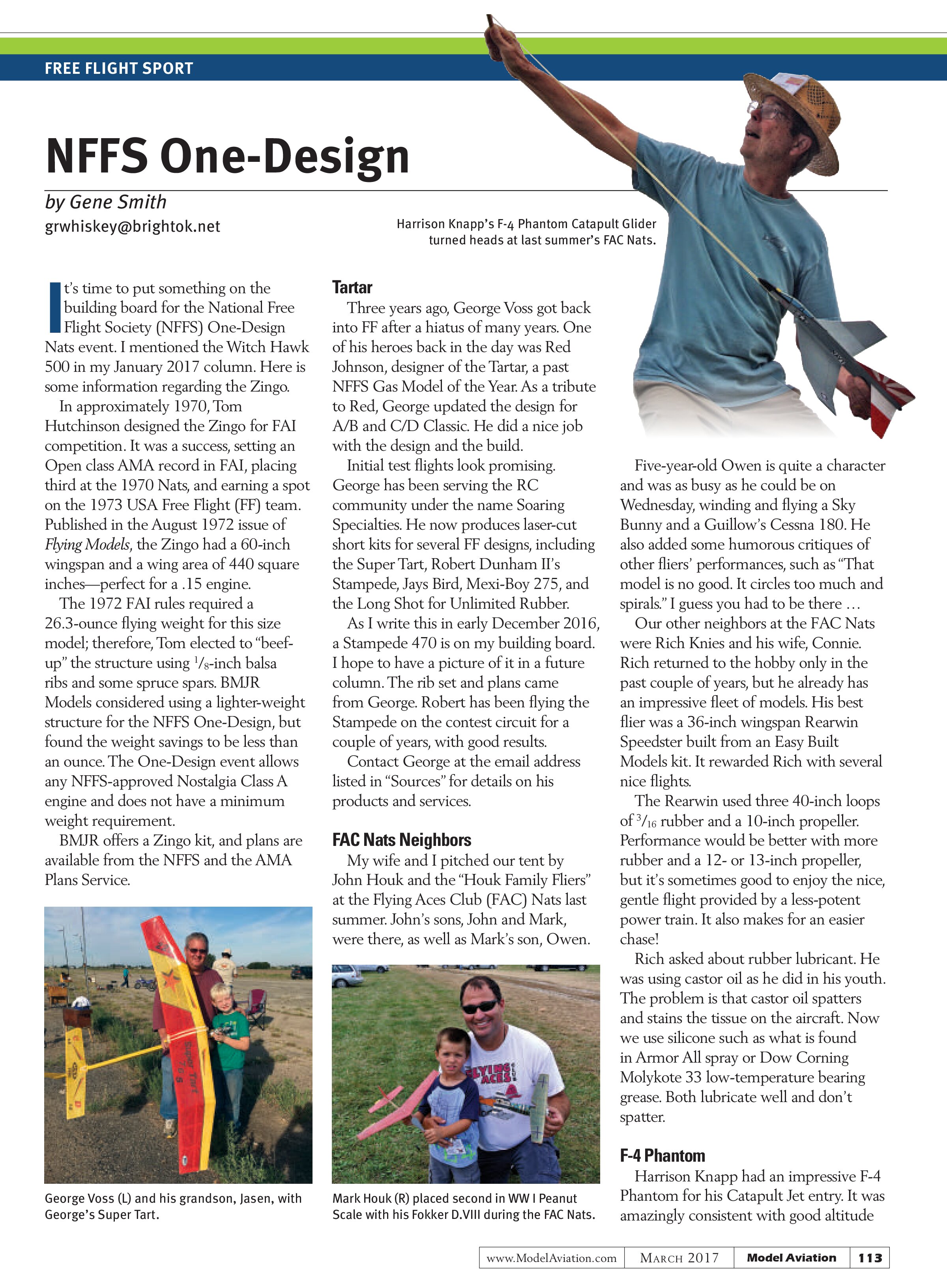
Harrison Knapp had an impressive F-4 Phantom for his Catapult Jet entry. It was amazingly consistent with good altitude

and an excellent recovery to the glide on virtually every launch. I never saw it catch air, but there is no doubt in my mind that it is capable of doing so.
How Do I?
If you have read this far and think you might be interested in building a stick-and-tissue model, you probably have many questions regarding the building and flying process. There are myriad covering materials, finishes, and designs. How much rubber do I need? What size propeller should I use? How can I make a propeller? What are the basics of getting the model to fly?
Your first inclination might be to go to the internet, and that’s fine. All of those questions can be answered there—eventually. If you would like to save a lot of time, effort, and searching, try a book.
In 1988, Don Ross published a book called Rubber Powered Model Airplanes. It is so good that it has gone through a number of printings and is still available in many places, including through Volaré Products and Easy Built Models. My copy is dog-eared from the many times I have referred to it. I still occasionally reach for it because it has an excellent section about propellers.
Included are plans for three beginner models. The plans are small, but all of the needed dimensions are given, so drawing your own full-size set of plans is easy.
In the laser-cut kits section on the Easy Built Models website, you can find the 18-inch wingspan Freshman Embryo and the 12-inch wingspan Little Richard. Both full kits are straightforward builds,

and designed to be easy to fly.
FAC Website
Check out the FAC website. Not only does it contain an excellent newsletter dedicated to stick-and-tissue model airplanes, but under “About the FAC,” there is also a listing of all of the FAC clubs with locations and contact information. See if there is a club near you.
SOURCES:
BMJR Models
(321) 537-1159
www.bjmrmodels.com
AMA Plans Service
(800) 435-9262, ext. 507
www.modelaircraft.org/plans.aspx
NFFS
www.freeflight.org
George Voss
gavoss@swbell.net
Armor All
(800) 222-7784
www.armorall.com
Dow Corning
(989) 496-4400
www.dowcorning.com
Volaré Products
(269) 339-9795
www.volareproducts.com
Easy Built Models
(334) 358-5184
www.easybuiltmodels.com
FAC
www.flyingacesclub.com