FOCAL POINT
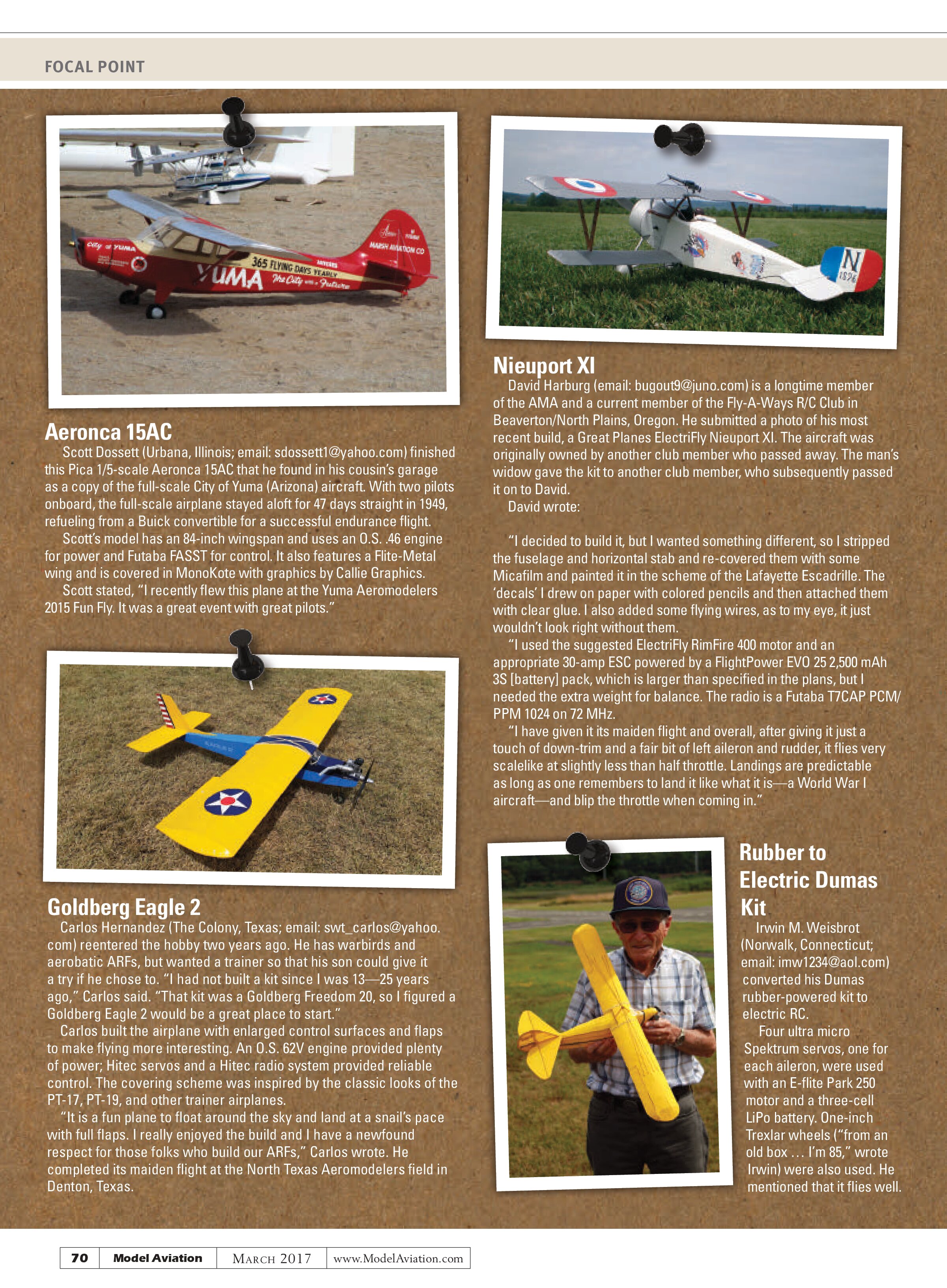
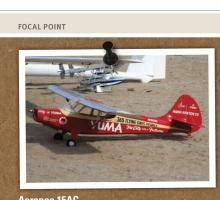
Aeronca 15AC
Scott Dossett (Urbana, Illinois; email: sdossett1@yahoo.com) finished this Pica 1/5-scale Aeronca 15AC that he found in his cousin’s garage as a copy of the full-scale City of Yuma (Arizona) aircraft. With two pilots onboard, the full-scale airplane stayed aloft for 47 days straight in 1949, refueling from a Buick convertible for a successful endurance flight.
Scott’s model has an 84-inch wingspan and uses an O.S. .46 engine for power and Futaba FASST for control. It also features a Flite-Metal wing and is covered in MonoKote with graphics by Callie Graphics.
Scott stated, “I recently flew this plane at the Yuma Aeromodelers 2015 Fun Fly. It was a great event with great pilots.”

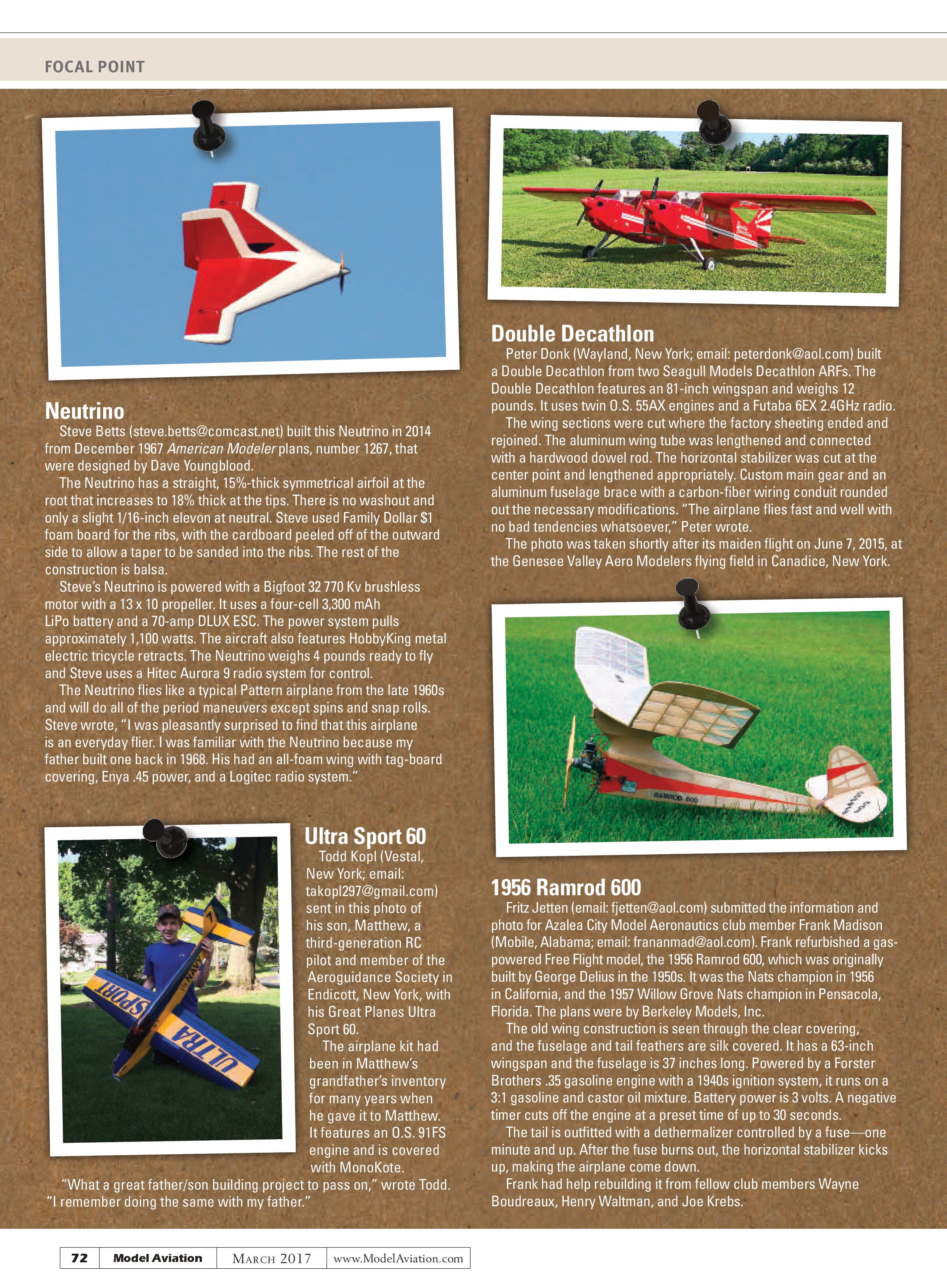
Goldberg Eagle 2
Carlos Hernandez (The Colony, Texas; email: swt_carlos@yahoo.com) reentered the hobby two years ago. He has warbirds and aerobatic ARFs, but wanted a trainer so that his son could give it a try if he chose to. “I had not built a kit since I was 13—25 years ago,” Carlos said. “That kit was a Goldberg Freedom 20, so I figured a Goldberg Eagle 2 would be a great place to start.”
Carlos built the airplane with enlarged control surfaces and flaps to make flying more interesting. An O.S. 62V engine provided plenty of power; Hitec servos and a Hitec radio system provided reliable control. The covering scheme was inspired by the classic looks of the PT-17, PT-19, and other trainer airplanes.
“It is a fun plane to float around the sky and land at a snail’s pace with full flaps. I really enjoyed the build and I have a newfound respect for those folks who build our ARFs,” Carlos wrote. He completed its maiden flight at the North Texas Aeromodelers field in Denton, Texas.

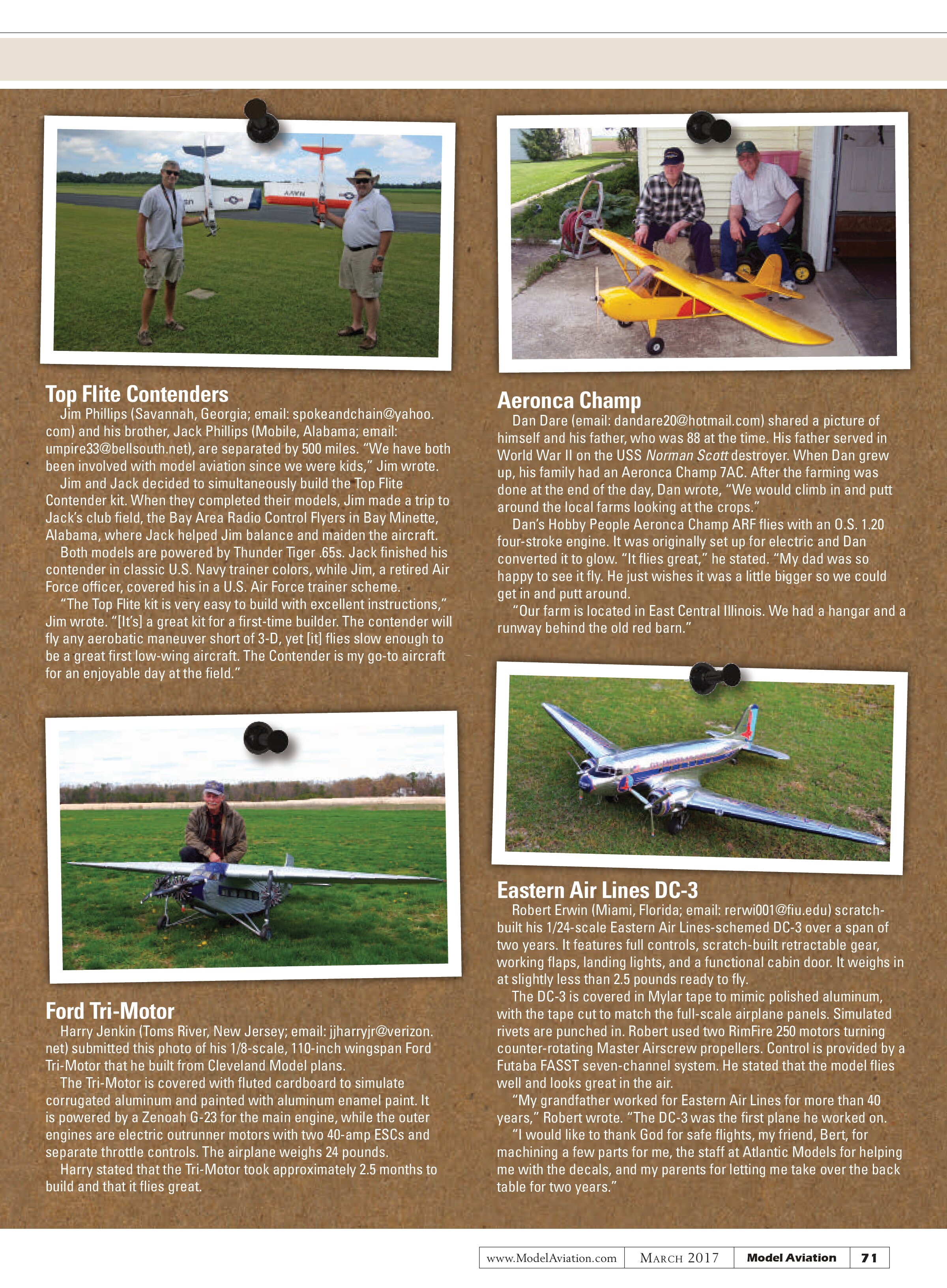
Nieuport XI
David Harburg (email: bugout9@juno.com) is a longtime member of the AMA and a current member of the Fly-A-Ways R/C Club in Beaverton/North Plains, Oregon. He submitted a photo of his most recent build, a Great Planes ElectriFly Nieuport XI. The aircraft was originally owned by another club member who passed away. The man’s widow gave the kit to another club member, who subsequently passed it on to David.
David wrote:
“I decided to build it, but I wanted something different, so I stripped the fuselage and horizontal stab and re-covered them with some Micafilm and painted it in the scheme of the Lafayette Escadrille. The ‘decals’ I drew on paper with colored pencils and then attached them with clear glue. I also added some flying wires, as to my eye, it just wouldn’t look right without them.
“I used the suggested ElectriFly RimFire 400 motor and an appropriate 30-amp ESC powered by a FlightPower EVO 25 2,500 mAh 3S [battery] pack, which is larger than specified in the plans, but I needed the extra weight for balance. The radio is a Futaba T7CAP PCM/PPM 1024 on 72 MHz.
“I have given it its maiden flight and overall, after giving it just a touch of down-trim and a fair bit of left aileron and rudder, it flies very scalelike at slightly less than half throttle. Landings are predictable as long as one remembers to land it like what it is—a World War I aircraft—and blip the throttle when coming in.”

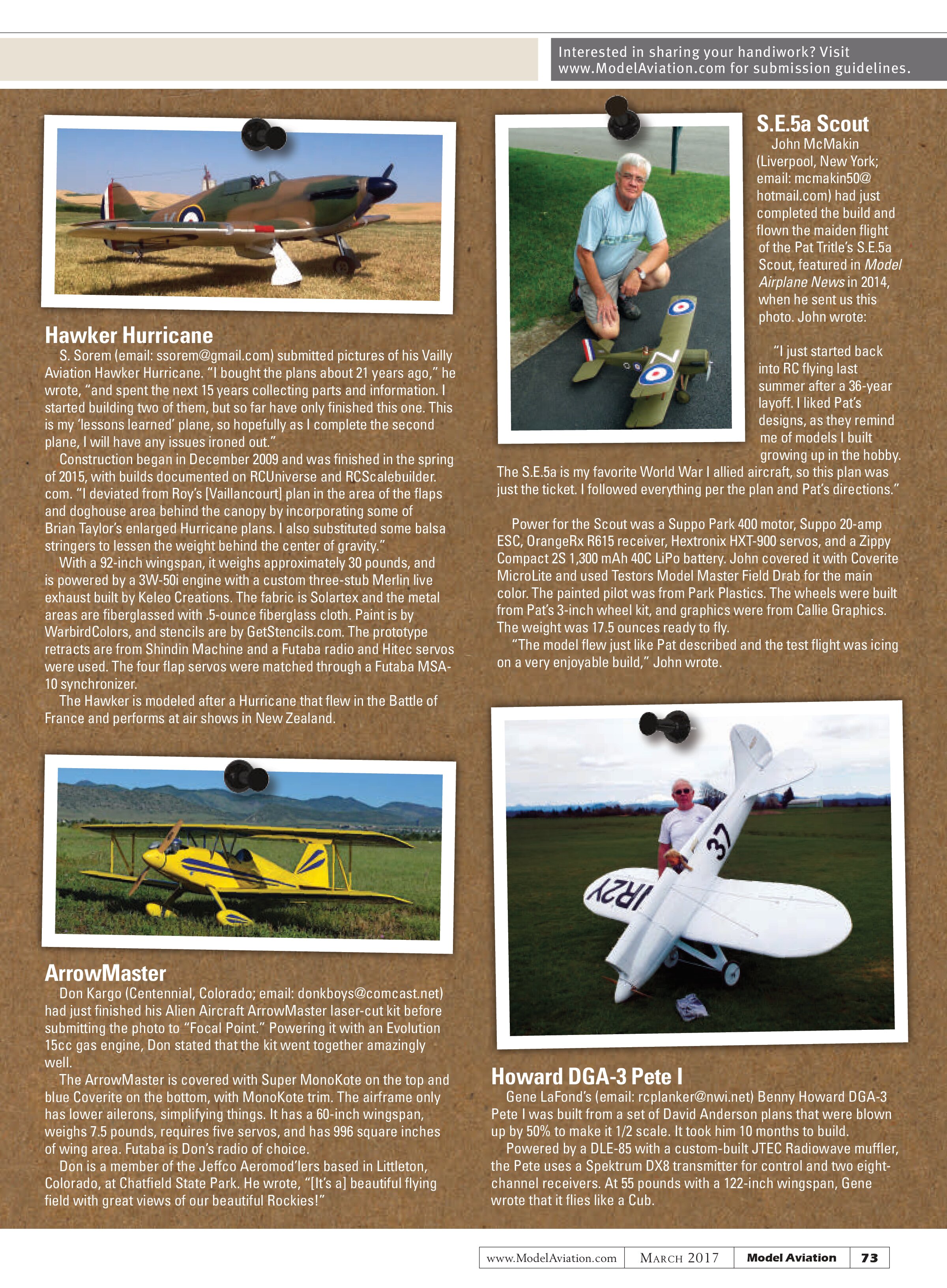
Rubber to Electric Dumas Kit
Irwin M. Weisbrot (Norwalk, Connecticut; email: imw1234@aol.com) converted his Dumas rubber-powered kit to electric RC.
Four ultra micro Spektrum servos, one for each aileron, were used with an E-flite Park 250 motor and a three-cell LiPo battery. One-inch Trexlar wheels (“from an old box … I’m 85,” wrote Irwin) were also used. He mentioned that it flies well.

Top Flite Contenders
Jim Phillips (Savannah, Georgia; email: spokeandchain@yahoo.com) and his brother, Jack Phillips (Mobile, Alabama; email: umpire33@bellsouth.net), are separated by 500 miles. “We have both been involved with model aviation since we were kids,” Jim wrote.
Jim and Jack decided to simultaneously build the Top Flite Contender kit. When they completed their models, Jim made a trip to Jack’s club field, the Bay Area Radio Control Flyers in Bay Minette, Alabama, where Jack helped Jim balance and maiden the aircraft.
Both models are powered by Thunder Tiger .65s. Jack finished his contender in classic U.S. Navy trainer colors, while Jim, a retired Air Force officer, covered his in a U.S. Air Force trainer scheme.
“The Top Flite kit is very easy to build with excellent instructions,” Jim wrote. “[It’s] a great kit for a first-time builder. The contender will fly any aerobatic maneuver short of 3-D, yet [it] flies slow enough to be a great first low-wing aircraft. The Contender is my go-to aircraft for an enjoyable day at the field.”

Ford Tri-Motor
Harry Jenkin (Toms River, New Jersey; email: jjharryjr@verizon.net) submitted this photo of his 1/8-scale, 110-inch wingspan Ford Tri-Motor that he built from Cleveland Model plans.
The Tri-Motor is covered with fluted cardboard to simulate corrugated aluminum and painted with aluminum enamel paint. It is powered by a Zenoah G-23 for the main engine, while the outer engines are electric outrunner motors with two 40-amp ESCs and separate throttle controls. The airplane weighs 24 pounds.
Harry stated that the Tri-Motor took approximately 2.5 months to build and that it flies great.

Aeronca Champ
Dan Dare (email: dandare20@hotmail.com) shared a picture of himself and his father, who was 88 at the time. His father served in World War II on the USS Norman Scott destroyer. When Dan grew up, his family had an Aeronca Champ 7AC. After the farming was done at the end of the day, Dan wrote, “We would climb in and putt around the local farms looking at the crops.”
Dan’s Hobby People Aeronca Champ ARF flies with an O.S. 1.20 four-stroke engine. It was originally set up for electric and Dan converted it to glow. “It flies great,” he stated. “My dad was so happy to see it fly. He just wishes it was a little bigger so we could get in and putt around.”
“Our farm is located in East Central Illinois. We had a hangar and a runway behind the old red barn.”

Eastern Air Lines DC-3
Robert Erwin (Miami, Florida; email: rerwi001@fiu.edu) scratch-built his 1/24-scale Eastern Air Lines-schemed DC-3 over a span of two years. It features full controls, scratch-built retractable gear, working flaps, landing lights, and a functional cabin door. It weighs in at slightly less than 2.5 pounds ready to fly.
The DC-3 is covered in Mylar tape to mimic polished aluminum, with the tape cut to match the full-scale airplane panels. Simulated rivets are punched in. Robert used two RimFire 250 motors turning counter-rotating Master Airscrew propellers. Control is provided by a Futaba FASST seven-channel system. He stated that the model flies well and looks great in the air.
“My grandfather worked for Eastern Air Lines for more than 40 years,” Robert wrote. “The DC-3 was the first plane he worked on.
“I would like to thank God for safe flights, my friend, Bert, for machining a few parts for me, the staff at Atlantic Models for helping me with the decals, and my parents for letting me take over the back table for two years.”

Neutrino
Steve Betts (steve.betts@comcast.net) built this Neutrino in 2014 from December 1967 American Modeler plans, number 1267, that were designed by Dave Youngblood.
The Neutrino has a straight, 15%-thick symmetrical airfoil at the root that increases to 18% thick at the tips. There is no washout and only a slight 1/16-inch elevon at neutral. Steve used Family Dollar $1 foam board for the ribs, with the cardboard peeled off of the outward side to allow a taper to be sanded into the ribs. The rest of the construction is balsa.
Steve’s Neutrino is powered with a Bigfoot 32 770 Kv brushless motor with a 13 x 10 propeller. It uses a four-cell 3,300 mAh LiPo battery and a 70-amp DLUX ESC. The power system pulls approximately 1,100 watts. The aircraft also features HobbyKing metal electric tricycle retracts. The Neutrino weighs 4 pounds ready to fly and Steve uses a Hitec Aurora 9 radio system for control.
The Neutrino flies like a typical Pattern airplane from the late 1960s and will do all of the period maneuvers except spins and snap rolls. Steve wrote, “I was pleasantly surprised to find that this airplane is an everyday flier. I was familiar with the Neutrino because my father built one back in 1968. His had an all-foam wing with tag-board covering, Enya .45 power, and a Logitec radio system.”

Ultra Sport 60
Todd Kopl (Vestal, New York; email: takopl297@gmail.com) sent in this photo of his son, Matthew, a third-generation RC pilot and member of the Aeroguidance Society in Endicott, New York, with his Great Planes Ultra Sport 60.
The airplane kit had been in Matthew’s grandfather’s inventory for many years when he gave it to Matthew. It features an O.S. 91FS engine and is covered with MonoKote.

“What a great father/son building project to pass on,” wrote Todd. “I remember doing the same with my father.”
Double Decathlon
Peter Donk (Wayland, New York; email: peterdonk@aol.com) built a Double Decathlon from two Seagull Models Decathlon ARFs. The Double Decathlon features an 81-inch wingspan and weighs 12 pounds. It uses twin O.S. 55AX engines and a Futaba 6EX 2.4GHz radio.
The wing sections were cut where the factory sheeting ended and rejoined. The aluminum wing tube was lengthened and connected with a hardwood dowel rod. The horizontal stabilizer was cut at the center point and lengthened appropriately. Custom main gear and an aluminum fuselage brace with a carbon-fiber wiring conduit rounded out the necessary modifications. “The airplane flies fast and well with no bad tendencies whatsoever,” Peter wrote.
The photo was taken shortly after its maiden flight on June 7, 2015, at the Genesee Valley Aero Modelers flying field in Canadice, New York.

1956 Ramrod 600
Fritz Jetten (email: fjetten@aol.com) submitted the information and photo for Azalea City Model Aeronautics club member Frank Madison (Mobile, Alabama; email: franmam@aol.com). Frank refurbished a gas-powered Free Flight model, the 1956 Ramrod 600, which was originally built by George Delius in the 1950s. It was the Nats champion in 1956 in California, and the 1957 Willow Grove Nats champion in Pensacola, Florida. The plans were by Berkeley Models, Inc.
The old wing construction is seen through the clear covering, and the fuselage and tail feathers are silk covered. It has a 63-inch wingspan and the fuselage is 37 inches long. Powered by a Forster Brothers .35 gasoline engine with a 1940s ignition system, it runs on a 3:1 gasoline and castor oil mixture. Battery power is 3 volts. A negative timer cuts off the engine at a preset time of up to 30 seconds.
The tail is outfitted with a dethermalizer controlled by a fuse—one minute and up. After the fuse burns out, the horizontal stabilizer kicks up, making the airplane come down.
Frank had help rebuilding it from fellow club members Wayne Boudreaux, Henry Waltman, and Joe Krebs.

Hawker Hurricane
S. Sorem (email: ssorem@gmail.com) submitted pictures of his Vailly Aviation Hawker Hurricane. “I bought the plans about 21 years ago,” he wrote, “and spent the next 15 years collecting parts and information. I started building two of them, but so far have only finished this one. This is my ‘lessons learned’ plane, so hopefully as I complete the second plane, I will have any issues ironed out.”
Construction began in December 2009 and was finished in the spring of 2015, with builds documented on RCUniVerse and RCScalebuilder.com. “I deviated from Roy’s [Vaillancourt] plan in the area of the flaps and doghouse area behind the canopy by incorporating some of Brian Taylor’s enlarged Hurricane plans. I also substituted some balsa stringers to lessen the weight behind the center of gravity.”
With a 92-inch wingspan, it weighs approximately 30 pounds, and is powered by a 3W-50i engine with a custom three-stub Merlin live exhaust built by Keleo Creations. The fabric is Solartex and the metal areas are fiberglassed with .5-ounce fiberglass cloth. Paint is by WarbirdColors, and stencils are by GetStencils.com. The prototype retracts are from Shindin Machine and a Futaba radio and Hitec servos were used. The four flap servos were matched through a Futaba MSA-10 synchronizer.
The Hawker is modeled after a Hurricane that flew in the Battle of France and performs at air shows in New Zealand.

ArrowMaster
Don Kargo (Centennial, Colorado; email: donkboys@comcast.net) had just finished his Alien Aircraft ArrowMaster laser-cut kit before submitting the photo to “Focal Point.” Powering it with an Evolution 15cc gas engine, Don stated that the kit went together amazingly well.
The ArrowMaster is covered with Super MonoKote on the top and blue Coverite on the bottom, with MonoKote trim. The airframe only has lower ailerons, simplifying things. It has a 60-inch wingspan, weighs 7.5 pounds, requires five servos, and has 996 square inches of wing area. Futaba is Don’s radio of choice.
Don is a member of the Jeffco Aeromodelers based in Littleton, Colorado, at Chatfield State Park. He wrote, “[It’s] a beautiful flying field with great views of our beautiful Rockies!”

S.E.5a Scout
John McMakin (Liverpool, New York; email: mcmakin50@hotmail.com) had just completed the build and flown the maiden flight of the Pat Tritle’s S.E.5a Scout, featured in Model Airplane News in 2014, when he sent us this photo. John wrote:
“I just started back into RC flying last summer after a 36-year layoff. I liked Pat’s designs, as they remind me of models I built growing up in the hobby.
The S.E.5a is my favorite World War I allied aircraft, so this plan was just the ticket. I followed everything per the plan and Pat’s directions.”
Power for the Scout was a Suppo Park 400 motor, Suppo 20-amp ESC, OrangeRx R615 receiver, Hextronik HXT-900 servos, and a Zippy Compact 2S 1,300 mAh 40C LiPo battery. John covered it with Coverite MicroLite and used Testors Model Master Field Drab for the main color. The painted pilot was from Park Plastics. The wheels were built from Pat’s 3-inch wheel kit, and graphics were from Callie Graphics. The weight was 17.5 ounces ready to fly.
“The model flew just like Pat described and the test flight was icing on a very enjoyable build,” John wrote.

Howard DGA-3 Pete I
Gene LaFond’s (email: rcplanker@nwi.net) Benny Howard DGA-3 Pete I was built from a set of David Anderson plans that were blown up by 50% to make it 1/2 scale. It took him 10 months to build.
Powered by a DLE-85 with a custom-built JTEC Radiowave muffler, the Pete uses a Spektrum DX8 transmitter for control and two eight-channel receivers. At 55 pounds with a 122-inch wingspan, Gene wrote that it flies like a Cub.