New Combat year begins
by Mark Rudner
rudner@mit.edu
This is the March issue of Model Aviation, which means you are reading this as the season is getting off and running. The March Madness season kickoff in Phoenix should be just around the corner.
If you don’t already have your tickets or hotel reservations for March Madness, buy them or make them now and get to Phoenix for a great weekend of Combat—guaranteed!
Coincidentally, as I’m writing this, I just got back from the season-ending Dave Stewart Red Flag F2D Fast and F2D Combat Challenge. Lance Matassa did a great job putting on another first-rate event as the contest director (CD), with invaluable help from Jeff Hanauer, Steve Stewart, and Arlene Pyles. Thanks to all of these people for their hard work and the long hours that it took to produce this contest.
November’s Red Flag event had one of the best turnouts on record, with 29 pilots in F2D. Given the large turnout and finite daylight, it was decided to fly double elimination. However, a Cactus Cup flyoff (similar to the Penguin Cup that was introduced by Henning Forbech of Denmark) was included for pilots who were eliminated in the first two rounds.
The Cactus Cup guarantees that every pilot gets to fly at least three times, while the main competition sticks to double-elimination format (double elimination is required for World Cup events in F2D). The extra matches can also be run at various times throughout the contest during breaks. In this way, the contest does not need to take any longer than a standard double-elimination contest, and there is more continuous action for spectators throughout the day.
Triple elimination is great when the situation permits, by increasing the overall amount of flying, but the Cactus or Penguin Cup also gives some sort of intermediate compromise when needed.
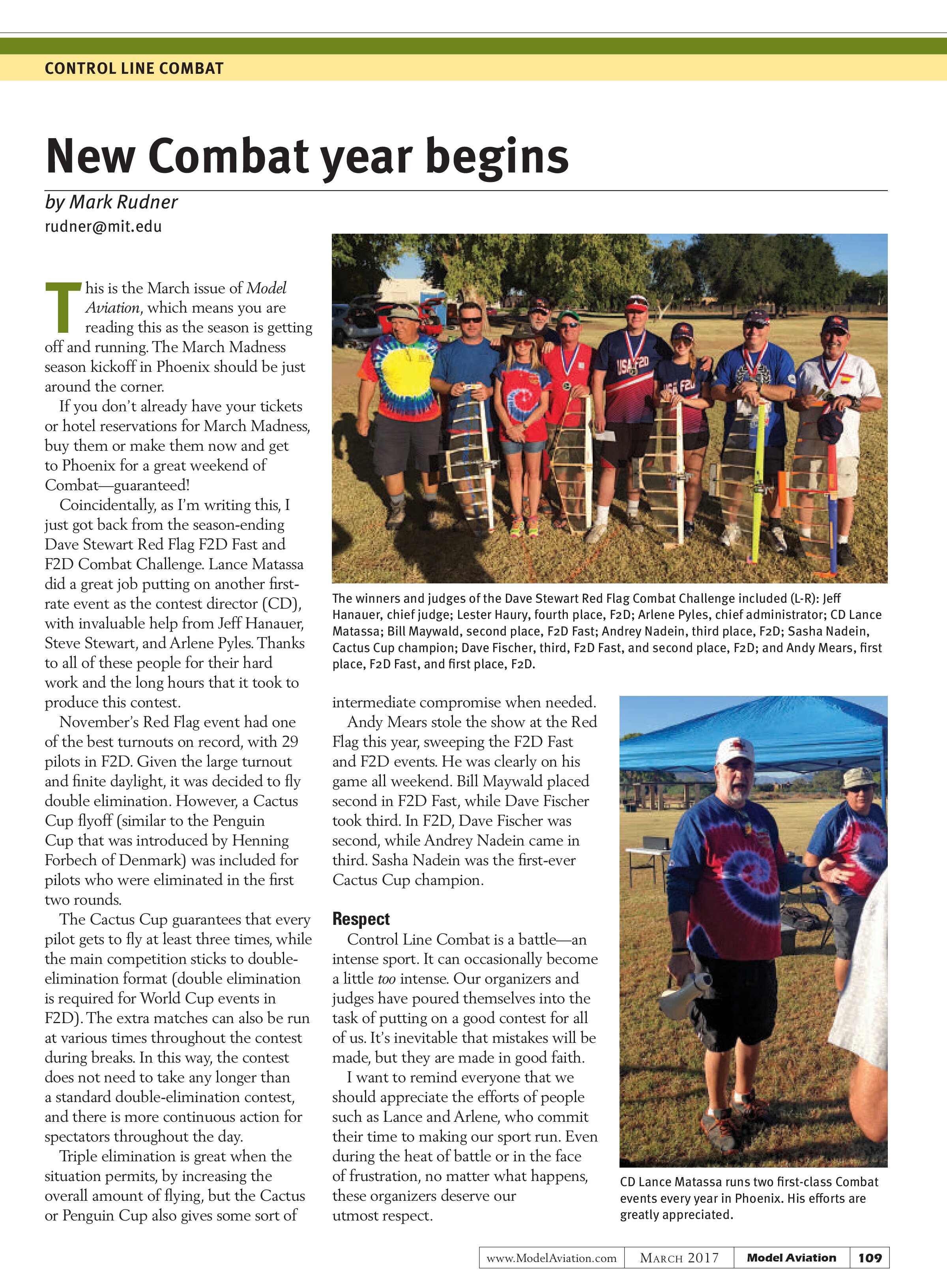
Andy Mears stole the show at the Red Flag this year, sweeping the F2D Fast and F2D events. He was clearly on his game all weekend. Bill Maywald placed second in F2D Fast, while Dave Fischer took third. In F2D, Dave Fischer was second, while Andrey Nadein came in third. Sasha Nadein was the first-ever Cactus Cup champion.
Respect
Control Line Combat is a battle—an intense sport. It can occasionally become a little too intense. Our organizers and judges have poured themselves into the task of putting on a good contest for all of us. It’s inevitable that mistakes will be made, but they are made in good faith.
I want to remind everyone that we should appreciate the efforts of people such as Lance and Arlene, who commit their time to making our sport run. Even during the heat of battle or in the face of frustration, no matter what happens, these organizers deserve our utmost respect.


contact and force are used to actively push an opponent out of position (or worse, out of the circle, which is explicitly a disqualifiable offense).
I think basketball provides a good analogy here. You can set a screen or post up with no problem. If you drop a shoulder while hitting a screen, or switch from basketball mode to hockey mode, that’s out of line.
We should police ourselves on such matters, but ultimately it falls on the center marshal to make a call when a pilot goes too far. It’s often a thankless job and a tough call, because rough flying could result in a harsh reaction. However, we’ve seen some instances of physicality slowly escalating in recent contests.
Establishing firm boundaries and calling some penalties are the best ways to nip it in the bud and keep everyone flying on a level playing field. In the end, strict and fair judging will be appreciated by all and will keep the event fun and thriving.
New Combat Models
On the technical side, I had a long discussion with Lester Haury, of Dallas, while we were in Phoenix. At a time when most F2D pilots are buying airplanes from Ukraine, Moldova, or Latvia, Lester has been developing his own new generation of models.
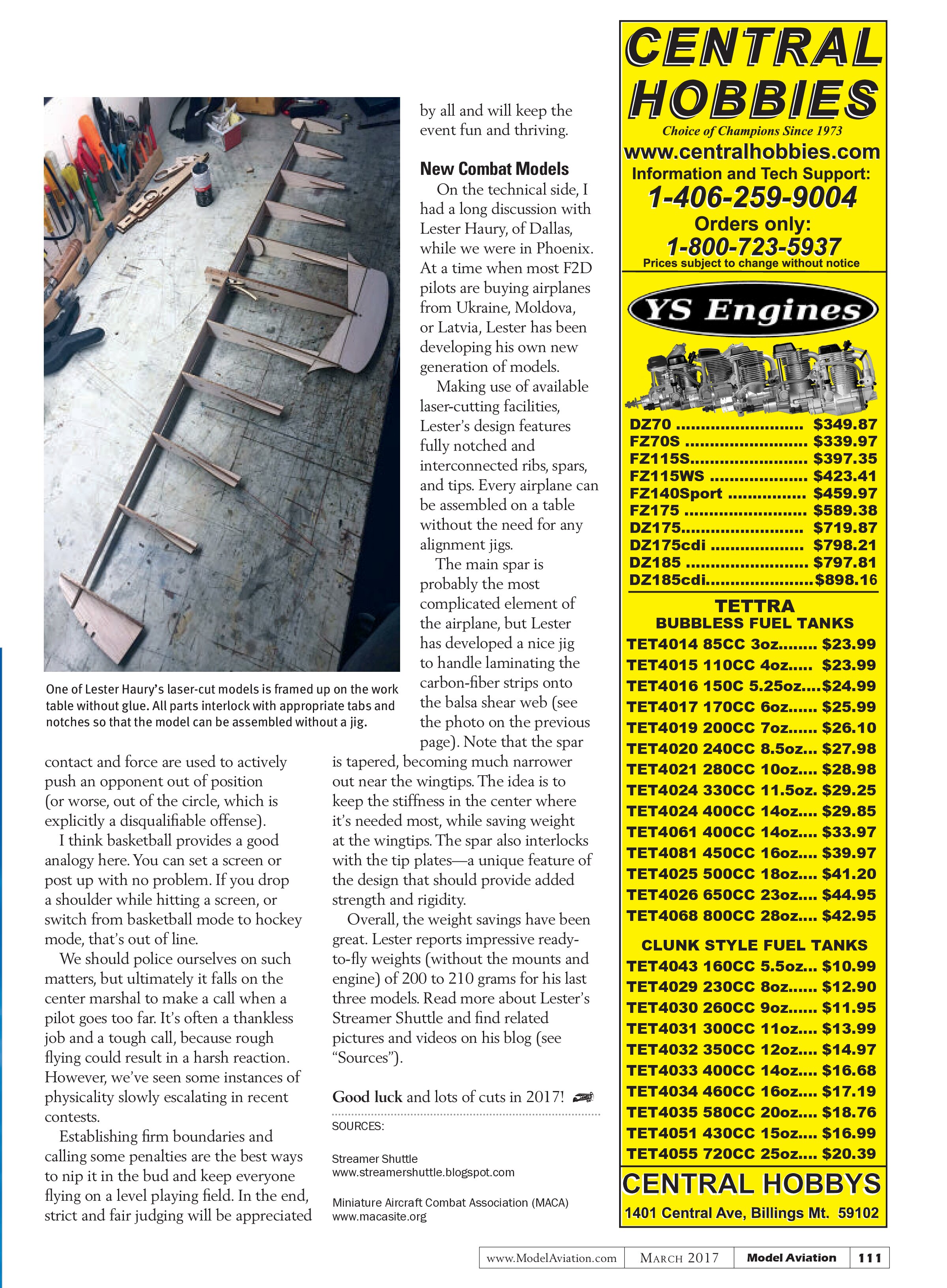
Making use of available laser-cutting facilities, Lester’s design features fully notched and interconnected ribs, spars, and tips. Every airplane can be assembled on a table without the need for any alignment jigs.
The main spar is probably the most complicated element of the airplane, but Lester has developed a nice jig to handle laminating the carbon-fiber strips onto the balsa shear web (see the photo on the previous page). Note that the spar is tapered, becoming much narrower out near the wingtips. The idea is to keep the stiffness in the center where it’s needed most, while saving weight at the wingtips. The spar also interlocks with the tip plates—a unique feature of the design that should provide added strength and rigidity.
Overall, the weight savings have been great. Lester reports impressive ready-to-fly weights (without the mounts and engine) of 200 to 210 grams for his last three models. Read more about Lester’s Streamer Shuttle and find related pictures and videos on his blog (see “Sources”).
Good luck and lots of cuts in 2017!
SOURCES:
Streamer Shuttle
www.streamershuttle.blogspot.com
Miniature Aircraft Combat Association (MACA)
www.macasite.org