In the Air
Membership news and updates
from AMA Headquarters

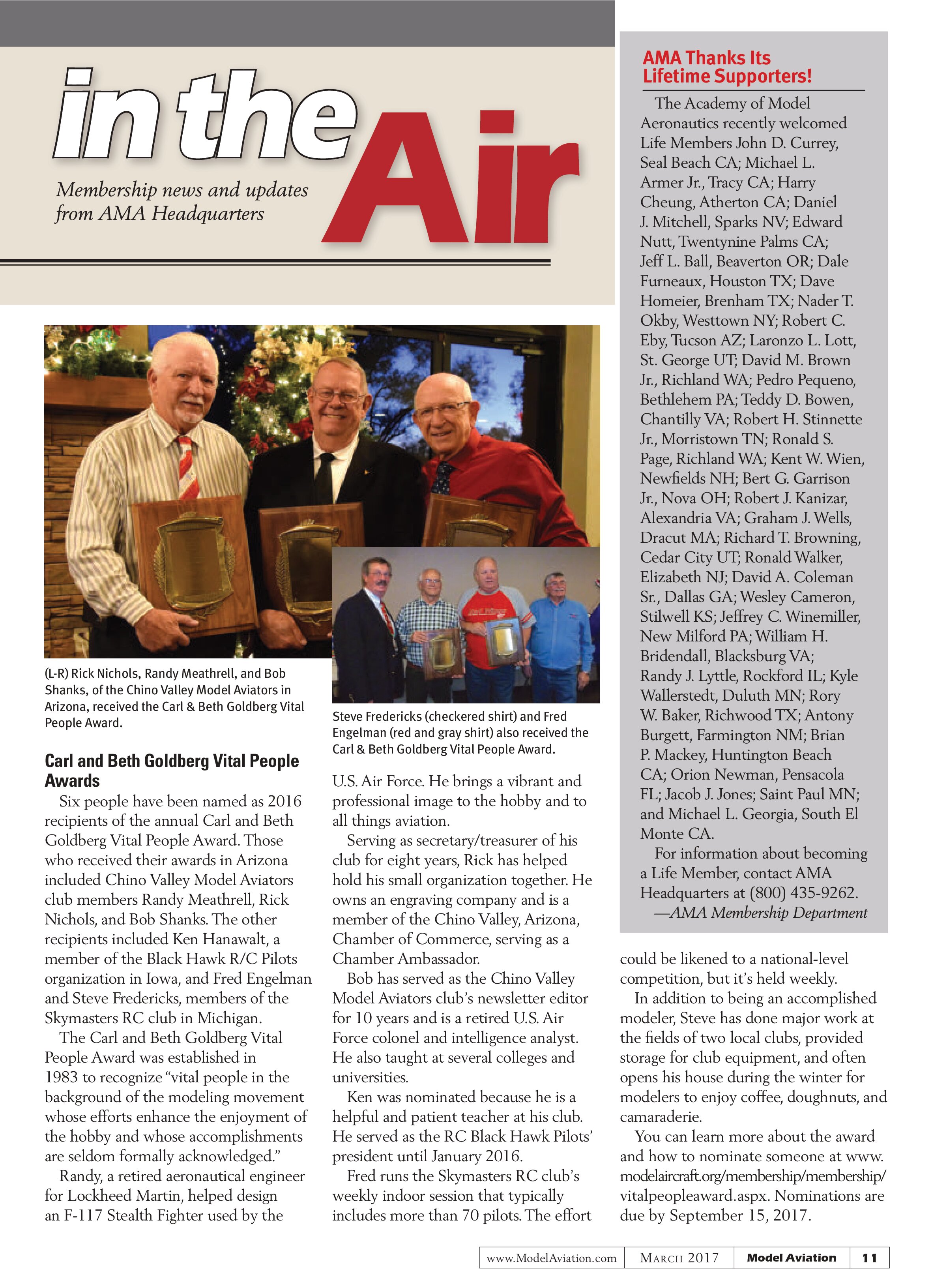
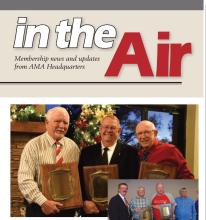
(L-R) Rick Nichols, Randy Meathrell, and Bob Shanks, of the Chino Valley Model Aviators in Arizona, received the Carl & Beth Goldberg Vital People Award.

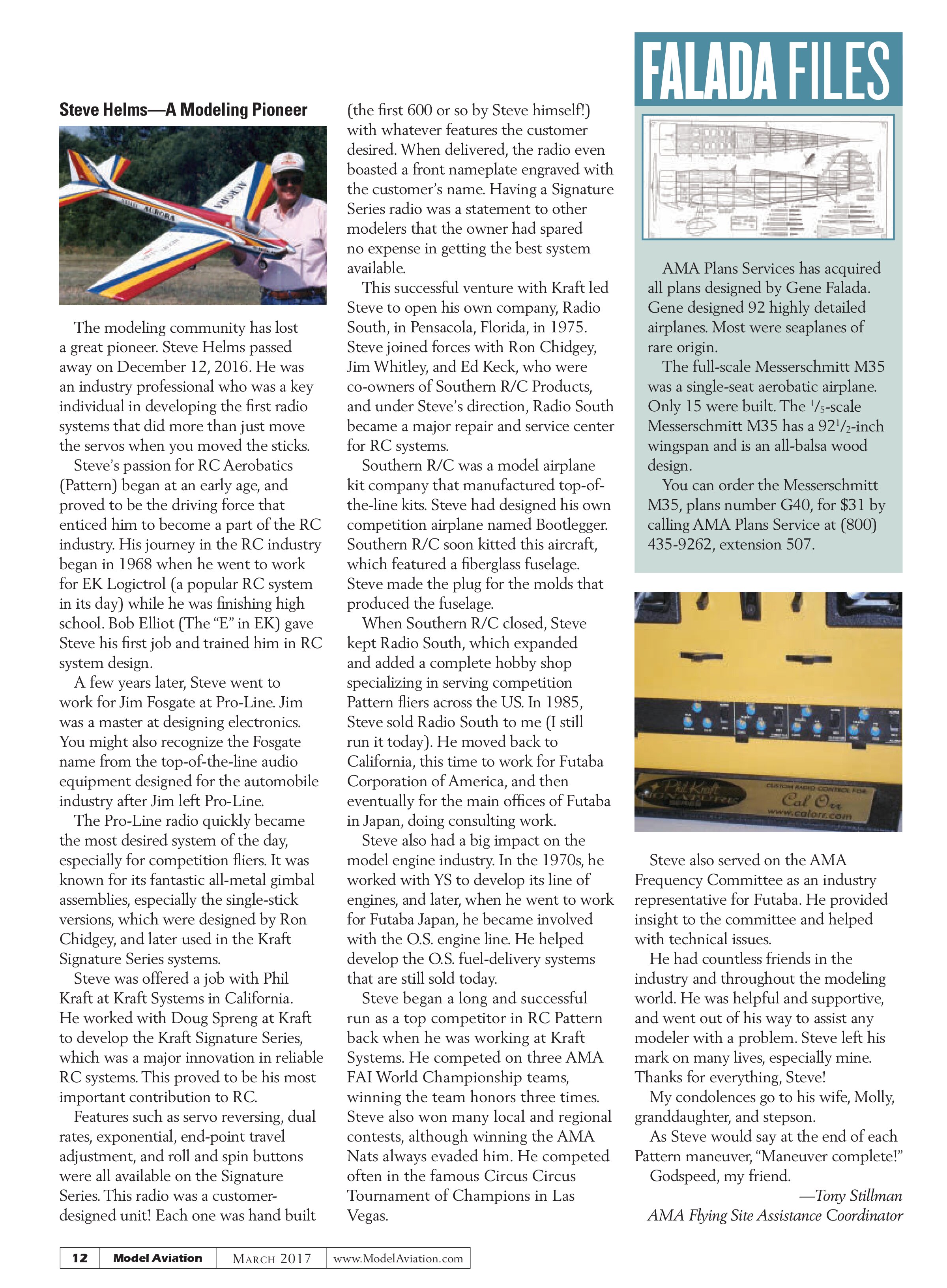
Steve Fredericks (checkered shirt) and Fred Engelman (red and gray shirt) also received the Carl & Beth Goldberg Vital People Award.
Carl and Beth Goldberg Vital People Awards
Six people have been named as 2016 recipients of the annual Carl and Beth Goldberg Vital People Award. Those who received their awards in Arizona included Chino Valley Model Aviators club members Randy Meathrell, Rick Nichols, and Bob Shanks. The other recipients included Ken Hanawalt, a member of the Black Hawk R/C Pilots organization in Iowa, and Fred Engelman and Steve Fredericks, members of the Skymasters RC club in Michigan.
The Carl and Beth Goldberg Vital People Award was established in 1983 to recognize “vital people in the background of the modeling movement whose efforts enhance the enjoyment of the hobby and whose accomplishments are seldom formally acknowledged.”
Randy, a retired aeronautical engineer for Lockheed Martin, helped design an F-117 Stealth Fighter used by the U.S. Air Force. He brings a vibrant and professional image to the hobby and to all things aviation.
Serving as secretary/treasurer of his club for eight years, Rick has helped hold his small organization together. He owns an engraving company and is a member of the Chino Valley, Arizona, Chamber of Commerce, serving as a Chamber Ambassador.
Bob has served as the Chino Valley Model Aviators club’s newsletter editor for 10 years and is a retired U.S. Air Force colonel and intelligence analyst. He also taught at several colleges and universities.
Ken was nominated because he is a helpful and patient teacher at his club. He served as the RC Black Hawk Pilots’ president until January 2016.
Fred runs the Skymasters RC club’s weekly indoor session that typically includes more than 70 pilots. The effort could be likened to a national-level competition, but it’s held weekly.
In addition to being an accomplished modeler, Steve has done major work at the fields of two local clubs, provided storage for club equipment, and often opens his house during the winter for modelers to enjoy coffee, doughnuts, and camaraderie.
You can learn more about the award and how to nominate someone at www.modelaircraft.org/membership/membership/vitalpeopleaward.aspx. Nominations are due by September 15, 2017.
AMA Thanks Its Lifetime Supporters!
The Academy of Model Aeronautics recently welcomed Life Members John D. Currey, Seal Beach CA; Michael L. Armer Jr., Tracy CA; Harry Cheung, Atherton CA; Daniel J. Mitchell, Sparks NV; Edward Nutt, Twentynine Palms CA; Jeff L. Ball, Beaverton OR; Dale Furneaux, Houston TX; Dave Homeier, Brenham TX; Nader T. Okby, Westtown NY; Robert C. Eby, Tucson AZ; Laronzo L. Lott, St. George UT; David M. Brown Jr., Richland WA; Pedro Pequeno, Bethlehem PA; Teddy D. Bowen, Chantilly VA; Robert H. Stinnette Jr., Morristown TN; Ronald S. Page, Richland WA; Kent W. Wien, Newfields NH; Bert G. Garrison Jr., Nova OH; Robert J. Kanizar, Alexandria VA; Graham J. Wells, Dracut MA; Richard T. Browning, Cedar City UT; Ronald Walker, Elizabeth NJ; David A. Coleman Sr., Dallas GA; Wesley Cameron, Stilwell KS; Jeffrey C. Winemiller, New Milford PA; William H. Bridendall, Blacksburg VA; Randy J. Lyttle, Rockford IL; Kyle Wallerstedt, Duluth MN; Rory W. Baker, Richwood TX; Antony Burgett, Farmington NM; Brian P. Mackey, Huntington Beach CA; Orion Newman, Pensacola FL; Jacob J. Jones; Saint Paul MN; and Michael L. Georgia, South El Monte CA.
For information about becoming a Life Member, contact AMA Headquarters at (800) 435-9262.
—AMA Membership Department
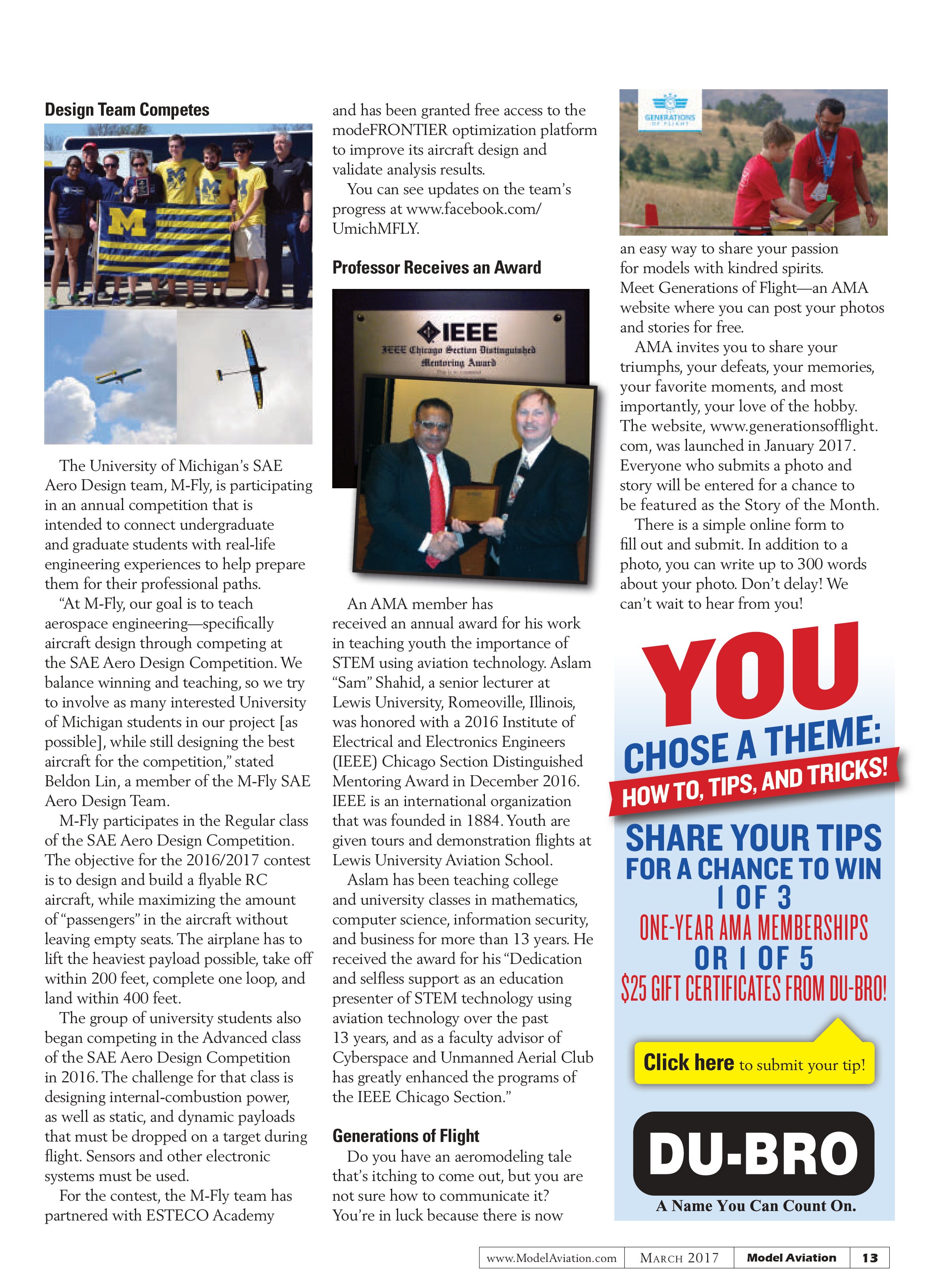
Steve Helms—A Modeling Pioneer

The modeling community has lost a great pioneer. Steve Helms passed away on December 12, 2016. He was an industry professional who was a key individual in developing the first radio systems that did more than just move the servos when you moved the sticks.
Steve’s passion for RC Aerobatics (Pattern) began at an early age, and proved to be the driving force that enticed him to become a part of the RC industry. His journey in the RC industry began in 1968 when he went to work for EK Logictrol (a popular RC system in its day) while he was finishing high school. Bob Elliot (The “E” in EK) gave Steve his first job and trained him in RC system design.
A few years later, Steve went to work for Jim Fosgate at Pro-Line. Jim was a master at designing electronics. You might also recognize the Fosgate name from the top-of-the-line audio equipment designed for the automobile industry after Jim left Pro-Line.
The Pro-Line radio quickly became the most desired system of the day, especially for competition fliers. It was known for its fantastic all-metal gimbal assemblies, especially the single-stick versions, which were designed by Ron Chidgey, and later used in the Kraft Signature Series systems.
Steve was offered a job with Phil Kraft at Kraft Systems in California. He worked with Doug Spreng at Kraft to develop the Kraft Signature Series, which was a major innovation in reliable RC systems. This proved to be his most important contribution to RC.
Features such as servo reversing, dual rates, exponential, end-point travel adjustment, and roll and spin buttons were all available on the Signature Series. This radio was a customer-designed unit! Each one was hand built (the first 600 or so by Steve himself!) with whatever features the customer desired. When delivered, the radio even boasted a front nameplate engraved with the customer’s name. Having a Signature Series radio was a statement to other modelers that the owner had spared no expense in getting the best system available.
This successful venture with Kraft led Steve to open his own company, Radio South, in Pensacola, Florida, in 1975. Steve joined forces with Ron Chidgey, Jim Whitley, and Ed Keck, who were co-owners of Southern R/C Products, and under Steve’s direction, Radio South became a major repair and service center for RC systems.
Southern R/C was a model airplane kit company that manufactured top-of-the-line kits. Steve had designed his own competition airplane named Bootlegger. Southern R/C soon kitted this aircraft, which featured a fiberglass fuselage. Steve made the plug for the molds that produced the fuselage.
When Southern R/C closed, Steve kept Radio South, which expanded and added a complete hobby shop specializing in serving competition Pattern fliers across the US. In 1985, Steve sold Radio South to me (I still run it today). He moved back to California, this time to work for Futaba Corporation of America, and then eventually for the main offices of Futaba in Japan, doing consulting work.
Steve also had a big impact on the model engine industry. In the 1970s, he worked with YS to develop its line of engines, and later, when he went to work for Futaba Japan, he became involved with the O.S. engine line. He helped develop the O.S. fuel-delivery systems that are still sold today.
Steve began a long and successful run as a top competitor in RC Pattern back when he was working at Kraft Systems. He competed on three AMA FAI World Championship teams, winning the team honors three times. Steve also won many local and regional contests, although winning the AMA Nats always evaded him. He competed often in the famous Circus Circus Tournament of Champions in Las Vegas.
Falada Files

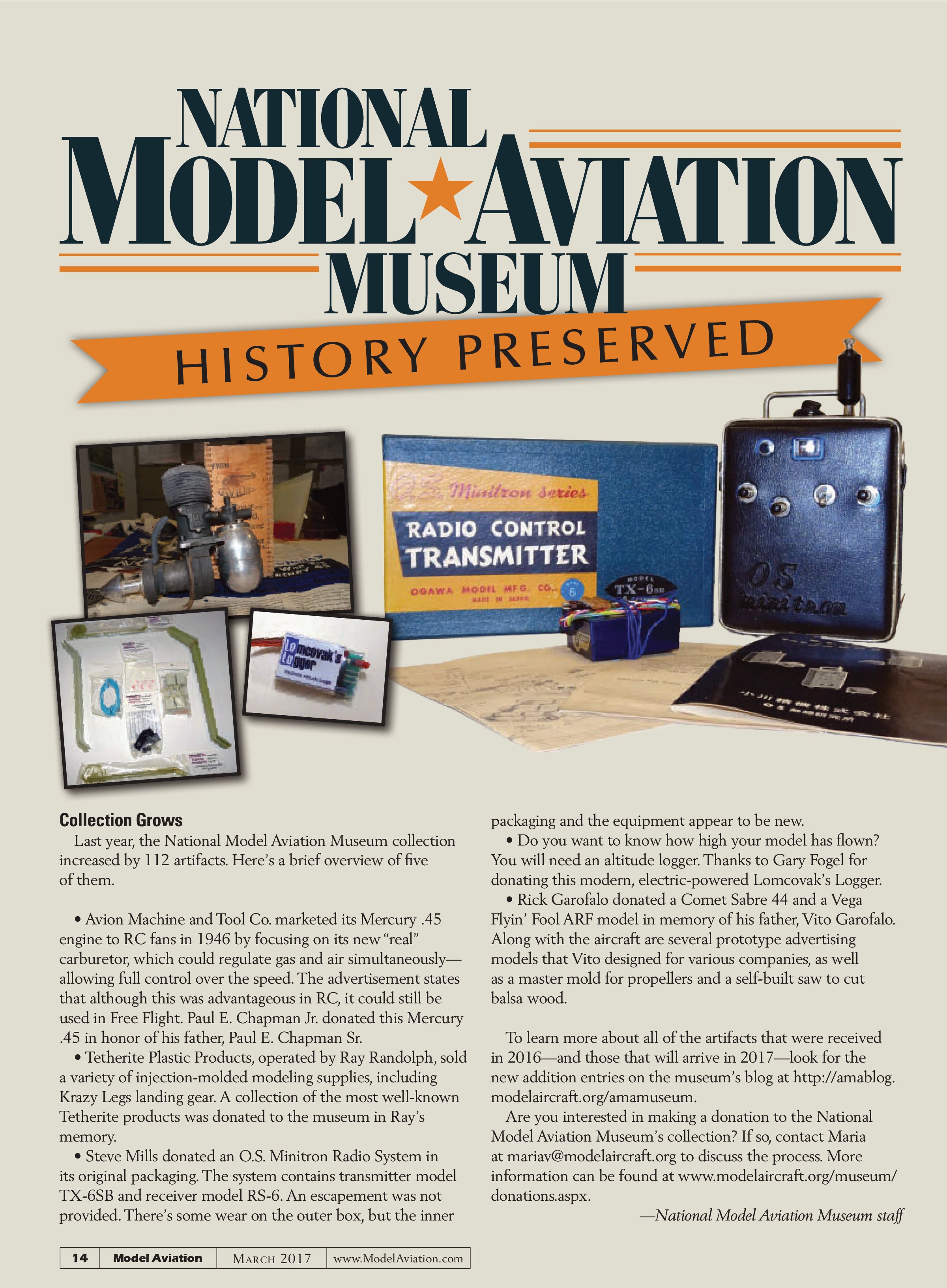
AMA Plans Services has acquired all plans designed by Gene Falada. Gene designed 92 highly detailed airplanes. Most were seaplanes of rare origin.
The full-scale Messerschmitt M35 was a single-seat aerobatic airplane. Only 15 were built. The ¹/₅-scale Messerschmitt M35 has a 9½-inch wingspan and is an all-balsa wood design.
You can order the Messerschmitt M35, plans number G40, for $31 by calling AMA Plans Service at (800) 435-9262, extension 507.

Steve also served on the AMA Frequency Committee as an industry representative for Futaba. He provided insight to the committee and helped with technical issues.
He had countless friends in the industry and throughout the modeling world. He was helpful and supportive, and went out of his way to assist any modeler with a problem. Steve left his mark on many lives, especially mine. Thanks for everything, Steve!
My condolences go to his wife, Molly, granddaughter, and stepson.
As Steve would say at the end of each Pattern maneuver, “Maneuver complete!” Godspeed, my friend.
—Tony Stillman
AMA Flying Site Assistance Coordinator
Design Team Competes

The University of Michigan’s SAE Aero Design team, M-Fly, is participating in an annual competition that is intended to connect undergraduate and graduate students with real-life engineering experiences to help prepare them for their professional paths.
“At M-Fly, our goal is to teach aerospace engineering—specifically aircraft design through competing at the SAE Aero Design Competition. We balance winning and teaching, so we try to involve as many interested University of Michigan students in our project [as possible], while still designing the best aircraft for the competition,” stated Beldon Lin, a member of the M-Fly SAE Aero Design Team.
M-Fly participates in the Regular class of the SAE Aero Design Competition. The objective for the 2016/2017 contest is to design and build a flyable RC aircraft, while maximizing the amount of “passengers” in the aircraft without leaving empty seats. The airplane has to lift the heaviest payload possible, take off within 200 feet, complete one loop, and land within 400 feet.
The group of university students also began competing in the Advanced class of the SAE Aero Design Competition in 2016. The challenge for that class is designing internal-combustion power, as well as static, and dynamic payloads that must be dropped on a target during flight. Sensors and other electronic systems must be used.
For the contest, the M-Fly team has partnered with ESTECO Academy and has been granted free access to the modeFRONTIER optimization platform to improve its aircraft design and validate analysis results.
You can see updates on the team’s progress at www.facebook.com/UmichMFLY.
Professor Receives an Award


An AMA member has received an annual award for his work in teaching youth the importance of STEM using aviation technology. Aslam “Sam” Shahid, a senior lecturer at Lewis University, Romeoville, Illinois, was honored with a 2016 Institute of Electrical and Electronics Engineers (IEEE) Chicago Section Distinguished Mentoring Award in December 2016. IEEE is an international organization that was founded in 1884. Youth are given tours and demonstration flights at Lewis University Aviation School.
Aslam has been teaching college and university classes in mathematics, computer science, information security, and business for more than 13 years. He received the award for his “Dedication and selfless support as an education presenter of STEM technology using aviation technology over the past 13 years, and as a faculty advisor of Cyberspace and Unmanned Aerial Club has greatly enhanced the programs of the IEEE Chicago Section.”
Generations of Flight
Do you have an aeromodeling tale that’s itching to come out, but you are not sure how to communicate it? You’re in luck because there is now

an easy way to share your passion for models with kindred spirits. Meet Generations of Flight—an AMA website where you can post your photos and stories for free.
AMA invites you to share your triumphs, your defeats, your memories, your favorite moments, and most importantly, your love of the hobby. The website, www.generationsofflight.com, was launched in January 2017. Everyone who submits a photo and story will be entered for a chance to be featured as the Story of the Month.
There is a simple online form to fill out and submit. In addition to a photo, you can write up to 300 words about your photo. Don’t delay! We can’t wait to hear from you!

Collection Grows
Last year, the National Model Aviation Museum collection increased by 112 artifacts. Here’s a brief overview of five of them.
- Avion Machine and Tool Co. marketed its Mercury .45 engine to RC fans in 1946 by focusing on its new “real” carburetor, which could regulate gas and air simultaneously—allowing full control over the speed. The advertisement states that although this was advantageous in RC, it could still be used in Free Flight. Paul E. Chapman Jr. donated this Mercury .45 in honor of his father, Paul E. Chapman Sr.
- Tetherite Plastic Products, operated by Ray Randolph, sold a variety of injection-molded modeling supplies, including Krazy Legs landing gear. A collection of the most well-known Tetherite products was donated to the museum in Ray’s memory.
- Steve Mills donated an O.S. Minitron Radio System in its original packaging. The system contains transmitter model TX-6SB and receiver model RS-6. An escapement was not provided. There’s some wear on the outer box, but the inner packaging and the equipment appear to be new.
- Do you want to know how high your model has flown? You will need an altitude logger. Thanks to Gary Fogel for donating this modern, electric-powered Lomcovak’s Logger.
- Rick Garofalo donated a Comet Sabre 44 and a Vega Flyin’ Fool ARF model in memory of his father, Vito Garofalo. Along with the aircraft are several prototype advertising models that Vito designed for various companies, as well as a master mold for propellers and a self-built saw to cut balsa wood.
To learn more about all of the artifacts that were received in 2016—and those that will arrive in 2017—look for the new addition entries on the museum’s blog at http://amablog.modelaircraft.org/amamuseum.
Are you interested in making a donation to the National Model Aviation Museum’s collection? If so, contact Maria at mariav@modelaircraft.org to discuss the process. More information can be found at www.modelaircraft.org/museum/donations.aspx.
—National Model Aviation Museum staff