Model Aviation welcomes a new writer
Pat Tritle
patscustommodels@gmail.com
I’ve read the “Small-Field Flying” column for many years, and have enjoyed former columnist Paul Bradley’s insights into modeling. When I became involved with the Small Model Airplane Lovers League (SMALL), I had the opportunity to meet him. I quickly realized that he is a first-class modeler in his own right, and was more than willing to share his thoughts on anything modeling related. Throughout the years, we’ve swapped a number of ideas that have simplified more than one tricky spot when traveling through uncharted territory.
I want to thank Paul for all that he’s done and has offered us throughout the past 14 years. His efforts have been appreciated, and I am honored to have been given the opportunity to take the torch and run with it, keeping with the groundwork that Paul has laid throughout the years.
Some of you already know who I am through RCGroups or other print media. For those who don’t know me, I’ve been involved in modeling in one form or fashion for roughly 58 years. It all began with a Carl Goldberg Cessna 180, and with a little coaching from my dad, I was able to build that kit. In the summer of 1958, my goal was to fly the model all the way across our front yard, which, at the time, I didn’t know was only 25 feet wide—but hey, you have to start somewhere.
Since that time, with the exception of six weeks in U.S. Air Force basic training, modeling has been a nonstop endeavor. I’ve enjoyed nearly every aspect of the hobby, including plastic scale, Free Flight (FF), Control Line (CL), and RC. My modeling wasn’t only airplanes. It included cars, motorcycles, boats, architectural endeavors, and nearly anything else that could be assembled, painted, floated, flown, or merely displayed.
My first article was published in Model Airplane News (MAN) in 1971. It was a FF design that had been a drafting class project in 1970. My next article was a 30-inch Shoestring that appeared in MAN in the mid-1990s. From there, I have produced construction articles, how-to articles, and kit reviews practically nonstop that were published in nearly all of the domestic modeling magazines, including seven years of authoring the “Small Talk” column in Flying Models.
After leaving the Air Force in 1976, I spent 17 years in the automotive repair business. I spent two years building UAVs part time, and then I went into modeling full time in 1993 with a custom building service. The business soon evolved into model boat and airplane design as well, and it wasn’t long before I began an ongoing series of RC airplane designs with Dare Distributors and Dumas Products, completing nearly 65 designs between the two companies. In my spare

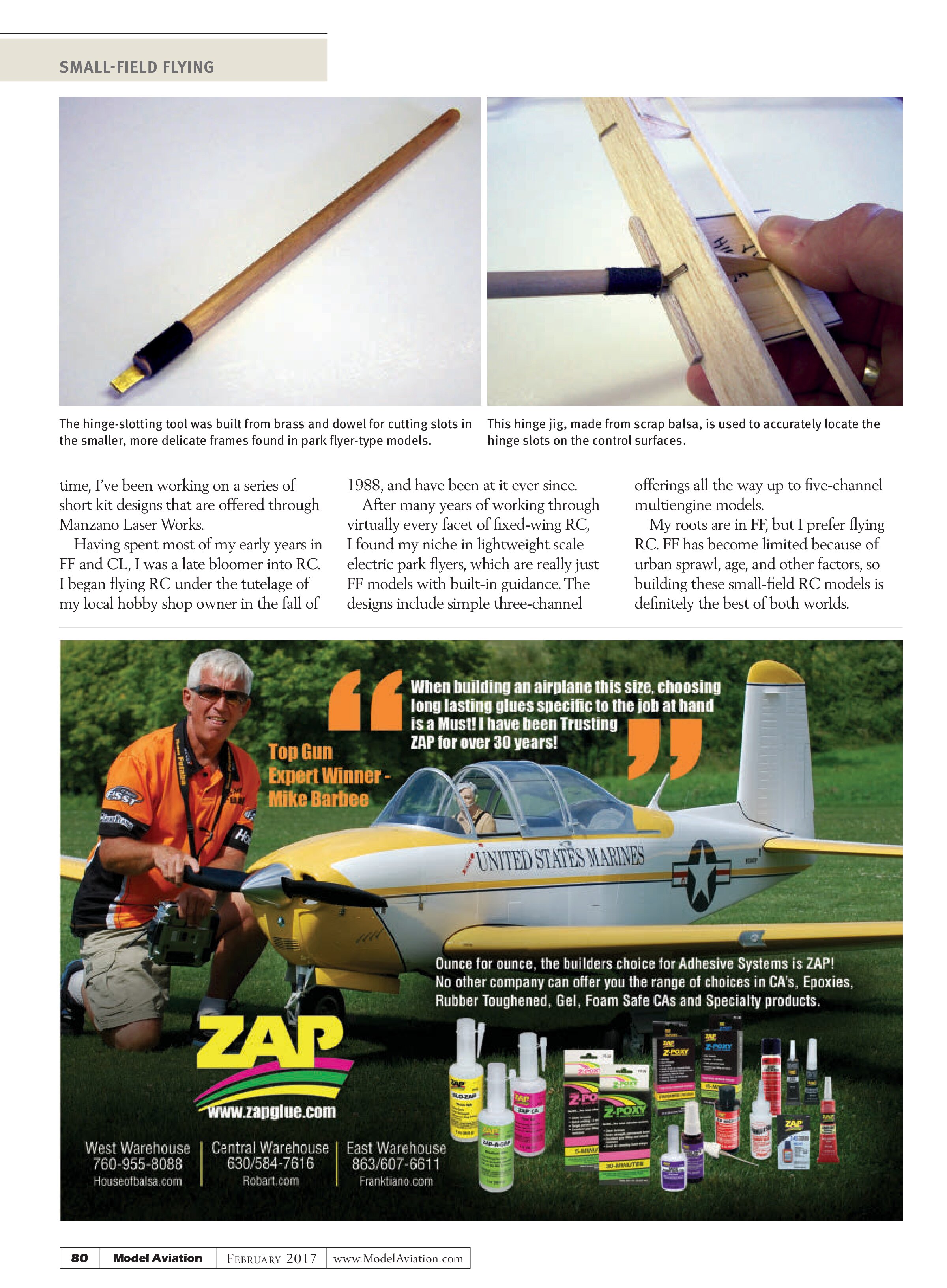
The 1/8-scale C-172 is a typical small-field flyer. Its compact size and light weight are the perfect combination for areas where field size is limited.

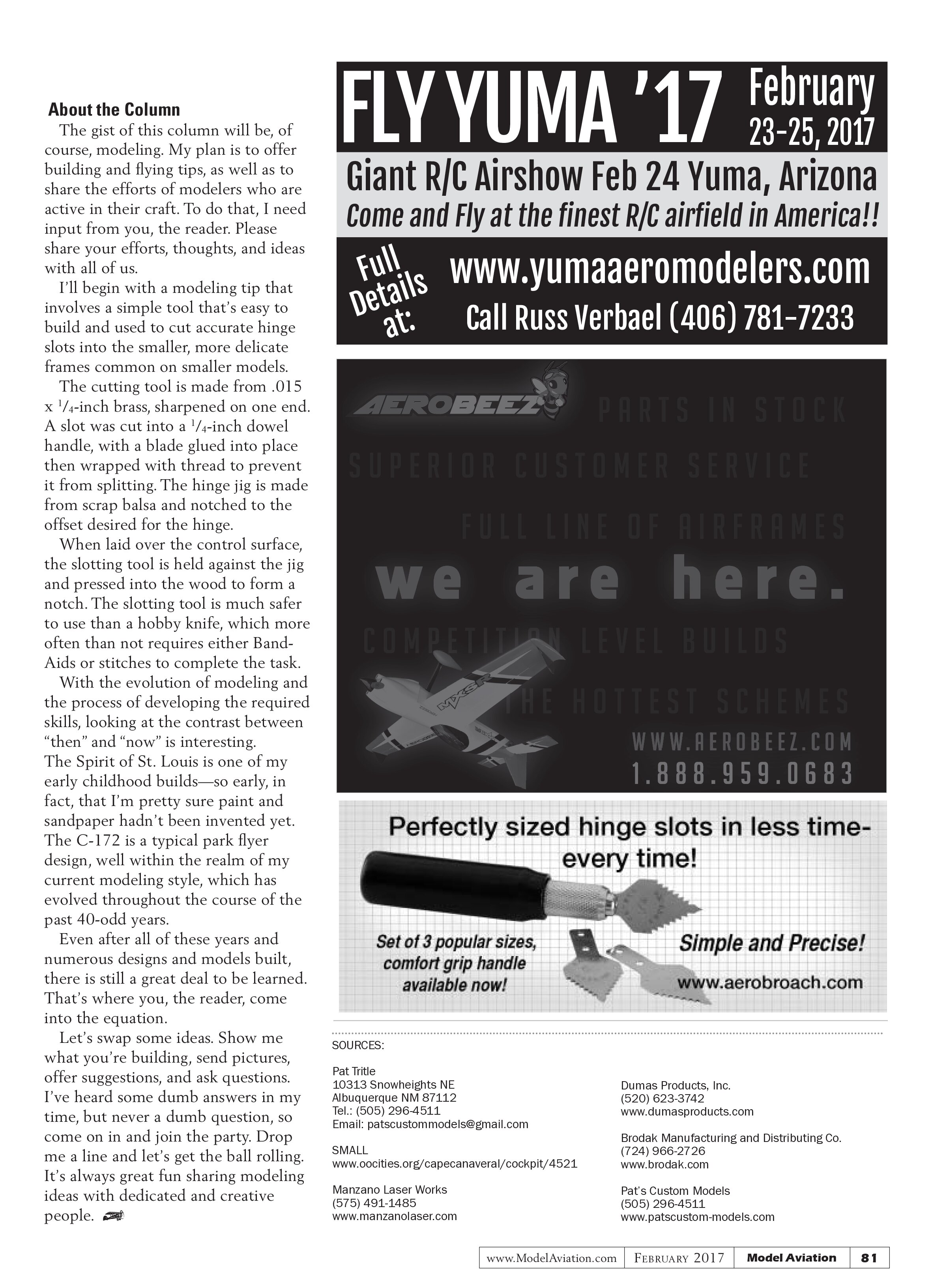
This Spirit of St. Louis was built many years ago and still hangs in the author’s shop as a gentle reminder of his early modeling days.


time, I’ve been working on a series of short kit designs that are offered through Manzano Laser Works.
Having spent most of my early years in FF and CL, I was a late bloomer into RC. I began flying RC under the tutelage of my local hobby shop owner in the fall of 1988, and have been at it ever since.
After many years of working through virtually every facet of fixed-wing RC, I found my niche in lightweight scale electric park flyers, which are really just FF models with built-in guidance. The designs include simple three-channel offerings all the way up to five-channel multiengine models.
My roots are in FF, but I prefer flying RC. FF has become limited because of urban sprawl, age, and other factors, so building these small-field RC models is definitely the best of both worlds.
About the Column
The gist of this column will be, of course, modeling. My plan is to offer building and flying tips, as well as to share the efforts of modelers who are active in their craft. To do that, I need input from you, the reader. Please share your efforts, thoughts, and ideas with all of us.
I’ll begin with a modeling tip that involves a simple tool that’s easy to build and used to cut accurate hinge slots into the smaller, more delicate frames common on smaller models.
The cutting tool is made from .015 x ¼-inch brass, sharpened on one end. A slot was cut into a ¼-inch dowel handle, with a blade glued into place then wrapped with thread to prevent it from splitting. The hinge jig is made from scrap balsa and notched to the offset desired for the hinge.
When laid over the control surface, the slotting tool is held against the jig and pressed into the wood to form a notch. The slotting tool is much safer to use than a hobby knife, which more often than not requires either Band-Aids or stitches to complete the task.
With the evolution of modeling and the process of developing the required skills, looking at the contrast between “then” and “now” is interesting. The Spirit of St. Louis is one of my early childhood builds—so early, in fact, that I’m pretty sure paint and sandpaper hadn’t been invented yet. The C-172 is a typical park flyer design, well within the realm of my current modeling style, which has evolved throughout the course of the past 40-odd years.
Even after all of these years and numerous designs and models built, there is still a great deal to be learned. That’s where you, the reader, come into the equation.
Let’s swap some ideas. Show me what you’re building, send pictures, offer suggestions, and ask questions. I’ve heard some dumb answers in my time, but never a dumb question, so come on in and join the party. Drop me a line and let’s get the ball rolling. It’s always great fun sharing modeling ideas with dedicated and creative people.
SOURCES:
Pat Tritle
10313 Snowheights NE
Albuquerque NM 87112
Tel.: (505) 296-4511
Email: patscustommodels@gmail.com
SMALL
www.oocities.org/capecanaveral/cockpit/4521
Manzano Laser Works
(575) 491-1485
www.manzanolaser.com
Dumas Products, Inc.
(520) 623-3742
www.dumasproducts.com
Brodak Manufacturing and Distributing Co.
(724) 966-2726
www.brodak.com
Pat’s Custom Models
(505) 296-4511
www.patscustom-models.com