Location, location, location
Do you know the address of your club’s flying field? More importantly, do local first responders know it?
Rich Howerton wrote to me with that excellent point. Rich had a minor injury at his somewhat-remote RC field, and he began to wonder about how things would have worked if it had been a more severe wound and help was needed. Could emergency crews find the right spot?
Rich said it’s no use telling them that you’re at the old landfill, because there are three in his area. An unmarked gravel road dead-ends at a locked gate where modelers enter the flying site.
Rich met with his local county police and discussed the matter. The 911 operators apparently have a way to tie the RC club’s name to the closest road intersection on their computer display. Thanks to that feature, if, in the future (heaven forbid) a serious call for medical help is made, the ambulance will go to the right location.
Flying sites tend to be remote. The RC pilots know how to get there, and probably the local ice cream truck, but it might be wise for your club to ensure that the fire department knows the way as well.

Peace Pipe
One RC field in my area is in a large municipal park. If I were waiting for emergency medical assistance, I’d sure hate for an ambulance to take a scenic tour around the lake and golf course looking for the model airport. Unless the driver knows the area, it could be a problem. There is also an informal Free Flight zone a mile or two from the RC runway. There’s no address—just an open area.
I have, unfortunately, had occasional encounters with my local rescue squad, and Rich’s email got me thinking about how I might describe the location to a 911 operator. “We’re right under the tree where my Corsair got stuck that time.” Lotsa luck with that one.
Preventing incidents with upstream measures is always better. Carl Trevison sent in a clever idea that could help avoid a visit from the EMT crew. Carl said:
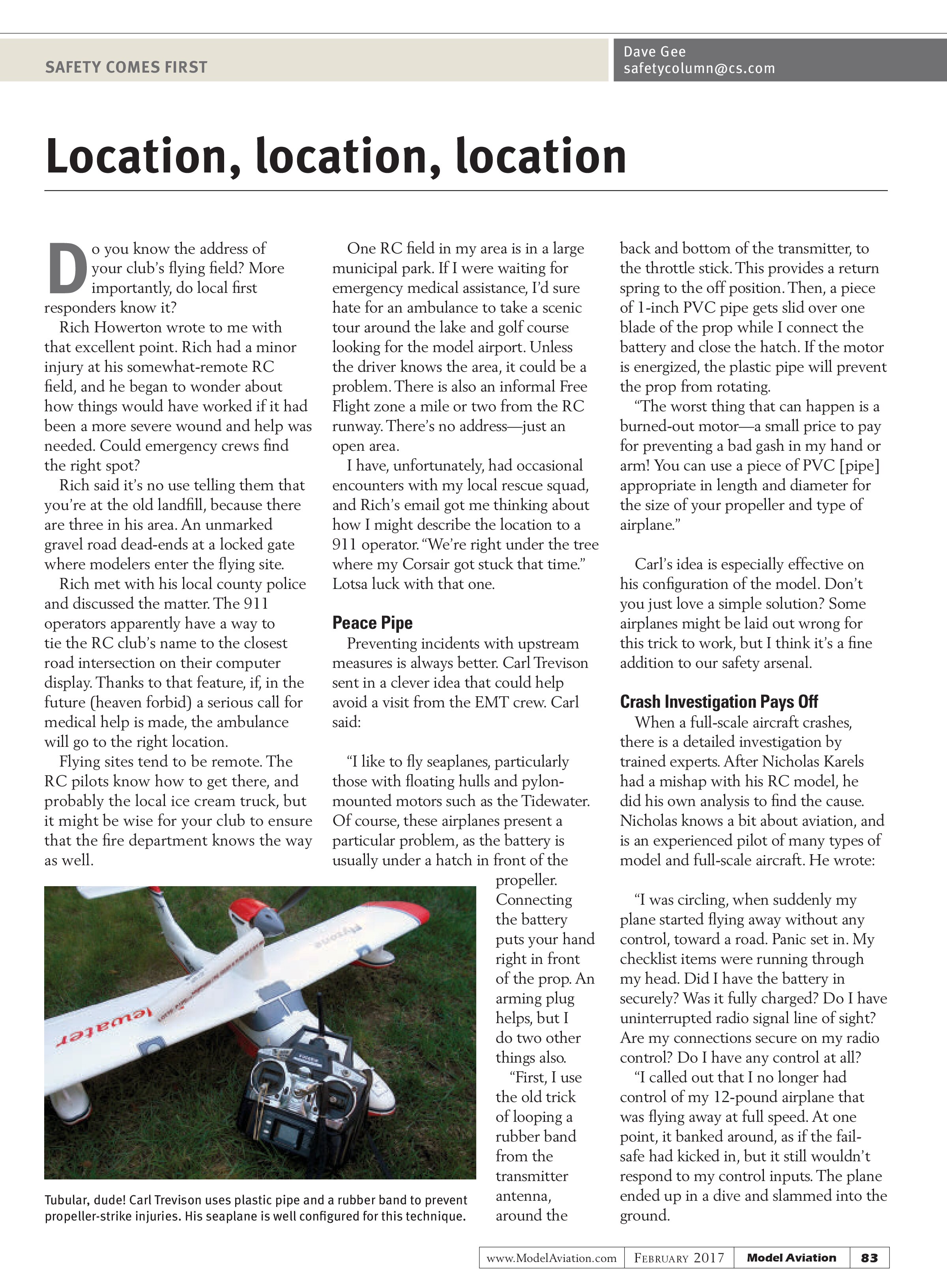
“I like to fly seaplanes, particularly those with floating hulls and pylon-mounted motors such as the Tidewater. Of course, these airplanes present a particular problem, as the battery is usually under a hatch in front of the propeller. Connecting the battery puts your hand right in front of the prop. An arming plug helps, but I do two other things also. “First, I use the old trick of looping a rubber band from the transmitter antenna, around the back and bottom of the transmitter, to the throttle stick. This provides a return spring to the off position. Then, a piece of 1-inch PVC pipe gets slid over one blade of the prop while I connect the battery and close the hatch. If the motor is energized, the plastic pipe will prevent the prop from rotating.
“The worst thing that can happen is a burned-out motor—a small price to pay for preventing a bad gash in my hand or arm! You can use a piece of PVC [pipe] appropriate in length and diameter for the size of your propeller and type of airplane.”
Carl’s idea is especially effective on his configuration of the model. Don’t you just love a simple solution? Some airplanes might be laid out wrong for this trick to work, but I think it’s a fine addition to our safety arsenal.
Crash Investigation Pays Off
When a full-scale aircraft crashes, there is a detailed investigation by trained experts. After Nicholas Karels had a mishap with his RC model, he did his own analysis to find the cause. Nicholas knows a bit about aviation, and is an experienced pilot of many types of model and full-scale aircraft. He wrote:
“I was circling, when suddenly my plane started flying away without any control, toward a road. Panic set in. My checklist items were running through my head. Did I have the battery in securely? Was it fully charged? Do I have uninterrupted radio signal line of sight? Are my connections secure on my radio control? Do I have any control at all?
“I called out that I no longer had control of my 12-pound airplane that was flying away at full speed. At one point, it banked around, as if the fail-safe had kicked in, but it still wouldn’t respond to my control inputs. The plane ended up in a dive and slammed into the ground.
“We don’t have ‘black box’ flight recorders in our hobby, but I tried to gather as much information from the wreck as possible before deciding to scrap or reuse anything, or even fly again that day. The problem was that I had no control whatsoever. This eliminated many possible issues, like individual control surfaces and linkages.
“Examination of the aircraft showed that there was still power to the receiver. If the receiver LED was lit, that also meant my battery had enough charge to operate the equipment.
“I had to also consider my radio transmitter as a potential problem. After several tries, I was able to get the RC system to operate the controls, but not properly. This transmitter is used for many other aircraft, but I wasn’t going to trust it until I could be sure it was working properly.
“Ground tests with another plane were inconclusive. Despite having several other fully charged aircraft on hand, I decided to call it a day. No more flying until I had figured out what had gone wrong!
“I eventually discovered that the receiver was the subject of a manufacturer’s recall. It was a good decision not to fly any more of my airplanes that day because they all used identical units.
“We trust our electronics to be reliable, and often after buying them, we never look back. In the future, I will periodically check the status of my electronic equipment for recalls or

service bulletins. It could save a plane, or maybe even someone’s life.”

Mystery Airplane
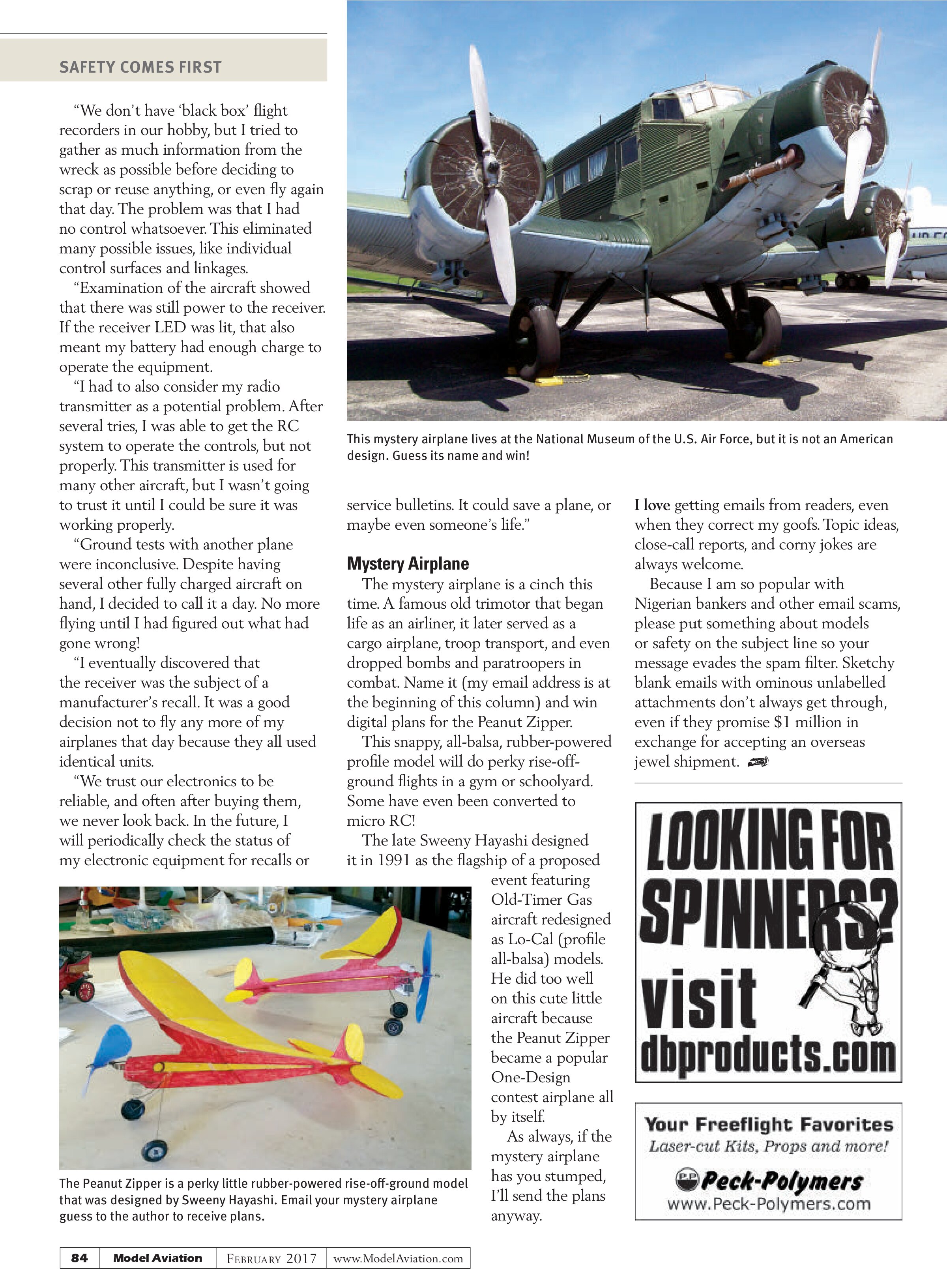
The mystery airplane is a cinch this time. A famous old trimotor that began life as an airliner, it later served as a cargo airplane, troop transport, and even dropped bombs and paratroopers in combat. Name it (my email address is at the beginning of this column) and win digital plans for the Peanut Zipper.
This snappy, all-balsa, rubber-powered profile model will do perky rise-off-ground flights in a gym or schoolyard. Some have even been converted to micro RC!
The late Sweeny Hayashi designed it in 1991 as the flagship of a proposed event featuring Old-Timer Gas aircraft redesigned as Lo-Cal (profile all-balsa) models. He did too well on this cute little aircraft because the Peanut Zipper became a popular One-Design contest airplane all by itself.
As always, if the mystery airplane has you stumped, I’ll send the plans anyway.
I love getting emails from readers, even when they correct my goofs. Topic ideas, close-call reports, and corny jokes are always welcome.
Because I am so popular with Nigerian bankers and other email scams, please put something about models or safety on the subject line so your message evades the spam filter. Sketchy blank emails with ominous unlabelled attachments don’t always get through, even if they promise $1 million in exchange for accepting an overseas jewel shipment.