Soar Utah 2016
by Dave Garwood
dave.garwood.518@gmail.com
Joe Chovan, from Syracuse, New York, participated in the Soar Utah 2016 event—one of the most venerable destinations on the national Slope Soaring event circuit. He documented the gathering.

Every two years during Labor Day weekend, RC sailplane pilots gather at one of the best Slope Soaring venues worldwide: Soar Utah. Just south of Salt Lake City is a unique geologic formation that has daily lift and a hill shape that virtually eliminates any sort of turbulence. This lack of “rotor,” stunning sweeping western vistas, and the warm hospitality of the Intermountain Silent Flyers (IMSF) attracts pilots with aircraft ranging from lightweight and delicate hand-launch sailplanes, to beautiful scale Thermal Duration sailplanes spanning four meters or more, to the fastest lead sleds that the white-knuckle crowd can brandish. Everything flies at Point of the Mountain, which is one of three featured flying sites during the event. Excellent flying conditions greeted early arrivals on Thursday, September 1,

2016. I met with longtime friends, Doug Taylor, of Indio, California, and Duayne Sims, of Soda Springs, Idaho, who were reunited this weekend. Each brought several projects, including Duayne’s 65-inch wingspan, 4-pound, 2-ounce Amazing Grace canard, which was originally built in 1978 from RCM&E magazine plans.
The wing is foam-core sheeted with ¹⁄₆₄ plywood. The fuselage is ¹⁄₃₂ plywood with balsa, and the finish is K&B epoxy. Thirty-eight years is a long time to wait for a maiden flight, but the sailplane flew well in the hands of veteran pilot Marty Hill. I was happy to see two old friends enjoying the experience.
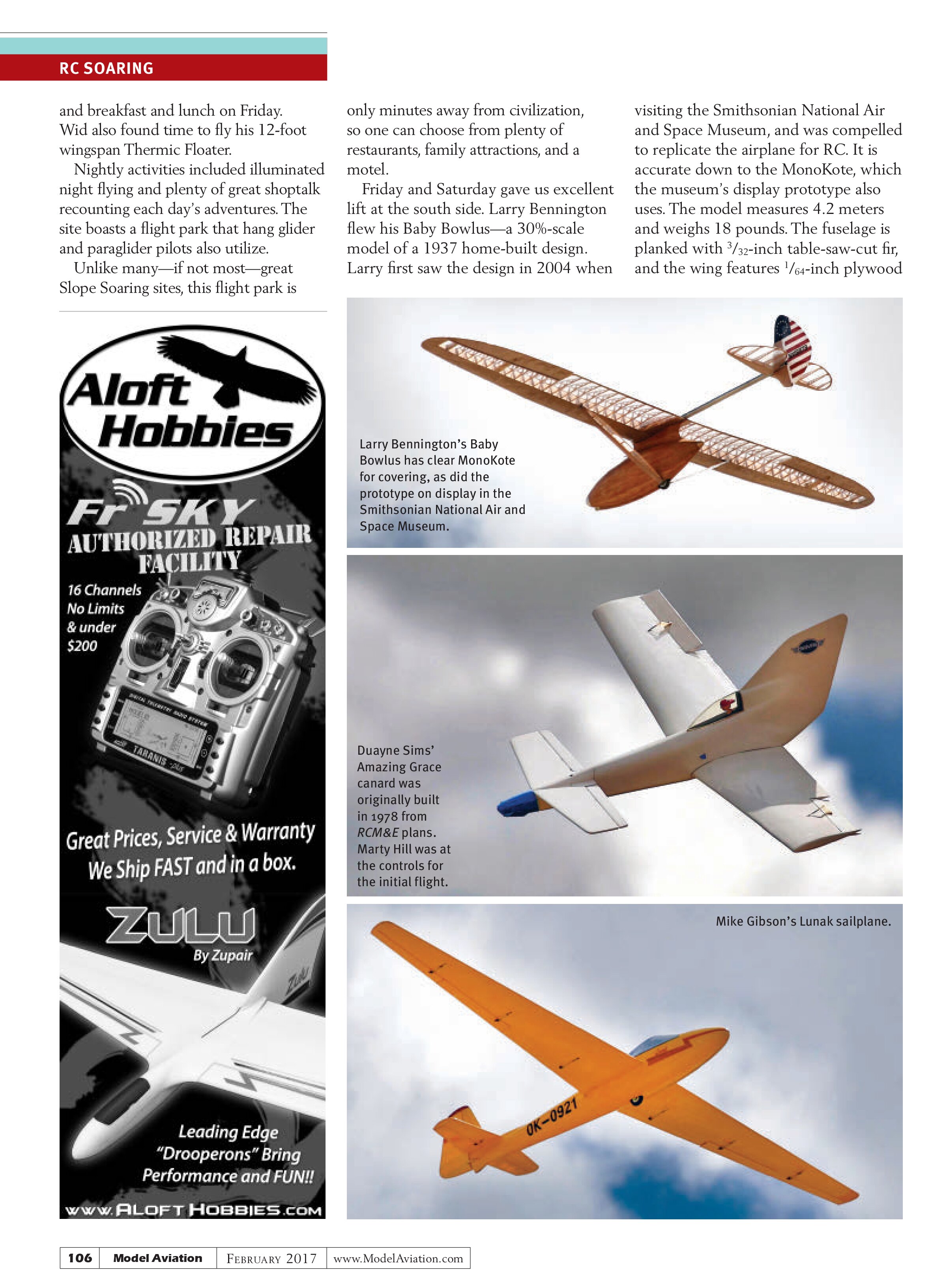
On Friday, September 2, 20 pilots met at the Grantsville salt flats for some aerotow fun. Tug services were provided by Tom Hoopes with his DA-100-powered Pegasus, and Mike Gibson with his DA-85-powered Pilatus Porter.
Notable flights were also made by Scott Hinkley and his ¹⁄₄-scale Aeronaut SHK and Olympia 2b, Norm Whittle and his ¹⁄₃-scale Cherokee RM, Lee Chaplin and his ¹⁄₃-scale Woodstock, George Blair and his ¹⁄₄-scale Ka8, and Dick Bean and his Discus 2c. Clyde Knecht had the longest flight at more than 45 minutes with his ASK 21.
Lyle Terry and Nick Scholes assisted several visitors with field repairs and bungee launches. Wid Tolman, at 87 years young, prepared dinner Thursday
and breakfast and lunch on Friday. Wid also found time to fly his 12-foot wingspan Thermic Floater.
Nightly activities included illuminated night flying and plenty of great shoptalk recounting each day’s adventures. The site boasts a flight park that hang glider and paraglider pilots also utilize.
Unlike many—if not most—great Slope Soaring sites, this flight park is
only minutes away from civilization, so one can choose from plenty of restaurants, family attractions, and a motel.
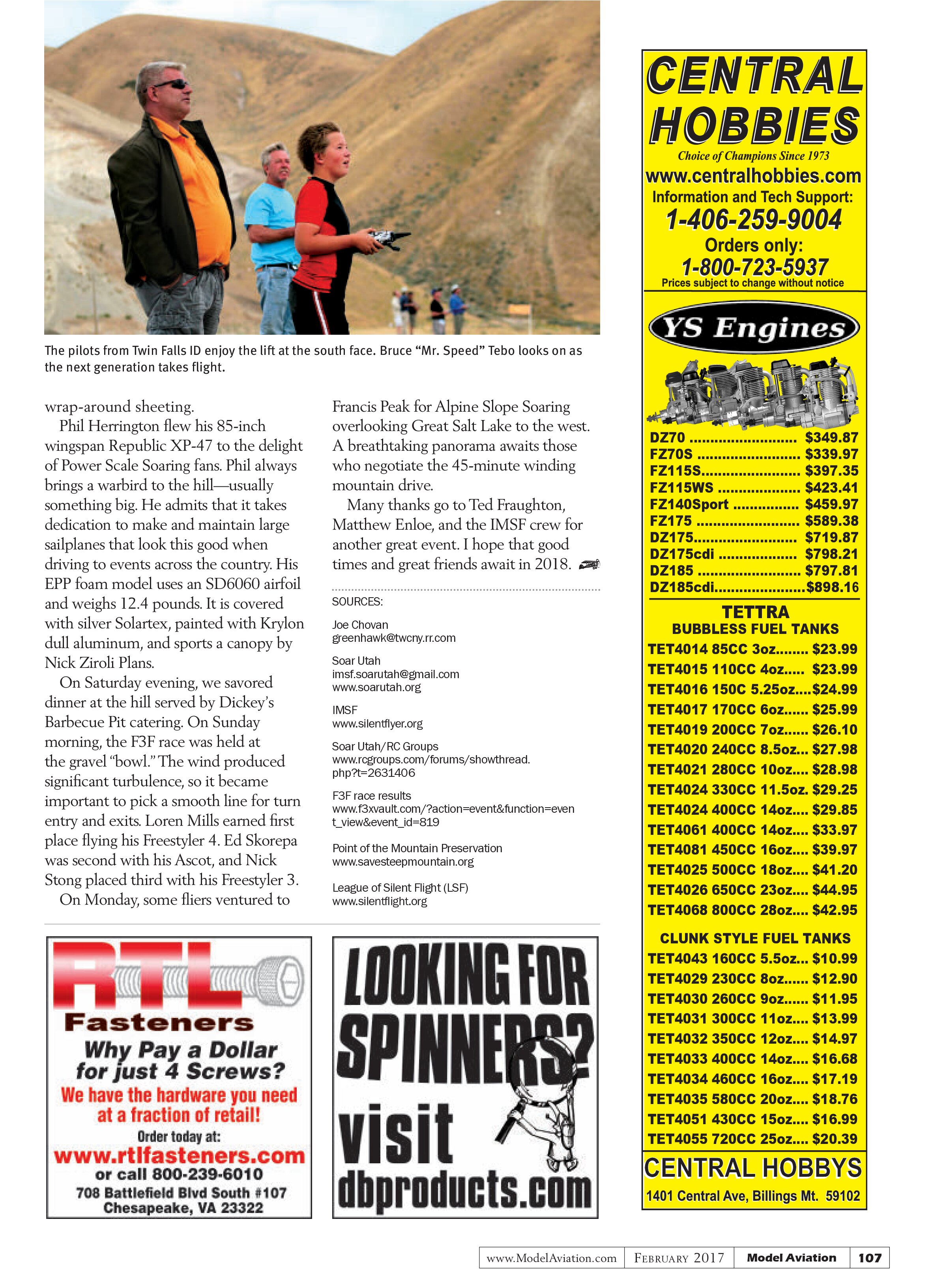
Friday and Saturday gave us excellent lift at the south side. Larry Bennington flew his Baby Bowlus—a 30%-scale model of a 1937 home-built design. Larry first saw the design in 2004 when
visiting the Smithsonian National Air and Space Museum, and was compelled to replicate the airplane for RC. It is accurate down to the MonoKote, which the museum’s display prototype also uses. The model measures 4.2 meters and weighs 18 pounds. The fuselage is planked with ³⁄₃₂-inch table-saw-cut fir, and the wing features ¹⁄₆₄-inch plywood


wrap-around sheeting.
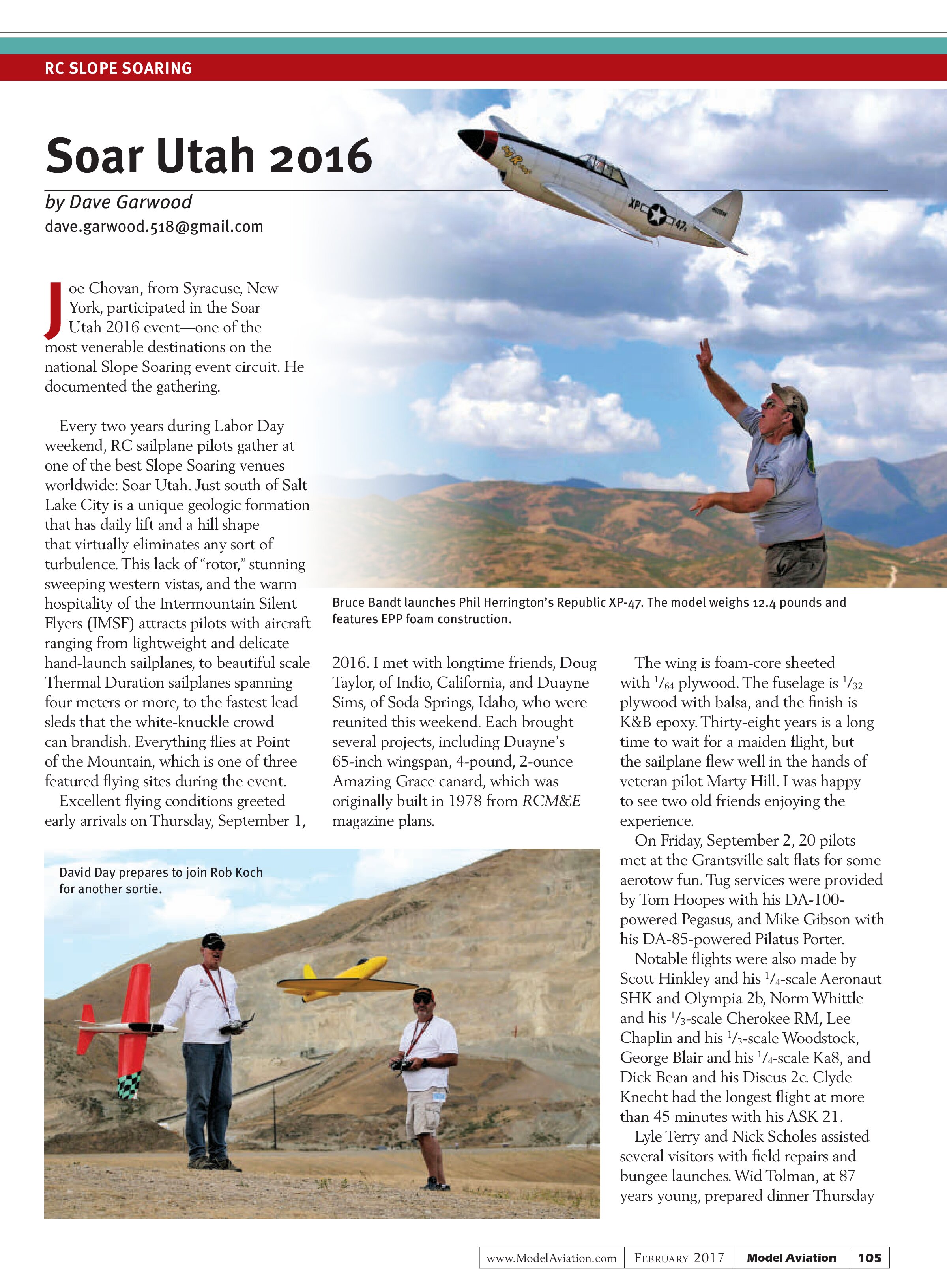
Phil Herrington flew his 85-inch wingspan Republic XP-47 to the delight of Power Scale Soaring fans. Phil always brings a warbird to the hill—usually something big. He admits that it takes dedication to make and maintain large sailplanes that look this good when driving to events across the country. His EPP foam model uses an SD6060 airfoil and weighs 12.4 pounds. It is covered with silver Solartex, painted with Krylon dull aluminum, and sports a canopy by Nick Ziroli Plans.
On Saturday evening, we savored dinner at the hill served by Dickey’s Barbecue Pit catering. On Sunday morning, the F3F race was held at the gravel “bowl.” The wind produced significant turbulence, so it became important to pick a smooth line for turn entry and exits. Loren Mills earned first place flying his Freestyler 4, Ed Skorepa was second with his Ascot, and Nick Stong placed third with his Freestyler 3.
On Monday, some fliers ventured to
Francis Peak for Alpine Slope Soaring overlooking Great Salt Lake to the west. A breathtaking panorama awaits those who negotiate the 45-minute winding mountain drive.
Many thanks go to Ted Fraughton, Matthew Enloe, and the IMSF crew for another great event. I hope that good times and great friends await in 2018.
SOURCES:
Joe Chovan
greenhawk@twcny.rr.com
Soar Utah
imsf.soarutah@gmail.com
www.soarutah.org
Soar Utah/RC Groups
www.rcgroups.com/forums/showthread.php?t=2631406
F3F race results
www.f3xvault.com/?action=event&function=event_view&event_id=819
Point of the Mountain Preservation
www.savesteepmountain.org
League of Silent Flight (LSF)
www.silentflight.org