Easy-to-build, FAC Nats-winning FF Scale model


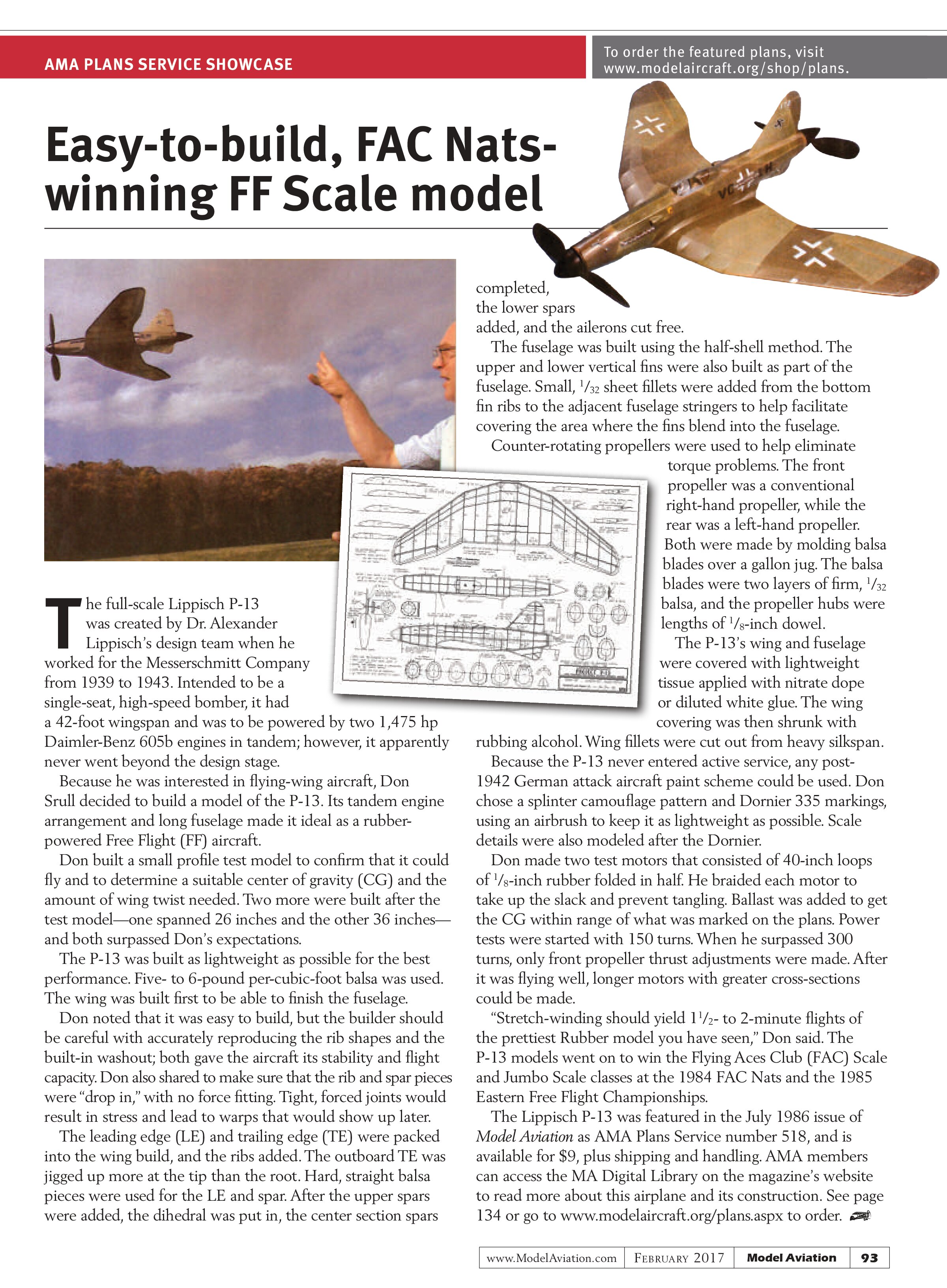
The full-scale Lippisch P-13 was created by Dr. Alexander Lippisch’s design team when he worked for the Messerschmitt Company from 1939 to 1943. Intended to be a single-seat, high-speed bomber, it had a 42-foot wingspan and was to be powered by two 1,475 hp Daimler-Benz 605b engines in tandem; however, it apparently never went beyond the design stage.
Because he was interested in flying-wing aircraft, Don Srull decided to build a model of the P-13. Its tandem engine arrangement and long fuselage made it ideal as a rubber-powered Free Flight (FF) aircraft.
Don built a small profile test model to confirm that it could fly and to determine a suitable center of gravity (CG) and the amount of wing twist needed. Two more were built after the test model—one spanned 26 inches and the other 36 inches—and both surpassed Don’s expectations.
The P-13 was built as lightweight as possible for the best performance. Five- to 6-pound per-cubic-foot balsa was used. The wing was built first to be able to finish the fuselage.
Don noted that it was easy to build, but the builder should be careful with accurately reproducing the rib shapes and the built-in washout; both gave the aircraft its stability and flight capacity. Don also shared to make sure that the rib and spar pieces were “drop in,” with no force fitting. Tight, forced joints would result in stress and lead to warps that would show up later.
The leading edge (LE) and trailing edge (TE) were packed into the wing build, and the ribs added. The outboard TE was jigged up more at the tip than the root. Hard, straight balsa pieces were used for the LE and spar. After the upper spars were added, the dihedral was put in, the center section spars completed, the lower spars added, and the ailerons cut free.

The fuselage was built using the half-shell method. The upper and lower vertical fins were also built as part of the fuselage. Small, 1/32 sheet fillets were added from the bottom fin ribs to the adjacent fuselage stringers to help facilitate covering the area where the fins blend into the fuselage.
Counter-rotating propellers were used to help eliminate torque problems. The front propeller was a conventional right-hand propeller, while the rear was a left-hand propeller. Both were made by molding balsa blades over a gallon jug. The balsa blades were two layers of firm, 1/32 balsa, and the propeller hubs were lengths of 1/8-inch dowel.
The P-13’s wing and fuselage were covered with lightweight tissue applied with nitrate dope or diluted white glue. The wing covering was then shrunk with rubbing alcohol. Wing fillets were cut out from heavy silkspan.
Because the P-13 never entered active service, any post-1942 German attack aircraft paint scheme could be used. Don chose a splinter camouflage pattern and Dornier 335 markings, using an airbrush to keep it as lightweight as possible. Scale details were also modeled after the Dornier.
Don made two test motors that consisted of 40-inch loops of 1/8-inch rubber folded in half. He braided each motor to take up the slack and prevent tangling. Ballast was added to get the CG within range of what was marked on the plans. Power tests were started with 150 turns. When he surpassed 300 turns, only front propeller thrust adjustments were made. After it was flying well, longer motors with greater cross-sections could be made.
“Stretch-winding should yield 1½- to 2-minute flights of the prettiest Rubber model you have seen,” Don said. The P-13 models went on to win the Flying Aces Club (FAC) Scale and Jumbo Scale classes at the 1984 FAC Nats and the 1985 Eastern Free Flight Championships.
The Lippisch P-13 was featured in the July 1986 issue of Model Aviation as AMA Plans Service number 518, and is available for $9, plus shipping and handling. AMA members can access the MA Digital Library on the magazine’s website to read more about this airplane and its construction. See page 134 or go to www.modelaircraft.org/plans.aspx to order.