SAM Champs
Bob Angel
samrcflier@verizon.net
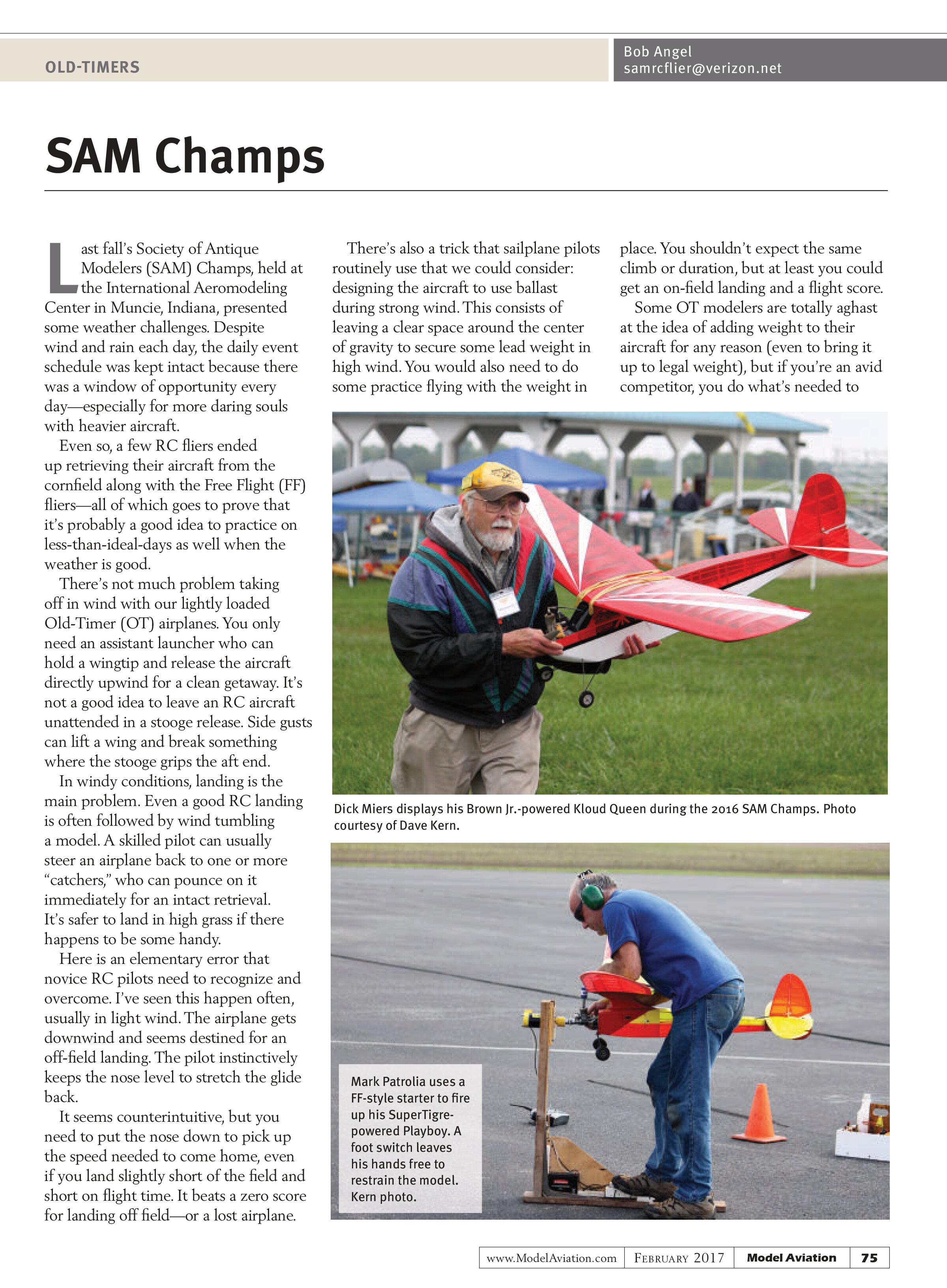
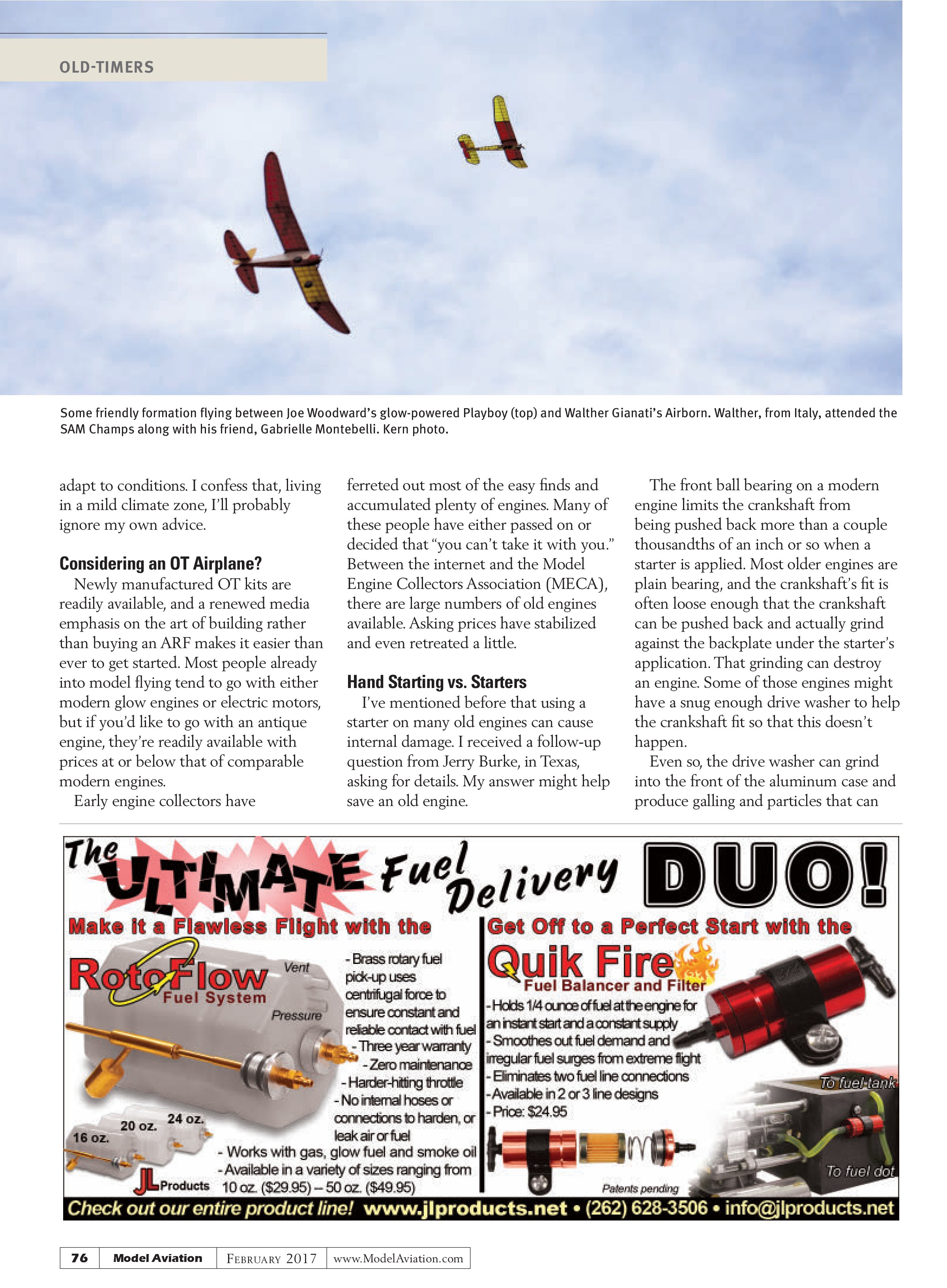
Last fall’s Society of Antique Modelers (SAM) Champs, held at the International Aeromodeling Center in Muncie, Indiana, presented some weather challenges. Despite wind and rain each day, the daily event schedule was kept intact because there was a window of opportunity every day—especially for more daring souls with heavier aircraft.
Even so, a few RC fliers ended up retrieving their aircraft from the cornfield along with the Free Flight (FF) fliers—all of which goes to prove that it’s probably a good idea to practice on less-than-ideal-days as well when the weather is good.
There’s not much problem taking off in wind with our lightly loaded Old-Timer (OT) airplanes. You only need an assistant launcher who can hold a wingtip and release the aircraft directly upwind for a clean getaway. It’s not a good idea to leave an RC aircraft unattended in a stooge release. Side gusts can lift a wing and break something where the stooge grips the aft end.
In windy conditions, landing is the main problem. Even a good RC landing is often followed by wind tumbling a model. A skilled pilot can usually steer an airplane back to one or more “catchers,” who can pounce on it immediately for an intact retrieval. It’s safer to land in high grass if there happens to be some handy.
Here is an elementary error that novice RC pilots need to recognize and overcome. I’ve seen this happen often, usually in light wind. The airplane gets downwind and seems destined for an off-field landing. The pilot instinctively keeps the nose level to stretch the glide back.
It seems counterintuitive, but you need to put the nose down to pick up the speed needed to come home, even if you land slightly short of the field and short on flight time. It beats a zero score for landing off field—or a lost airplane.
There’s also a trick that sailplane pilots routinely use that we could consider: designing the aircraft to use ballast during strong wind. This consists of leaving a clear space around the center of gravity to secure some lead weight in high wind. You would also need to do some practice flying with the weight in
place. You shouldn’t expect the same climb or duration, but at least you could get an on-field landing and a flight score. Some OT modelers are totally aghast at the idea of adding weight to their aircraft for any reason (even to bring it up to legal weight), but if you’re an avid competitor, you do what’s needed to

It seems counterintuitive, but you need to put the nose down to pick up the speed needed to come home, even if you land slightly short of the field and short on flight time. It beats a zero score for landing off field—or a lost airplane.


adapt to conditions. I confess that, living in a mild climate zone, I’ll probably ignore my own advice.
Considering an OT Airplane?
Newly manufactured OT kits are readily available, and a renewed media emphasis on the art of building rather than buying an ARF makes it easier than ever to get started. Most people already into model flying tend to go with either modern glow engines or electric motors, but if you’d like to go with an antique engine, they’re readily available with prices at or below that of comparable modern engines.
Early engine collectors have ferreted out most of the easy finds and accumulated plenty of engines. Many of these people have either passed on or decided that “you can’t take it with you.” Between the internet and the Model Engine Collectors Association (MECA), there are large numbers of old engines available. Asking prices have stabilized and even retreated a little.
Hand Starting vs. Starters
I’ve mentioned before that using a starter on many old engines can cause internal damage. I received a follow-up question from Jerry Burke, in Texas, asking for details. My answer might help save an old engine.
The front ball bearing on a modern engine limits the crankshaft from being pushed back more than a couple thousandths of an inch or so when a starter is applied. Most older engines are plain bearing, and the crankshaft’s fit is often loose enough that the crankshaft can be pushed back and actually grind against the backplate under the starter’s application. That grinding can destroy an engine. Some of those engines might have a snug enough drive washer to help the crankshaft fit so that this doesn’t happen.
Even so, the drive washer can grind into the front of the aluminum case and produce galling and particles that can migrate into other parts of the engine.
A thin, smooth, stainless-steel shim behind the drive washer can reduce or eliminate that galling, but finding a shim of a suitable size is difficult if the engine doesn’t already have one.
EuroChamps 2017
The annual EuroChamps 2017 event is scheduled for June 18-23 at the Dubnica Glider Airport in Dubnica nad Váhom, Slovakia. The event draws contestants from a number of countries. It moves to various locations each year, and is always a well-managed and supported affair, with the countries themselves even competing to produce a great experience.
The 2.4 GHz radios have simplified the problems of different frequencies in different countries. Unfortunately, there is usually no FF offered at the EuroChamps because of space limitations, and this year is no exception. See the “Sources” list for contact information.
RC Transmitter Preservation
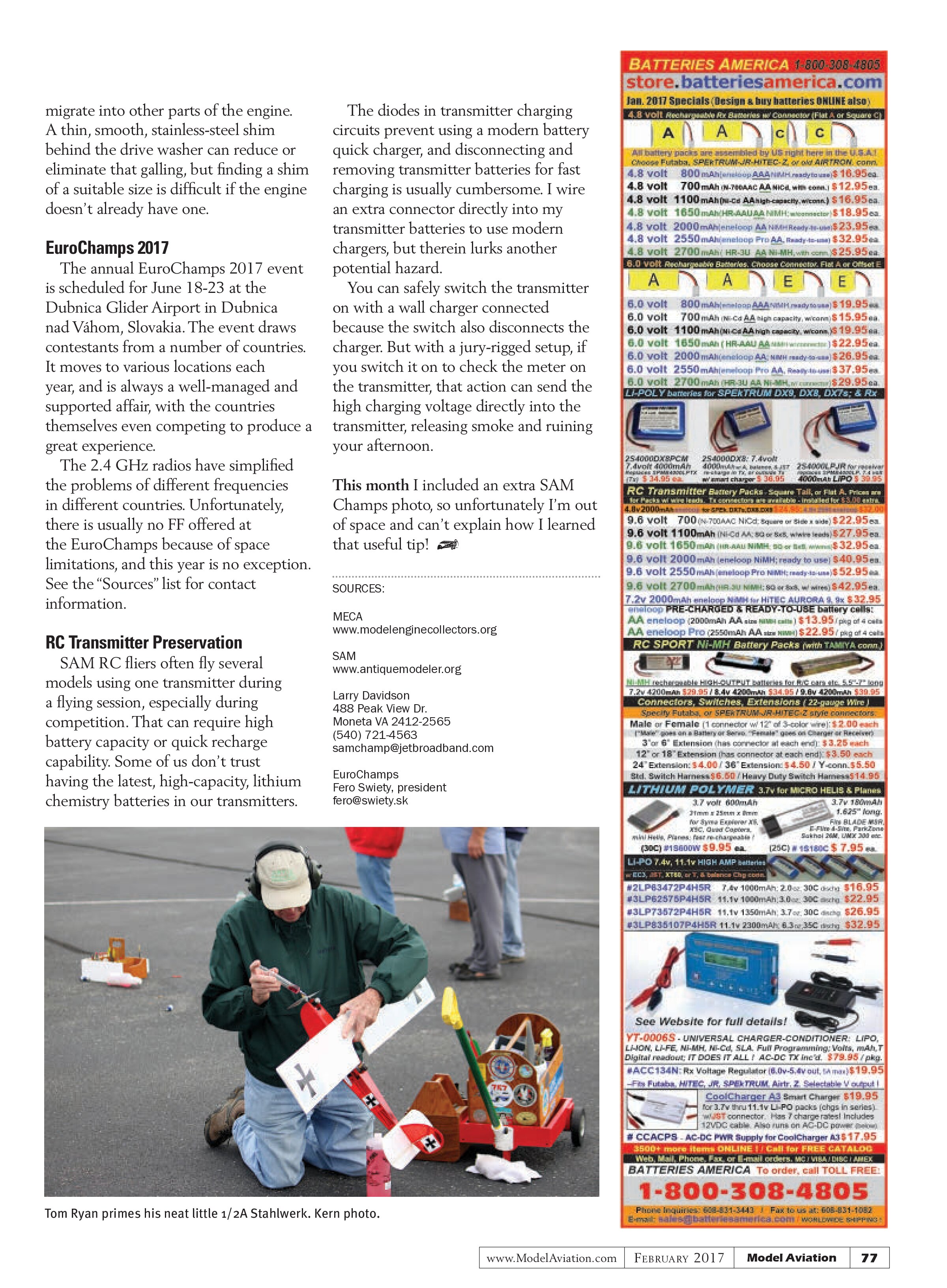
SAM RC fliers often fly several models using one transmitter during a flying session, especially during competition. That can require high battery capacity or quick recharge capability. Some of us don’t trust having the latest, high-capacity, lithium chemistry batteries in our transmitters.
The diodes in transmitter charging circuits prevent using a modern battery quick charger, and disconnecting and removing transmitter batteries for fast charging is usually cumbersome. I wire an extra connector directly into my transmitter batteries to use modern chargers, but therein lurks another potential hazard.
You can safely switch the transmitter on with a wall charger connected because the switch also disconnects the charger. But with a jury-rigged setup, if you switch it on to check the meter on the transmitter, that action can send the high charging voltage directly into the transmitter, releasing smoke and ruining your afternoon.
This month I included an extra SAM Champs photo, so unfortunately I’m out of space and can’t explain how I learned that useful tip!
SOURCES:
MECA
www.modelenginecollectors.org
Larry Davidson
488 Peak View Dr.
Moneta VA 24121-2565
(540) 721-4563
samchamp@jetbroadband.com
EuroChamps
Fero Swiety, president
fero@swiety.sk