Radio Controlled Drag Racing League
Bob Aberle
baberle@optonline.net
Q638: I’ve flown RC aircraft for many years. Throughout that time, I have also explored other types of RC operation, such as boats and cars.
I recently heard about a new effort in the RC car world. I participated in car racing both at tracks and off-road events, but lately I’ve heard about something new called the Radio Controlled Drag Racing League (RCDRL). Can you provide some background information about this new league, such as what it does and where is it located?
A638: I don’t know all of the details, but I can give you some information that will allow you to understand what RCDRL is all about. I have to thank my longtime friend and noted RC pilot, Bob Wilder, of Colleyville, Texas, for passing on this information.
It appears that the RCDRL got its start in the Dallas area. Throughout the last three years, RCDRL activities have also been established in areas of California and Louisiana. One thing I quickly learned is that the league is highly organized. I’ve listed the website for the Texas activity in the “Sources” section of this column. When you enter the site, go to “Membership.” Under that category, a drop-down menu takes you to the current RCDRL rule book. It is a 10-page PDF file.
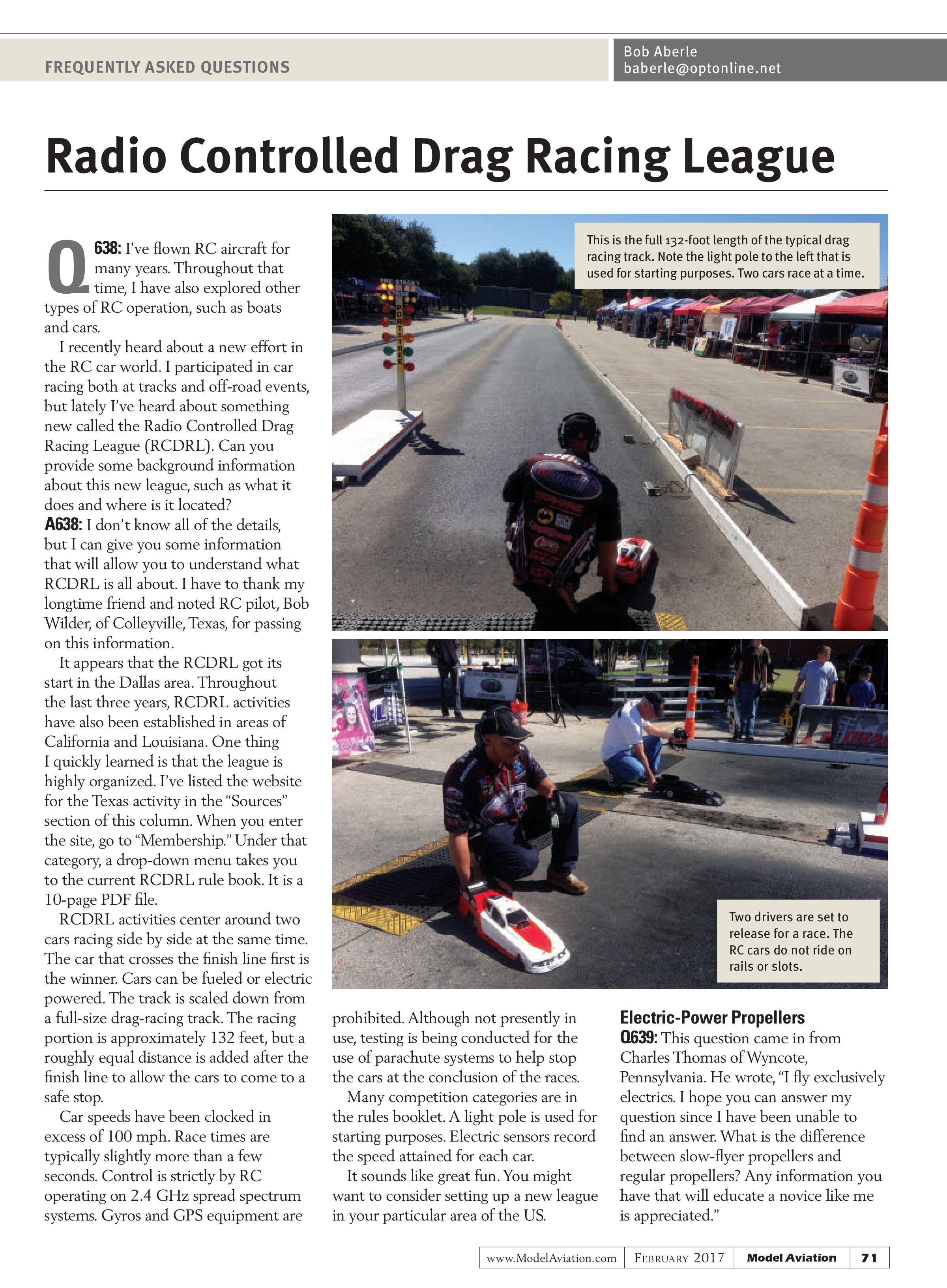
RCDRL activities center around two cars racing side by side at the same time. The car that crosses the finish line first is the winner. Cars can be fueled or electric powered. The track is scaled down from a full-size drag-racing track. The racing portion is approximately 132 feet, but a roughly equal distance is added after the finish line to allow the cars to come to a safe stop.
Car speeds have been clocked in excess of 100 mph. Race times are typically slightly more than a few seconds. Control is strictly by RC operating on 2.4 GHz spread spectrum systems. Gyros and GPS equipment are prohibited. Although not presently in use, testing is being conducted for the use of parachute systems to help stop the cars at the conclusion of the races.
Many competition categories are in the rules booklet. A light pole is used for starting purposes. Electric sensors record the speed attained for each car.
It sounds like great fun. You might want to consider setting up a new league in your particular area of the US.


Electric-Power Propellers
Q639: This question came in from Charles Thomas of Wyncote, Pennsylvania. He wrote, “I fly exclusively electrics. I hope you can answer my question since I have been unable to find an answer. What is the difference between slow-flyer propellers and regular propellers? Any information you have that will educate a novice like me is appreciated.”
A639: I asked noted electric expert, Tom Hunt, to answer this question.
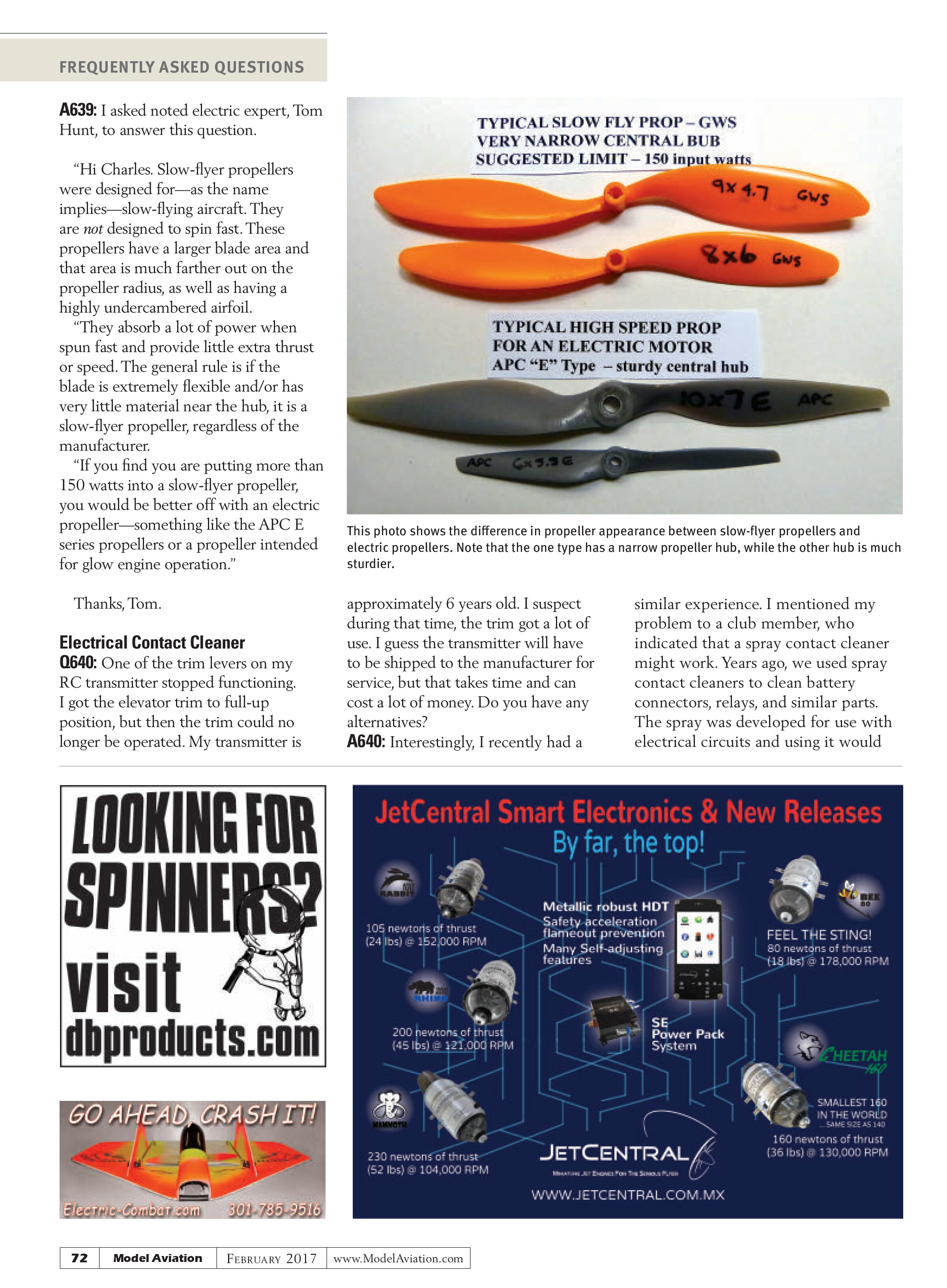
“Hi Charles. Slow-flyer propellers were designed for—as the name implies—slow-flying aircraft. They are not designed to spin fast. These propellers have a larger blade area and that area is much farther out on the propeller radius, as well as having a highly undercambered airfoil.
“They absorb a lot of power when spun fast and provide little extra thrust or speed. The general rule is if the blade is extremely flexible and/or has very little material near the hub, it is a slow-flyer propeller, regardless of the manufacturer.
“If you find you are putting more than 150 watts into a slow-flyer propeller, you would be better off with an electric propeller—something like the APC E series propellers or a propeller intended for glow engine operation.”

Thanks, Tom.
Electrical Contact Cleaner
Q640: One of the trim levers on my RC transmitter stopped functioning. I got the elevator trim to full-up position, but then the trim could no longer be operated. My transmitter is approximately 6 years old. I suspect during that time, the trim got a lot of use. I guess the transmitter will have to be shipped to the manufacturer for service, but that takes time and can cost a lot of money. Do you have any alternatives?
A640: Interestingly, I recently had a similar experience. I mentioned my problem to a club member, who indicated that a spray contact cleaner might work. Years ago, we used spray contact cleaners to clean battery connectors, relays, and similar parts. The spray was developed for use with electrical circuits and using it would not cause a short circuit.


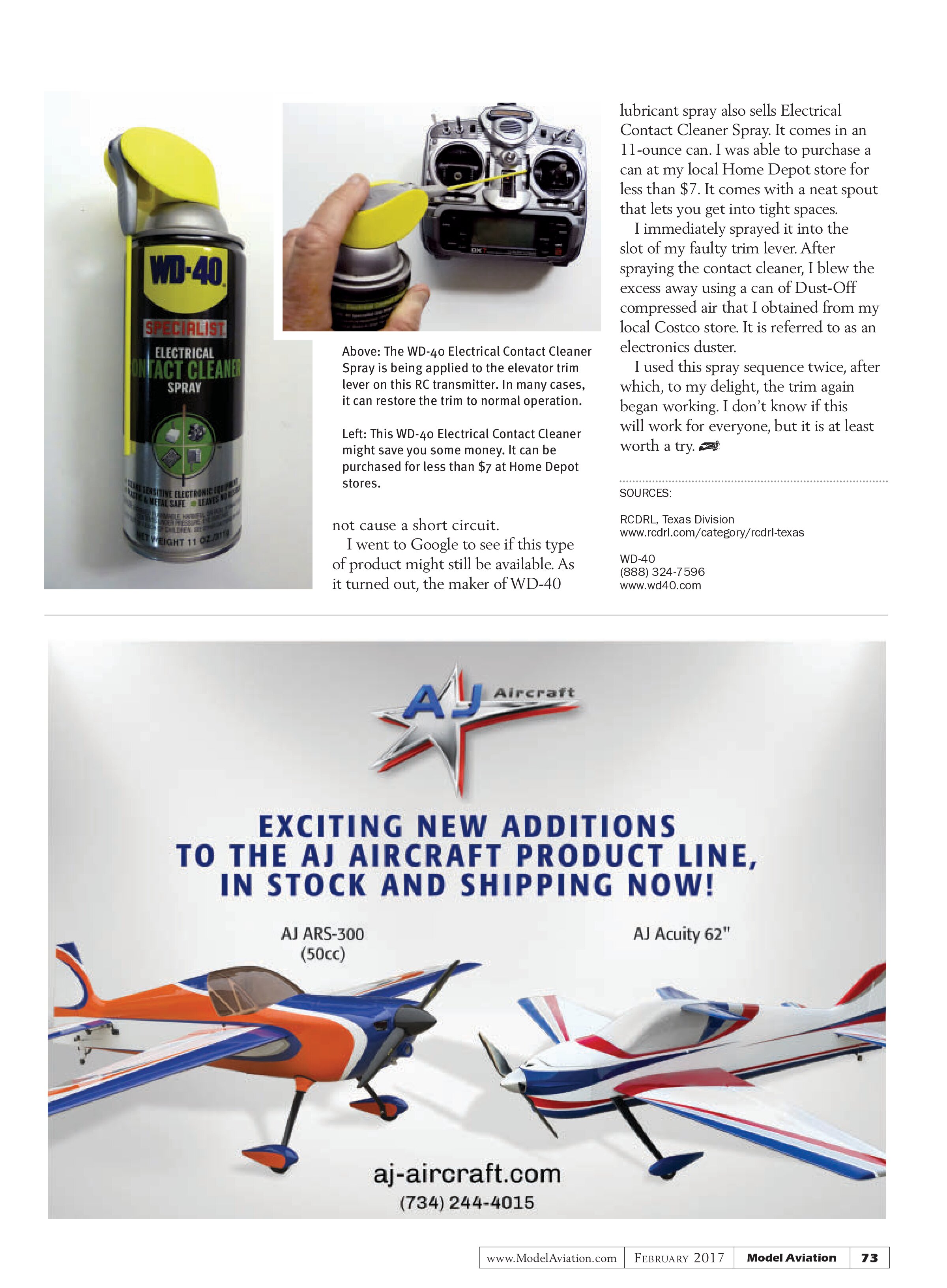
Above: The WD-40 Electrical Contact Cleaner Spray is being applied to the elevator trim lever on this RC transmitter. In many cases, it can restore the trim to normal operation.
Left: This WD-40 Electrical Contact Cleaner might save you some money. It can be purchased for less than $7 at Home Depot stores.
I went to Google to see if this type of product might still be available. As it turned out, the maker of WD-40 lubricant spray also sells Electrical Contact Cleaner Spray. It comes in an 11-ounce can. I was able to purchase a can at my local Home Depot store for less than $7. It comes with a neat spout that lets you get into tight spaces.
I immediately sprayed it into the slot of my faulty trim lever. After spraying the contact cleaner, I blew the excess away using a can of Dust-Off compressed air that I obtained from my local Costco store. It is referred to as an electronics duster.
I used this spray sequence twice, after which, to my delight, the trim again began working. I don’t know if this will work for everyone, but it is at least worth a try.
SOURCES:
RCDRL, Texas Division
www.rcdrl.com/category/rcdrl-texas
WD-40
(888) 324-7596
www.wd40.com