FOCAL POINT
FJ-1 Fury

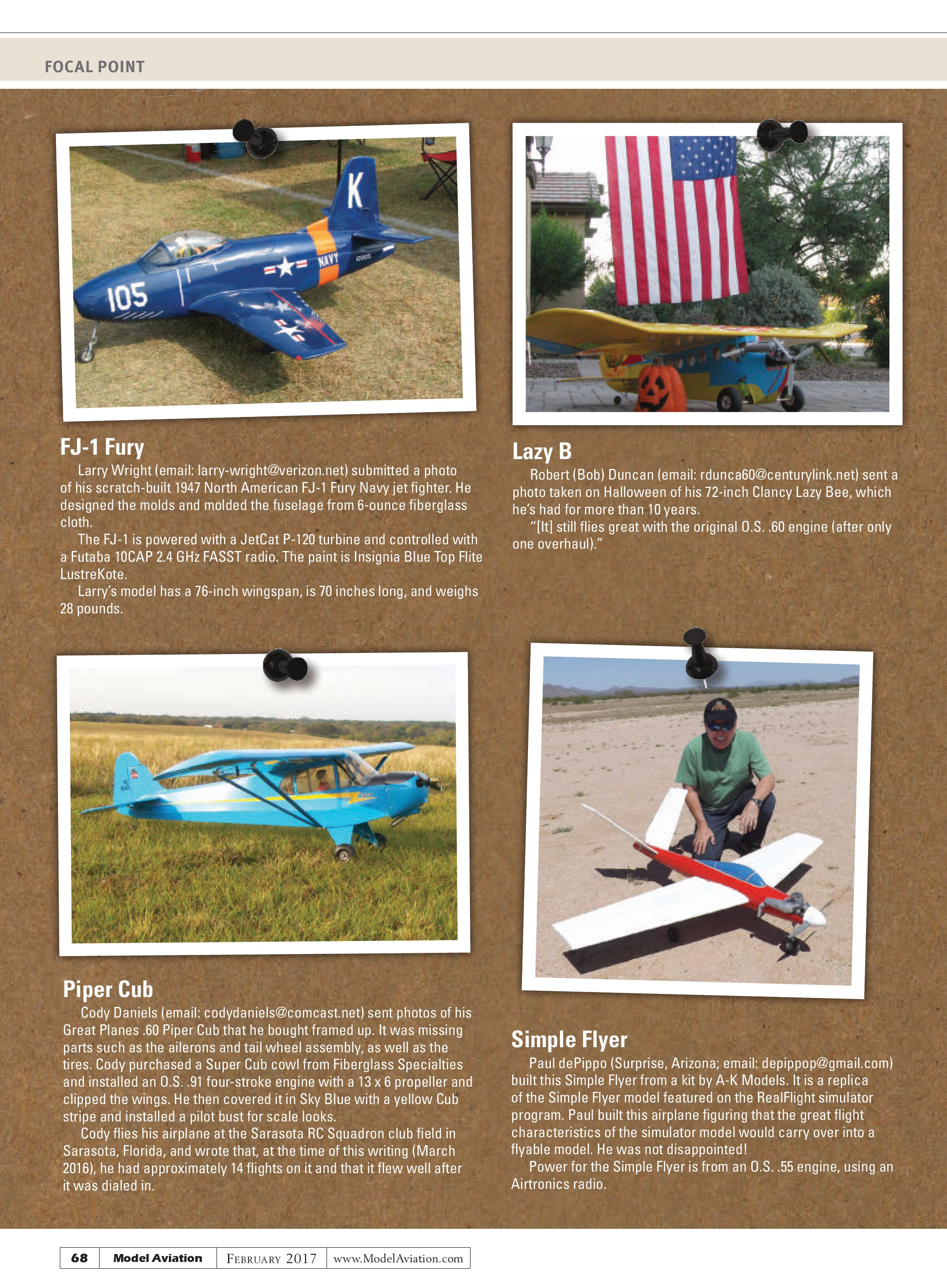
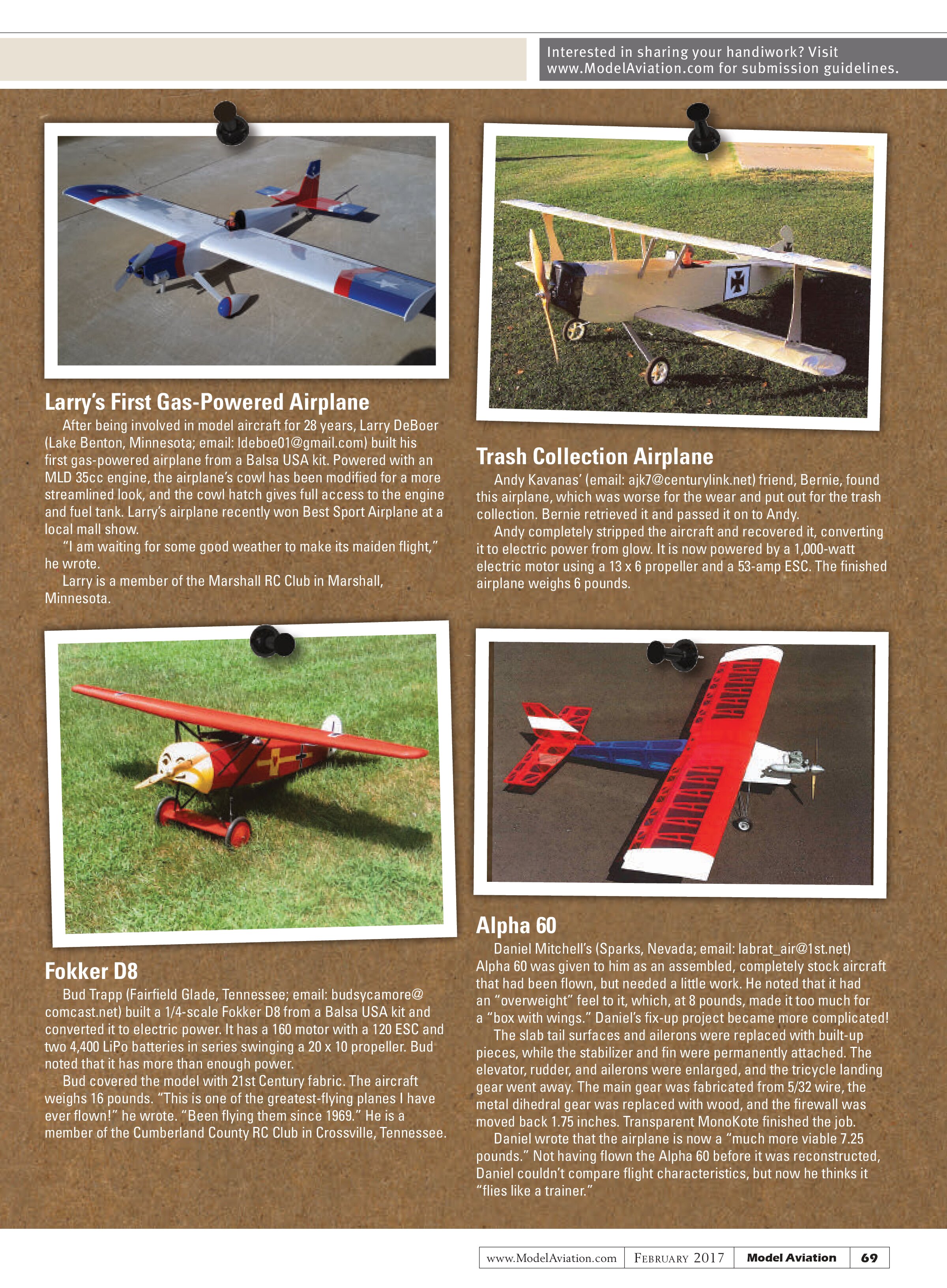
Larry Wright (email: larry-wright@verizon.net) submitted a photo of his scratch-built 1947 North American FJ-1 Fury Navy jet fighter. He designed the molds and molded the fuselage from 6-ounce fiberglass cloth.
The FJ-1 is powered with a JetCat P-120 turbine and controlled with a Futaba 10CAP 2.4 GHz FASST radio. The paint is Insignia Blue Top Flite LustreKote.
Larry’s model has a 76-inch wingspan, is 70 inches long, and weighs 28 pounds.
Piper Cub

Cody Daniels (email: codydaniels@comcast.net) sent photos of his Great Planes .60 Piper Cub that he bought framed up. It was missing parts such as the ailerons and tail wheel assembly, as well as the tires. Cody purchased a Super Cub cowl from Fiberglass Specialties and installed an O.S. .91 four-stroke engine with a 13 x 6 propeller and clipped the wings. He then covered it in Sky Blue with a yellow Cub stripe and installed a pilot bust for scale looks.
Cody flies his airplane at the Sarasota RC Squadron club field in Sarasota, Florida, and wrote that, at the time of this writing (March 2016), he had approximately 14 flights on it and that it flew well after it was dialed in.
Lazy B

Robert (Bob) Duncan (email: rdunca60@centurylink.net) sent a photo taken on Halloween of his 72-inch Clancy Lazy Bee, which he’s had for more than 10 years.
“[It] still flies great with the original O.S. .60 engine (after only one overhaul).”
Simple Flyer

Paul dePippo (Surprise, Arizona; email: depippon@gmail.com) built this Simple Flyer from a kit by A-K Models. It is a replica of the Simple Flyer model featured on the RealFlight simulator program. Paul built this airplane figuring that the great flight characteristics of the simulator model would carry over into a flyable model. He was not disappointed!
Power for the Simple Flyer is from an O.S. .55 engine, using an Airtronics radio.
Larry’s First Gas-Powered Airplane

After being involved in model aircraft for 28 years, Larry DeBoer (Lake Benton, Minnesota; email: ldeboe01@gmail.com) built his first gas-powered airplane from a Balsa USA kit. Powered with an MLD 35cc engine, the airplane’s cowl has been modified for a more streamlined look, and the cowl hatch gives full access to the engine and fuel tank. Larry’s airplane recently won Best Sport Airplane at a local mall show.
“I am waiting for some good weather to make its maiden flight,” he wrote.
Larry is a member of the Marshall RC Club in Marshall, Minnesota.
Fokker D8

Bud Trapp (Fairfield Glade, Tennessee; email: budsycamore@comcast.net) built a 1/4-scale Fokker D8 from a Balsa USA kit and converted it to electric power. It has a 160 motor with a 120 ESC and two 4,400 LiPo batteries in series swinging a 20 x 10 propeller. Bud noted that it has more than enough power.
Bud covered the model with 21st Century fabric. The aircraft weighs 16 pounds. “This is one of the greatest-flying planes I have ever flown!” he wrote. “Been flying them since 1969.” He is a member of the Cumberland County RC Club in Crossville, Tennessee.
Trash Collection Airplane

Andy Kavanas’ (email: ajk7@centurylink.net) friend, Bernie, found this airplane, which was worse for the wear and put out for the trash collection. Bernie retrieved it and passed it on to Andy.
Andy completely stripped the aircraft and recovered it, converting it to electric power from glow. It is now powered by a 1,000-watt electric motor using a 13 x 6 propeller and a 53-amp ESC. The finished airplane weighs 6 pounds.
Alpha 60

Daniel Mitchell’s (Sparks, Nevada; email: labrat_air@1st.net) Alpha 60 was given to him as an assembled, completely stock aircraft that had been flown, but needed a little work. He noted that it had an “overweight” feel to it, which, at 8 pounds, made it too much for a “box with wings.” Daniel’s fix-up project became more complicated!
The slab tail surfaces and ailerons were replaced with built-up pieces, while the stabilizer and fin were permanently attached. The elevator, rudder, and ailerons were enlarged, and the tricycle landing gear went away. The main gear was fabricated from 5/32 wire, the metal dihedral gear was replaced with wood, and the firewall was moved back 1.75 inches. Transparent MonoKote finished the job.
Daniel wrote that the airplane is now a “much more viable 7.25 pounds.” Not having flown the Alpha 60 before it was reconstructed, Daniel couldn’t compare flight characteristics, but now he thinks it “flies like a trainer.”