No slowdown for proposed UAS legislation
Most local and state governments traditionally slow down this time of year, yet proposed legislation regarding UAS has not eased. It is difficult to tally how many locally proposed bills, policies, and ordinances were introduced in 2016, but it is safe to assume that the number is easily in the thousands.
In addition to the 300-plus state UAS bills proposed by elected legislators in 2016, other state-level governing bodies such as tax commissions, department of transportation offices, and natural resources agencies also introduced UAS-related policies. There are more than 89,000 city, county, and local governments in the US. As many members can testify, a significant number of these local-level governing bodies also proposed UAS bills.
Although 2016 was extremely problematic with UAS legislation, we expect 2017 to be as intense. Despite the fact that cities and states might have good intentions when drafting UAS legislation, many of these bills run afoul of federal authority and are unnecessary and harmful to our community’s safe, responsible pilots. We are increasing our efforts to address these bills, ensuring that our members and the hobby can thrive free from unnecessary and overly burdensome regulations.
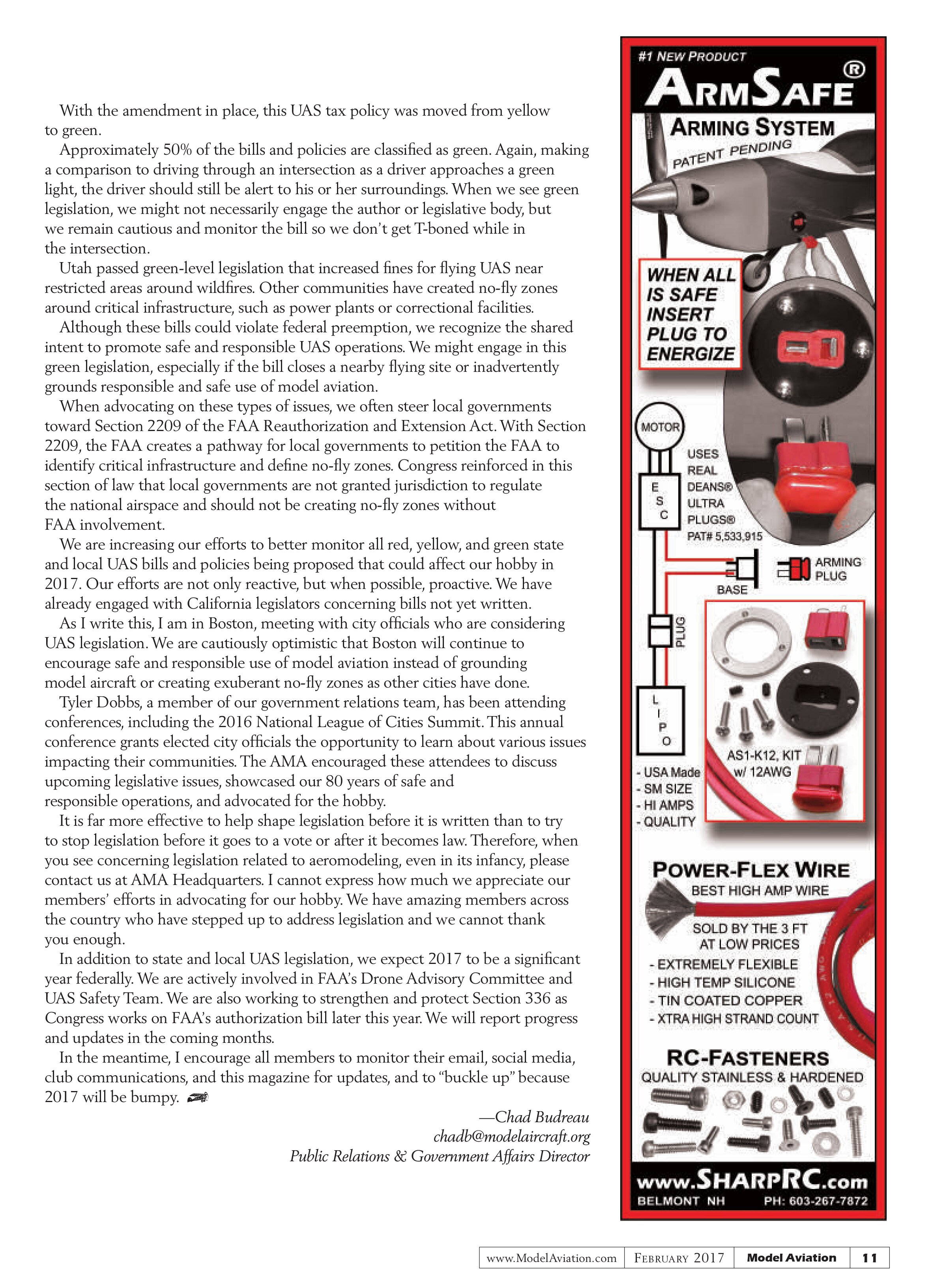
When we discover a new UAS bill or policy, we classify it into one of three categories: “red,” “yellow,” “green”—similar to a traffic light. Roughly 20% of the bills we see are in the red category and need to be stopped. These problematic bills are harmful to our hobby. For example, Chicago has an ordinance that charges a $50 registration fee per model and essentially grounds the entire city as a no-fly zone.

Other communities, such as Jefferson, Wisconsin, are trying to make it illegal for children to enjoy the hobby of model aviation. Although the Chicago ordinance has not yet been revoked, I am happy to share that, thanks to the help of local AMA members, the Jefferson “red” bill is unlikely to pass.
I recently spoke with the city attorney of Orlando, Florida. Orlando is considering regulations on our hobby through ordinance 2016-87. Although the city has genuine concerns about protecting its citizens, the proposed ordinance will inadvertently penalize our community’s safe operators by creating no-fly zones and increasing registration requirements, even though our members are already registered through the AMA and FAA. The bill could also restrict UAS use in the classroom.
As this report was being written, Orlando was amending its ordinance to reflect AMA’s concerns. The ordinance could still run afoul of federal authority, but early revisions seem less problematic, which could upgrade the bill’s category from red to yellow.
Approximately 30% of the bills we see are in the yellow category. Yellow does not mean we should allow a bill to coast into law.
When an automobile driver approaches an intersection with a yellow light, the operator needs to either stop or practice additional caution. Most yellow bills might not necessarily ground model aircraft, but could add unnecessary restrictions such as limiting operations to daylight hours or mandating additional registration requirements.
A recent example of a yellow-level action was by the Nevada Tax Commission. The commission was considering a tax on all model aircraft weighing 55 pounds or less. This tax didn’t necessarily ground model aircraft, but was still problematic enough to compel us to engage.
We reached out directly to the Nevada Tax Commission, advocating against the tax. We also mobilized our members to write to the commission and attend the commissioners’ meeting. I am happy to report the commissioners added an amendment exempting hobbyists from this Nevada UAS tax. The following statement was sent to AMA by the Nevada Department of Taxation regarding the proposed UAS tax:
“Recently we became aware of the concerns of the Academy of Model Aeronautics regarding the proposed regulation, particularly whether the regulation is intended to apply to unmanned aircraft systems (UAS) owned by hobbyists. . . . the Department has submitted a proposed amendment to the regulation which clearly states that the term ‘aircraft’ subject to the regulation does not include ‘small unmanned aircraft systems qualifying as exempt recreational equipment pursuant to NRS 361.069(4)(a)(7).’”
With the amendment in place, this UAS tax policy was moved from yellow to green.
Approximately 50% of the bills and policies are classified as green. Again, making a comparison to driving through an intersection as a driver approaches a green light, the driver should still be alert to his or her surroundings. When we see green legislation, we might not necessarily engage the author or legislative body, but we remain cautious and monitor the bill so we don’t get T-boned while in the intersection.
Utah passed green-level legislation that increased fines for flying UAS near restricted areas around wildfires. Other communities have created no-fly zones around critical infrastructure, such as power plants or correctional facilities.
Although these bills could violate federal preemption, we recognize the shared intent to promote safe and responsible UAS operations. We might engage in this green legislation, especially if the bill closes a nearby flying site or inadvertently grounds responsible and safe use of model aviation.
When advocating on these types of issues, we often steer local governments toward Section 2209 of the FAA Reauthorization and Extension Act. With Section 2209, the FAA creates a pathway for local governments to petition the FAA to identify critical infrastructure and define no-fly zones. Congress reinforced in this section of law that local governments are not granted jurisdiction to regulate the national airspace and should not be creating no-fly zones without FAA involvement.
We are increasing our efforts to better monitor all red, yellow, and green state and local UAS bills and policies being proposed that could affect our hobby in 2017. Our efforts are not only reactive, but when possible, proactive. We have already engaged with California legislators concerning bills not yet written.
As I write this, I am in Boston, meeting with city officials who are considering UAS legislation. We are cautiously optimistic that Boston will continue to encourage safe and responsible use of model aviation instead of grounding model aircraft or creating exuberant no-fly zones as other cities have done.
Tyler Dobbs, a member of our government relations team, has been attending conferences, including the 2016 National League of Cities Summit. This annual conference grants elected city officials the opportunity to learn about various issues impacting their communities. The AMA encouraged these attendees to discuss upcoming legislative issues, showcased our 80 years of safe and responsible operations, and advocated for the hobby.
It is far more effective to help shape legislation before it is written than to try to stop legislation before it goes to a vote or after it becomes law. Therefore, when you see concerning legislation related to aeromodeling, even in its infancy, please contact us at AMA Headquarters. I cannot express how much we appreciate our members’ efforts in advocating for our hobby. We have amazing members across the country who have stepped up to address legislation and we cannot thank you enough.
In addition to state and local UAS legislation, we expect 2017 to be a significant year federally. We are actively involved in FAA’s Drone Advisory Committee and UAS Safety Team. We are also working to strengthen and protect Section 336 as Congress works on FAA’s authorization bill later this year. We will report progress and updates in the coming months.
In the meantime, I encourage all members to monitor their email, social media, club communications, and this magazine for updates, and to “buckle up” because 2017 will be bumpy.
—Chad Budreau
chadb@modelaircraft.org
Public Relations & Government Affairs Director