RC in the 1950s
Bob Noll
As I mentioned in my first column, I got into RC in 1953 when I was still in high school. The 1950s were a time for experimenters. Many who got into the hobby at that time were amateur radio operators. There was a need to share information among those who had the talent to do the experimenting, so a technical newsletter was born.
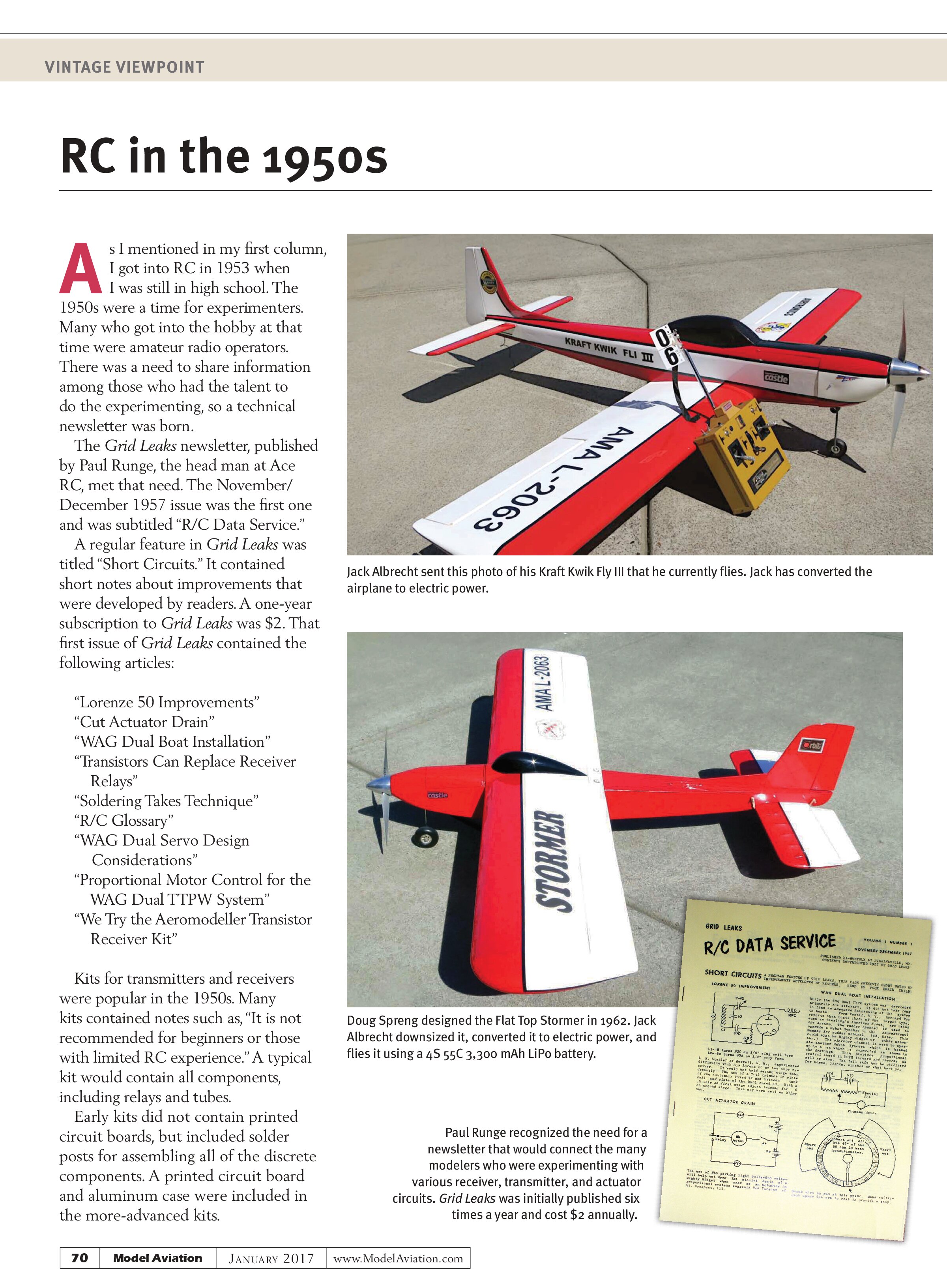
The Grid Leaks newsletter, published by Paul Runge, the head man at Ace RC, met that need. The November/December 1957 issue was the first one and was subtitled “R/C Data Service.”
A regular feature in Grid Leaks was titled “Short Circuits.” It contained short notes about improvements that were developed by readers. A one-year subscription to Grid Leaks was $2. That first issue of Grid Leaks contained the following articles:
- “Lorenze 50 Improvements”
- “Cut Actuator Drain”
- “WAG Dual Boat Installation”
- “Transistors Can Replace Receiver Relays”
- “Soldering Takes Technique”
- “R/C Glossary”
- “WAG Dual Servo Design Considerations”
- “Proportional Motor Control for the WAG Dual TTPW System”
- “We Try the Aeromodeller Transistor Receiver Kit”
Kits for transmitters and receivers were popular in the 1950s. Many kits contained notes such as, “It is not recommended for beginners or those with limited RC experience.” A typical kit would contain all components, including relays and tubes.
Early kits did not contain printed circuit boards, but included solder posts for assembling all of the discrete components. A printed circuit board and aluminum case were included in the more-advanced kits.


Techniques for minimizing the need to push a control button to activate escapements became popular in the late 1950s. Gadgets such as the Code-A-Matic by Aristo-Craft sold for $10.95 and plugged into a single-channel transmitter. The Code-A-Matic contained a trick mechanism so that movement of the control stick to any of the four positions would automatically send the correct number of switch closures to the transmitter. No battery was needed for the Code-A-Matic.
Another keying device came along that was built around a clock motor and encased in a blue aluminum box. I can’t read the make on the one I have, but it works by sending the correct number of switch closures when the stick is moved to any of the four positions. A button is included to operate the engine escapement. Does anyone know who made this device?
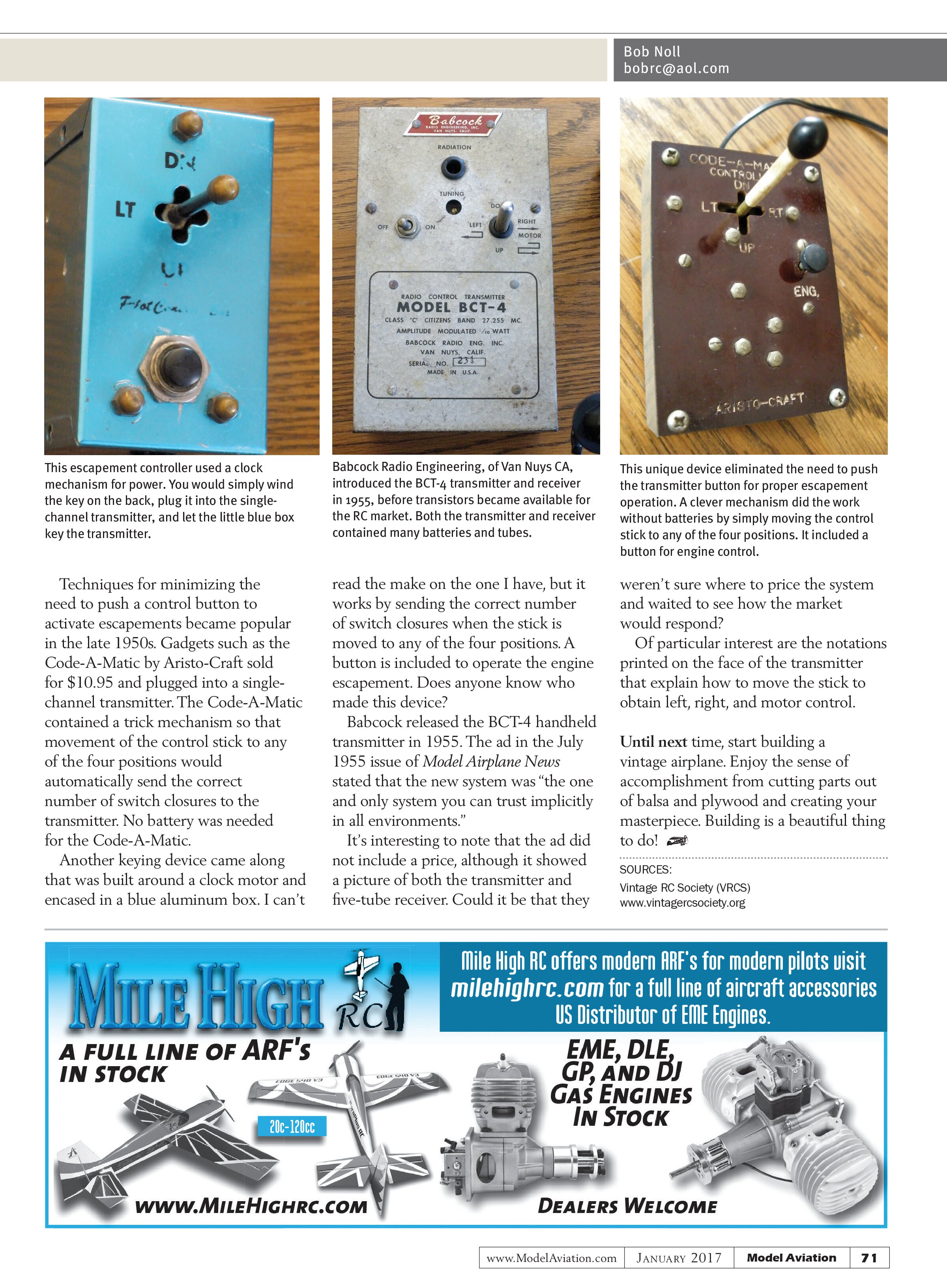
Babcock released the BCT-4 handheld transmitter in 1955. The ad in the July 1955 issue of Model Airplane News stated that the new system was “the one and only system you can trust implicitly in all environments.”
It’s interesting to note that the ad did not include a price, although it showed a picture of both the transmitter and five-tube receiver. Could it be that they weren’t sure where to price the system and waited to see how the market would respond?
Of particular interest are the notations printed on the face of the transmitter that explain how to move the stick to obtain left, right, and motor control.
Until next time, start building a vintage airplane. Enjoy the sense of accomplishment from cutting parts out of balsa and plywood and creating your masterpiece. Building is a beautiful thing to do!
SOURCES:
Vintage RC Society (VRCS)
www.vintagercsociety.org