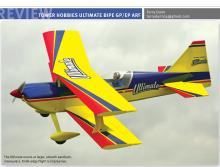
TOWER HOBBIES ULTIMATE BIPE GP/EP ARF
Terry Dunn
terrydunn74@gmail.com

Everyday aerobatics with two wings
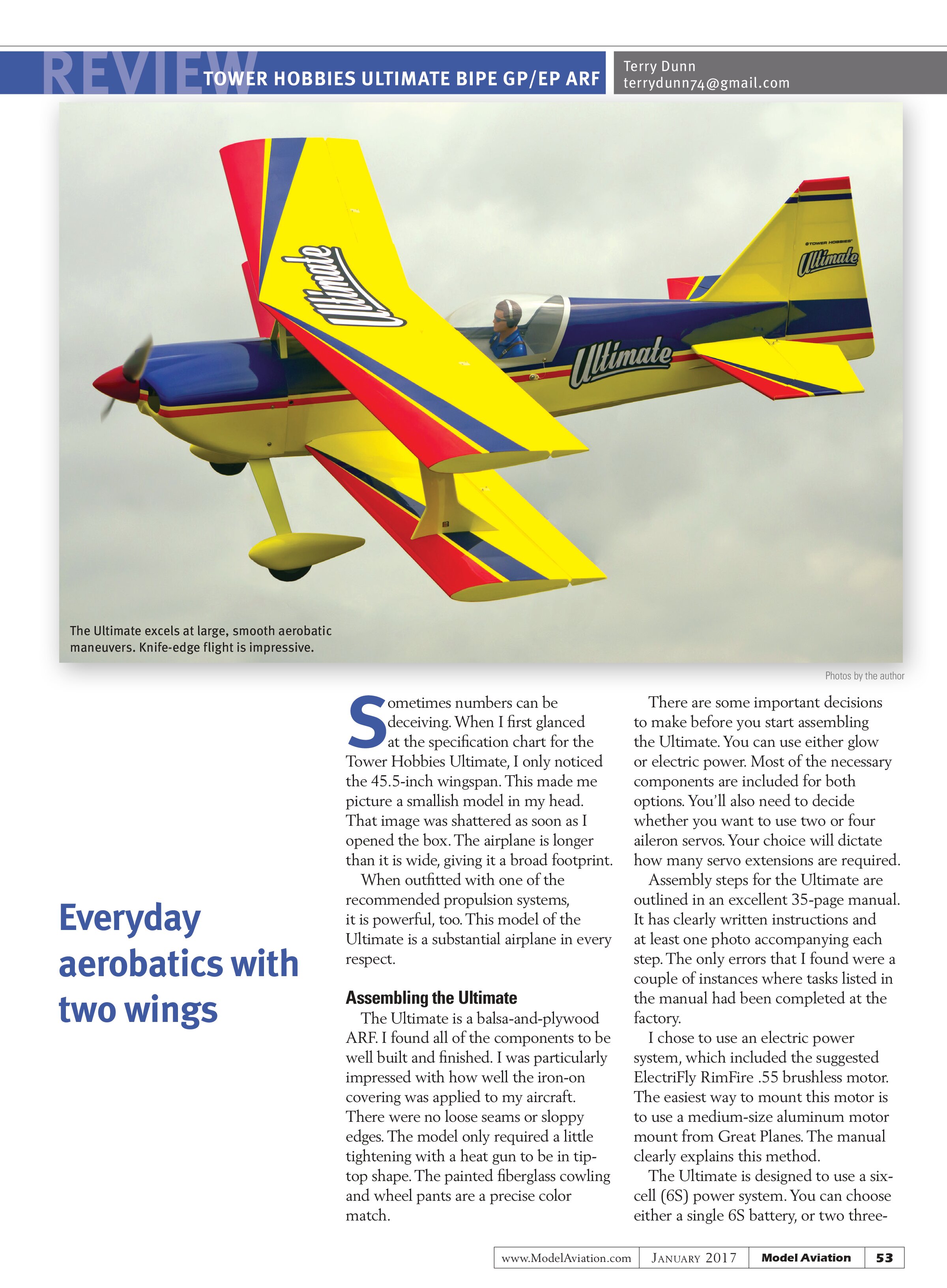
Sometimes numbers can be deceiving. When I first glanced at the specification chart for the Tower Hobbies Ultimate, I only noticed the 45.5-inch wingspan. This made me picture a smallish model in my head. That image was shattered as soon as I opened the box. The airplane is longer than it is wide, giving it a broad footprint.
When outfitted with one of the recommended propulsion systems, it is powerful, too. This model of the Ultimate is a substantial airplane in every respect.
Assembling the Ultimate
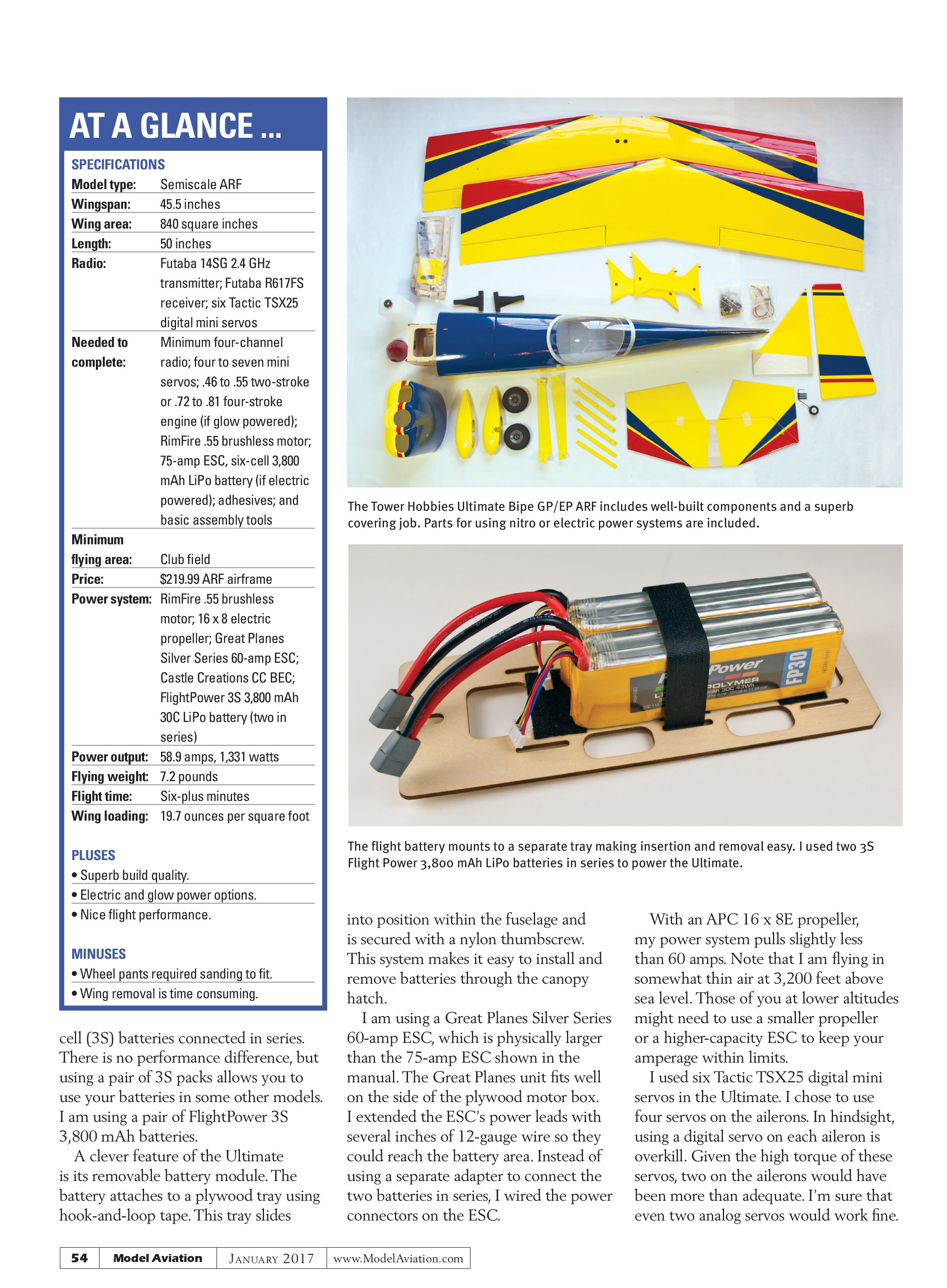
The Ultimate is a balsa-and-plywood ARF. I found all of the components to be well built and finished. I was particularly impressed with how well the iron-on covering was applied to my aircraft. There were no loose seams or sloppy edges. The model only required a little tightening with a heat gun to be in tip-top shape. The painted fiberglass cowling and wheel pants are a precise color match.
There are some important decisions to make before you start assembling the Ultimate. You can use either glow or electric power. Most of the necessary components are included for both options. You’ll also need to decide whether you want to use two or four aileron servos. Your choice will dictate how many servo extensions are required.
Assembly steps for the Ultimate are outlined in an excellent 35-page manual. It has clearly written instructions and at least one photo accompanying each step. The only errors that I found were a couple of instances where tasks listed in the manual had been completed at the factory.
I chose to use an electric power system, which included the suggested ElectriFly RimFire .55 brushless motor. The easiest way to mount this motor is to use a medium-size aluminum motor mount from Great Planes. The manual clearly explains this method.
The Ultimate is designed to use a six-cell (6S) power system. You can choose either a single 6S battery, or two three-
At a Glance ...
Specifications
Model type: Semiscale ARF
Wingspan: 45.5 inches
Wing area: 840 square inches
Length: 50 inches
Radio: Futaba 14SG 2.4 GHz transmitter; Futaba R617FS receiver; six Tactic TSX25 digital mini servos
Needed to complete: Minimum four-channel radio; four to seven mini servos; .46 to .55 two-stroke or .72 to .81 four-stroke engine (if glow powered); RimFire .55 brushless motor; 75-amp ESC, six-cell 3,800 mAh LiPo battery (if electric powered); adhesives; and basic assembly tools
Minimum flying area: Club field
Price: $219.99 ARF airframe
Power system: RimFire .55 brushless motor; 16 x 8 electric propeller; Great Planes Silver Series 60-amp ESC; Castle Creations CC BEC; FlightPower 3S 3,800 mAh 30C LiPo battery (two in series)
Power output: 58.9 amps, 1,331 watts
Flying weight: 7.2 pounds
Flight time: Six-plus minutes
Wing loading: 19.7 ounces per square foot
Pluses
- Superb build quality.
- Electric and glow power options.
- Nice flight performance.
Minuses
- Wheel pants required sanding to fit.
- Wing removal is time consuming.
cell (3S) batteries connected in series. There is no performance difference, but using a pair of 3S packs allows you to use your batteries in some other models. I am using a pair of FlightPower 3S 3,800 mAh batteries.
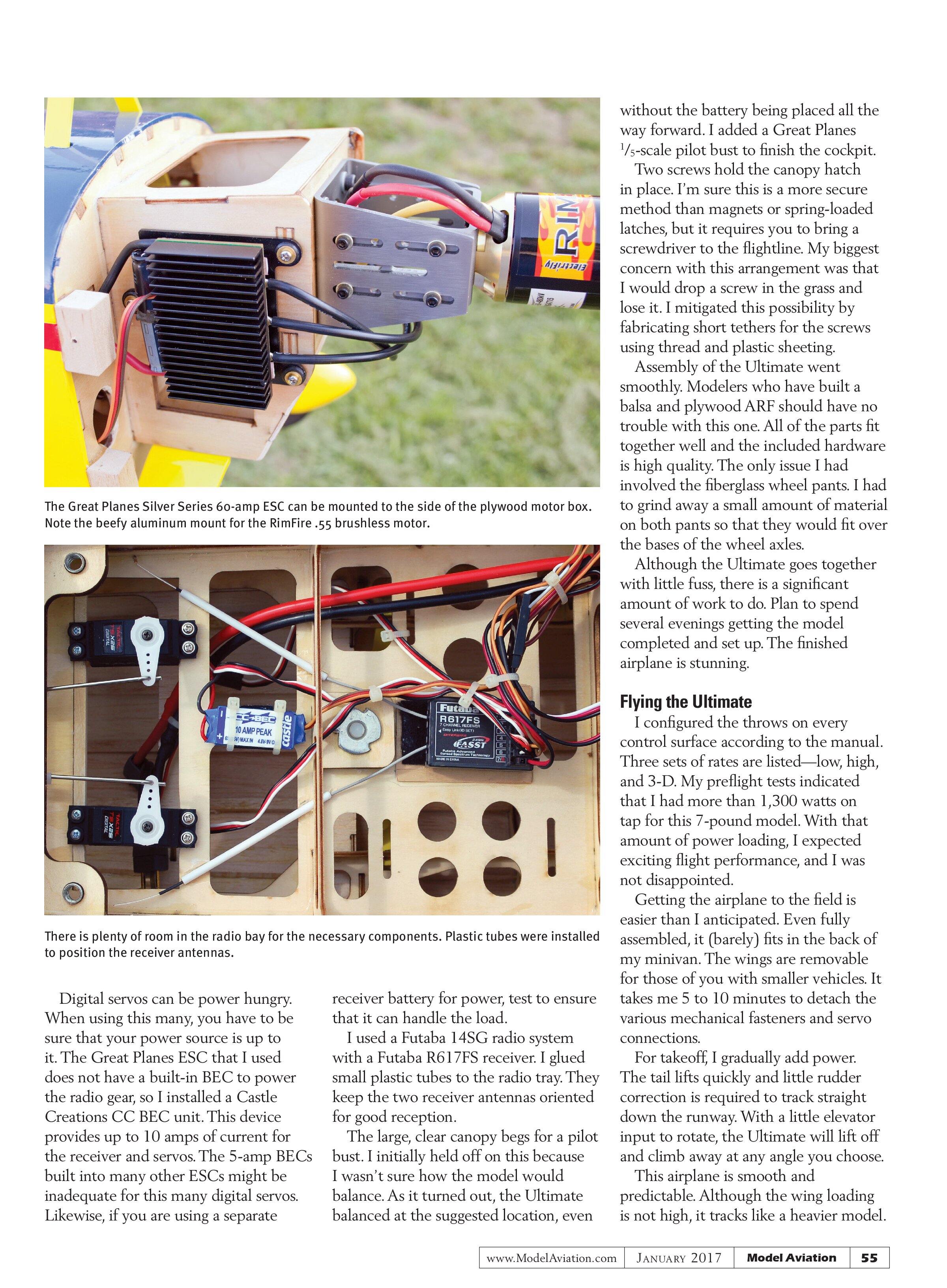
A clever feature of the Ultimate is its removable battery module. The battery attaches to a plywood tray using hook-and-loop tape. This tray slides into position within the fuselage and is secured with a nylon thumbscrew. This system makes it easy to install and remove batteries through the canopy hatch.
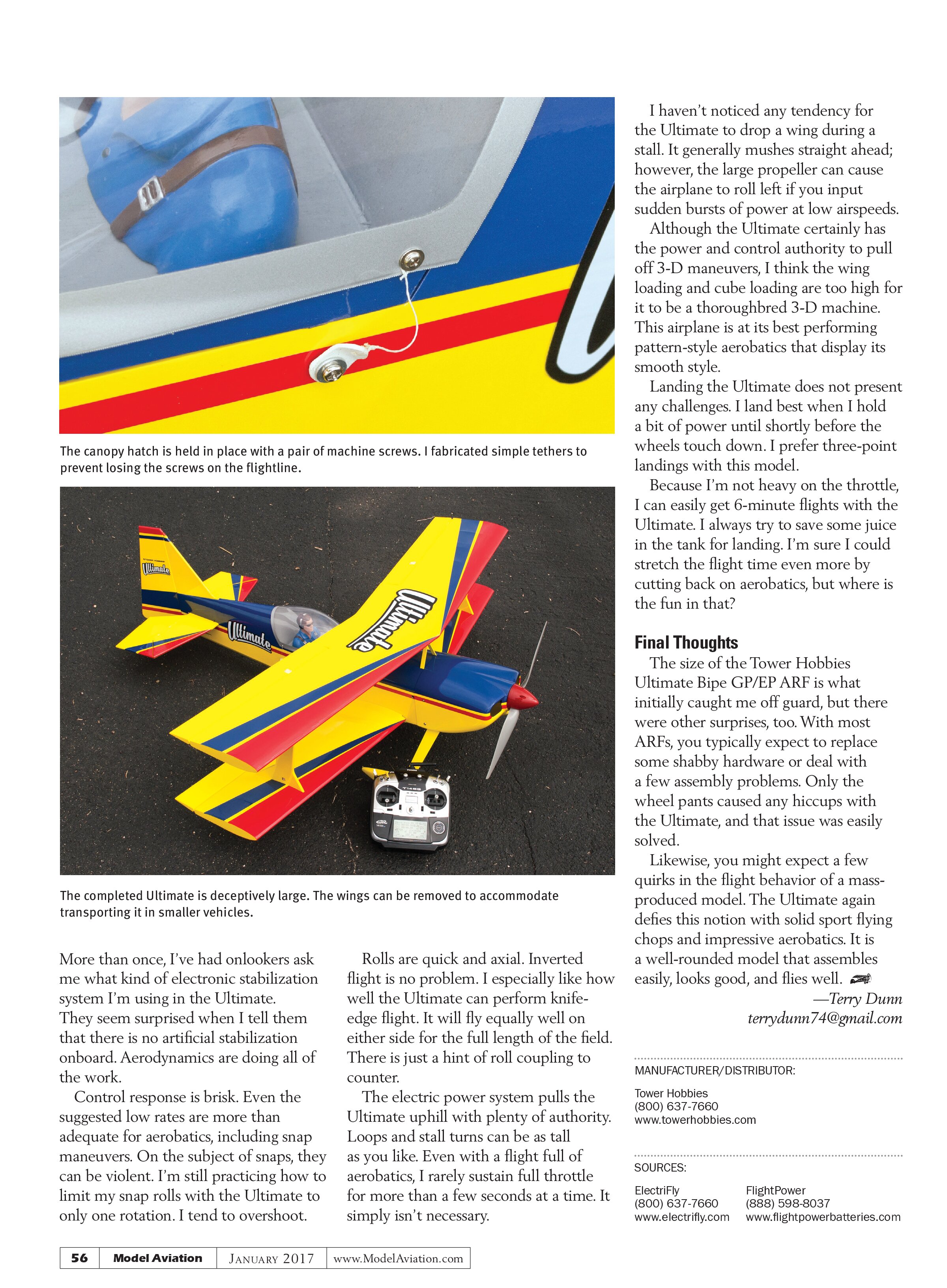
I am using a Great Planes Silver Series 60-amp ESC, which is physically larger than the 75-amp ESC shown in the manual. The Great Planes unit fits well on the side of the plywood motor box. I extended the ESC’s power leads with several inches of 12-gauge wire so they could reach the battery area. Instead of using a separate adapter to connect the two batteries in series, I wired the power connectors on the ESC.
With an APC 16 x 8E propeller, my power system pulls slightly less than 60 amps. Note that I am flying in somewhat thin air at 3,200 feet above sea level. Those of you at lower altitudes might need to use a smaller propeller or a higher-capacity ESC to keep your amperage within limits.
I used six Tactic TSX25 digital mini servos in the Ultimate. I chose to use four servos on the ailerons. In hindsight, using a digital servo on each aileron is overkill. Given the high torque of these servos, two on the ailerons would have been more than adequate. I’m sure that even two analog servos would work fine.

The Tower Hobbies Ultimate Bipe GP/EP ARF includes well-built components and a superb covering job. Parts for using nitro or electric power systems are included.

The flight battery mounts to a separate tray making insertion and removal easy. I used two 3S FlightPower 3,800 mAh LiPo batteries in series to power the Ultimate.
Digital servos can be power hungry. When using this many, you have to be sure that your power source is up to it. The Great Planes ESC that I used does not have a built-in BEC to power the radio gear, so I installed a Castle Creations CC BEC unit. This device provides up to 10 amps of current for the receiver and servos. The 5-amp BECs built into many other ESCs might be inadequate for this many digital servos. Likewise, if you are using a separate receiver battery for power, test to ensure that it can handle the load.
I used a Futaba 14SG radio system with a Futaba R617FS receiver. I glued small plastic tubes to the radio tray. They keep the two receiver antennas oriented for good reception.
The large, clear canopy begs for a pilot bust. I initially held off on this because I wasn’t sure how the model would balance. As it turned out, the Ultimate balanced at the suggested location, even without the battery being placed all the way forward. I added a Great Planes ⅕-scale pilot bust to finish the cockpit. Two screws hold the canopy hatch in place. I’m sure this is a more secure method than magnets or spring-loaded latches, but it requires you to bring a screwdriver to the flightline. My biggest concern with this arrangement was that I would drop a screw in the grass and lose it. I mitigated this possibility by fabricating short tethers for the screws using thread and plastic sheeting.

The Great Planes Silver Series 60-amp ESC can be mounted to the side of the plywood motor box. Note the beefy aluminum mount for the RimFire .55 brushless motor.

There is plenty of room in the radio bay for the necessary components. Plastic tubes were installed to position the receiver antennas.
Assembly of the Ultimate went smoothly. Modelers who have built a balsa and plywood ARF should have no trouble with this one. All of the parts fit together well and the included hardware is high quality. The only issue I had involved the fiberglass wheel pants. I had to grind away a small amount of material on both pants so that they would fit over the bases of the wheel axles.
Although the Ultimate goes together with little fuss, there is a significant amount of work to do. I plan to spend several evenings getting the model completed and set up. The finished airplane is stunning.
Flying the Ultimate
I configured the throws on every control surface according to the manual. Three sets of rates are listed—low, high, and 3-D. My preflight tests indicated that I had more than 1,300 watts on tap for this 7-pound model. With that amount of power loading, I expected exciting flight performance, and I was not disappointed.
Getting the airplane to the field is easier than I anticipated. Even fully assembled, it (barely) fits in the back of my minivan. The wings are removable for those of you with smaller vehicles. It takes me 5 to 10 minutes to detach the various mechanical fasteners and servo connections.
For takeoff, I gradually add power. The tail lifts quickly and little rudder correction is required to track straight down the runway. With a little elevator input to rotate, the Ultimate will lift off and climb away at any angle you choose.
This airplane is smooth and predictable. Although the wing loading is not high, it tracks like a heavier model.
More than once, I’ve had onlookers ask me what kind of electronic stabilization system I’m using in the Ultimate. They seem surprised when I tell them that there is no artificial stabilization onboard. Aerodynamics are doing all of the work.
Control response is brisk. Even the suggested low rates are more than adequate for aerobatics, including snap maneuvers. On the subject of snaps, they can be violent. I’m still practicing how to limit my snap rolls with the Ultimate to only one rotation. I tend to overshoot.
Rolls are quick and axial. Inverted flight is no problem. I especially like how well the Ultimate can perform knife-edge flight. It will fly equally well on either side for the full length of the field. There is just a hint of roll coupling to counter.
The electric power system pulls the Ultimate uphill with plenty of authority. Loops and stall turns can be as tall as you like. Even with a flight full of aerobatics, I rarely sustain full throttle for more than a few seconds at a time. It simply isn’t necessary.
I haven’t noticed any tendency for the Ultimate to drop a wing during a stall. It generally mushes straight ahead; however, the large propeller can cause the airplane to roll left if you input sudden bursts of power at low airspeeds.
Although the Ultimate certainly has the power and control authority to pull off 3-D maneuvers, I think the wing loading and cube loading are too high for it to be a thoroughbred 3-D machine. This airplane is at its best performing pattern-style aerobatics that display its smooth style.
Landing the Ultimate does not present any challenges. I land best when I hold a bit of power until shortly before the wheels touch down. I prefer three-point landings with this model.
Because I’m not heavy on the throttle, I can easily get 6-minute flights with the Ultimate. I always try to save some juice in the tank for landing. I’m sure I could stretch the flight time even more by cutting back on aerobatics, but where is the fun in that?
Final Thoughts
The size of the Tower Hobbies Ultimate Bipe GP/EP ARF is what initially caught me off guard, but there were other surprises, too. With most ARFs, you typically expect to replace some shabby hardware or deal with a few assembly problems. Only the wheel pants caused any hiccups with the Ultimate, and that issue was easily solved.
Likewise, you might expect a few quirks in the flight behavior of a mass-produced model. The Ultimate again defies this notion with solid sport flying chops and impressive aerobatics. It is a well-rounded model that assembles easily, looks good, and flies well.
—Terry Dunn
terrydunn74@gmail.com


MANUFACTURER/DISTRIBUTOR:
Tower Hobbies
(800) 637-7660
www.towerhobbies.com
SOURCES:
ElectriFly
(800) 637-7660
www.electrifly.com
FlightPower
(888) 598-8037
www.flightpowerbatteries.com