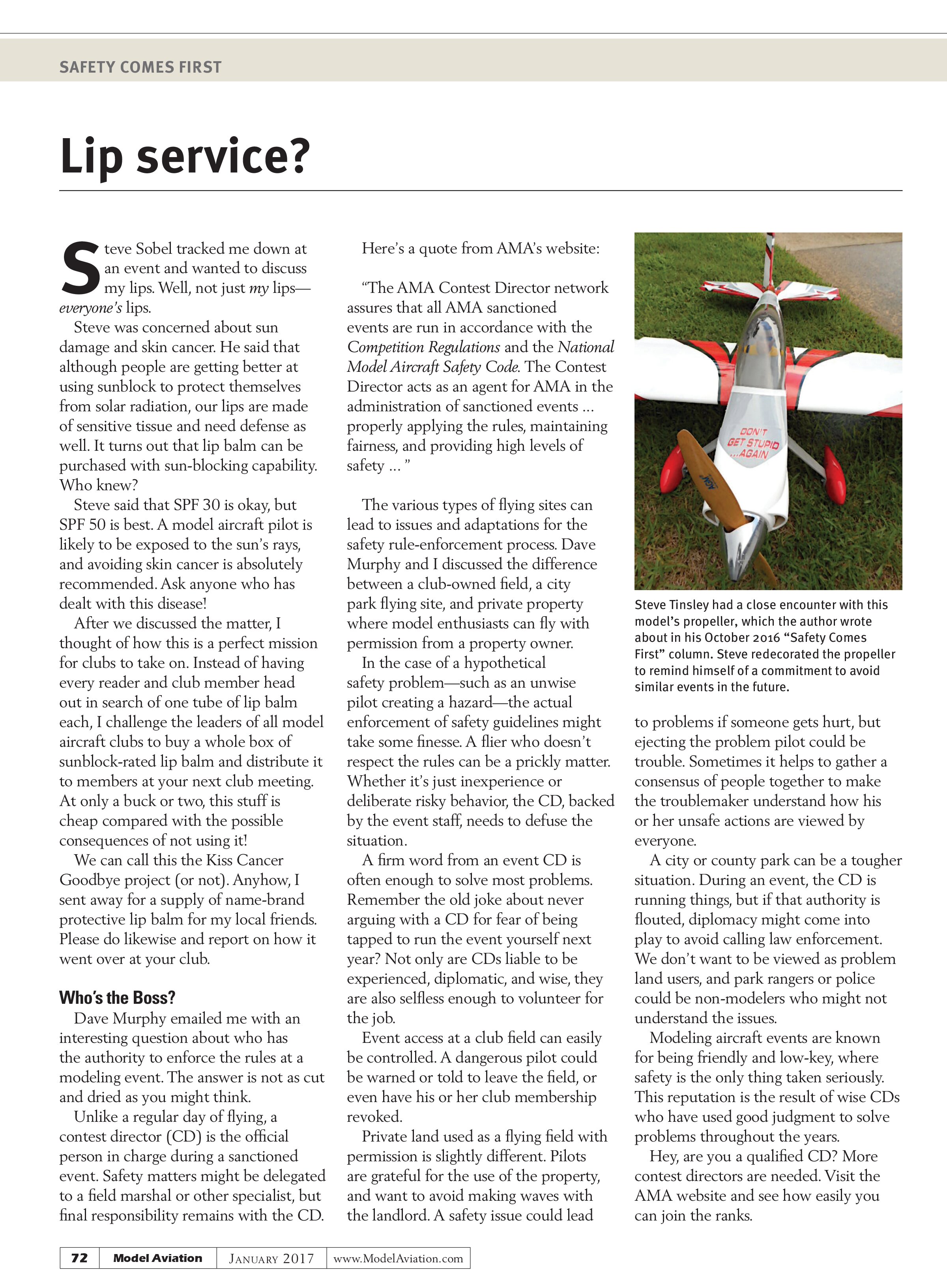
Lip service?
Steve Sobel tracked me down at an event and wanted to discuss my lips. Well, not just my lips—everyone’s lips.
Steve was concerned about sun damage and skin cancer. He said that although people are getting better at using sunblock to protect themselves from solar radiation, our lips are made of sensitive tissue and need defense as well. It turns out that lip balm can be purchased with sun-blocking capability. Who knew?
Steve said that SPF 30 is okay, but SPF 50 is best. A model aircraft pilot is likely to be exposed to the sun’s rays, and avoiding skin cancer is absolutely recommended. Ask anyone who has dealt with this disease!
After we discussed the matter, I thought of how this is a perfect mission for clubs to take on. Instead of having every reader and club member head out in search of one tube of lip balm each, I challenge the leaders of all model aircraft clubs to buy a whole box of sunblock-rated lip balm and distribute it to members at your next club meeting. At only a buck or two, this stuff is cheap compared with the possible consequences of not using it!
We can call this the Kiss Cancer Goodbye project (or not). Anyhow, I sent away for a supply of name-brand protective lip balm for my local friends. Please do likewise and report on how it went over at your club.
Who’s the Boss?
Dave Murphy emailed me with an interesting question about who has the authority to enforce the rules at a modeling event. The answer is not as cut and dried as you might think.
Unlike a regular day of flying, a contest director (CD) is the official person in charge during a sanctioned event. Safety matters might be delegated to a field marshal or other specialist, but final responsibility remains with the CD.
Here’s a quote from AMA’s website:
“The AMA Contest Director network assures that all AMA sanctioned events are run in accordance with the Competition Regulations and the National Model Aircraft Safety Code. The Contest Director acts as an agent for AMA in the administration of sanctioned events ... properly applying the rules, maintaining fairness, and providing high levels of safety ...”
The various types of flying sites can lead to issues and adaptations for the safety rule-enforcement process. Dave Murphy and I discussed the difference between a club-owned field, a city park flying site, and private property where model enthusiasts can fly with permission from a property owner.
In the case of a hypothetical safety problem—such as an unwise pilot creating a hazard—the actual enforcement of safety guidelines might take some finesse. A flier who doesn’t respect the rules can be a prickly matter. Whether it’s just inexperience or deliberate risky behavior, the CD, backed by the event staff, needs to defuse the situation.
A firm word from an event CD is often enough to solve most problems. Remember the old joke about never arguing with a CD for fear of being tapped to run the event yourself next year? Not only are CDs liable to be experienced, diplomatic, and wise, they are also selfless enough to volunteer for the job.
Event access at a club field can easily be controlled. A dangerous pilot could be warned or told to leave the field, or even have his or her club membership revoked.
Private land used as a flying field with permission is slightly different. Pilots are grateful for the use of the property, and want to avoid making waves with the landlord. A safety issue could lead to problems if someone gets hurt, but ejecting the problem pilot could be trouble. Sometimes it helps to gather a consensus of people together to make the troublemaker understand how his or her unsafe actions are viewed by everyone.
A city or county park can be a tougher situation. During an event, the CD is running things, but if that authority is flouted, diplomacy might come into play to avoid calling law enforcement. We don’t want to be viewed as problem land users, and park rangers or police could be non-modelers who might not understand the issues.
Modeling aircraft events are known for being friendly and low-key, where safety is the only thing taken seriously. This reputation is the result of wise CDs who have used good judgment to solve problems throughout the years.
Hey, are you a qualified CD? More contest directors are needed. Visit the AMA website and see how easily you can join the ranks.

Name the airplane with the green rudder and win digital PQ-14A drone plans via email! Yes, it’s kind of a trick question, but any answer will do.
Droning Into Trouble
I recently witnessed an event coordinator doing his duty at an aviation event that combined full-scale aircraft and model airplanes. The event coordinator was an experienced man, with exceptional people skills. He had given a comprehensive pilot briefing that morning, and appointed safety marshals for each area of the show.
I was helping out at a booth when I noticed an RC pilot walking and working a transmitter. His eyes were on a large quadcopter hovering overhead. He and the drone were inside the spectator area, on the wrong side of the safety line. I almost dropped my ice cream!
Although few people were nearby, this was an obvious problem. Several alert volunteers converged on the coordinator with the news. He snapped into action and had the matter resolved in moments.
I don’t know the details of how this situation came to be, but there was one factor I could see for sure: the pilot had an unshakeable faith in the machine and control system he was using. He probably couldn’t imagine anything happening but the proper responses to his control inputs. This overconfidence is a dangerous mindset. Our models are incredibly advanced and reliable, but they are not infallible.
One little glitch in a servo, or one weak solder joint or burble of air current, and trouble has arrived. Experienced fliers always plan for something to go wrong so that they can be pleasantly surprised if it doesn’t. This way of thinking is especially important at a public event. We want to put the spectators’ safety above all else, right?
Hardware failure is always a possibility, so sharp and cautious pilots plan for it. That way, the CD will be smiling happily when he walks by.
Mystery Airplane Contest!
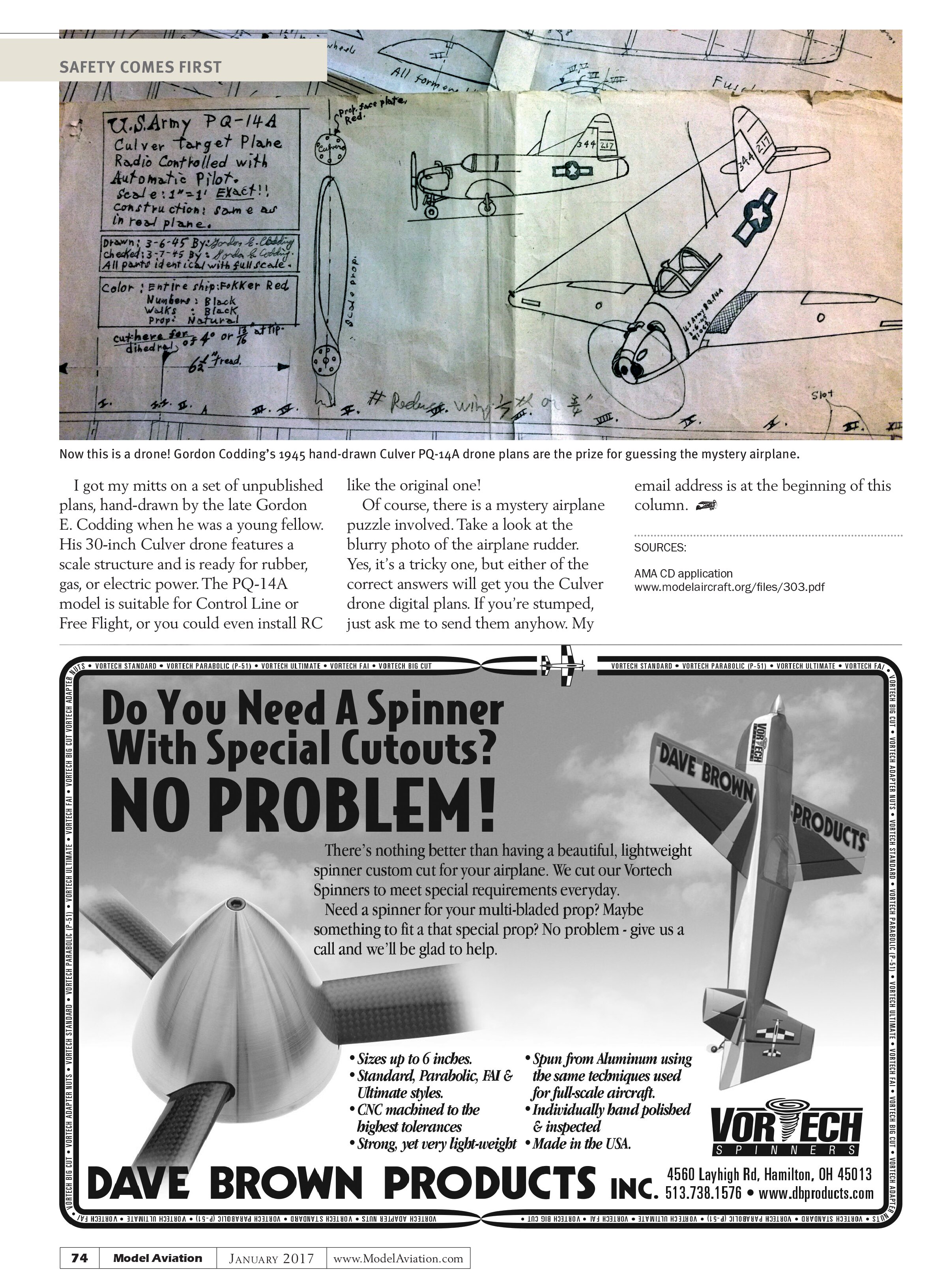
Ask modelers to define the word “drone” and you’ll get many answers because our models cover such a wide spectrum of types. Well, I was given some excellent drawings for a drone, and this time nobody will argue with the term. The U.S. Army once used Culver PQ-14A Cadet drones for target practice. These tidy little aircraft were too pretty to shoot down, and a few examples that survived the war became sport airplanes.


I got my mitts on a set of unpublished plans, hand-drawn by the late Gordon E. Codding when he was a young fellow. His 30-inch Culver drone features a scale structure and is ready for rubber, gas, or electric power. The PQ-14A model is suitable for Control Line or Free Flight, or you could even install RC
like the original one! Of course, there is a mystery airplane puzzle involved. Take a look at the blurry photo of the airplane rudder. Yes, it’s a tricky one, but either of the correct answers will get you the Culver drone digital plans. If you’re stumped, just ask me to send them anyhow. My
email address is at the beginning of this column.
SOURCES:
AMA CD application
www.modelaircraft.org/files/303.pdf