2016 Indoor Nats
by Don Slusarczyk
don@donsrc.com
The 2016 Indoor Free Flight (FF) Nats is in the books and all I can say is boy, was it hot and humid! Temperatures were in the 90s and the humidity was more than 80%, which made it difficult for all who attended. Fortunately, we had plenty of water and Gatorade to keep everyone hydrated, and wet towels to keep our heads and necks cool.
The high humidity not only affected the contestants, but the models as well. The balsa soaked in the excess moisture and caused warping, weight gain, and structural weakness. Tissue-covered models also absorbed some of the moisture and turned normally nice, smooth, covered surfaces wrinkly and baggy.
My condenser-paper-covered A-6 gained 150 milligrams and my No-Cal models needed some nose weight to compensate for the weight gain in the

tail. Flaring propellers tended to over-flare from the extra moisture that was softening the spar wood, and propellers often had to be repitched after each flight to hold a setting. I even tried putting a few models in my car in the direct sunlight for a few hours to help dry some of the moisture from the tissue.
While going out for a quick lunch, I heard on the local radio that “corn sweat” was the reason for the high humidity. After a quick internet search on my cellphone, I found that corn sweat is a term used to describe when corn crops absorb water from the ground and it then evaporates into the air at a rate of up to 4,000 gallons per acre, per day. With so many acres of cornfields in the area, it all started to make sense. These conditions were quite different from only a month earlier when my dad and I made the trip for a weekend contest to get used to the site and test-fly some models before the Nats.
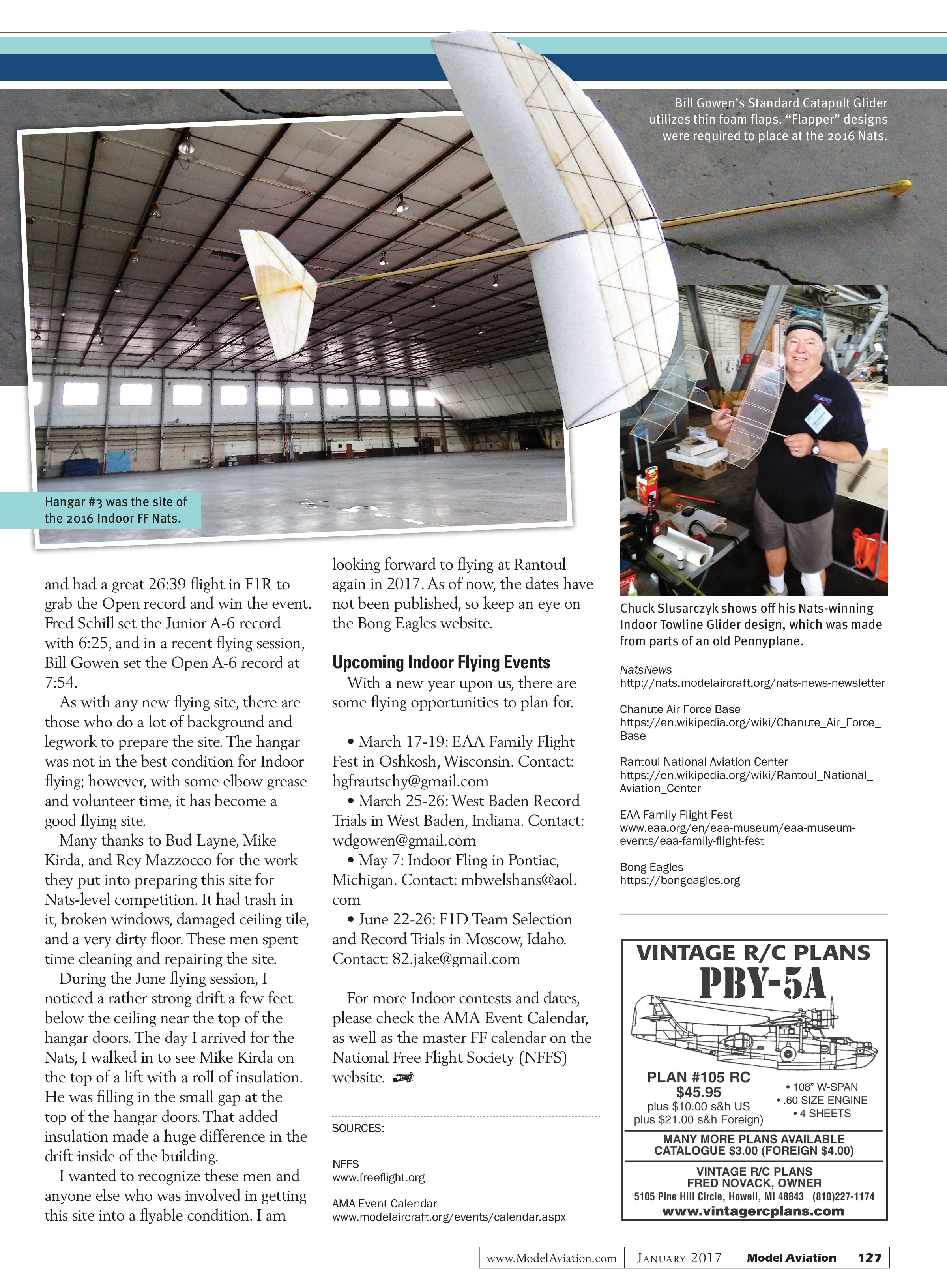
For those who did not attend, the 2016 Indoor Nats were held in Hangar #3 at the Rantoul National Aviation Center, which is on the site of the now-decommissioned Chanute Air Force base. The hangar has a 44-foot ceiling height, making it a Category II Indoor site. The smooth ceiling has obstacles hanging below it. There are lights and a sprinkler system installed that at times can help your model or cause it to hang up at the most inopportune moment.
Despite the physical obstacles, the site is capable of record-setting performances. At the Nats, Josh Finn set the Open Autogyro record with 13:10

and had a great 26:39 flight in F1R to grab the Open record and win the event. Fred Schill set the Junior A-6 record with 6:25, and in a recent flying session, Bill Gowen set the Open A-6 record at 7:54.
As with any new flying site, there are those who do a lot of background and legwork to prepare the site. The hangar was not in the best condition for Indoor flying; however, with some elbow grease and volunteer time, it has become a good flying site.
Many thanks to Bud Layne, Mike Kirda, and Rey Mazzocco for the work they put into preparing this site for Nats-level competition. It had trash in it, broken windows, damaged ceiling tile, and a very dirty floor. These men spent time cleaning and repairing the site.
During the June flying session, I noticed a rather strong drift a few feet below the ceiling near the top of the hangar doors. The day I arrived for the Nats, I walked in to see Mike Kirda on the top of a lift with a roll of insulation. He was filling in the small gap at the top of the hangar doors. That added insulation made a huge difference in the drift inside of the building.
I wanted to recognize these men and anyone else who was involved in getting this site into a flyable condition. I am

looking forward to flying at Rantoul again in 2017. As of now, the dates have not been published, so keep an eye on the Bong Eagles website.
Upcoming Indoor Flying Events
With a new year upon us, there are some flying opportunities to plan for.
- March 17-19: EAA Family Flight Fest in Oshkosh, Wisconsin. Contact: hgftrautschy@gmail.com
- March 25-26: West Baden Record Trials in West Baden, Indiana. Contact: wdgowen@gmail.com
- May 7: Indoor Fling in Pontiac, Michigan. Contact: mbwelshans@aol.com
- June 22-26: F1D Team Selection and Record Trials in Moscow, Idaho. Contact: 82.jake@gmail.com
For more Indoor contests and dates, please check the AMA Event Calendar, as well as the master FF calendar on the National Free Flight Society (NFFS) website.
SOURCES:
AMA Event Calendar
www.modelaircraft.org/events/calendar.aspx

and had a great 26:39 flight in F1R to grab the Open record and win the event. Fred Schill set the Junior A-6 record with 6:25, and in a recent flying session, Bill Gowen set the Open A-6 record at 7:54.