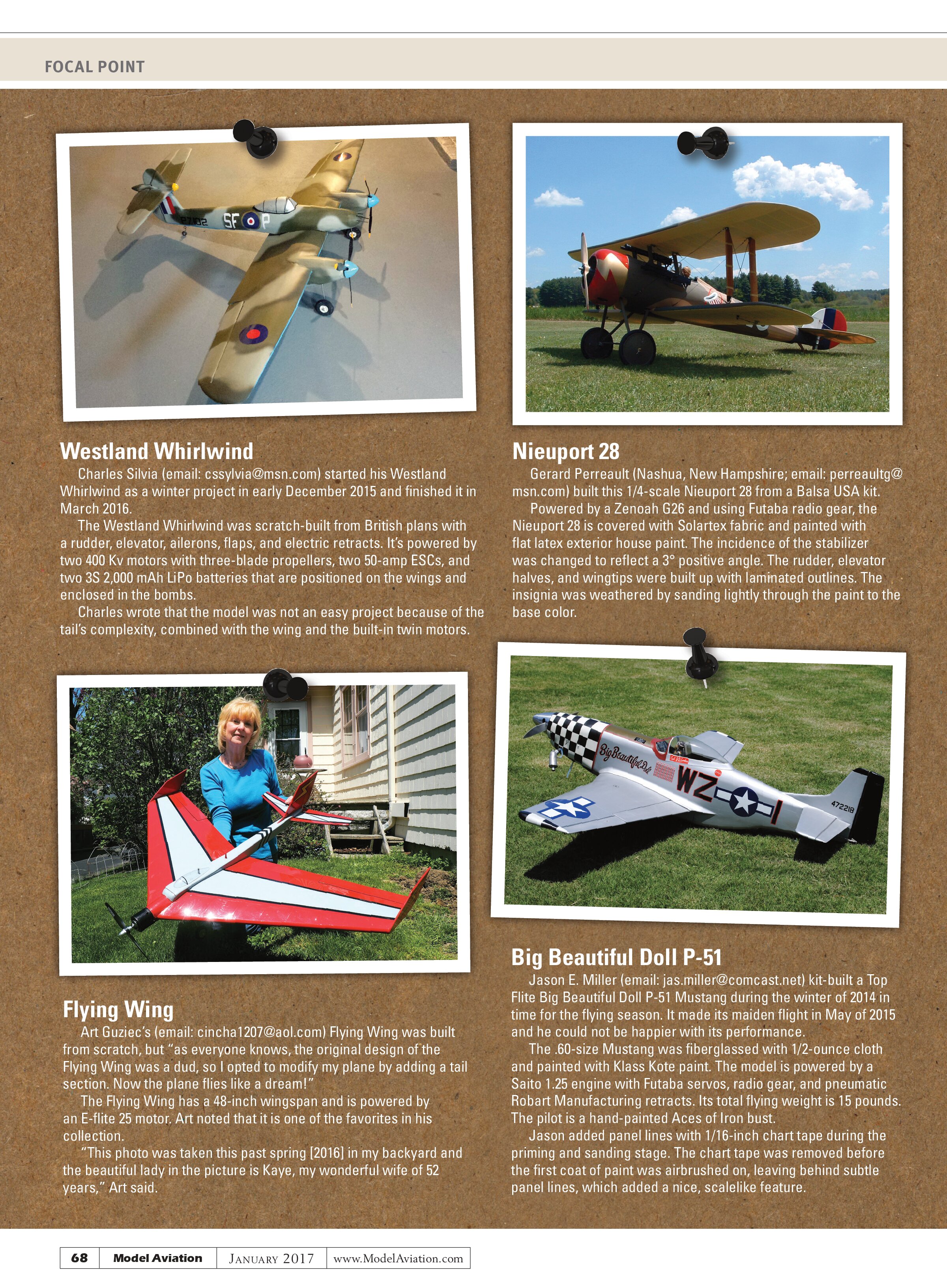
Focal Point

Westland Whirlwind
Charles Silvia (email: cssylvia@msn.com) started his Westland Whirlwind as a winter project in early December 2015 and finished it in March 2016.
The Westland Whirlwind was scratch-built from British plans with a rudder, elevator, ailerons, flaps, and electric retracts. It’s powered by two 400 Kv motors with three-blade propellers, two 50-amp ESCs, and two 3S 2,000 mAh LiPo batteries that are positioned on the wings and enclosed in the bombs.
Charles wrote that the model was not an easy project because of the tail’s complexity, combined with the wing and the built-in twin motors.

Flying Wing
Art Guziec’s (email: cincha1207@aol.com) Flying Wing was built from scratch, but “as everyone knows, the original design of the Flying Wing was a dud, so I opted to modify my plane by adding a tail section. Now the plane flies like a dream!”
The Flying Wing has a 48-inch wingspan and is powered by an E-flite 25 motor. Art noted that it is one of the favorites in his collection.
“This photo was taken this past spring [2016] in my backyard and the beautiful lady in the picture is Kaye, my wonderful wife of 52 years,” Art said.

Nieuport 28
Gerard Perreault (Nashua, New Hampshire; email: perreaultg@msn.com) built this 1/4-scale Nieuport 28 from a Balsa USA kit. Powered by a Zenoah G26 and using Futaba radio gear, the Nieuport 28 is covered with Solartex fabric and painted with flat latex exterior house paint. The incidence of the stabilizer was changed to reflect a 3° positive angle. The rudder, elevator halves, and wingtips were built up with laminated outlines. The insignia was weathered by sanding lightly through the paint to the base color.

Big Beautiful Doll P-51
Jason E. Miller (email: jas.miller@comcast.net) kit-built a Top Flite Big Beautiful Doll P-51 Mustang during the winter of 2014 in time for the flying season. It made its maiden flight in May of 2015 and he could not be happier with its performance.
The .60-size Mustang was fiberglassed with 1/2-ounce cloth and painted with Klass Kote paint. The model is powered by a Saito 1.25 engine with Futaba servos, radio gear, and pneumatic Robart Manufacturing retracts. Its total flying weight is 15 pounds. The pilot is a hand-painted Aces of Iron bust.
Jason added panel lines with 1/16-inch chart tape during the priming and sanding stage. The chart tape was removed before the first coat of paint was airbrushed on, leaving behind subtle panel lines, which added a nice, scalelike feature.

Tequila Sunrise Kobra
Ken Lawrence (El Cajon, California; email: mkaway@cox.net) named his Sig Manufacturing Kobra Tequila Sunrise because of its trim scheme. It is powered by an O.S. .25 electric motor, a Castle Creations Thunderbird 54 ESC, and a 3S 2,200 mAh LiPo battery.
The Kobra is covered with UltraCote and weighs slightly less than 3 pounds with the battery. Control is with an Airtronics RDS8000 radio system and four Hitec HS-82MG servos, two of which gave him aileron differential and flaperons.
Ken wrote that flight is smooth and predictable, yet the Kobra is responsive and has sufficient power for any maneuvers.

Cessna 150
Robert Blackwell (Rossville, Georgia; email: robdebblackwell57@gmail.com) submitted this 30% scale Cessna 150 that he built from Wendell Hostetler Plans.
The 115-inch wingspan Cessna has a length of 86.7 inches and flying weight of 43 pounds using a DA-50 engine. Control is with a JR radio. Robert utilizes Glennis air brakes with right and left control.
The aircraft has working details, including yokes that move in and out with elevator control and move left and right with the ailerons. The foot pedals also move with right and left rudder control. The wingtip lights, vertical tail lights, landing lights, and the dome light all work, and the windows on both doors open. A trim tab on the right elevator works off of a knob on the dash.
The 7,800-plus rivets on the Cessna were all placed by hand. Robert credits the building and detailing to his friend, Danny Parker. “I just wanted this plane to be seen,” he wrote.

P-80 Shooting Star
Dave Herbert’s (Sibley, Iowa; email: niteflyr@hickorytech.net) vintage P-80 Shooting Star hung in his garage for more than 30 years. He originally flew it in California in 1982 after acquiring it from Pete Gallardo, whose father had built it before he passed away. Dave restored the model and flew it in Pete’s father’s honor.
“I recently flew it and crashed it twice due to miscalculated CG [center of gravity] location,” Dave wrote. “I did extensive searching to find the actual CG location or plans—even the real ones—but was unsuccessful. Rebuilding it after two serious crashes was intense, but never giving up is my motto and it paid off.” With advice from full-scale pilot friends, Dave was successful in flying it well.
The P-80 weighs 12.5 pounds and is powered with a Rossi .61 rear-exhaust engine. Dave uses 5% Sig Manufacturing fuel on a tuned pipe. The wingspan is 62 inches with a length of 55 inches.
Dave could not find who manufactured the P-80 kit. “If anybody recognizes who originally manufactured this kit, I would appreciate knowing.”

Lou Andrews Trainermaster
This Lou Andrews Trainermaster is the fifth one that Michael O’Donnell (Fort Atkinson, Wisconsin) has scratch-built.
Covered with MonoKote and using conventional gear, the Trainermaster is powered by an O.S. .52 four-stroke engine. Michael uses a JR radio for control.