FMS PILATUS PC-21
Jon Barnes

Step up to an advanced trainer
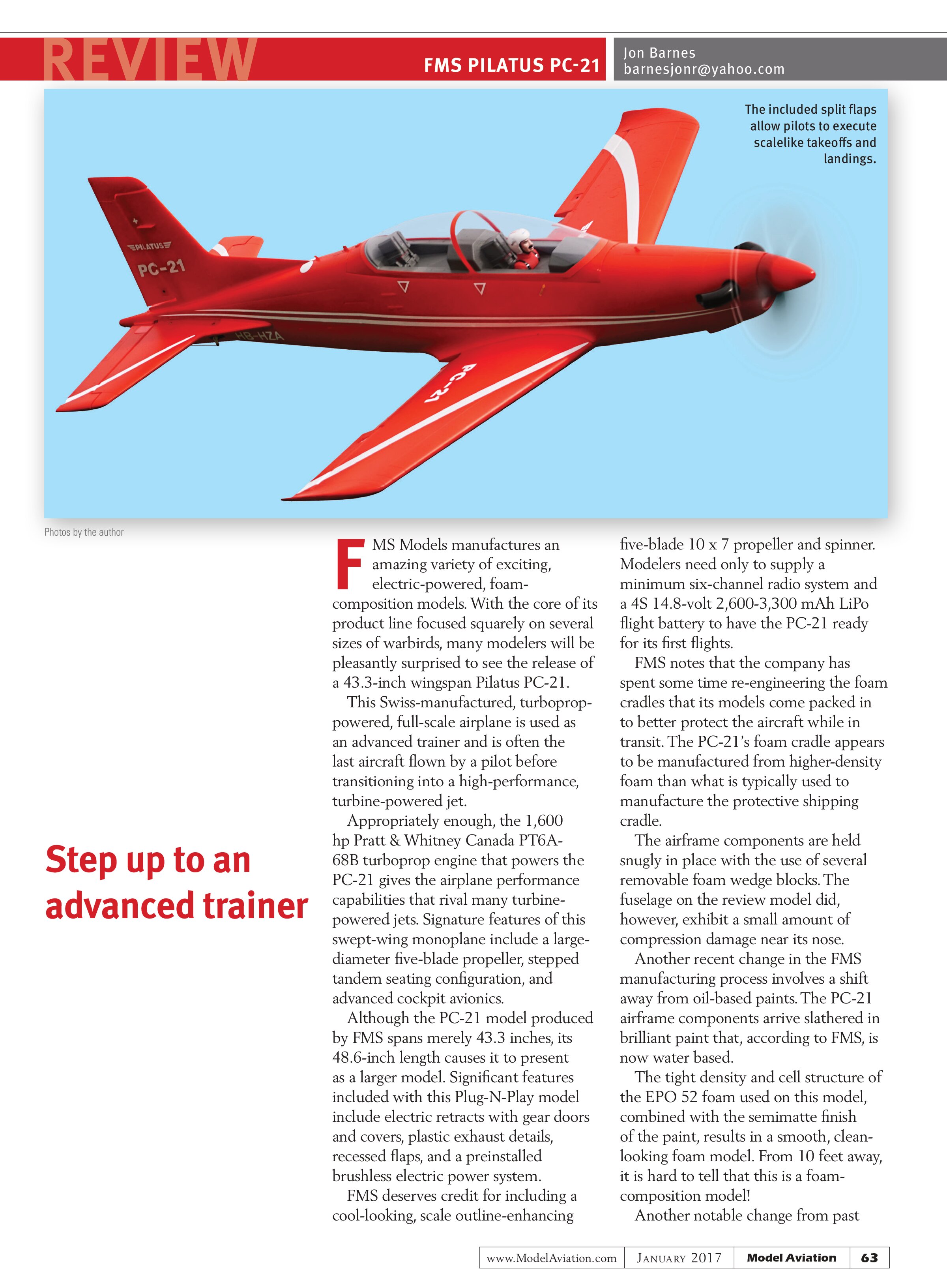
FMS Models manufactures an amazing variety of exciting, electric-powered, foam-composition models. With the core of its product line focused squarely on several sizes of warbirds, many modelers will be pleasantly surprised to see the release of a 43.3-inch wingspan Pilatus PC-21.
This Swiss-manufactured, turboprop-powered, full-scale airplane is used as an advanced trainer and is often the last aircraft flown by a pilot before transitioning into a high-performance, turbine-powered jet.
Appropriately enough, the 1,600 hp Pratt & Whitney Canada PT6A-68B turboprop engine that powers the PC-21 gives the airplane performance capabilities that rival many turbine-powered jets. Signature features of this swept-wing monoplane include a large-diameter five-blade propeller, stepped tandem seating configuration, and advanced cockpit avionics.
Although the PC-21 model produced by FMS spans merely 43.3 inches, its 48.6-inch length causes it to present as a larger model. Significant features included with this Plug-N-Play model include electric retracts with gear doors and covers, plastic exhaust details, recessed flaps, and a preinstalled brushless electric power system.
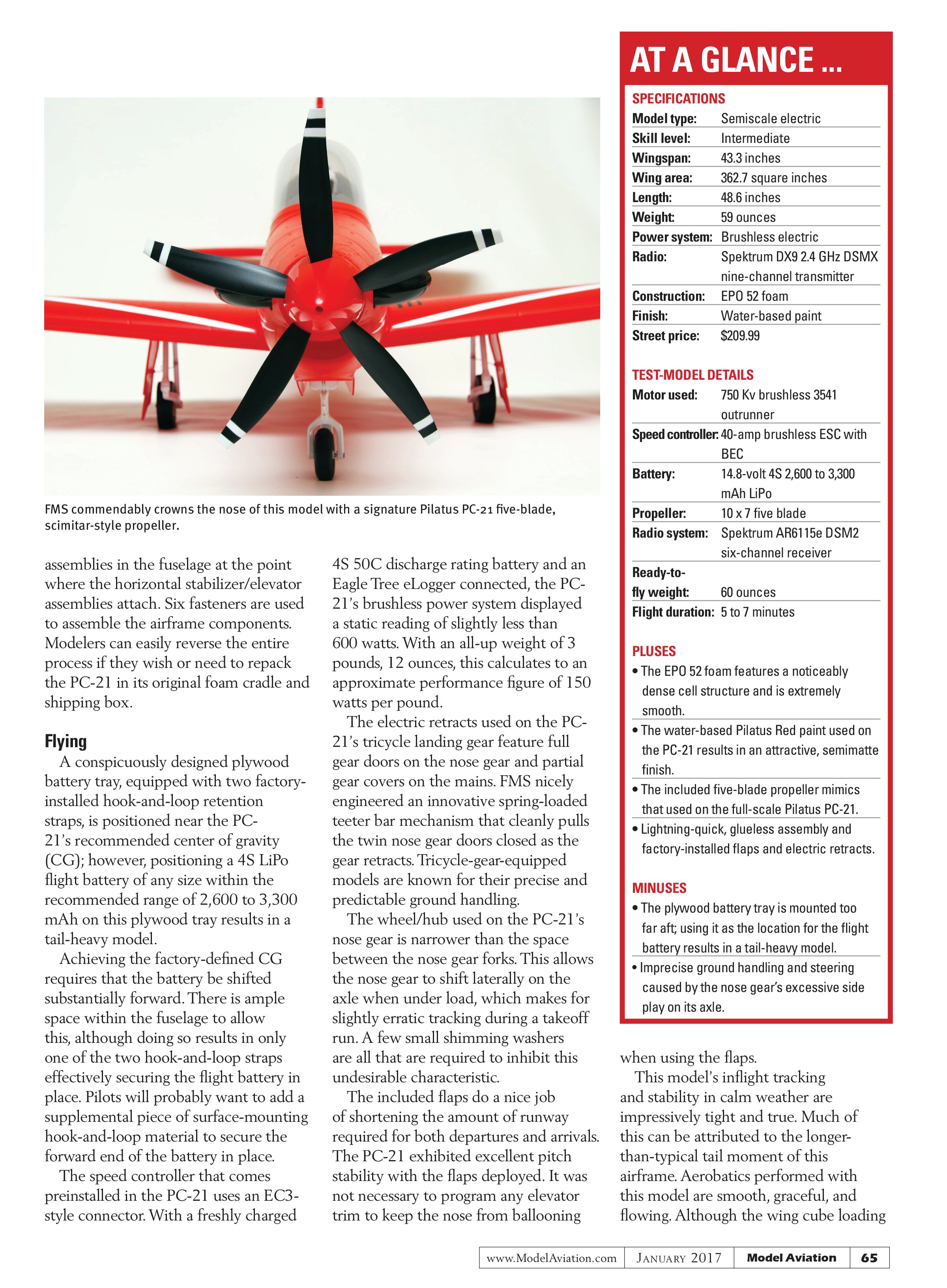
FMS deserves credit for including a cool-looking, scale outline-enhancing five-blade 10 x 7 propeller and spinner. Modelers need only to supply a minimum six-channel radio system and a 4S 14.8-volt 2,600-3,300 mAh LiPo flight battery to have the PC-21 ready for its first flights.
FMS notes that the company has spent some time re-engineering the foam cradles that its models come packed in to better protect the aircraft while in transit. The PC-21’s foam cradle appears to be manufactured from higher-density foam than what is typically used to manufacture the protective shipping cradle.
The airframe components are held snugly in place with the use of several removable foam wedge blocks. The fuselage on the review model did, however, exhibit a small amount of compression damage near its nose.
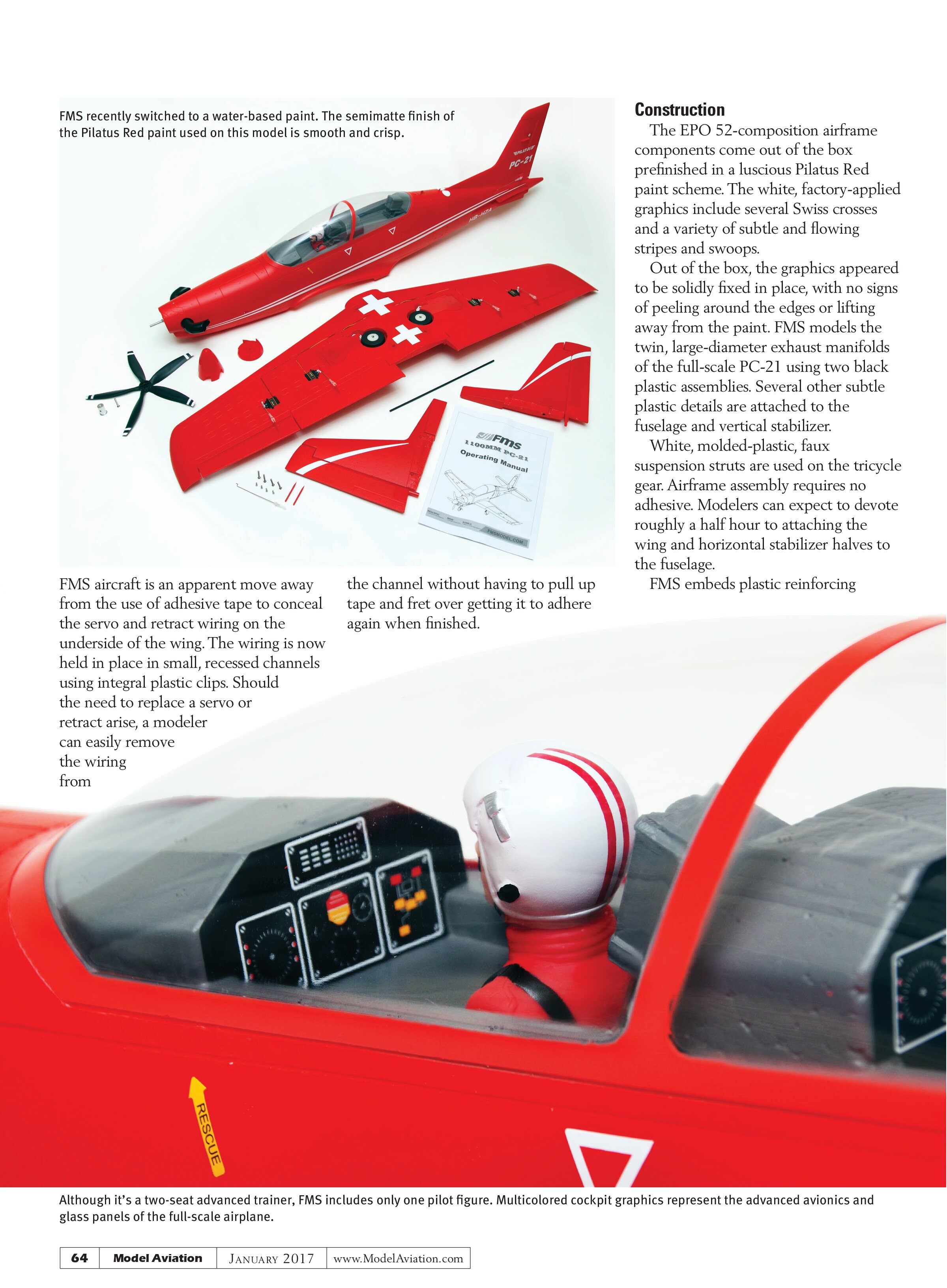
Another recent change in the FMS manufacturing process involves a shift away from oil-based paints. The PC-21 airframe components arrive slathered in brilliant paint that, according to FMS, is now water based.
The tight density and cell structure of the EPO 52 foam used on this model, combined with the semimatte finish of the paint, results in a smooth, clean-looking foam model. From 10 feet away, it is hard to tell that this is a foam-composition model!
Another notable change from past

FMS aircraft is an apparent move away from the use of adhesive tape to conceal the servo and retract wiring on the underside of the wing. The wiring is now held in place in small, recessed channels using integral plastic clips. Should the need to replace a servo or retract arise, a modeler can easily remove the wiring from the channel without having to pull up tape and fret over getting it to adhere again when finished.
Construction
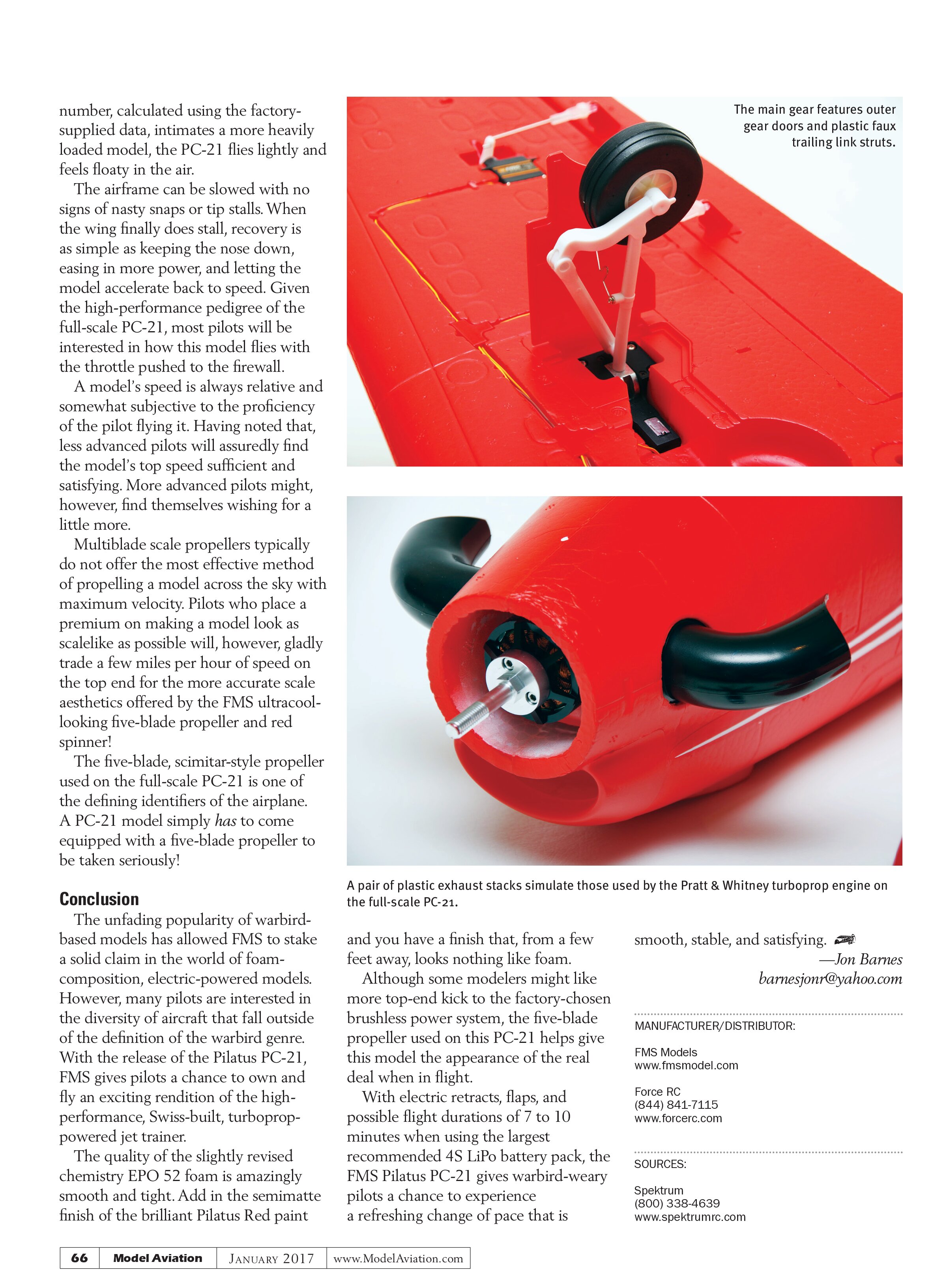
The EPO 52-composition airframe components come out of the box prefinished in a luscious Pilatus Red paint scheme. The white, factory-applied graphics include several Swiss crosses and a variety of subtle and flowing stripes and swoops. Out of the box, the graphics appeared to be solidly fixed in place, with no signs of peeling around the edges or lifting away from the paint. FMS models the twin, large-diameter exhaust manifolds of the full-scale PC-21 using two black plastic assemblies. Several other subtle plastic details are attached to the fuselage and vertical stabilizer. White, molded-plastic, faux suspension struts are used on the tricycle gear. Airframe assembly requires no adhesive. Modelers can expect to devote roughly a half hour to attaching the wing and horizontal stabilizer halves to the fuselage. FMS embeds plastic reinforcing
Although it’s a two-seat advanced trainer, FMS includes only one pilot figure. Multicolored cockpit graphics represent the advanced avionics and glass panels of the full-scale airplane.

FMS commendably crowns the nose of this model with a signature Pilatus PC-21 five-blade, scimitar-style propeller.
assemblies in the fuselage at the point where the horizontal stabilizer/elevator assemblies attach. Six fasteners are used to assemble the airframe components. Modelers can easily reverse the entire process if they wish or need to repack the PC-21 in its original foam cradle and shipping box.
Flying
A conspicuously designed plywood battery tray, equipped with two factory-installed hook-and-loop retention straps, is positioned near the PC-21’s recommended center of gravity (CG); however, positioning a 4S LiPo flight battery of any size within the recommended range of 2,600 to 3,300 mAh on this plywood tray results in a tail-heavy model.
Achieving the factory-defined CG requires that the battery be shifted substantially forward. There is ample space within the fuselage to allow this, although doing so results in only one of the two hook-and-loop straps effectively securing the flight battery in place. Pilots will probably want to add a supplemental piece of surface-mounting hook-and-loop material to secure the forward end of the battery in place.
The speed controller that comes preinstalled in the PC-21 uses an EC3-style connector. With a freshly charged 4S 50C discharge rating battery and an Eagle Tree eLogger connected, the PC-21’s brushless power system displayed a static reading of slightly less than 600 watts. With an all-up weight of 3 pounds, 12 ounces, this calculates to an approximate performance figure of 150 watts per pound.
The electric retracts used on the PC-21’s tricycle landing gear feature full gear doors on the nose gear and partial gear covers on the mains. FMS nicely engineered an innovative spring-loaded teeter bar mechanism that cleanly pulls the twin nose gear doors closed as the gear retracts. Tricycle-gear-equipped models are known for their precise and predictable ground handling.
The wheel/hub used on the PC-21’s nose gear is narrower than the space between the nose gear forks. This allows the nose gear to shift laterally on the axle when under load, which makes for slightly erratic tracking during a takeoff run. A few small shimming washers are all that are required to inhibit this undesirable characteristic.
The included flaps do a nice job of shortening the amount of runway required for both departures and arrivals. The PC-21 exhibited excellent pitch stability with the flaps deployed. It was not necessary to program any elevator trim to keep the nose from ballooning when using the flaps.
This model’s inflight tracking and stability in calm weather are impressively tight and true. Much of this can be attributed to the longer-than-typical tail moment of this airframe. Aerobatics performed with this model are smooth, graceful, and flowing. Although the wing cube loading
At a Glance ...
Specifications
Model type: Semiscale electric
Skill level: Intermediate
Wingspan: 43.3 inches
Wing area: 362.7 square inches
Length: 48.6 inches
Weight: 59 ounces
Power system: Brushless electric
Radio: Spektrum DX9 2.4 GHz DSMX nine-channel transmitter
Construction: EPO 52 foam
Finish: Water-based paint
Street price: $209.99
Test-model details
Motor used: 750 Kv brushless 3541 outrunner
Speed controller: 40-amp brushless ESC with BEC
Battery: 14.8-volt 4S 2,600 to 3,300 mAh LiPo
Propeller: 10 x 7 five blade
Radio system: Spektrum AR6115e DSM2 six-channel receiver
Ready-to-fly weight: 60 ounces
Flight duration: 5 to 7 minutes
Pluses
- The EPO 52 foam features a noticeably dense cell structure and is extremely smooth.
- The water-based Pilatus Red paint used on the PC-21 results in an attractive, semimatte finish.
- The included five-blade propeller mimics that used on the full-scale Pilatus PC-21.
- Lightning-quick, glueless assembly and factory-installed flaps and electric retracts.
Minuses
- The plywood battery tray is mounted too far aft; using it as the location for the flight battery results in a tail-heavy model.
- Imprecise ground handling and steering caused by the nose gear’s excessive side play on its axle.

number, calculated using the factory-supplied data, intimates a more heavily loaded model, the PC-21 flies lightly and feels floaty in the air.
The airframe can be slowed with no signs of nasty snaps or tip stalls. When the wing finally does stall, recovery is as simple as keeping the nose down, easing in more power, and letting the model accelerate back to speed. Given the high-performance pedigree of the full-scale PC-21, most pilots will be interested in how this model flies with the throttle pushed to the firewall.
A model’s speed is always relative and somewhat subjective to the proficiency of the pilot flying it. Having noted that, less advanced pilots will assuredly find the model’s top speed sufficient and satisfying. More advanced pilots might, however, find themselves wishing for a little more.

Multiblade scale propellers typically do not offer the most effective method of propelling a model across the sky with maximum velocity. Pilots who place a premium on making a model look as scalelike as possible will, however, gladly trade a few miles per hour of speed on the top end for the more accurate scale aesthetics offered by the FMS ultracool-looking five-blade propeller and red spinner!
The five-blade, scimitar-style propeller used on the full-scale PC-21 is one of the defining identifiers of the airplane. A PC-21 model simply has to come equipped with a five-blade propeller to be taken seriously!
Conclusion
The unfading popularity of warbird-based models has allowed FMS to stake a solid claim in the world of foam-composition, electric-powered models. However, many pilots are interested in the diversity of aircraft that fall outside of the definition of the warbird genre. With the release of the Pilatus PC-21, FMS gives pilots a chance to own and fly an exciting rendition of the high-performance, Swiss-built, turboprop-powered jet trainer.
The quality of the slightly revised chemistry EPO 52 foam is amazingly smooth and tight. Add in the semimatte finish of the brilliant Pilatus Red paint and you have a finish that, from a few feet away, looks nothing like foam.

Although some modelers might like more top-end kick to the factory-chosen brushless power system, the five-blade propeller used on this PC-21 helps give this model the appearance of the real deal when in flight.
With electric retracts, flaps, and possible flight durations of 7 to 10 minutes when using the largest recommended 4S LiPo battery pack, the FMS Pilatus PC-21 gives warbird-weary pilots a chance to experience a refreshing change of pace that is smooth, stable, and satisfying.
—Jon Barnes
barnesjonr@yahoo.com
MANUFACTURER/DISTRIBUTOR:
FMS Models
www.fmsmodel.com
Force RC
(844) 841-7115
www.forcerc.com
SOURCES:
Spektrum
(800) 338-4639
www.spektrumrc.com