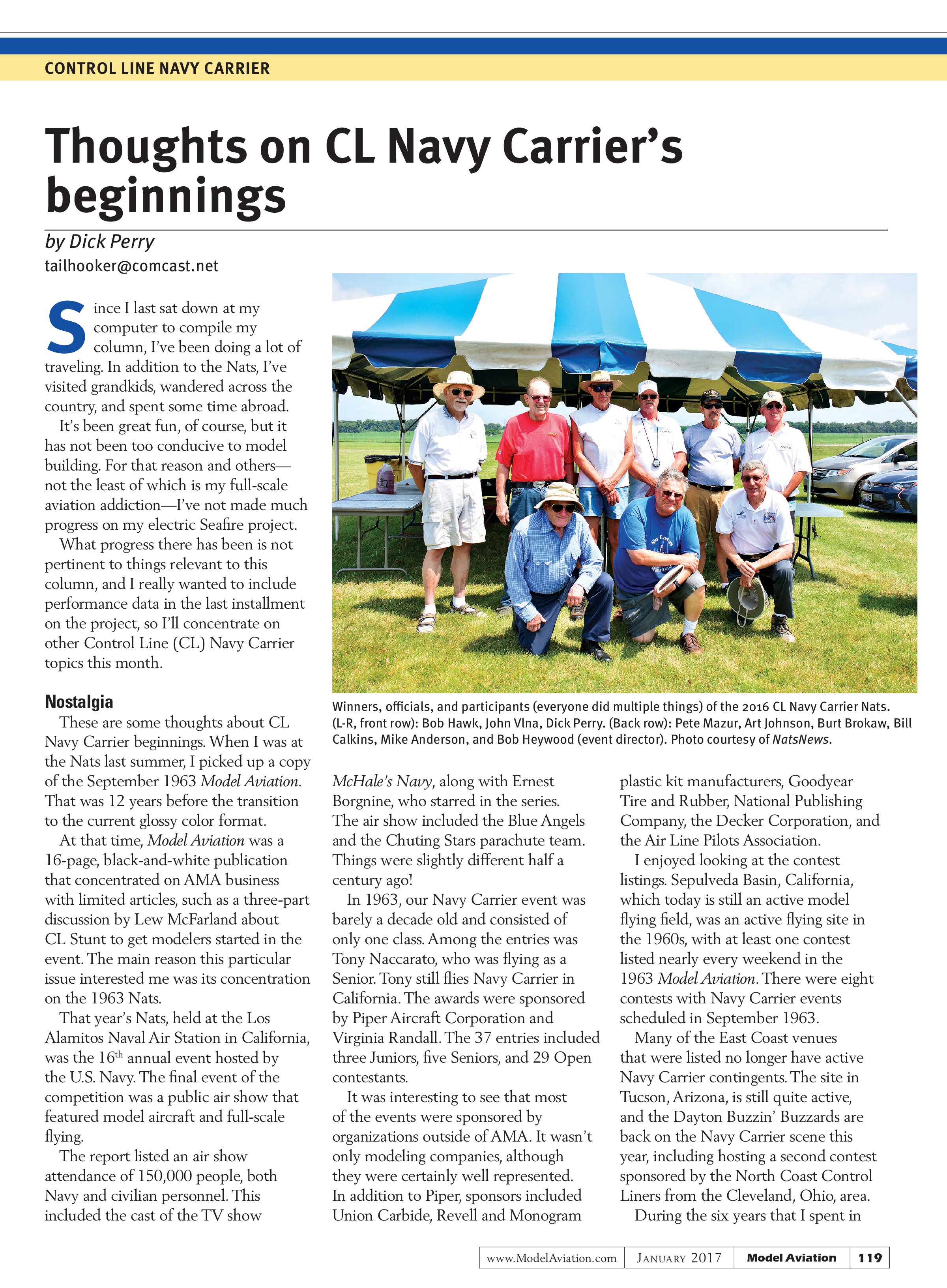
Thoughts on CL Navy Carrier’s beginnings
by Dick Perry
tailhooker@comcast.net
Since I last sat down at my computer to compile my column, I’ve been doing a lot of traveling. In addition to the Nats, I’ve visited grandkids, wandered across the country, and spent some time abroad. It’s been great fun, of course, but it has not been too conducive to model building. For that reason and others—not the least of which is my full-scale aviation addiction—I’ve not made much progress on my electric Seafire project. What progress there has been is not pertinent to things relevant to this column, and I really wanted to include performance data in the last installment on the project, so I’ll concentrate on other Control Line (CL) Navy Carrier topics this month.

Nostalgia
These are some thoughts about CL Navy Carrier beginnings. When I was at the Nats last summer, I picked up a copy of the September 1963 Model Aviation. That was 12 years before the transition to the current glossy color format.
At that time, Model Aviation was a 16-page, black-and-white publication that concentrated on AMA business with limited articles, such as a three-part discussion by Lew McFarland about CL Stunt to get modelers started in the event. The main reason this particular issue interested me was its concentration on the 1963 Nats.
That year’s Nats, held at the Los Alamitos Naval Air Station in California, was the 16th annual event hosted by the U.S. Navy. The final event of the competition was a public air show that featured model aircraft and full-scale flying.
The report listed an air show attendance of 150,000 people, both Navy and civilian personnel. This included the cast of the TV show McHale’s Navy, along with Ernest Borgnine, who starred in the series. The air show included the Blue Angels and the Chuting Stars parachute team. Things were slightly different half a century ago!
In 1963, our Navy Carrier event was barely a decade old and consisted of only one class. Among the entries was Tony Naccarato, who was flying as a Senior. Tony still flies Navy Carrier in California. The awards were sponsored by Piper Aircraft Corporation and Virginia Randall. The 37 entries included three Juniors, five Seniors, and 29 Open contestants.
It was interesting to see that most of the events were sponsored by organizations outside of AMA. It wasn’t only modeling companies, although they were certainly well represented. In addition to Piper, sponsors included Union Carbide, Revell and Monogram plastic kit manufacturers, Goodyear Tire and Rubber, National Publishing Company, the Decker Corporation, and the Air Line Pilots Association.
I enjoyed looking at the contest listings. Sepulveda Basin, California, which today is still an active model flying field, was an active flying site in the 1960s, with at least one contest listed nearly every weekend in the 1963 Model Aviation. There were eight contests with Navy Carrier events scheduled in September 1963.
Many of the East Coast venues that were listed no longer have active Navy Carrier contingents. The site in Tucson, Arizona, is still quite active, and the Dayton Buzzin’ Buzzards are back on the Navy Carrier scene this year, including hosting a second contest sponsored by the North Coast Control Liners from the Cleveland, Ohio, area.
During the six years that I spent in
Dayton, Ohio, I thoroughly enjoyed the Buzzin’ Buzzards club, as well as flying in Cleveland and Cincinnati. Since moving to the Southwest, I’ve tried to make annual trips to Tucson and Phoenix for Carrier contests a priority.
The 1963 Tucson contest, with Frank Townsend as the contest director, listed two classes, although there were not yet two classes written in the official rule book. The engine break point was at .37 cid for that contest.
There were modeling clubs sponsored by businesses as well, including American Airlines and Martin (later Martin Marietta then Lockheed Martin). There were reports on U.S. Air Force modeling activities in the United Kingdom—the Air Force team won the National Team Championship at the Nats.
Nats Analysis
I apologize for not having any commentary with the CL Navy Carrier NatsNews coverage this year. In previous years, it was difficult to accomplish the mutually exclusive tasks of photography, writing, officiating, competing, eating, and sleeping. I decided to fly this year, as well as officiate. With no volunteers forthcoming from our ranks to assume the photography and reporting duties, I elected to try competing, eating, and sleeping this time and abandoned the reporting and photography activities.
The Model Aviation staff filled in with their cameras so that CL Navy Carrier would not be completely neglected, and you were able to see the results in the daily NatsNews. I hope you were not too disappointed with the lack of commentary. I am still recruiting a Navy Carrier modeler to undertake the 2017 CL Navy Carrier NatsNews reporting. Let me know if you are interested.
In the Profile Carrier events, best high speed went to Burt Brokaw at 99.4 mph, with Pete Mazur achieving the best low speed at 282 seconds (6.4 mph). They placed first and second, respectively. Electric top speed honors went to John Vlna at 79.1 mph, with Pete Mazur slightly slower, but boasting a better low speed (210 seconds, 8.4 mph) to take first place.
In Class I and Class II, the trend was the same as in past years with electric high speeds lower than nitro high speeds, but the speeds were much closer with two thirds of the best speeds in all of the official classes breaking 100 mph. All were within 5 mph of one another.
In all three gas classes, there were more Nelson engines than any other, but they didn’t reach the top speed this year. That honor went to a SuperTigre G40 in Class I. That was followed by a Webra Speed .61 in Class II and a K&B 40S in Class I. The Nelson engines were all less than 100 mph this year. Unfortunately, most of the engines currently used in Navy Carrier are out of production, although they are often still available and occasionally, even in new condition.

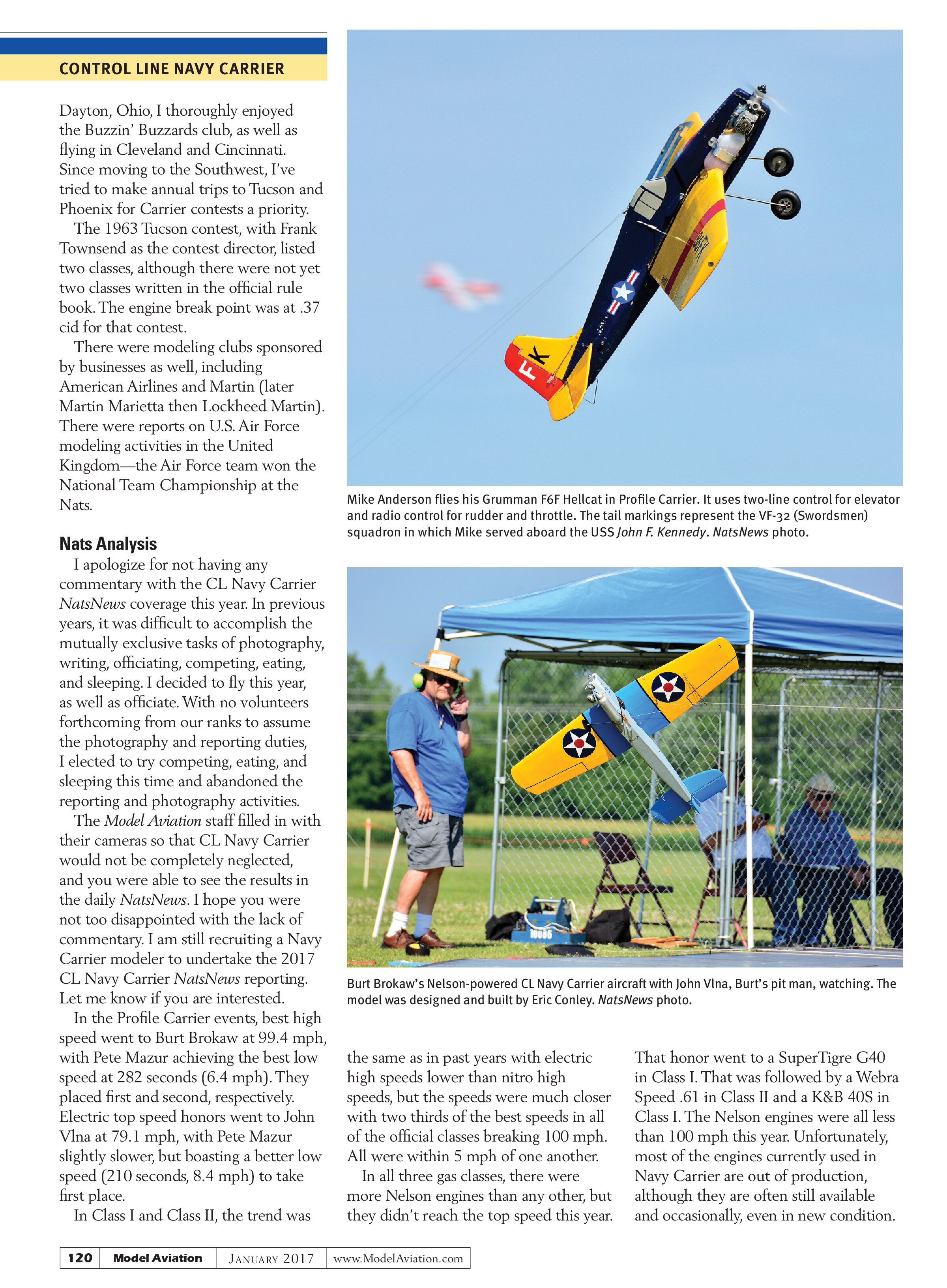
Mike Anderson flies his Grumman F6F Hellcat in Profile Carrier. It uses two-line control for elevator and radio control for rudder and throttle. The tail markings represent the VF-32 (Swordsmen) squadron in which Mike served aboard the USS John F. Kennedy. NatsNews photo.

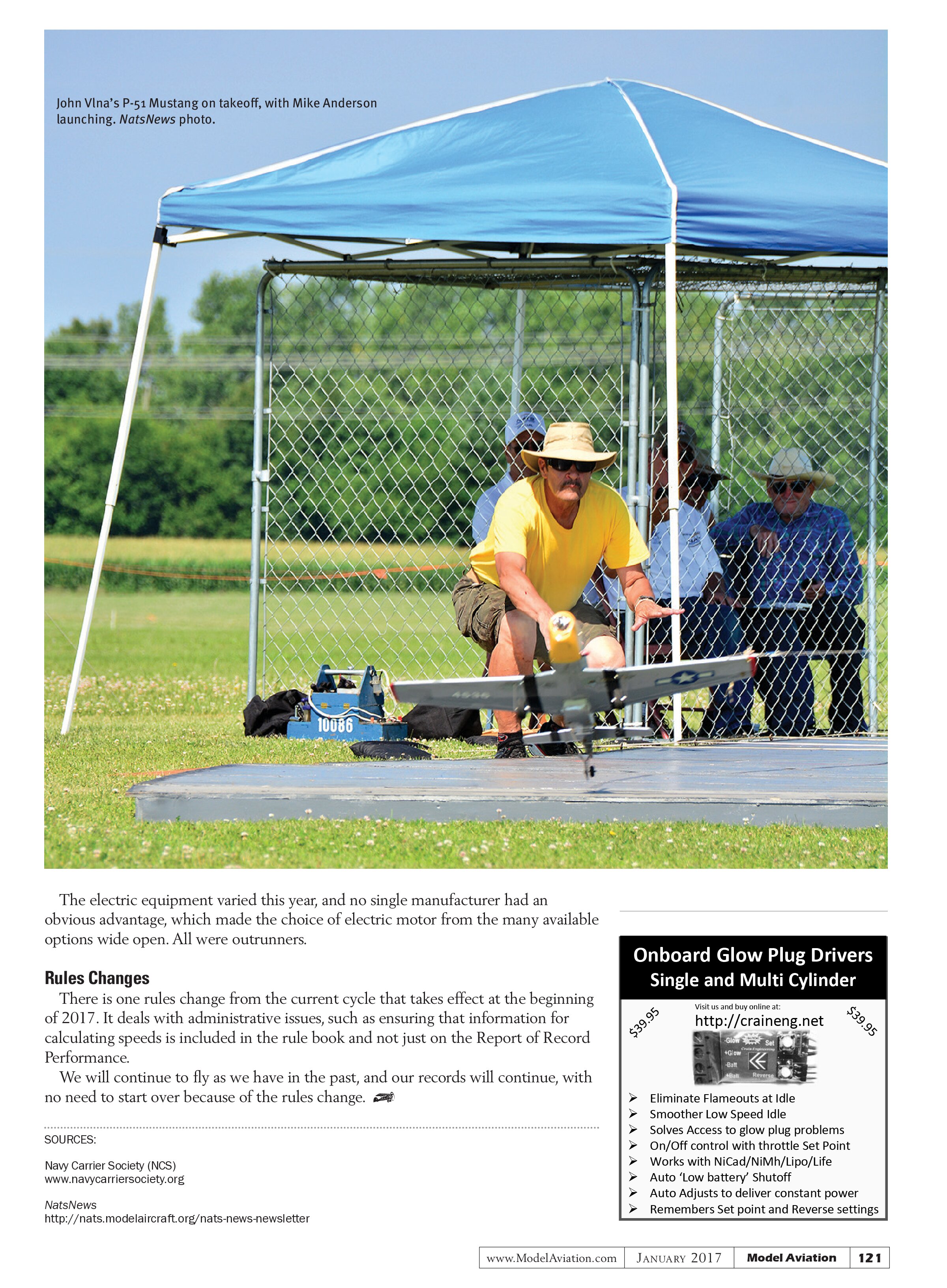
Burt Brokaw’s Nelson-powered CL Navy Carrier aircraft with John Vlna, Burt’s pit man, watching. The model was designed and built by Eric Conley. NatsNews photo.

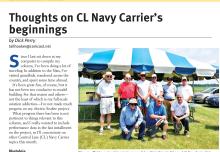
John Vlna’s P-51 Mustang on takeoff, with Mike Anderson launching. NatsNews photo.
The electric equipment varied this year, and no single manufacturer had an obvious advantage, which made the choice of electric motor from the many available options wide open. All were outrunners.
Rules Changes
There is one rules change from the current cycle that takes effect at the beginning of 2017. It deals with administrative issues, such as ensuring that information for calculating speeds is included in the rule book and not just on the Report of Record Performance.
We will continue to fly as we have in the past, and our records will continue, with no need to start over because of the rules change.
SOURCES:
Navy Carrier Society (NCS)
www.navycarriersociety.org