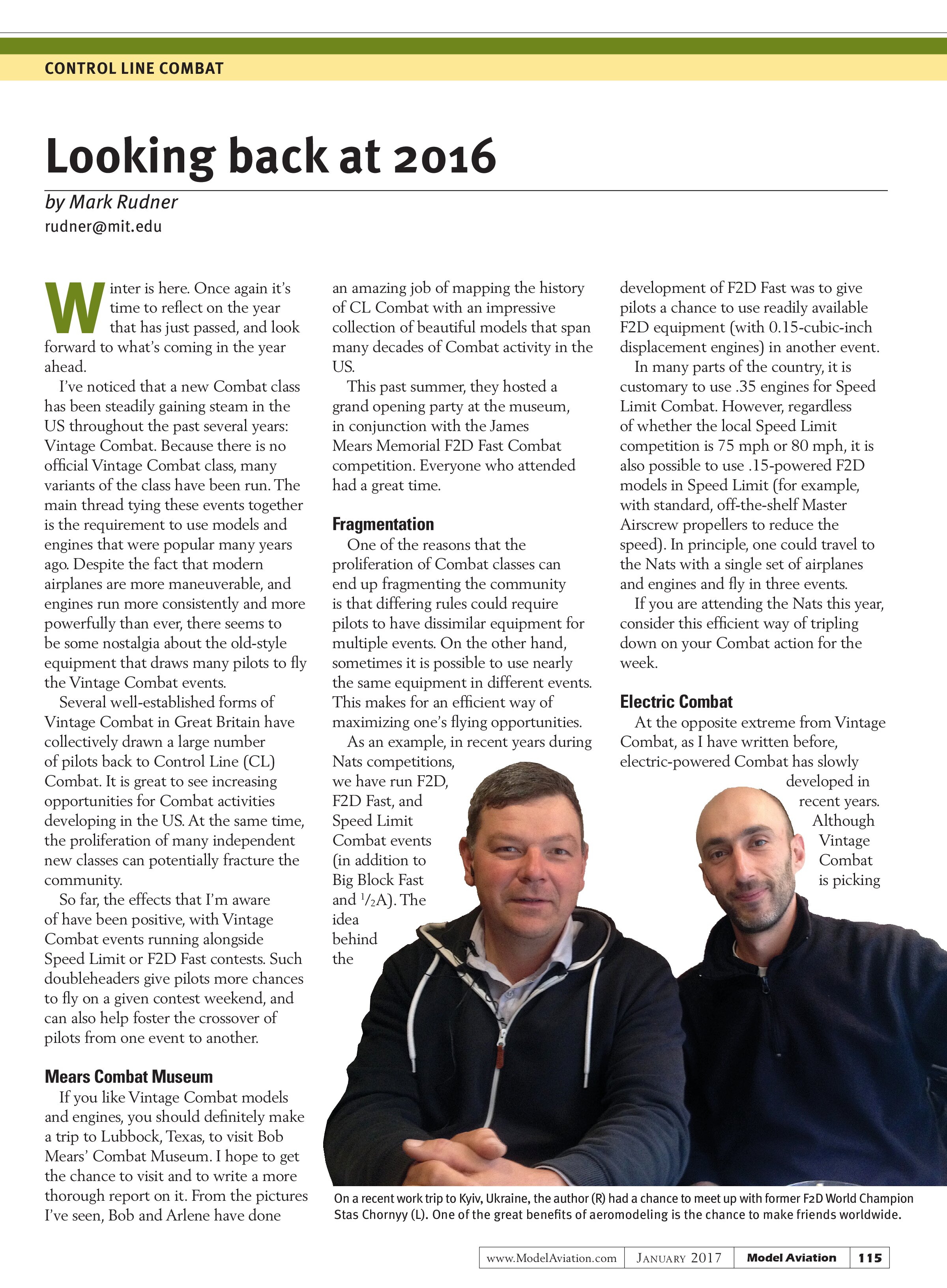
Looking back at 2016
by Mark Rudner
rudner@mit.edu
Winter is here. Once again it’s time to reflect on the year that has just passed, and look forward to what’s coming in the year ahead.
I’ve noticed that a new Combat class has been steadily gaining steam in the US throughout the past several years: Vintage Combat. Because there is no official Vintage Combat class, many variants of the class have been run. The main thread tying these events together is the requirement to use models and engines that were popular many years ago. Despite the fact that modern airplanes are more maneuverable, and engines run more consistently and more powerfully than ever, there seems to be some nostalgia about the old-style equipment that draws many pilots to fly the Vintage Combat events.
Several well-established forms of Vintage Combat in Great Britain have collectively drawn a large number of pilots back to Control Line (CL) Combat. It is great to see increasing opportunities for Combat activities developing in the US. At the same time, the proliferation of many independent new classes can potentially fracture the community.
So far, the effects that I’m aware of have been positive, with Vintage Combat events running alongside Speed Limit or F2D Fast contests. Such doubleheaders give pilots more chances to fly on a given contest weekend, and can also help foster the crossover of pilots from one event to another.
Mears Combat Museum
If you like Vintage Combat models and engines, you should definitely make a trip to Lubbock, Texas, to visit Bob Mears’ Combat Museum. I hope to get the chance to visit and to write a more thorough report on it. From the pictures I’ve seen, Bob and Arlene have done
an amazing job of mapping the history of CL Combat with an impressive collection of beautiful models that span many decades of Combat activity in the US.
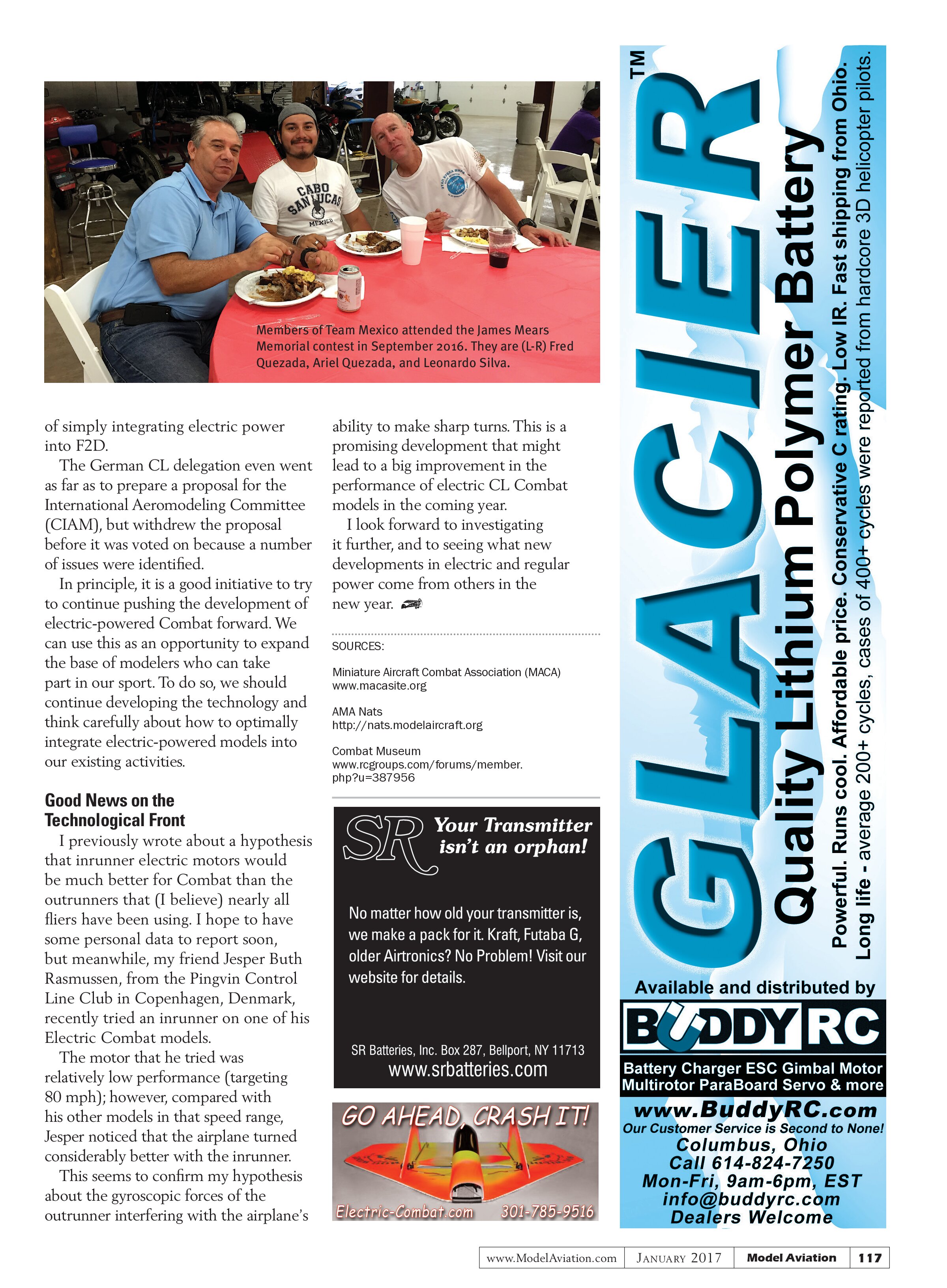
This past summer, they hosted a grand opening party at the museum, in conjunction with the James Mears Memorial F2D Fast Combat competition. Everyone who attended had a great time.
Fragmentation
One of the reasons that the proliferation of Combat classes can end up fragmenting the community is that differing rules could require pilots to have dissimilar equipment for multiple events. On the other hand, sometimes it is possible to use nearly the same equipment in different events. This makes for an efficient way of maximizing one’s flying opportunities.
As an example, in recent years during Nats competitions, we have run F2D, F2D Fast, and Speed Limit Combat events (in addition to Big Block Fast and ½A). The idea behind the development of F2D Fast was to give pilots a chance to use readily available F2D equipment (with 0.15-cubic-inch displacement engines) in another event.
In many parts of the country, it is customary to use .35 engines for Speed Limit Combat. However, regardless of whether the local Speed Limit competition is 75 mph or 80 mph, it is also possible to use .15-powered F2D models in Speed Limit (for example, with standard, off-the-shelf Master Airscrew propellers to reduce the speed). In principle, one could travel to the Nats with a single set of airplanes and engines and fly in three events.
If you are attending the Nats this year, consider this efficient way of tripling down on your Combat action for the week.
Electric Combat
At the opposite extreme from Vintage Combat, as I have written before, electric-powered Combat has slowly developed in recent years. Although Vintage Combat is picking


of simply integrating electric power into F2D.
The German CL delegation even went as far as to prepare a proposal for the International Aeromodeling Committee (CIAM), but withdrew the proposal before it was voted on because a number of issues were identified.
In principle, it is a good initiative to try to continue pushing the development of electric-powered Combat forward. We can use this as an opportunity to expand the base of modelers who can take part in our sport. To do so, we should continue developing the technology and think carefully about how to optimally integrate electric-powered models into our existing activities.
Good News on the Technological Front
I previously wrote about a hypothesis that inrunner electric motors would be much better for Combat than the outrunners that (I believe) nearly all fliers have been using. I hope to have some personal data to report soon, but meanwhile, my friend Jesper Buth Rasmussen, from the Pingvin Control Line Club in Copenhagen, Denmark, recently tried an inrunner on one of his Electric Combat models.
The motor that he tried was relatively low performance (targeting 80 mph); however, compared with his other models in that speed range, Jesper noticed that the airplane turned considerably better with the inrunner.
This seems to confirm my hypothesis about the gyroscopic forces of the outrunner interfering with the airplane’s ability to make sharp turns. This is a promising development that might lead to a big improvement in the performance of electric CL Combat models in the coming year.
I look forward to investigating it further, and to seeing what new developments in electric and regular power come from others in the new year.
SOURCES:
Miniature Aircraft Combat Association (MACA)
www.mac asite.org
AMA Nats
http://nats.modelaircraft.org
Combat Museum
www.rcgroups.com/forums/member.php?u=387956