Faster building techniques
Thayer Syme
thayer@flying-models.com

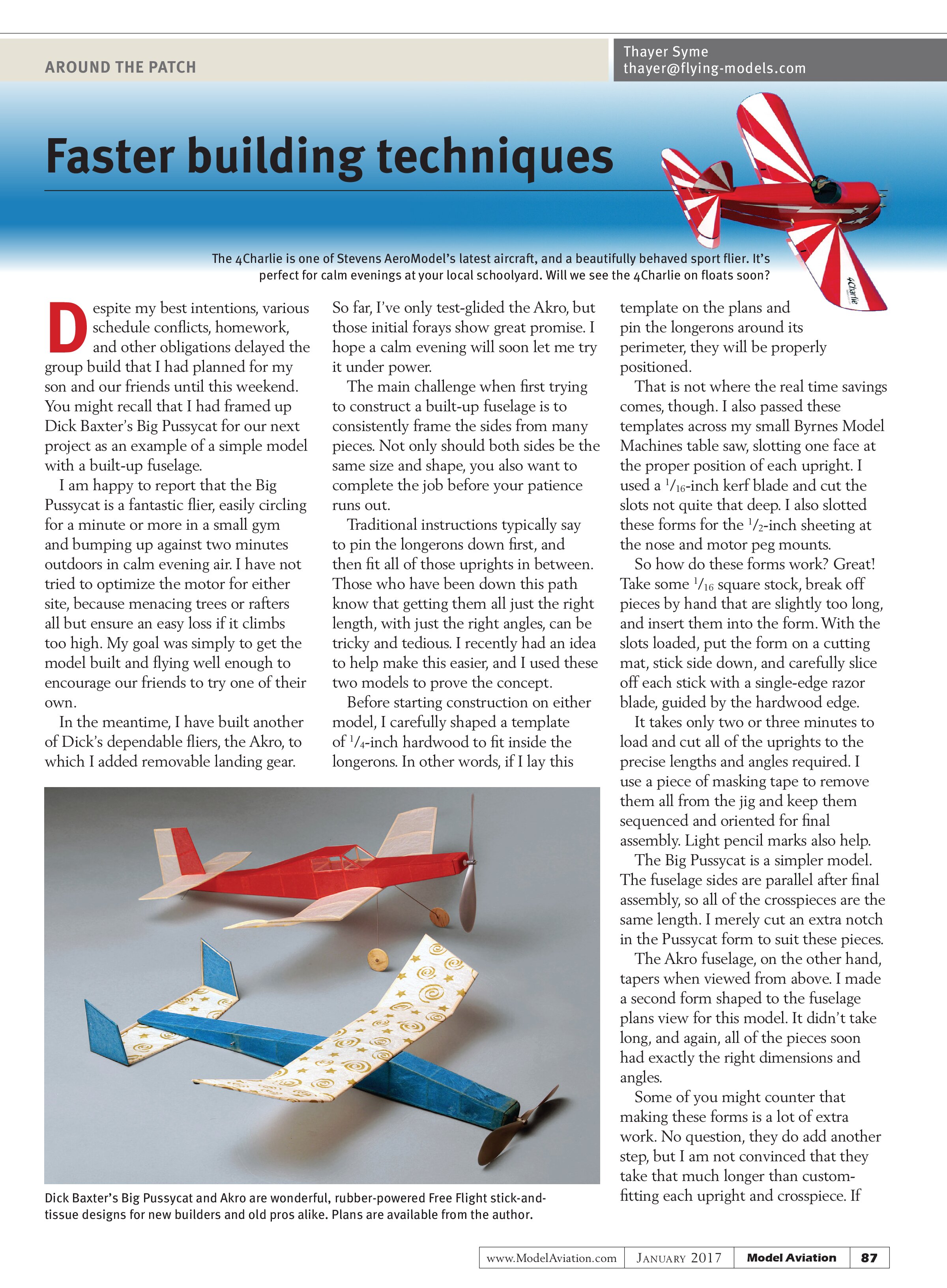
The 4Charlie is one of Stevens AeroModel’s latest aircraft, and a beautifully behaved sport flier. It’s perfect for calm evenings at your local schoolyard. Will we see the 4Charlie on floats soon?
Despite my best intentions, various schedule conflicts, homework, and other obligations delayed the group build that I had planned for my son and our friends until this weekend. You might recall that I had framed up Dick Baxter’s Big Pussycat for our next project as an example of a simple model with a built-up fuselage.
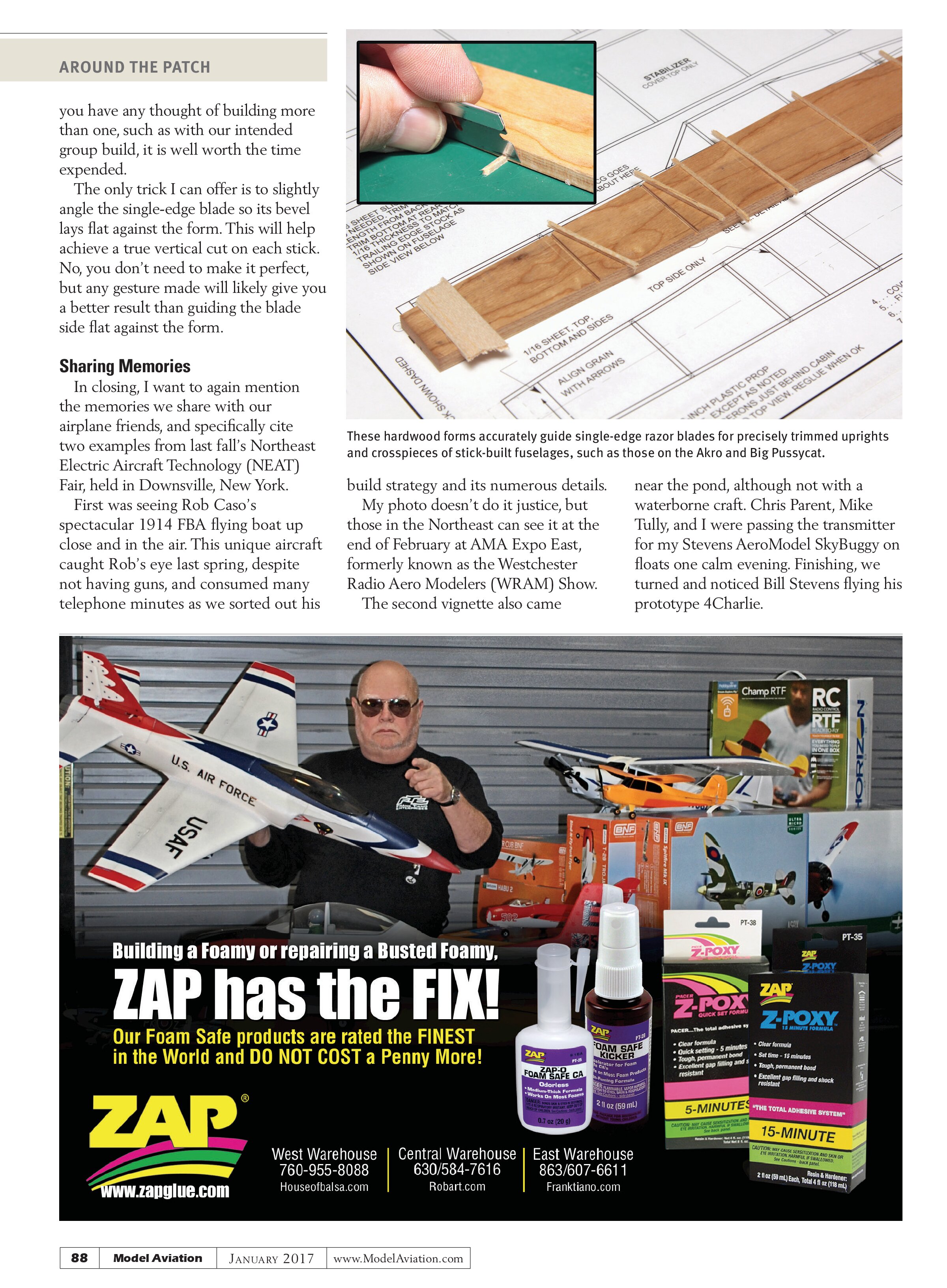
I am happy to report that the Big Pussycat is a fantastic flier, easily circling for a minute or more in a small gym and bumping up against two minutes outdoors in calm evening air. I have not tried to optimize the motor for either site, because menacing trees or rafters all but ensure an easy loss if it climbs too high. My goal was simply to get the model built and flying well enough to encourage our friends to try one of their own.
In the meantime, I have built another of Dick’s dependable fliers, the Akro, to which I added removable landing gear.
So far, I’ve only test-glided the Akro, but those initial forays show great promise. I hope a calm evening will soon let me try it under power.
The main challenge when first trying to construct a built-up fuselage is to consistently frame the sides from many pieces. Not only should both sides be the same size and shape, you also want to complete the job before your patience runs out.
Traditional instructions typically say to pin the longerons down first, and then fit all of those uprights in between. Those who have been down this path know that getting them all just the right length, with just the right angles, can be tricky and tedious. I recently had an idea to help make this easier, and I used these two models to prove the concept.
Before starting construction on either model, I carefully shaped a template of 1/4-inch hardwood to fit inside the longerons. In other words, if I lay this

Dick Baxter’s Big Pussycat and Akro are wonderful, rubber-powered Free Flight stick-and-tissue designs for new builders and old pros alike. Plans are available from the author.
template on the plans and pin the longerons around its perimeter, they will be properly positioned.
That is not where the real time savings comes, though. I also passed these templates across my small Byrnes Model Machines table saw, slotting one face at the proper position of each upright. I used a 1/16-inch kerf blade and cut the slots not quite that deep. I also slotted these forms for the 1/2-inch sheeting at the nose and motor peg mounts.
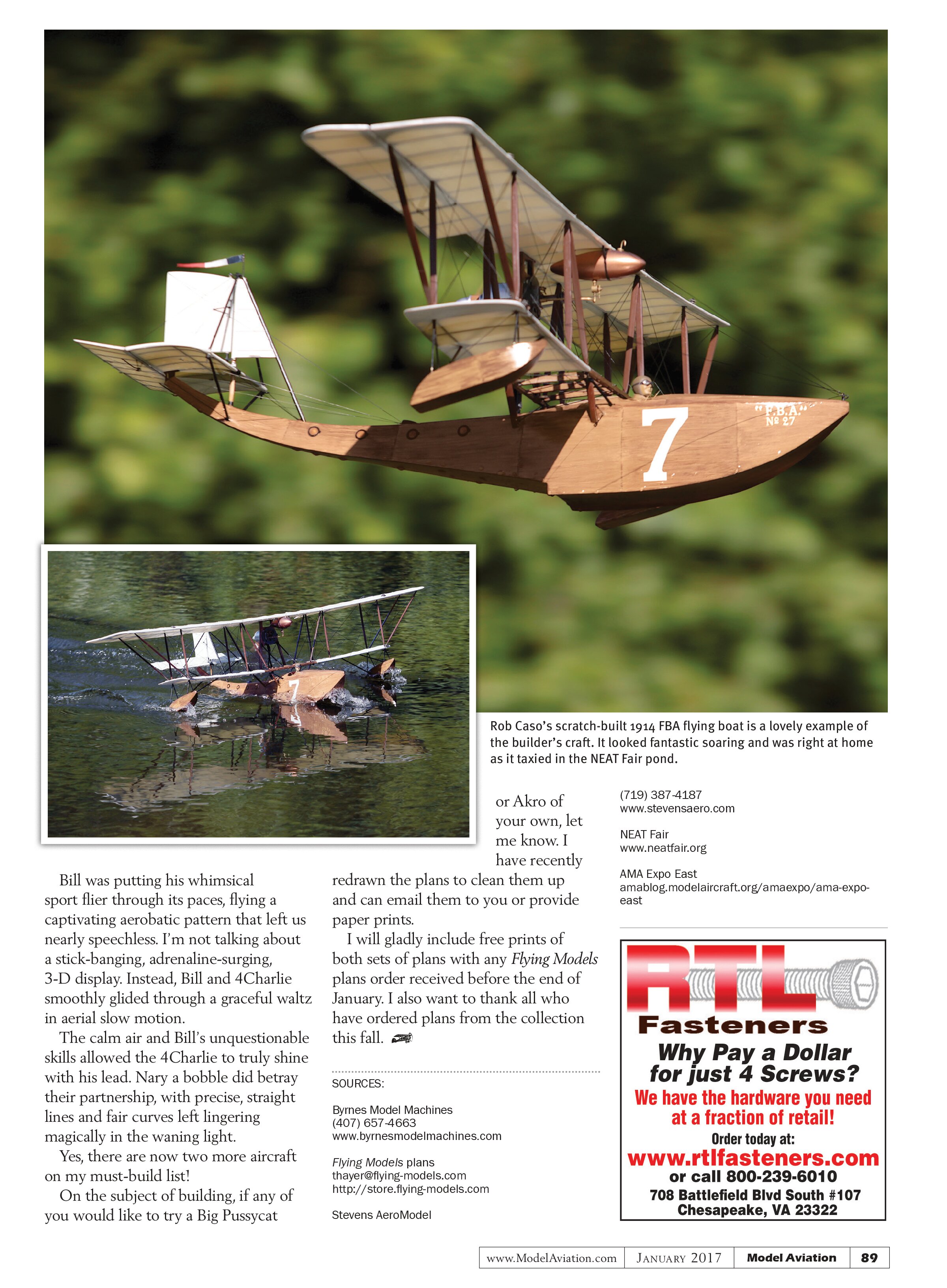
So how do these forms work? Great! Take some 1/16 square stock, break off pieces by hand that are slightly too long, and insert them into the form. With the slots loaded, put the form on a cutting mat, stick side down, and carefully slice off each stick with a single-edge razor blade, guided by the hardwood edge.
It takes only two or three minutes to load and cut all of the uprights to the precise lengths and angles required. I use a piece of masking tape to remove them all from the jig and keep them sequenced and oriented for final assembly. Light pencil marks also help.
The Big Pussycat is a simpler model. The fuselage sides are parallel after final assembly, so all of the crosspieces are the same length. I merely cut an extra notch in the Pussycat form to suit these pieces.
The Akro fuselage, on the other hand, tapers when viewed from above. I made a second form shaped to the fuselage plans view for this model. It didn’t take long, and again, all of the pieces soon had exactly the right dimensions and angles.
Some of you might counter that making these forms is a lot of extra work. No question, they do add another step, but I am not convinced that they take that much longer than custom-fitting each upright and crosspiece. If
you have any thought of building more than one, such as with our intended group build, it is well worth the time expended.
The only trick I can offer is to slightly angle the single-edge blade so its bevel lays flat against the form. This will help achieve a true vertical cut on each stick. No, you don’t need to make it perfect, but any gesture made will likely give you a better result than guiding the blade side flat against the form.
Sharing Memories
In closing, I want to again mention the memories we share with our airplane friends, and specifically cite two examples from last fall’s Northeast Electric Aircraft Technology (NEAT) Fair, held in Downsville, New York.
First was seeing Rob Caso’s spectacular 1914 FBA flying boat up close and in the air. This unique aircraft caught Rob’s eye last spring, despite not having guns, and consumed many telephone minutes as we sorted out his build strategy and its numerous details.


My photo doesn’t do it justice, but those in the Northeast can see it at the end of February at AMA Expo East, formerly known as the Westchester Radio Aero Modelers (WRAM) Show.
The second vignette also came near the pond, although not with a waterborne craft. Chris Parent, Mike Tully, and I were passing the transmitter for my Stevens AeroModel SkyBuggy on floats one calm evening. Finishing, we turned and noticed Bill Stevens flying his prototype 4Charlie.


Rob Caso’s scratch-built 1914 FBA flying boat is a lovely example of the builder’s craft. It looked fantastic soaring and was right at home as it taxied in the NEAT Fair pond.
Bill was putting his whimsical sport flier through its paces, flying a captivating aerobatic pattern that left us nearly speechless. I’m not talking about a stick-banging, adrenaline-surging, 3-D display. Instead, Bill and 4Charlie smoothly glided through a graceful waltz in aerial slow motion.
The calm air and Bill’s unquestionable skills allowed the 4Charlie to truly shine with his lead. Nary a bobble did betray their partnership, with precise, straight lines and fair curves left lingering magically in the waning light.
Yes, there are now two more aircraft on my must-build list!
On the subject of building, if any of you would like to try a Big Pussycat or Akro of your own, let me know. I have recently redrawn the plans to clean them up and can email them to you or provide paper prints.
I will gladly include free prints of both sets of plans with any Flying Models plans order received before the end of January. I also want to thank all who have ordered plans from the collection this fall.
SOURCES:
Byrnes Model Machines
(407) 657-4663
www.byrnesmodelmachines.com
Flying Models plans
thayer@flying-models.com
http://store.flying-models.com
Stevens AeroModel
(719) 387-4187
www.stevensaero.com
NEAT Fair
www.neatfair.org
AMA Expo East
amablog.modelaircraft.org/amaexpo/ama-expo-east