The sky is open for business
Patrick Sherman
lucidity@roswellflighttestcrew.com

Becoming a professional pilot means living up to professional standards. As in every other field of human endeavor, drone pilots must possess knowledge and skills that are an explicit requirement of their profession, as well as the best practices that aren’t listed in any rule book, but make the difference between success and failure.
To call yourself a professional pilot, you must be at least 16 years old or be instructed by someone 16 years old or older who possesses a Part 107 certificate, pass a background check by the Transportation Security Administration (TSA), and possess a Part 107 certificate from the FAA, which demonstrates you are a qualified Remote Pilot In Command (RPIC). Earning that certificate means taking a 60-question, multiple-choice test of aeronautical knowledge for two hours at an approved testing center, and passing it with a minimum score of 70%.
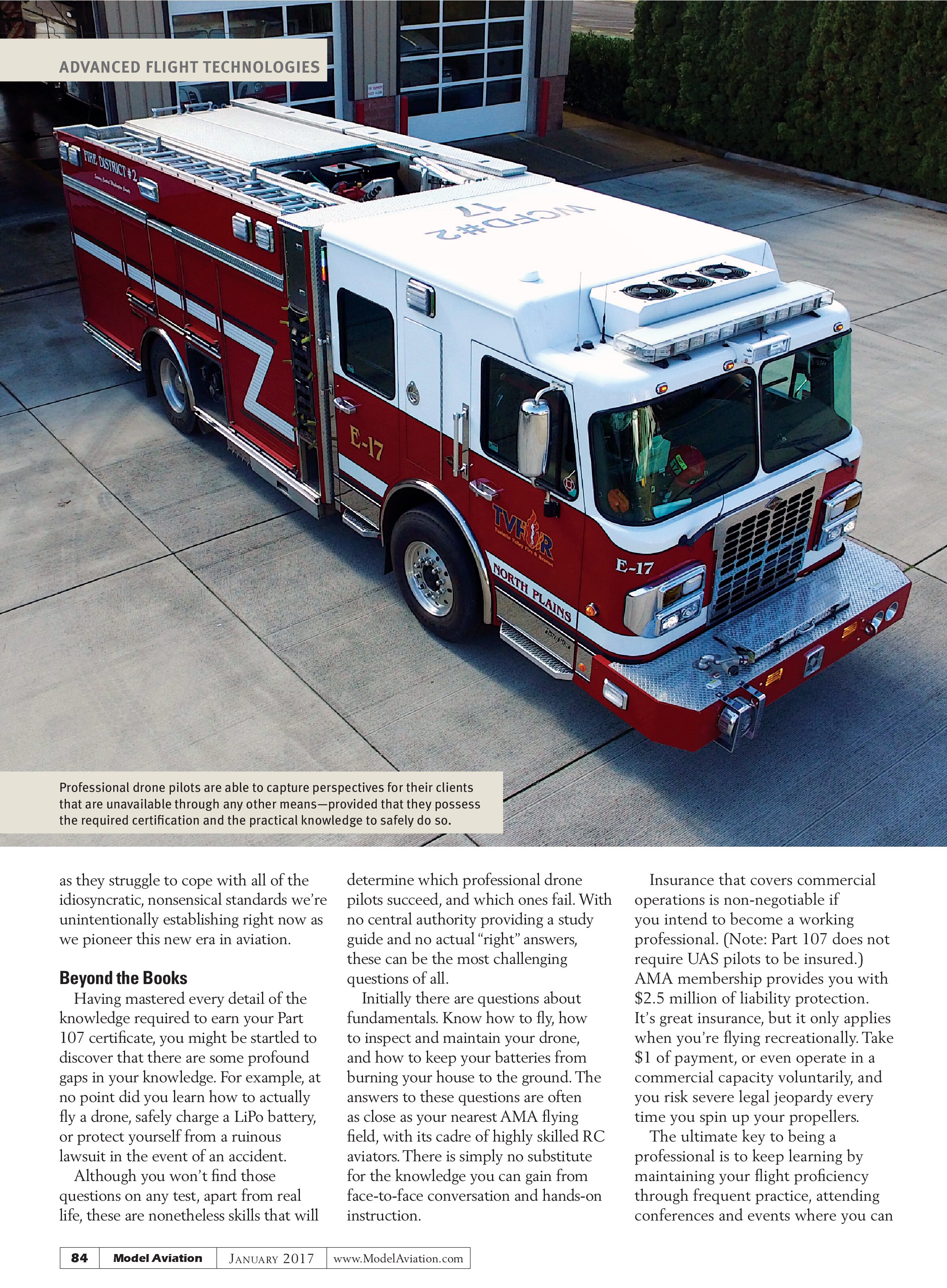
The test covers a range of topics, including reading charts and understanding the airspace system, the fundamentals of meteorology, the physics of flight, rules and regulations, crew resource management, and physiological and psychological factors that influence the safety of flight, emergency procedures, and more.
Being an experienced modeler or a skilled drone pilot won’t be enough to pass this test. There is specific, technical knowledge you must possess in order to be successful, such as decoding a Meteorological Terminal Aviation Routine Weather Report, known to pilots as a METAR. Here is an example:
METAR KGGG 161753Z AUTO
14021G26KT 3/4SM +TSRA BR
BKN008 OVC012CB 18/17 A2970
RMK PRESFR
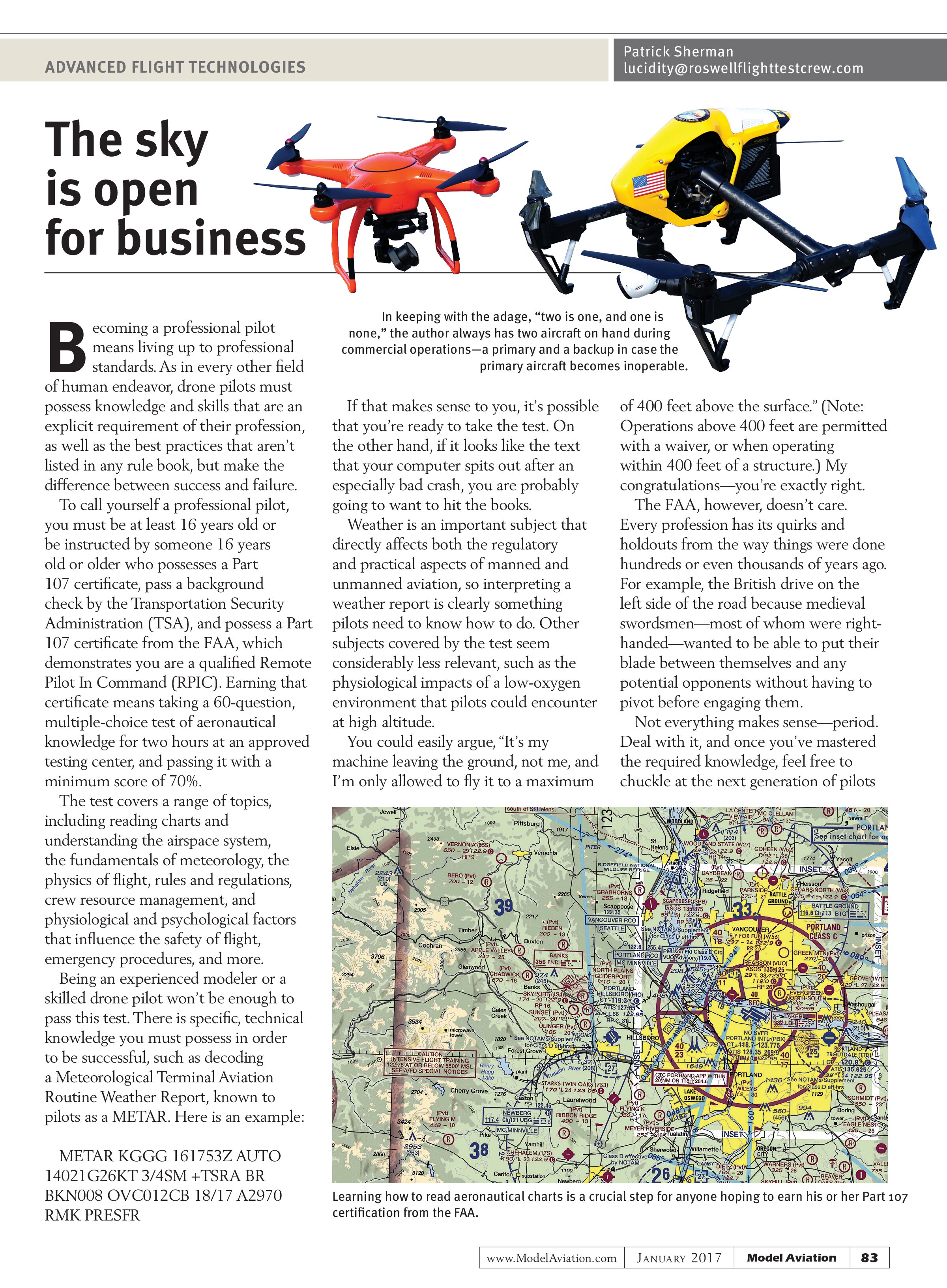
In keeping with the adage, “two is one, and one is none,” the author always has two aircraft on hand during commercial operations—a primary and a backup in case the primary aircraft becomes inoperable.
If that makes sense to you, it’s possible that you’re ready to take the test. On the other hand, if it looks like the text that your computer spits out after an especially bad crash, you are probably going to want to hit the books.
Weather is an important subject that directly affects both the regulatory and practical aspects of manned and unmanned aviation, so interpreting a weather report is clearly something pilots need to know how to do. Other subjects covered by the test seem considerably less relevant, such as the physiological impacts of a low-oxygen environment that pilots could encounter at high altitude.
You could easily argue, “It’s my machine leaving the ground, not me, and I’m only allowed to fly it to a maximum

of 400 feet above the surface.” (Note: Operations above 400 feet are permitted with a waiver, or when operating within 400 feet of a structure.) My congratulations—you’re exactly right.
The FAA, however, doesn’t care. Every profession has its quirks and holdouts from the way things were done hundreds or even thousands of years ago. For example, the British drive on the left side of the road because medieval swordsmen—most of whom were right-handed—wanted to be able to put their blade between themselves and any potential opponents without having to pivot before engaging them.
Not everything makes sense—period. Deal with it, and once you’ve mastered the required knowledge, feel free to chuckle at the next generation of pilots

as they struggle to cope with all of the idiosyncratic, nonsensical standards we’re unintentionally establishing right now as we pioneer this new era in aviation.
Beyond the Books
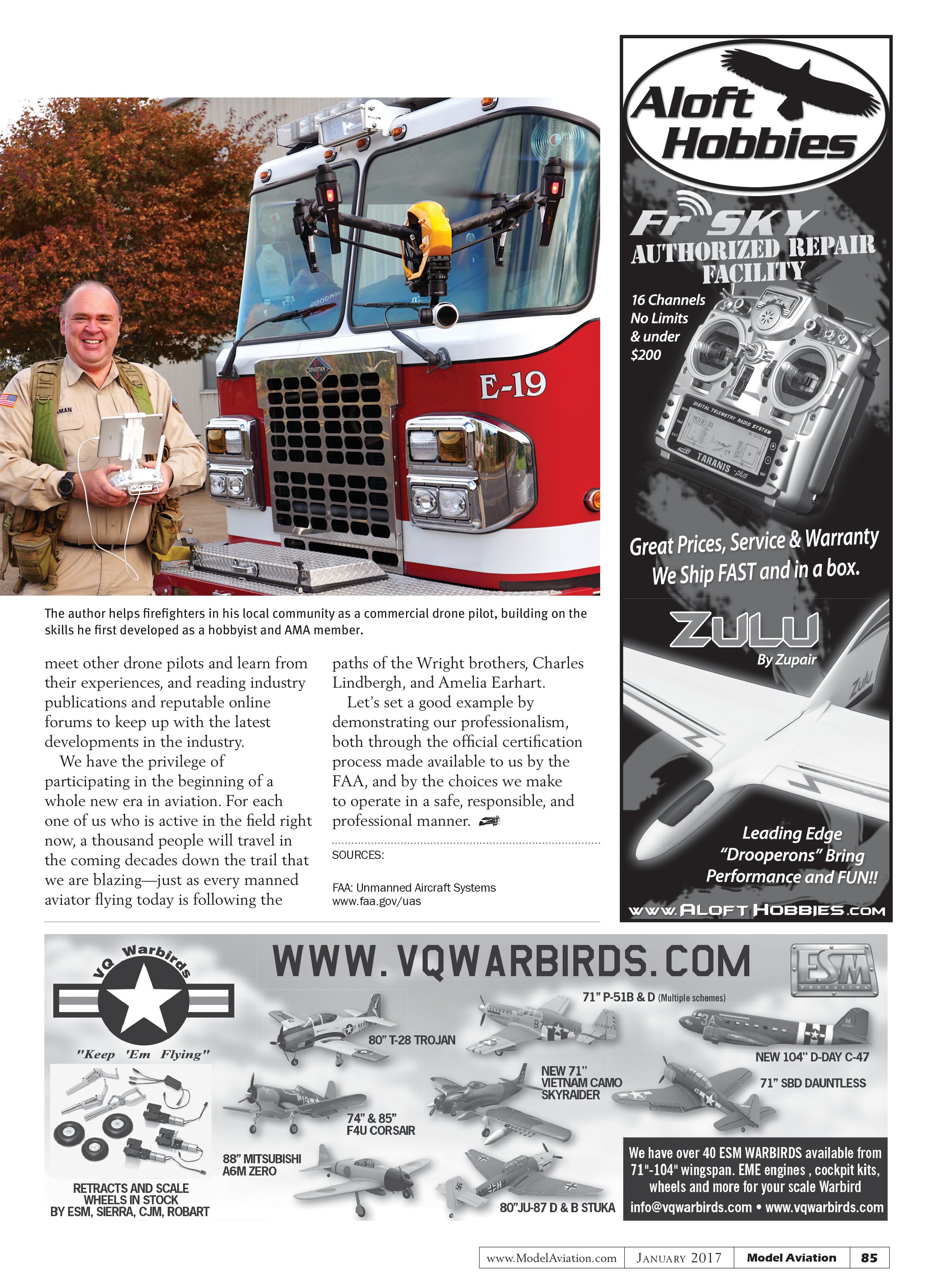
Having mastered every detail of the knowledge required to earn your Part 107 certificate, you might be startled to discover that there are some profound gaps in your knowledge. For example, at no point did you learn how to actually fly a drone, safely charge a LiPo battery, or protect yourself from a ruinous lawsuit in the event of an accident.
Although you won’t find those questions on any test, apart from real life, these are nonetheless skills that will
determine which professional drone pilots succeed, and which ones fail. With no central authority providing a study guide and no actual “right” answers, these can be the most challenging questions of all.
Initially there are questions about fundamentals. Know how to fly, how to inspect and maintain your drone, and how to keep your batteries from burning your house to the ground. The answers to these questions are often as close as your nearest AMA flying field, with its cadre of highly skilled RC aviators. There is simply no substitute for the knowledge you can gain from face-to-face conversation and hands-on instruction.
Insurance that covers commercial operations is non-negotiable if you intend to become a working professional. (Note: Part 107 does not require UAS pilots to be insured.) AMA membership provides you with $2.5 million of liability protection. It’s great insurance, but it only applies when you’re flying recreationally. Take $1 of payment, or even operate in a commercial capacity voluntarily, and you risk severe legal jeopardy every time you spin up your propellers. The ultimate key to being a professional is to keep learning by maintaining your flight proficiency through frequent practice, attending conferences and events where you can

meet other drone pilots and learn from their experiences, and reading industry publications and reputable online forums to keep up with the latest developments in the industry.
We have the privilege of participating in the beginning of a whole new era in aviation. For each one of us who is active in the field right now, a thousand people will travel in the coming decades down the trail that we are blazing—just as every manned aviator flying today is following the
paths of the Wright brothers, Charles Lindbergh, and Amelia Earhart.
Let’s set a good example by demonstrating our professionalism, both through the official certification process made available to us by the FAA, and by the choices we make to operate in a safe, responsible, and professional manner.
SOURCES:
FAA: Unmanned Aircraft Systems
www.faa.gov/uas