Converting sheet foam into a Torpedo
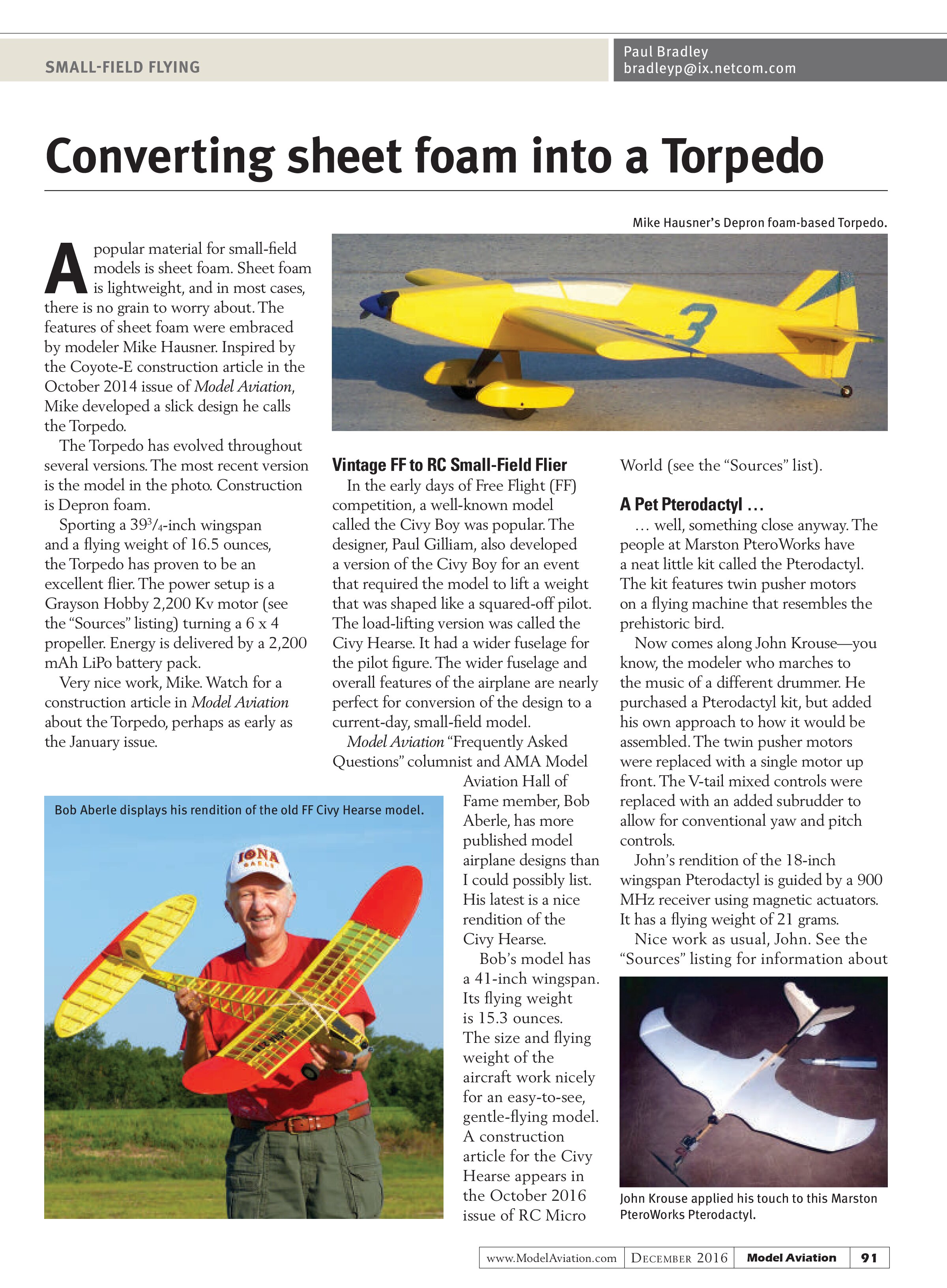
A popular material for small-field models is sheet foam. Sheet foam is lightweight, and in most cases, there is no grain to worry about. The features of sheet foam were embraced by modeler Mike Hausner. Inspired by the Coyote-E construction article in the October 2014 issue of Model Aviation, Mike developed a slick design he calls the Torpedo.
The Torpedo has evolved throughout several versions. The most recent version is the model in the photo. Construction is Depron foam.
Sporting a 39¾-inch wingspan and a flying weight of 16.5 ounces, the Torpedo has proven to be an excellent flier. The power setup is a Grayson Hobby 2,200 Kv motor (see the “Sources” listing) turning a 6 x 4 propeller. Energy is delivered by a 2,200 mAh LiPo battery pack.
Very nice work, Mike. Watch for a construction article in Model Aviation about the Torpedo, perhaps as early as the January issue.


Vintage FF to RC Small-Field Flier
In the early days of Free Flight (FF) competition, a well-known model called the Civy Boy was popular. The designer, Paul Gilliam, also developed a version of the Civy Boy for an event that required the model to lift a weight that was shaped like a squared-off pilot. The load-lifting version was called the Civy Hearse. It had a wider fuselage for the pilot figure. The wider fuselage and overall features of the airplane are nearly perfect for conversion of the design to a current-day, small-field model.
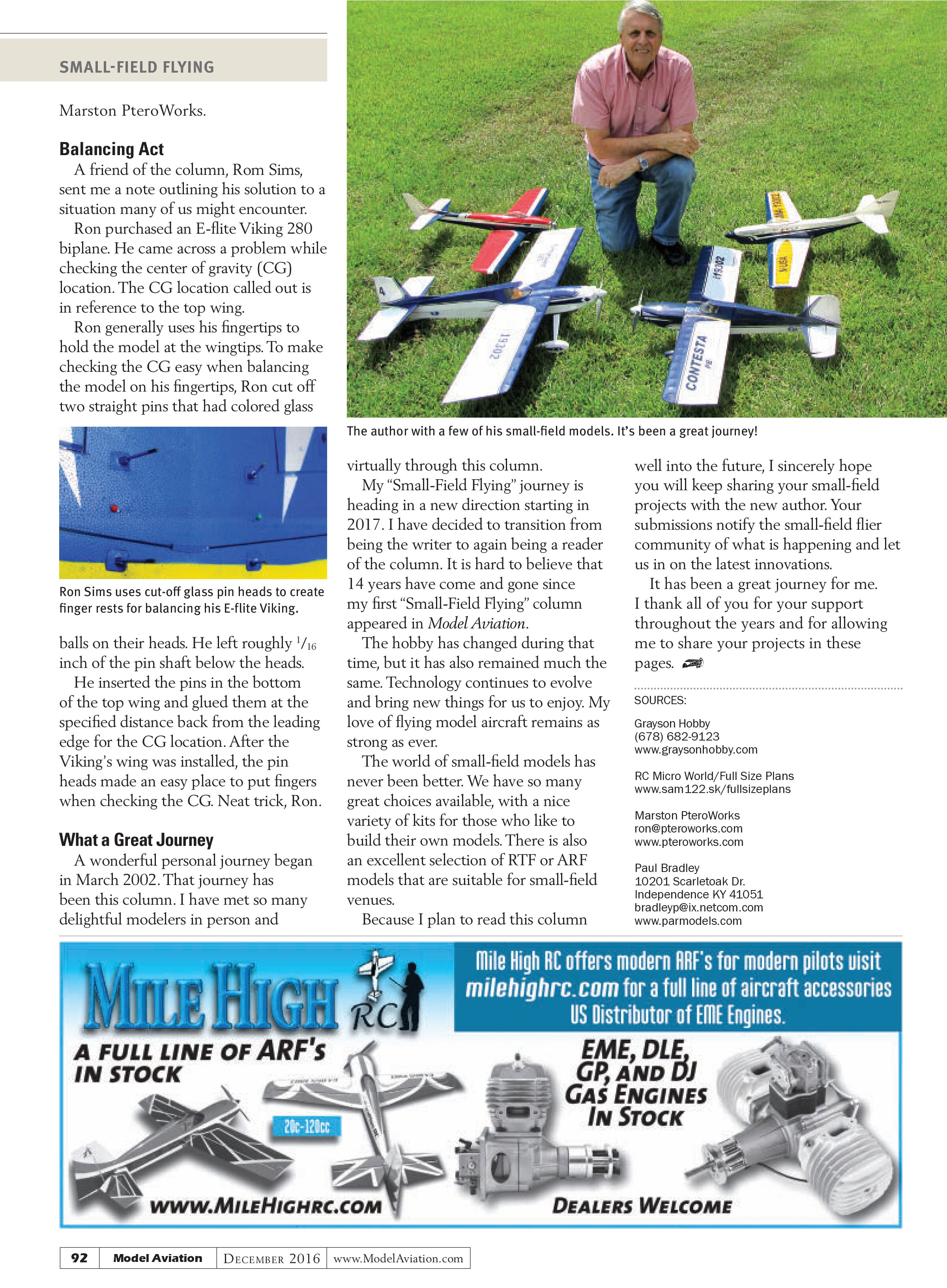
Model Aviation “Frequently Asked Questions” columnist and AMA Model Aviation Hall of Fame member, Bob Aberle, has more published model airplane designs than I could possibly list. His latest is a nice rendition of the Civy Hearse.
Bob’s model has a 41-inch wingspan. Its flying weight is 15.3 ounces. The size and flying weight of the aircraft work nicely for an easy-to-see, gentle-flying model. A construction article for the Civy Hearse appears in the October 2016 issue of RC Micro World (see the “Sources” list).
A Pet Pterodactyl …
… well, something close anyway. The people at Marston PteroWorks have a neat little kit called the Pterodactyl. The kit features twin pusher motors on a flying machine that resembles the prehistoric bird.
Now comes along John Krouse—you know, the modeler who marches to the music of a different drummer. He purchased a Pterodactyl kit, but added his own approach to how it would be assembled. The twin pusher motors were replaced with a single motor up front. The V-tail mixed controls were replaced with an added subrudder to allow for conventional yaw and pitch controls.
John’s rendition of the 18-inch wingspan Pterodactyl is guided by a 900 MHz receiver using magnetic actuators. It has a flying weight of 21 grams.
Nice work as usual, John. See the “Sources” listing for information about

Marston PteroWorks.
Balancing Act
A friend of the column, Ron Sims, sent me a note outlining his solution to a situation many of us might encounter. Ron purchased an E-flite Viking 280 biplane. He came across a problem while checking the center of gravity (CG) location. The CG location called out is in reference to the top wing. Ron generally uses his fingertips to hold the model at the wingtips. To make checking the CG easy when balancing the model on his fingertips, Ron cut off two straight pins that had colored glass

balls on their heads. He left roughly ¹⁄₁₆ inch of the pin shaft below the heads. He inserted the pins in the bottom of the top wing and glued them at the specified distance back from the leading edge for the CG location. After the Viking’s wing was installed, the pin heads made an easy place to put fingers when checking the CG. Neat trick, Ron.
What a Great Journey
A wonderful personal journey began in March 2002. That journey has been this column. I have met so many delightful modelers in person and

virtually through this column. My “Small-Field Flying” journey is heading in a new direction starting in 2017. I have decided to transition from being the writer to again being a reader of the column. It is hard to believe that 14 years have come and gone since my first “Small-Field Flying” column appeared in Model Aviation.
The hobby has changed during that time, but it has also remained much the same. Technology continues to evolve and bring new things for us to enjoy. My love of flying model aircraft remains as strong as ever.
The world of small-field models has never been better. We have so many great choices available, with a nice variety of kits for those who like to build their own models. There is also an excellent selection of RTF or ARF models that are suitable for small-field venues.
Because I plan to read this column well into the future, I sincerely hope you will keep sharing your small-field projects with the new author. Your submissions notify the small-field flier community of what is happening and let us in on the latest innovations.
It has been a great journey for me. I thank all of you for your support throughout the years and for allowing me to share your projects in these pages.
SOURCES:
Grayson Hobby
(678) 682-9123
www.graysonhobby.com
RC Micro World/Full Size Plans
www.sam122.sk/fullsizeplans
Marston PteroWorks
ron@pteroworks.com
www.pteroworks.com
Paul Bradley
10201 Scarlteoak Dr.
Independence KY 41051
bradley@ix.netcom.com
www.parmodels.com