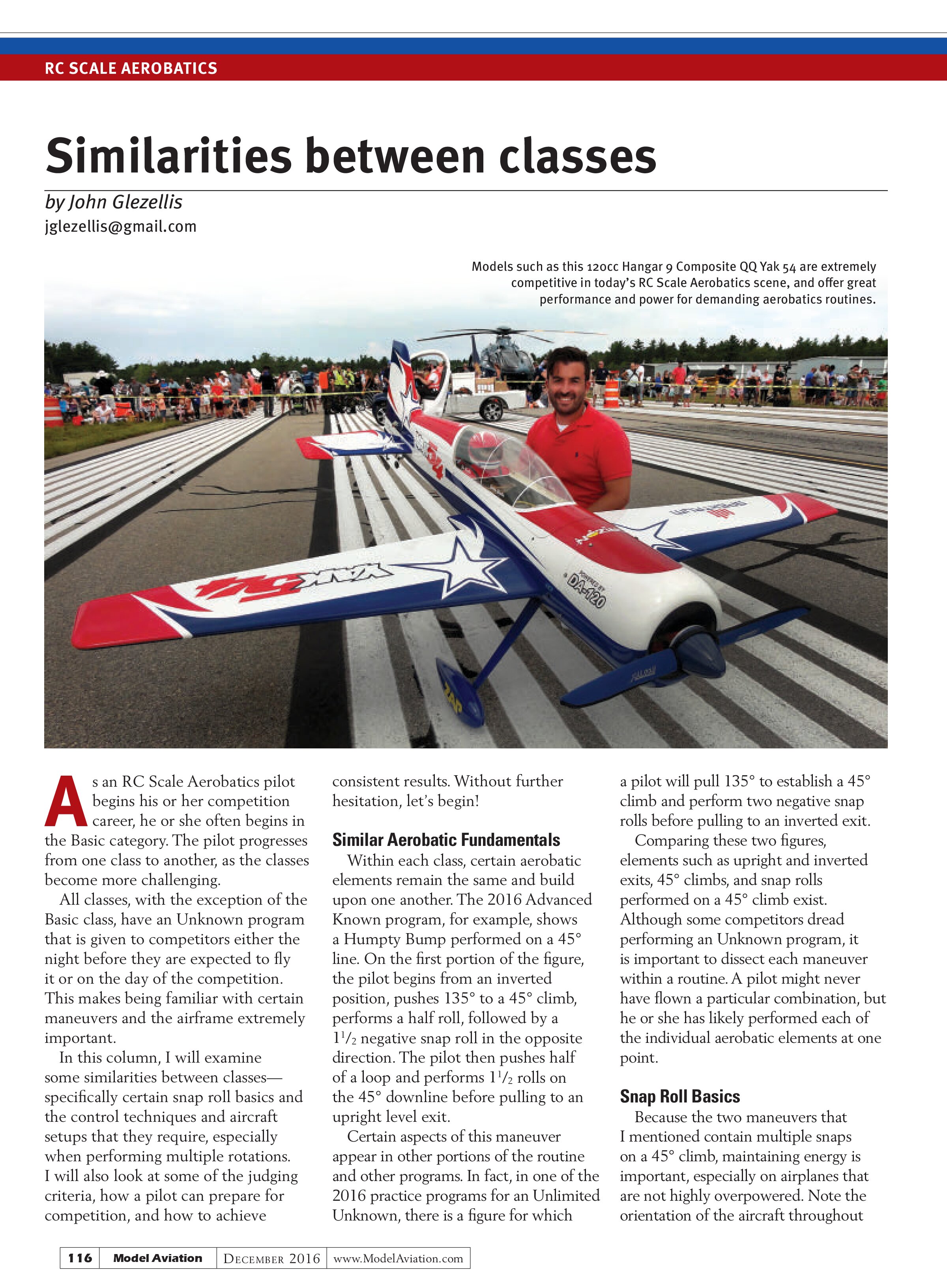
Similarities between classes
by John Glezellis
jglezellis@gmail.com

As an RC Scale Aerobatics pilot begins his or her competition career, he or she often begins in the Basic category. The pilot progresses from one class to another, as the classes become more challenging.
All classes, with the exception of the Basic class, have an Unknown program that is given to competitors either the night before they are expected to fly it or on the day of the competition. This makes being familiar with certain maneuvers and the airframe extremely important.
In this column, I will examine some similarities between classes—specifically certain snap roll basics and the control techniques and aircraft setups that they require, especially when performing multiple rotations. I will also look at some of the judging criteria, how a pilot can prepare for competition, and how to achieve consistent results. Without further hesitation, let’s begin!
Similar Aerobatic Fundamentals
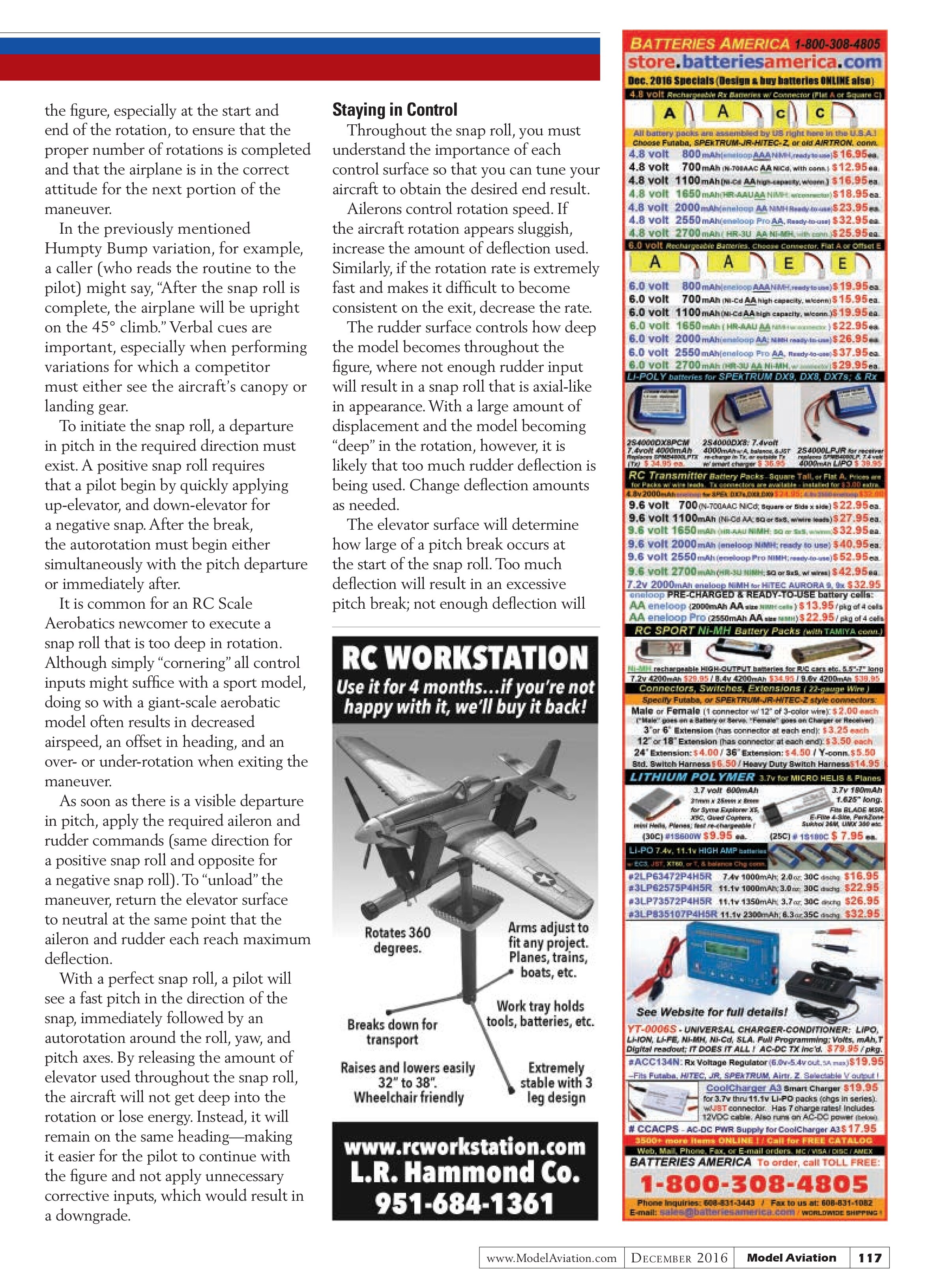
Within each class, certain aerobatic elements remain the same and build upon one another. The 2016 Advanced Known program, for example, shows a Humpty Bump performed on a 45° line. On the first portion of the figure, the pilot begins from an inverted position, pushes 135° to a 45° climb, performs a half roll, followed by a 1½ negative snap roll in the opposite direction. The pilot then pushes half of a loop and performs 1½ rolls on the 45° downline before pulling to an upright level exit.
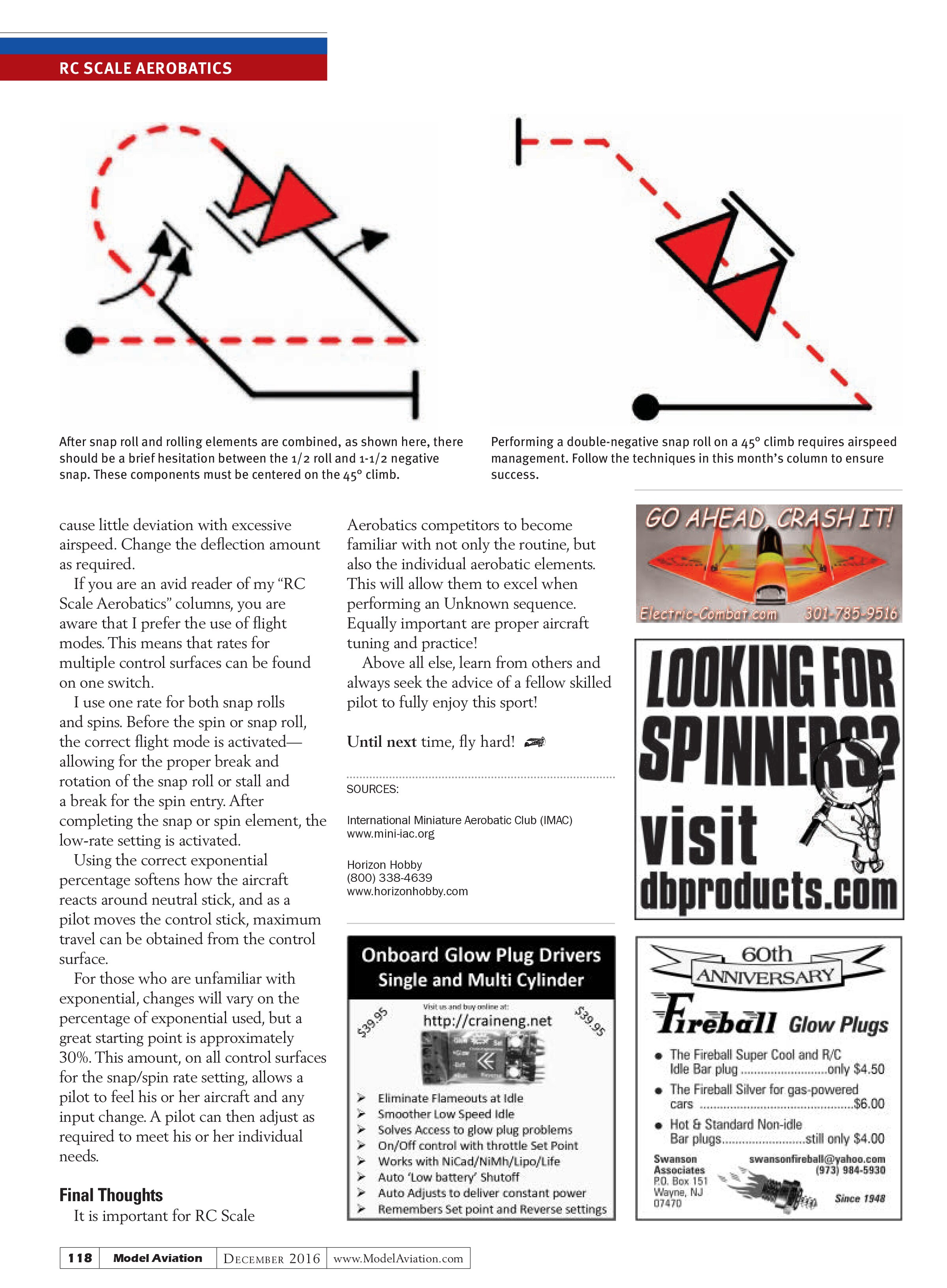
Certain aspects of this maneuver appear in other portions of the routine and other programs. In fact, in one of the 2016 practice programs for an Unlimited Unknown, there is a figure for which a pilot will pull 135° to establish a 45° climb and perform two negative snap rolls before pulling to an inverted exit.
Comparing these two figures, elements such as upright and inverted exits, 45° climbs, and snap rolls performed on a 45° climb exist. Although some competitors dread performing an Unknown program, it is important to dissect each maneuver within a routine. A pilot might never have flown a particular combination, but he or she has likely performed each of the individual aerobatic elements at one point.
Snap Roll Basics
Because the two maneuvers that I mentioned contain multiple snaps on a 45° climb, maintaining energy is important, especially on airplanes that are not highly overpowered. Note the orientation of the aircraft throughout the figure, especially at the start and end of the rotation, to ensure that the proper number of rotations is completed and that the airplane is in the correct attitude for the next portion of the maneuver.
In the previously mentioned Humpty Bump variation, for example, a caller (who reads the routine to the pilot) might say, “After the snap roll is complete, the airplane will be upright on the 45° climb.” Verbal cues are important, especially when performing variations for which a competitor must either see the aircraft’s canopy or landing gear.
To initiate the snap roll, a departure in pitch in the required direction must exist. A positive snap roll requires that a pilot begin by quickly applying up-elevator, and down-elevator for a negative snap. After the break, the autorotation must begin either simultaneously with the pitch departure or immediately after.
It is common for an RC Scale Aerobatics newcomer to execute a snap roll that is too deep in rotation. Although simply “cornering” all control inputs might suffice with a sport model, doing so with a giant-scale aerobatic model often results in decreased airspeed, an offset in heading, and an over- or under-rotation when exiting the maneuver.
As soon as there is a visible departure in pitch, apply the required aileron and rudder commands (same direction for a positive snap roll and opposite for a negative snap roll). To “unload” the maneuver, return the elevator surface to neutral at the same point that the aileron and rudder each reach maximum deflection.
With a perfect snap roll, a pilot will see a fast pitch in the direction of the snap, immediately followed by an autorotation around the roll, yaw, and pitch axes. By releasing the amount of elevator used throughout the snap roll, the aircraft will not get deep into the rotation or lose energy. Instead, it will remain on the same heading—making it easier for the pilot to continue with the figure and not apply unnecessary corrective inputs, which would result in a downgrade.
Staying in Control
Throughout the snap roll, you must understand the importance of each control surface so that you can tune your aircraft to obtain the desired end result.
Ailerons control rotation speed. If the aircraft rotation appears sluggish, increase the amount of deflection used. Similarly, if the rotation rate is extremely fast and makes it difficult to become consistent on the exit, decrease the rate.
The rudder surface controls how deep the model becomes throughout the figure, where not enough rudder input will result in a snap roll that is axial-like in appearance. With a large amount of displacement and the model becoming “deep” in the rotation, however, it is likely that too much rudder deflection is being used. Change deflection amounts as needed.
The elevator surface will determine how large of a pitch break occurs at the start of the snap roll. Too much deflection will result in an excessive pitch break; not enough deflection will


cause little deviation with excessive airspeed. Change the deflection amount as required.
If you are an avid reader of my “RC Scale Aerobatics” columns, you are aware that I prefer the use of flight modes. This means that rates for multiple control surfaces can be found on one switch.
I use one rate for both snap rolls and spins. Before the spin or snap roll, the correct flight mode is activated—allowing for the proper break and rotation of the snap roll or stall and a break for the spin entry. After completing the snap or spin element, the low-rate setting is activated.
Using the correct exponential percentage softens how the aircraft reacts around neutral stick, and as a pilot moves the control stick, maximum travel can be obtained from the control surface.
For those who are unfamiliar with exponential, changes will vary on the percentage of exponential used, but a great starting point is approximately 30%. This amount, on all control surfaces for the snap/spin rate setting, allows a pilot to feel his or her aircraft and any input change. A pilot can then adjust as required to meet his or her individual needs.
Final Thoughts
It is important for RC Scale Aerobatics competitors to become familiar with not only the routine, but also the individual aerobatic elements. This will allow them to excel when performing an Unknown sequence. Equally important are proper aircraft tuning and practice!
Above all else, learn from others and always seek the advice of a fellow skilled pilot to fully enjoy this sport!
Until next time, fly hard!
SOURCES:
International Miniature Aerobatic Club (IMAC)
www.mini-iac.org
Horizon Hobby
(800) 338-4639
www.horizonhobby.com