RC Scale Nats
by Stan Alexander
onawing4602@att.net
There have been so many things happening in RC Scale that finding column space for them is a problem! The Nats, EAA AirVenture Oshkosh, and other events have all kept me busy. I’m using the online portion of the magazine to expand the coverage of a few items that might interest you.
One of the best RC Scale Nats that I’ve attended in several years was held on Site 4 at the AMA’s International Aeromodeling Center this year. The condition of the grass was great, and AMA put a lot of work into the site.
The weather was nice. The June 24-26 event was well organized, with John Boyko serving as the event director this year.
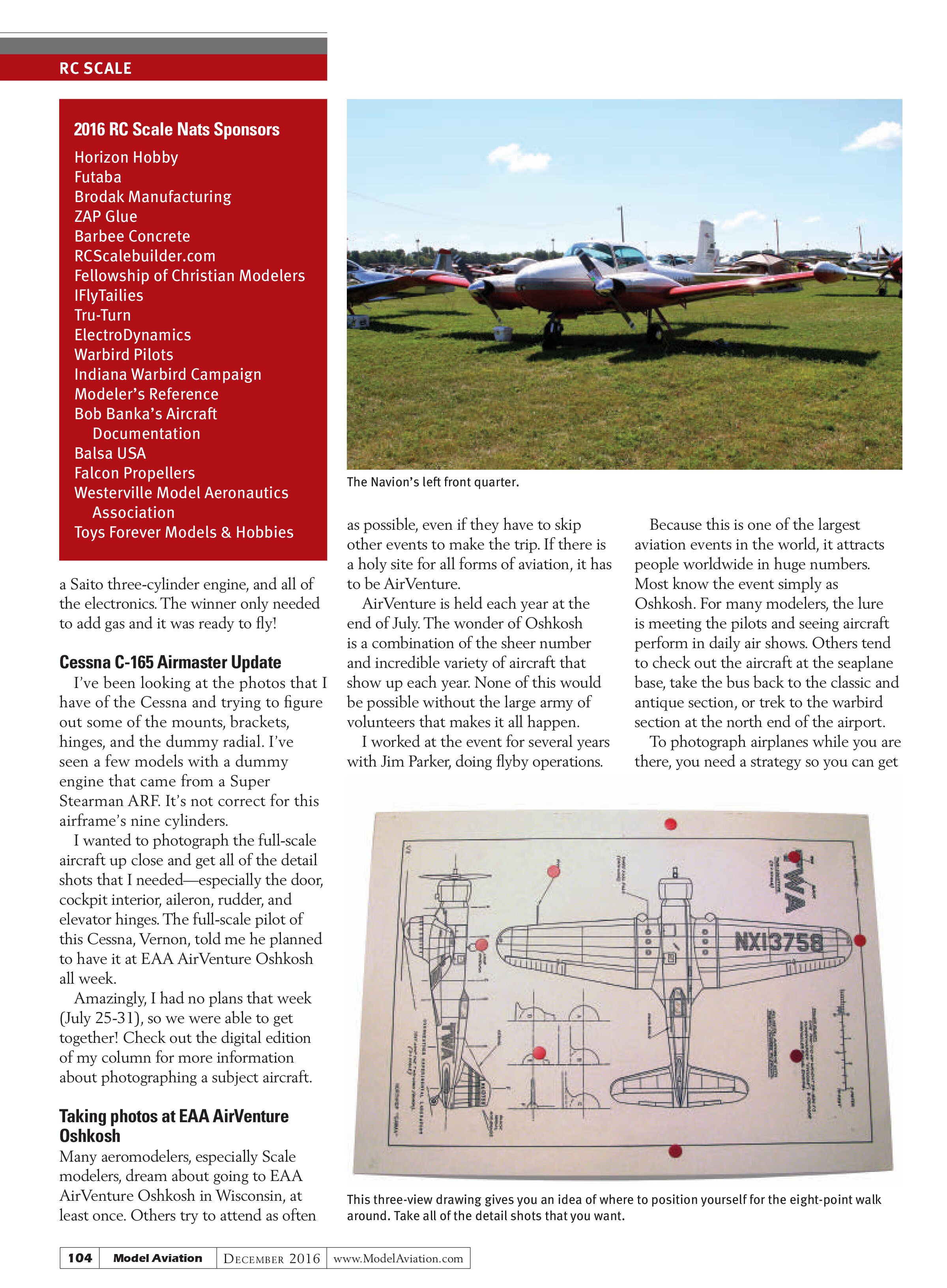
NatsNews, available on AMA’s website, has daily reports, so I won’t go into that here. Mike Barbee won the 2016 RC Scale Nats championship this year, flying in Team Scale with Frank Noll at the sticks of his Wildcat.
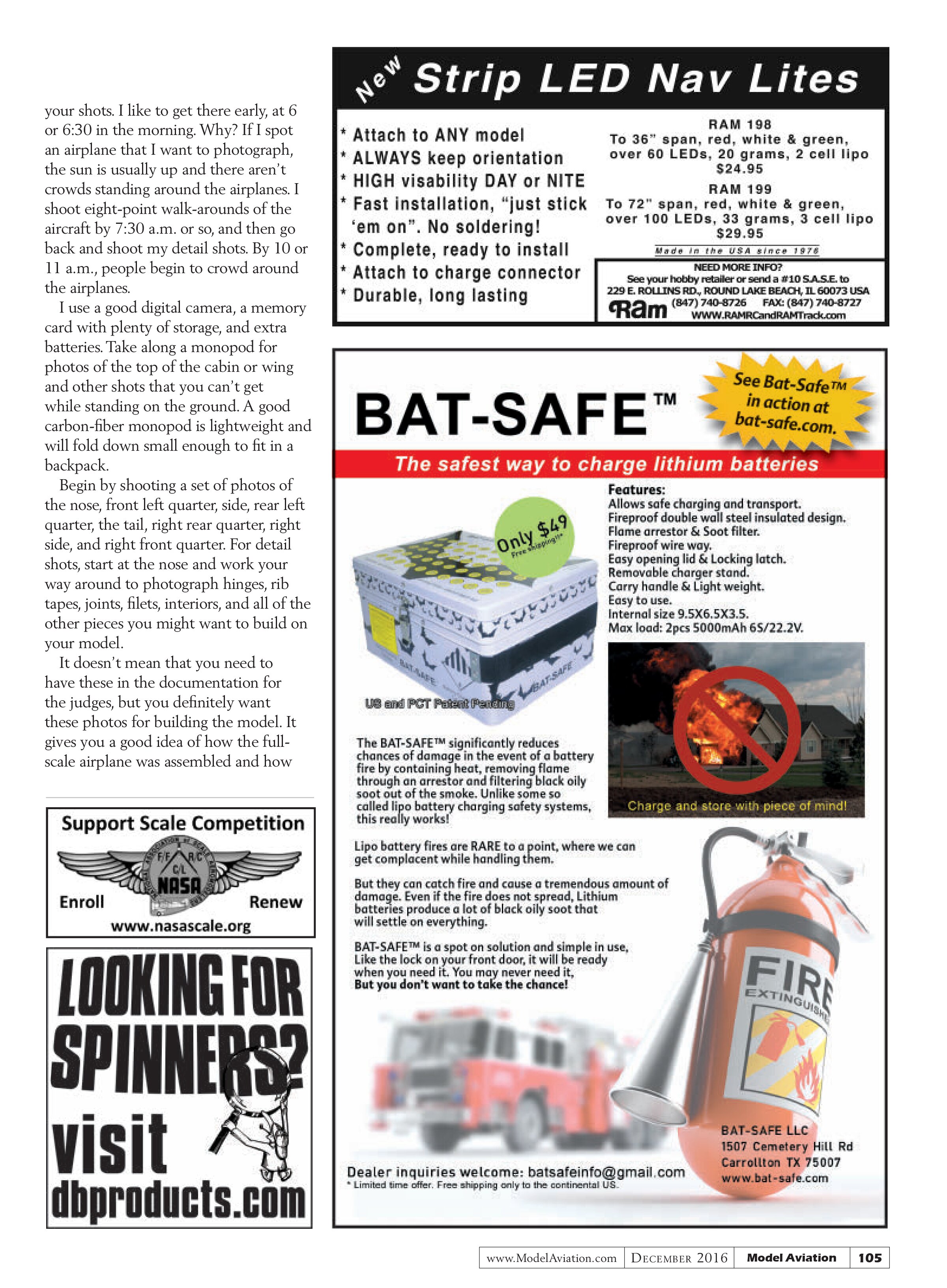
On the subject of the Wildcat, who designed and fabricated all of those fiberglass/foam parts that made up three of the winning aircraft at the Nats? All were Bob Patton designs: Mike Barbee’s T-34B in Expert class and his FM Wildcat in Team Scale, and Will Berninger’s T-34C in Open Scale. All three won their classes—that’s a feat I haven’t seen in years.
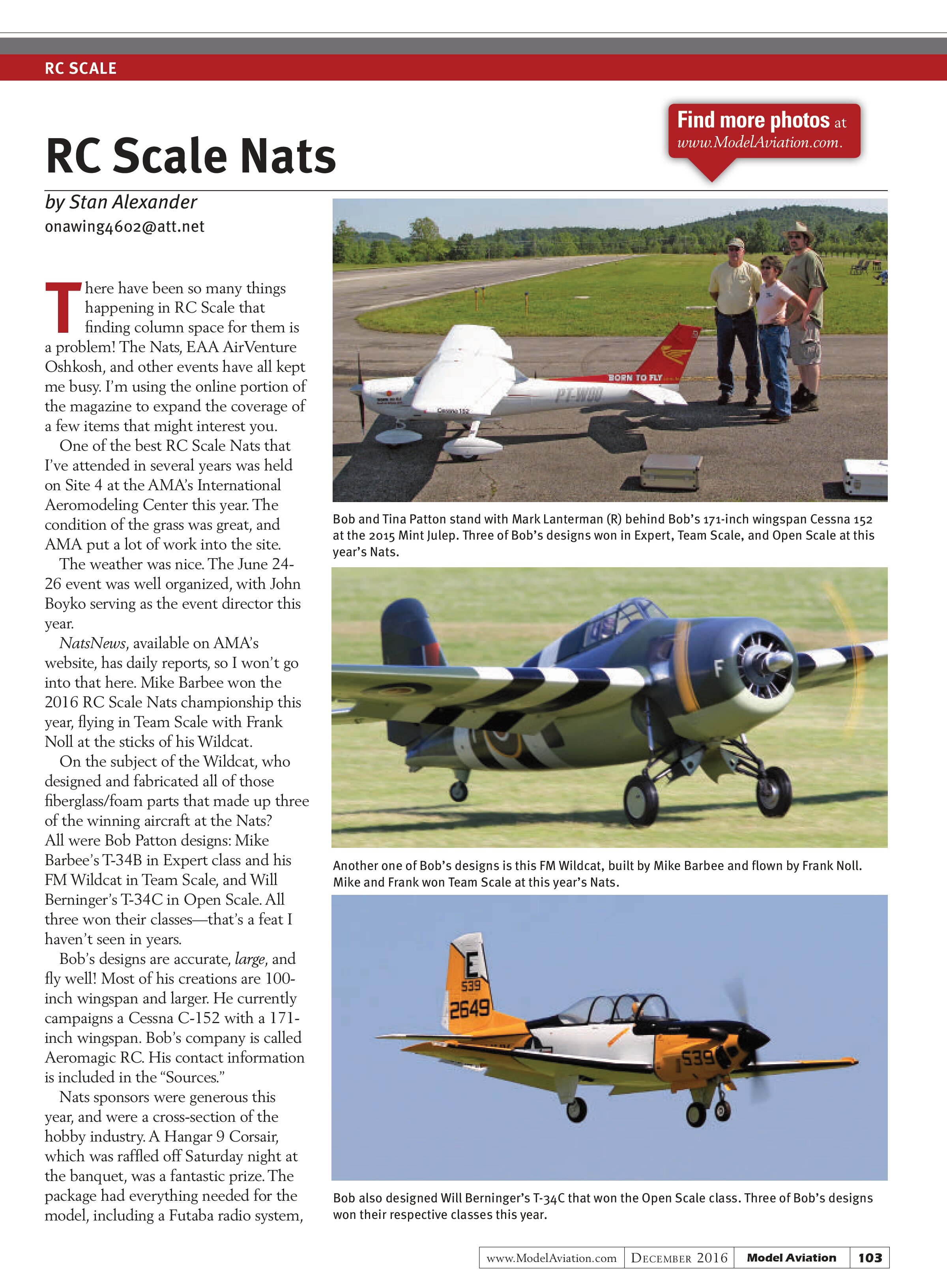
Bob’s designs are accurate, large, and fly well! Most of his creations are 100-inch wingspan and larger. He currently campaigns a Cessna C-152 with a 171-inch wingspan. Bob’s company is called Aeromagic RC. His contact information is included in the “Sources.”
Nats sponsors were generous this year, and were a cross-section of the hobby industry. A Hangar 9 Corsair, which was raffled off Saturday night at the banquet, was a fantastic prize. The package had everything needed for the model, including a Futaba radio system,


2016 RC Scale Nats Sponsors
Horizon Hobby
Futaba
Brodak Manufacturing
ZAP Glue
Barbee Concrete
RCScalebuilder.com
Fellowship of Christian Modelers
IFlyTailies
Tru-Turn
ElectroDynamics
Warbird Pilots
Indiana Warbird Campaign
Modeler’s Reference
Bob Banka’s Aircraft Documentation
Balsa USA
Falcon Propellers
Westerville Model Aeronautics Association
Toys Forever Models & Hobbies
a Saito three-cylinder engine, and all of the electronics. The winner only needed to add gas and it was ready to fly!
Cessna C-165 Airmaster Update
I’ve been looking at the photos that I have of the Cessna and trying to figure out some of the mounts, brackets, hinges, and the dummy radial. I’ve seen a few models with a dummy engine that came from a Super Stearman ARF. It’s not correct for this airframe’s nine cylinders.
I wanted to photograph the full-scale aircraft up close and get all of the detail shots that I needed—especially the door, cockpit interior, aileron, rudder, and elevator hinges. The full-scale pilot of this Cessna, Vernon, told me he planned to have it at EAA AirVenture Oshkosh all week.
Amazingly, I had no plans that week (July 25-31), so we were able to get together! Check out the digital edition of my column for more information about photographing a subject aircraft.
Taking photos at EAA AirVenture Oshkosh
Many aeromodelers, especially Scale modelers, dream about going to EAA AirVenture Oshkosh in Wisconsin, at least once. Others try to attend as often as possible, even if they have to skip other events to make the trip. If there is a holy site for all forms of aviation, it has to be AirVenture.
AirVenture is held each year at the end of July. The wonder of Oshkosh is a combination of the sheer number and incredible variety of aircraft that show up each year. None of this would be possible without the large army of volunteers that makes it all happen.
I worked at the event for several years with Jim Parker, doing flyby operations.
Because this is one of the largest aviation events in the world, it attracts people worldwide in huge numbers. Most know the event simply as Oshkosh. For many modelers, the lure is meeting the pilots and seeing aircraft perform in daily air shows. Others tend to check out the aircraft at the seaplane base, take the bus back to the classic and antique section, or trek to the warbird section at the north end of the airport.
To photograph airplanes while you are there, you need a strategy so you can get

your shots. I like to get there early, at 6 or 6:30 in the morning. Why? If I spot an airplane that I want to photograph, the sun is usually up and there aren’t crowds standing around the airplanes. I shoot eight-point walk-arounds of the aircraft by 7:30 a.m. or so, and then go back and shoot my detail shots. By 10 or 11 a.m., people begin to crowd around the airplanes.
I use a good digital camera, a memory card with plenty of storage, and extra batteries. Take along a monopod for photos of the top of the cabin or wing and other shots that you can’t get while standing on the ground. A good carbon-fiber monopod is lightweight and will fold down small enough to fit in a backpack.
Begin by shooting a set of photos of the nose, front left quarter, side, rear left quarter, the tail, right rear quarter, right side, and right front quarter. For detail shots, start at the nose and work your way around to photograph hinges, rib tapes, joints, filets, interiors, and all of the other pieces you might want to build on your model.
It doesn’t mean that you need to have these in the documentation for the judges, but you definitely want these photos for building the model. It gives you a good idea of how the full-scale airplane was assembled and how