Carl Goldberg and his models
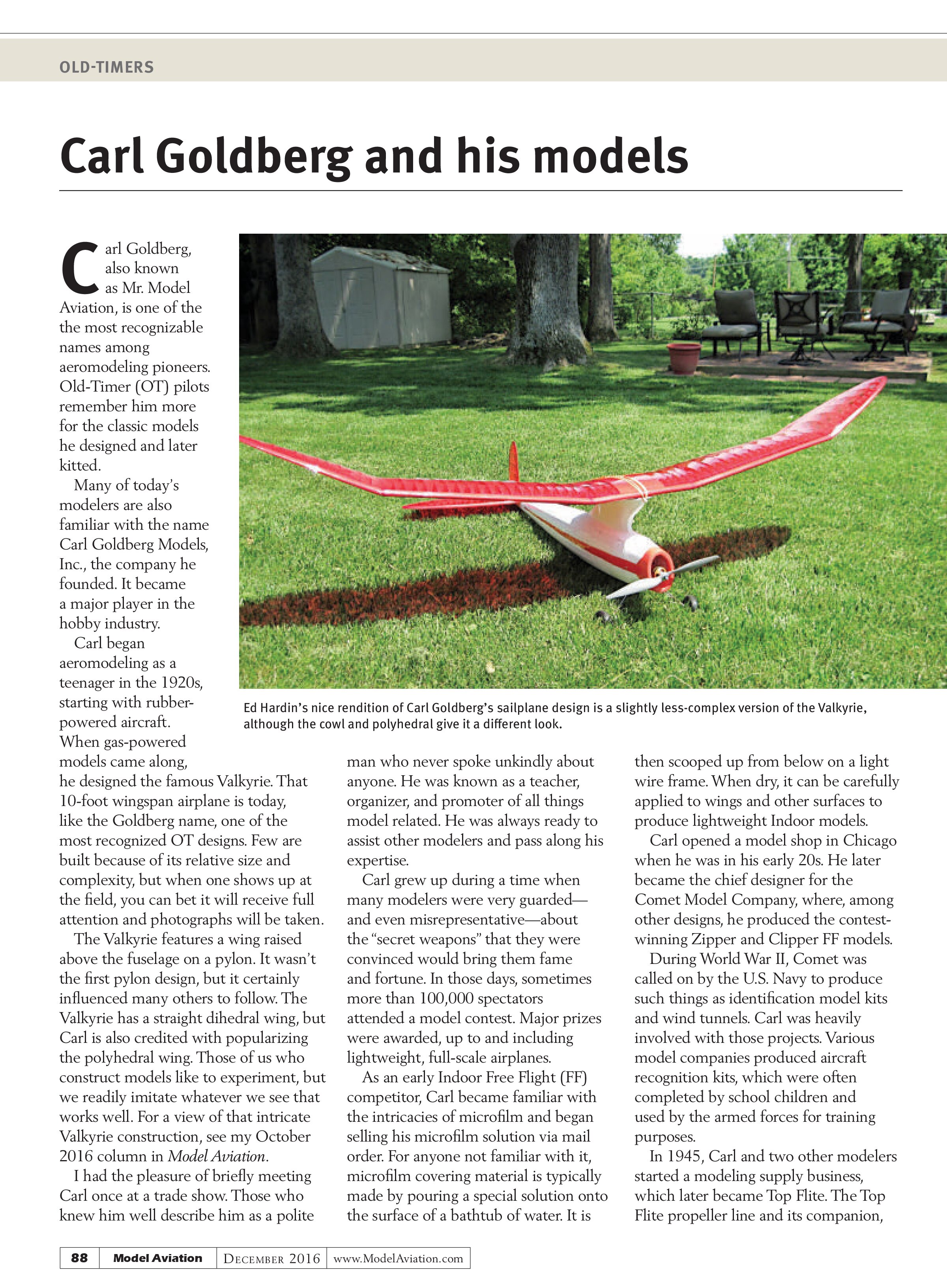
Carl Goldberg, also known as Mr. Model Aviation, is one of the most recognizable names among aeromodeling pioneers. Old-Timer (OT) pilots remember him more for the classic models he designed and later kitted. Many of today’s modelers are also familiar with the name Carl Goldberg Models, Inc., the company he founded. It became a major player in the hobby industry. Carl began aeromodeling as a teenager in the 1920s, starting with rubber-powered aircraft. When gas-powered models came along, he designed the famous Valkyrie. That 10-foot wingspan airplane is today, like the Goldberg name, one of the most recognized OT designs. Few are built because of its relative size and complexity, but when one shows up at the field, you can bet it will receive full attention and photographs will be taken. The Valkyrie features a wing raised above the fuselage on a pylon. It wasn’t the first pylon design, but it certainly influenced many others to follow. The Valkyrie has a straight dihedral wing, but Carl is also credited with popularizing the polyhedral wing. Those of us who construct models like to experiment, but we readily imitate whatever we see that works well. For a view of that intricate Valkyrie construction, see my October 2016 column in Model Aviation. I had the pleasure of briefly meeting Carl once at a trade show. Those who knew him well describe him as a polite

man who never spoke unkindly about anyone. He was known as a teacher, organizer, and promoter of all things model related. He was always ready to assist other modelers and pass along his expertise. Carl grew up during a time when many modelers were very guarded—and even misrepresentative—about the “secret weapons” that they were convinced would bring them fame and fortune. In those days, sometimes more than 100,000 spectators attended a model contest. Major prizes were awarded, up to and including lightweight, full-scale airplanes. As an early Indoor Free Flight (FF) competitor, Carl became familiar with the intricacies of microfilm and began selling his microfilm solution via mail order. For anyone not familiar with it, microfilm covering material is typically made by pouring a special solution onto the surface of a bathtub of water. It is then scooped up from below on a light wire frame. When dry, it can be carefully applied to wings and other surfaces to produce lightweight Indoor models. Carl opened a model shop in Chicago when he was in his early 20s. He later became the chief designer for the Comet Model Company, where, among other designs, he produced the contest-winning Zipper and Clipper FF models. During World War II, Comet was called on by the U.S. Navy to produce such things as identification model kits and wind tunnels. Carl was heavily involved with those projects. Various model companies produced aircraft recognition kits, which were often completed by school children and used by the armed forces for training purposes. In 1945, Carl and two other modelers started a modeling supply business, which later became Top Flite. The Top Flite propeller line and its companion, Power Point propellers, became the most readily available and most-used propellers for a number of years. In the early days of Control Line (CL) flying, most of us used Top Flite propellers because they were more scalelike than the Power Point series. But Top Flite propellers were thicker and more “clubby” looking than Power Point propellers and others—I’m not sure we had proper respect for them. When I test and compare Top Flite propellers to others that are on OT aircraft today, they do a good job of pulling an airplane to altitude—especially if you refinish them to produce a surface comparable to plastic and don’t overload the engine with too much propeller. (Incidentally, I suspect you may be familiar with another Top Flite product: MonoKote.) Carl Goldberg Models started small in 1955, and grew into a highly successful manufacturer and distributor of kits and supplies. As he did with the Top Flite and Comet companies, Carl continued to actively compete and design kits for the business as it grew. He didn’t limit himself to FF, but progressed within the hobby by designing CL and RC aircraft as well. As ARFs became popular, many of his designs were reworked. Even the classic George Aldrich-designed Nobler CL kit was presented as an ARF—much to the consternation of purists. When the AMA Model Aviation Hall of Fame was created in 1969, Carl was among the first inductees. He is also a member of several other model aircraft hobby halls of fame. Carl moved to Northridge, California, in 1976, but remained active with the company in semiretirement for a number of years. Carl Goldberg Models was later absorbed into Great Planes Model Manufacturing and Distributors. For biographical sketches, one good reference is always AMA’s History Project biographies. The information there is especially useful in establishing dates. You can find eight pages of biographical information about Carl. (See the “Sources” for the link.)
Gits Caps
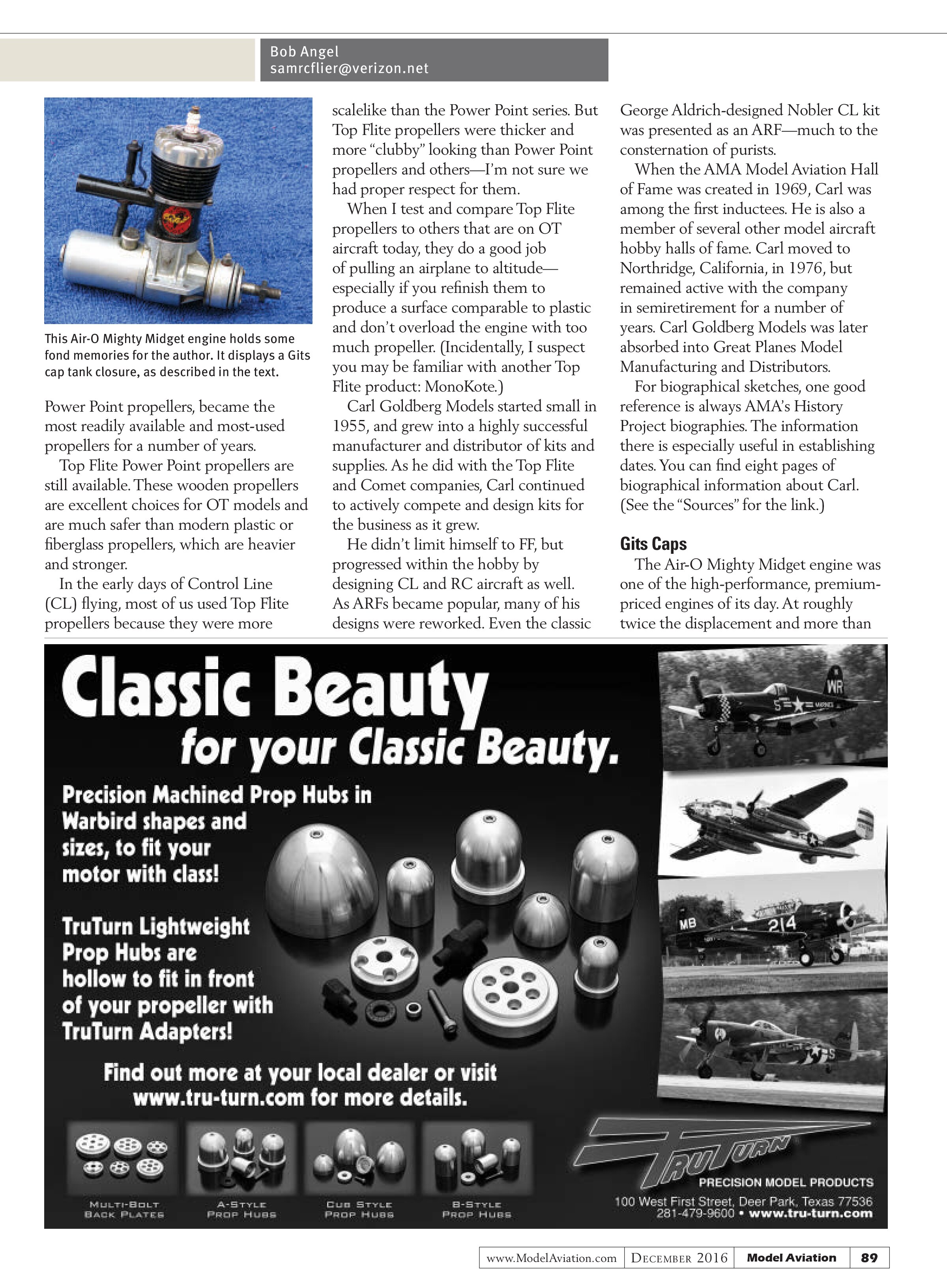
The Air-O Mighty Midget engine was one of the high-performance, premium-priced engines of its day. At roughly twice the displacement and more than

Power Point propellers, became the most readily available and most-used propellers for a number of years. Top Flite Power Point propellers are still available. These wooden propellers are excellent choices for OT models and are much safer than modern plastic or fiberglass propellers, which are heavier and stronger. In the early days of Control Line (CL) flying, most of us used Top Flite propellers because they were more
Top Flite propellers were thicker and more “clubby” looking than Power Point propellers and others—I’m not sure we had proper respect for them. When I test and compare Top Flite propellers to others that are on OT aircraft today, they do a good job of pulling an airplane to altitude—especially if you refinish them to produce a surface comparable to plastic and don’t overload the engine with too much propeller. (Incidentally, I suspect you may be familiar with another Top Flite product: MonoKote.) Carl Goldberg Models started small in 1955, and grew into a highly successful manufacturer and distributor of kits and supplies. As he did with the Top Flite and Comet companies, Carl continued to actively compete and design kits for the business as it grew. He didn’t limit himself to FF, but progressed within the hobby by designing CL and RC aircraft as well. As ARFs became popular, many of his designs were reworked. Even the classic
George Aldrich-designed Nobler CL kit was presented as an ARF—much to the consternation of purists. When the AMA Model Aviation Hall of Fame was created in 1969, Carl was among the first inductees. He is also a member of several other model aircraft hobby halls of fame. Carl moved to Northridge, California, in 1976, but remained active with the company in semiretirement for a number of years. Carl Goldberg Models was later absorbed into Great Planes Model Manufacturing and Distributors. For biographical sketches, one good reference is always AMA’s History Project biographies. The information there is especially useful in establishing dates. You can find eight pages of biographical information about Carl. (See the “Sources” for the link.)
twice the power of an Ohlsson & Rice .23, it wasn’t much heavier, and was sometimes used as a substitution. Not many engine-mount dimensions were interchangeable, but the Mighty Midget happened to fit the Ohlsson & Rice mounting holes, with space left over. We had real hot-rod CL airplanes when that swap was made.
Gits caps are little, spring-loaded, pop-up lids that many of our old spark-ignition engines use as fuel tank caps. They provide a nice dust cover, and with their large openings, no other tank vents are needed or used. The fit is normally loose enough that replacement air flows in freely as fuel is used. It’s rare, but occasionally those caps fit snugly enough to seal off the replacement air.
When that happens, an engine will usually start fine, run for a while, and suddenly quit. Because many things can cause that to happen, it can drive you nuts trying to solve the problem.
Many lists about why your engine won’t start (or run) have been published throughout the years, but I’ve never seen that cause listed. If you suspect this as a problem, slip a small wood sliver under the cap and try again. If that cures the problem, make a little notch in the opening of the neck for a permanent fix.
Incidentally, a Gits cap is one old engine part that’s still readily available from industrial suppliers and auto parts stores. It is usually a press-in fit. There are multiple sizes, so you need to measure the tank opening before you make a purchase. The Gits Manufacturing Co. caps and similar products are usually referred to today as oil cups.
SOURCES:
AMA History Project
www.modelaircraft.org/museum/history.aspx
Top Flite
(800) 637-7660
www.top-flite.com
Gits Manufacturing Co.
(800) 323-3238
www.gitsmfg.com