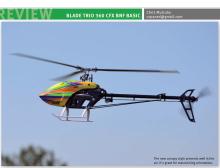
Blade Trio 360 Cfx BNF Basic
Chris Mulcahy
cspaced@gmail.com

Horizon Hobby hits a home run with this heli
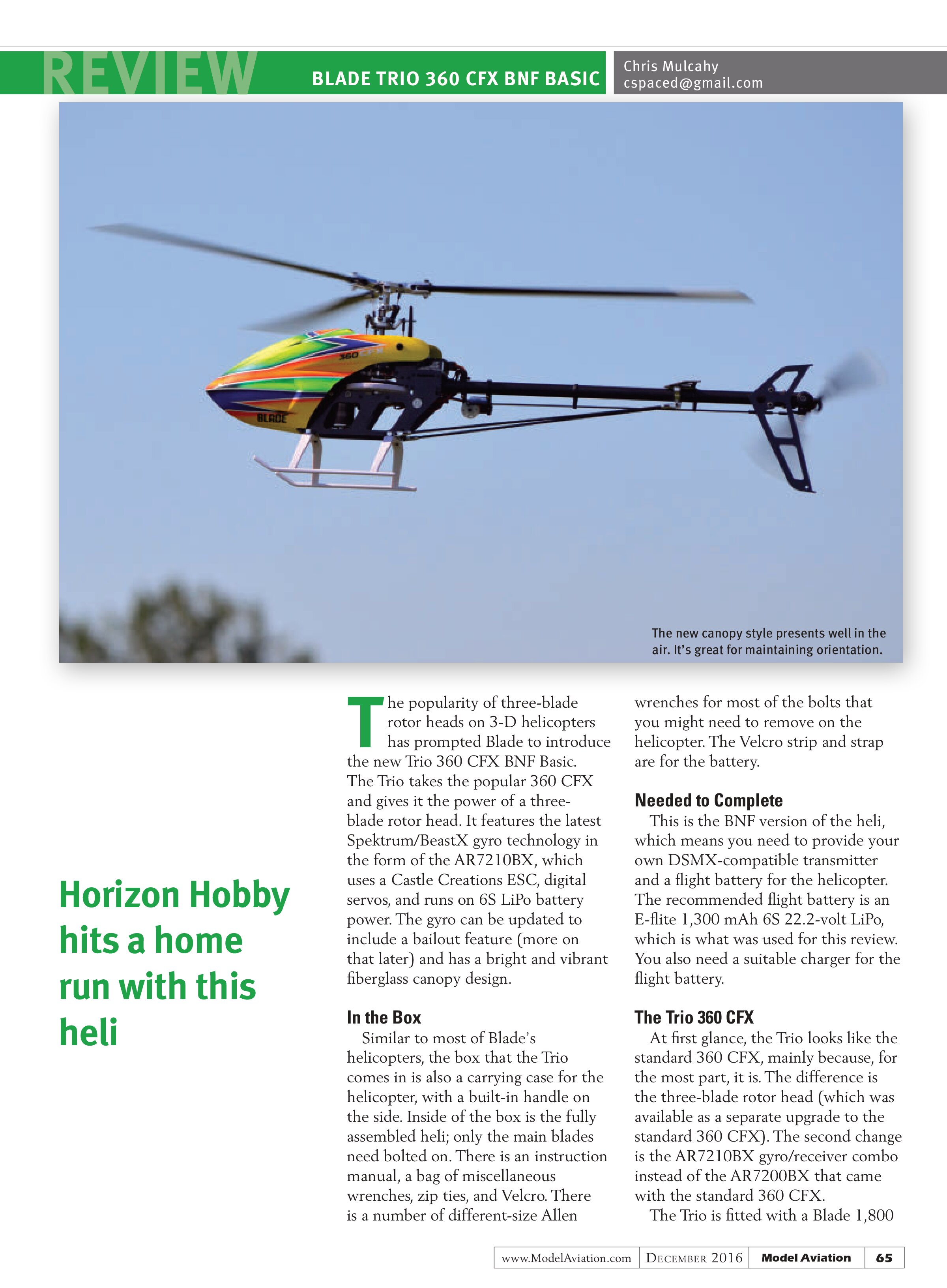
The popularity of three-blade rotor heads on 3-D helicopters has prompted Blade to introduce the new Trio 360 CFX BNF Basic. The Trio takes the popular 360 CFX and gives it the power of a three-blade rotor head. It features the latest Spektrum/BeastX gyro technology in the form of the AR7210BX, which uses a Castle Creations ESC, digital servos, and runs on 6S LiPo battery power. The gyro can be updated to include a bailout feature (more on that later) and has a bright and vibrant fiberglass canopy design.
In the Box
Similar to most of Blade’s helicopters, the box that the Trio comes in is also a carrying case for the helicopter, with a built-in handle on the side. Inside of the box is the fully assembled heli; only the main blades need bolted on. There is an instruction manual, a bag of miscellaneous wrenches, zip ties, and Velcro. There is a number of different-size Allen wrenches for most of the bolts that you might need to remove on the helicopter. The Velcro strip and strap are for the battery.
Needed to Complete
This is the BNF version of the heli, which means you need to provide your own DSMX-compatible transmitter and a flight battery for the helicopter. The recommended flight battery is an E-flite 1,300 mAh 6S 22.2-volt LiPo, which is what was used for this review. You also need a suitable charger for the flight battery.
The Trio 360 CFX
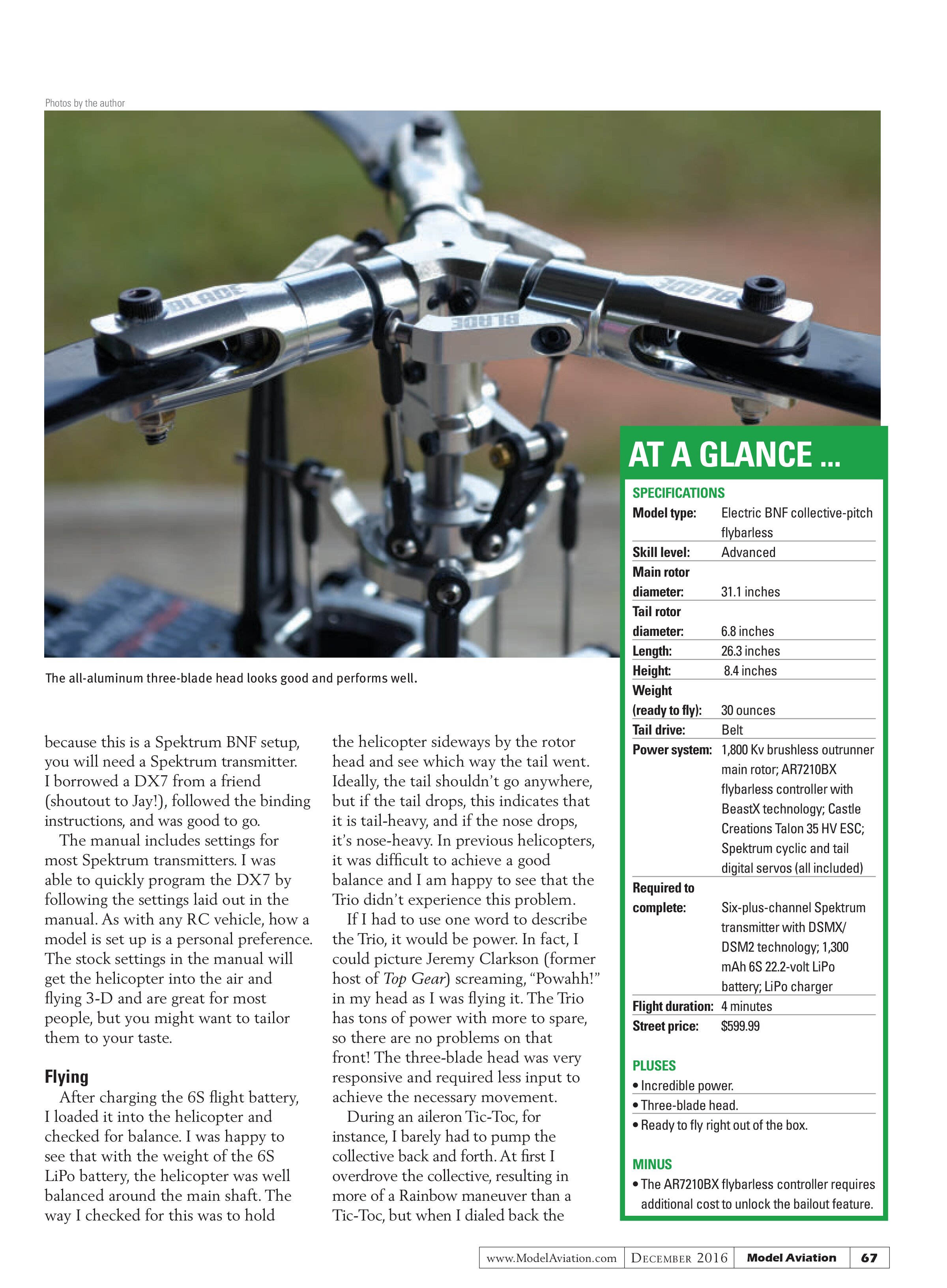
At first glance, the Trio looks like the standard 360 CFX, mainly because, for the most part, it is. The difference is the three-blade rotor head (which was available as a separate upgrade to the standard 360 CFX). The second change is the AR7210BX gyro/receiver combo instead of the AR7200BX that came with the standard 360 CFX.
The Trio is fitted with a Blade 1,800
Kv brushless outrunner motor driven by a Castle Creations Talon 35-amp ESC. This is a great ESC and fully programmable to suit your needs.
The Trio is set up to use the built-in governor on the Talon 35 for consistent rpm throughout your flights. The cyclic servos are Spektrum H3050 digital metal gear servos for precise control of the swashplate, with a Spektrum H3060 Digital metal gear tail servo. The canopy has a nice, bright design that proved highly visible when flying, which is great for orientation. Like the 360 CFX, the Trio features triple-bearing support for the hardened main shaft, an autorotation gear, the standard belt-driven tail used on many Blade helicopters, carbon-fiber main blades, and plastic tail blades.


The Spektrum AR7210BX
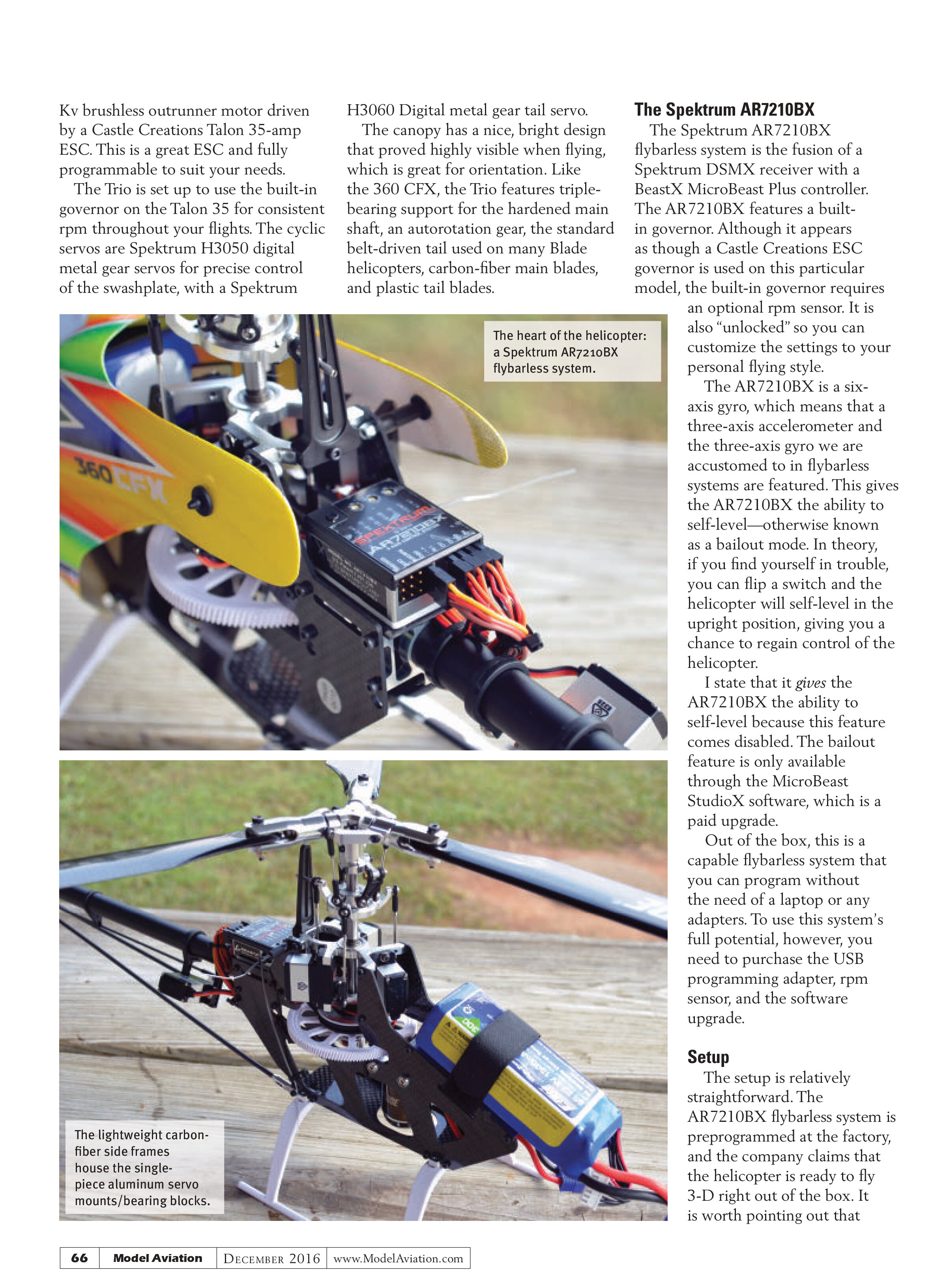
The Spektrum AR7210BX flybarless system is the fusion of a Spektrum DSMX receiver with a BeastX MicroBeast Plus controller. The AR7210BX features a built-in governor. Although it appears as though a Castle Creations ESC governor is used on this particular model, the built-in governor requires an optional rpm sensor. It is also “unlocked” so you can customize the settings to your personal flying style.
The AR7210BX is a six-axis gyro, which means that a three-axis accelerometer and the three-axis gyro we are accustomed to in flybarless systems are featured. This gives the AR7210BX the ability to self-level—otherwise known as a bailout mode. In theory, if you find yourself in trouble, you can flip a switch and the helicopter will self-level in the upright position, giving you a chance to regain control of the helicopter.
I state that it gives the AR7210BX the ability to self-level because this feature comes disabled. The bailout feature is only available through the MicroBeast StudioX software, which is a paid upgrade.
Out of the box, this is a capable flybarless system that you can program without the need of a laptop or any adapters. To use this system’s full potential, however, you need to purchase the USB programming adapter, rpm sensor, and the software upgrade.
Setup
The setup is relatively straightforward. The AR7210BX flybarless system is preprogrammed at the factory, and the company claims that the helicopter is ready to fly 3-D right out of the box. It is worth pointing out that

because this is a Spektrum BNF setup, you will need a Spektrum transmitter. I borrowed a DX7 from a friend (shoutout to Jay!), followed the binding instructions, and was good to go.
The manual includes settings for most Spektrum transmitters. I was able to quickly program the DX7 by following the settings laid out in the manual. As with any RC vehicle, how a model is set up is a personal preference. The stock settings in the manual will get the helicopter into the air and flying 3-D and are great for most people, but you might want to tailor them to your taste.
Flying
After charging the 6S flight battery, I loaded it into the helicopter and checked for balance. I was happy to see that with the weight of the 6S LiPo battery, the helicopter was well balanced around the main shaft. The way I checked for this was to hold the helicopter sideways by the rotor head and see which way the tail went. Ideally, the tail shouldn’t go anywhere, but if the tail drops, this indicates that it is tail-heavy, and if the nose drops, it’s nose-heavy. In previous helicopters, it was difficult to achieve a good balance and I am happy to see that the Trio didn’t experience this problem.
If I had to use one word to describe the Trio, it would be power. In fact, I could picture Jeremy Clarkson (former host of Top Gear) screaming, “Powahh!” in my head as I was flying it. The Trio has tons of power with more to spare, so there are no problems on that front! The three-blade head was very responsive and required less input to achieve the necessary movement.
During an aileron Tic-Toc, for instance, I barely had to pump the collective back and forth. At first I overdrove the collective, resulting in more of a Rainbow maneuver than a Tic-Toc, but when I dialed back the
AT A GLANCE ...
SPECIFICATIONS
Model type: Electric BNF collective-pitch flybarless
Skill level: Advanced
Main rotor diameter: 31.1 inches
Tail rotor diameter: 6.8 inches
Length: 26.3 inches
Height: 8.4 inches
Weight (ready to fly): 30 ounces
Tail drive: Belt
Power system: 1,800 Kv brushless outrunner main rotor; AR7210BX flybarless controller with BeastX technology; Castle Creations Talon 35 HV ESC; Spektrum cyclic and tail digital servos (all included)
Required to complete: Six-plus-channel Spektrum transmitter with DSMX/DSM2 technology; 1,300 mAh 6S 22.2-volt LiPo battery; LiPo charger
Flight duration: 4 minutes
Street price: $599.99
PLUSES
- Incredible power.
- Three-blade head.
- Ready to fly right out of the box.
MINUS
- The AR7210BX flybarless controller requires additional cost to unlock the bailout feature.
input, I was able to get it into the groove. I softened the pitch curve around mid-stick because it felt a touch twitchy to me, so maintaining consistent altitude when hovering looked more like a pogo stick bouncing up and down. After some slight setup tweaking, I was happy with the way that it flew. Inverted pirouettes were nice and solid, and the tail held well during backward flight.
The only problem was that I had to wait for the one battery that I have to charge in between flights! The 1,300 mAh LiPo battery gave me three minutes of hard 3-D flying, which might seem short, but is typical for that type of flying. You can increase flight time by reducing the head speed and flying more conservatively.
Conclusion
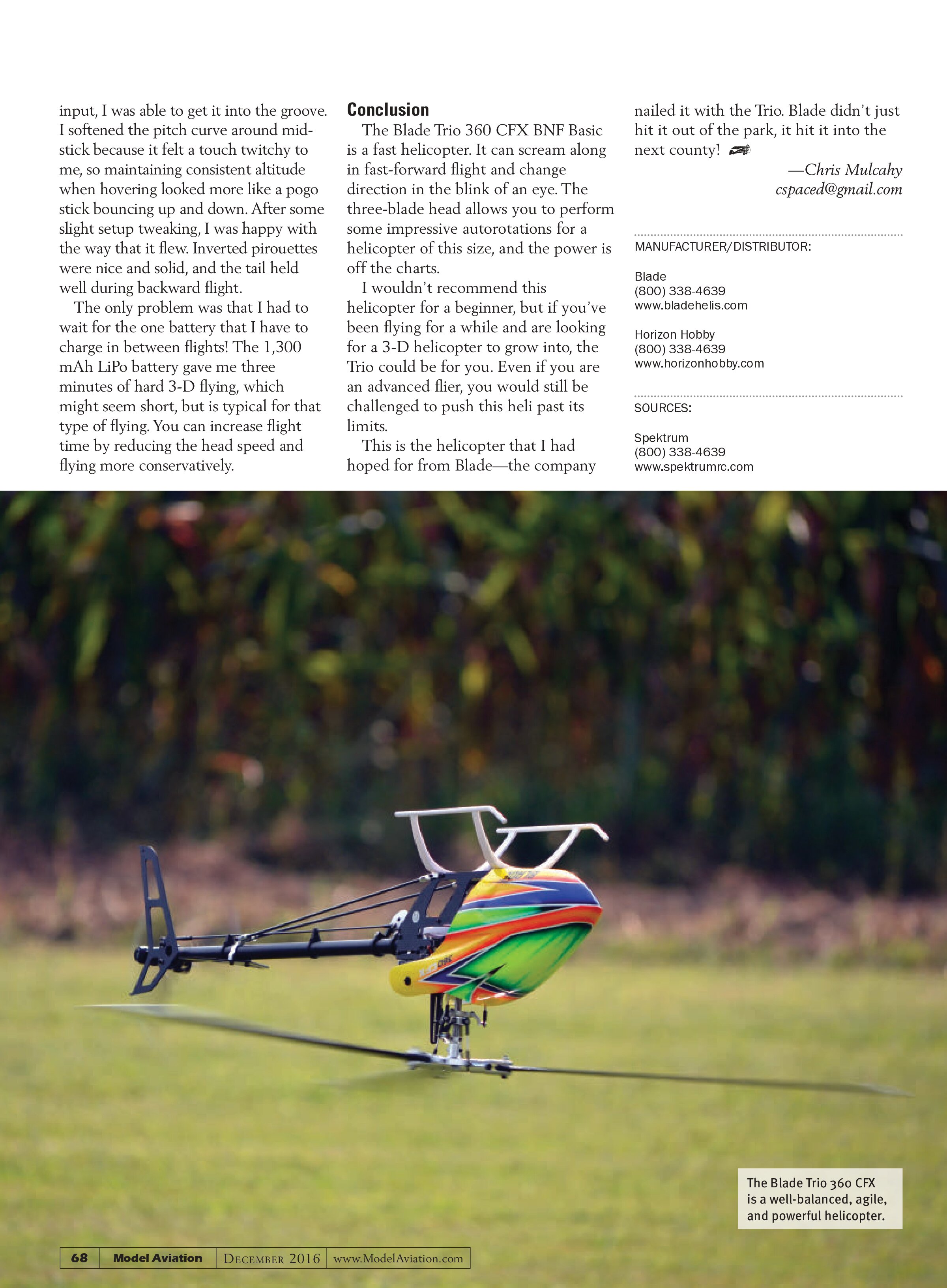
The Blade Trio 360 CFX BNF Basic is a fast helicopter. It can scream along in fast-forward flight and change direction in the blink of an eye. The three-blade head allows you to perform some impressive autorotations for a helicopter of this size, and the power is off the charts.
I wouldn’t recommend this helicopter for a beginner, but if you’ve been flying for a while and are looking for a 3-D helicopter to grow into, the Trio could be for you. Even if you are an advanced flier, you would still be challenged to push this heli past its limits.
This is the helicopter that I had hoped for from Blade—the company nailed it with the Trio. Blade didn’t just hit it out of the park, it hit it into the next county!
—Chris Mulcahy
cspaced@gmail.com
MANUFACTURER/DISTRIBUTOR:
Blade
(800) 338-4639
www.bladehelis.com
Horizon Hobby
(800) 338-4639
www.horizonhobby.com
SOURCES:
Spektrum
(800) 338-4639
www.spektrumrc.com