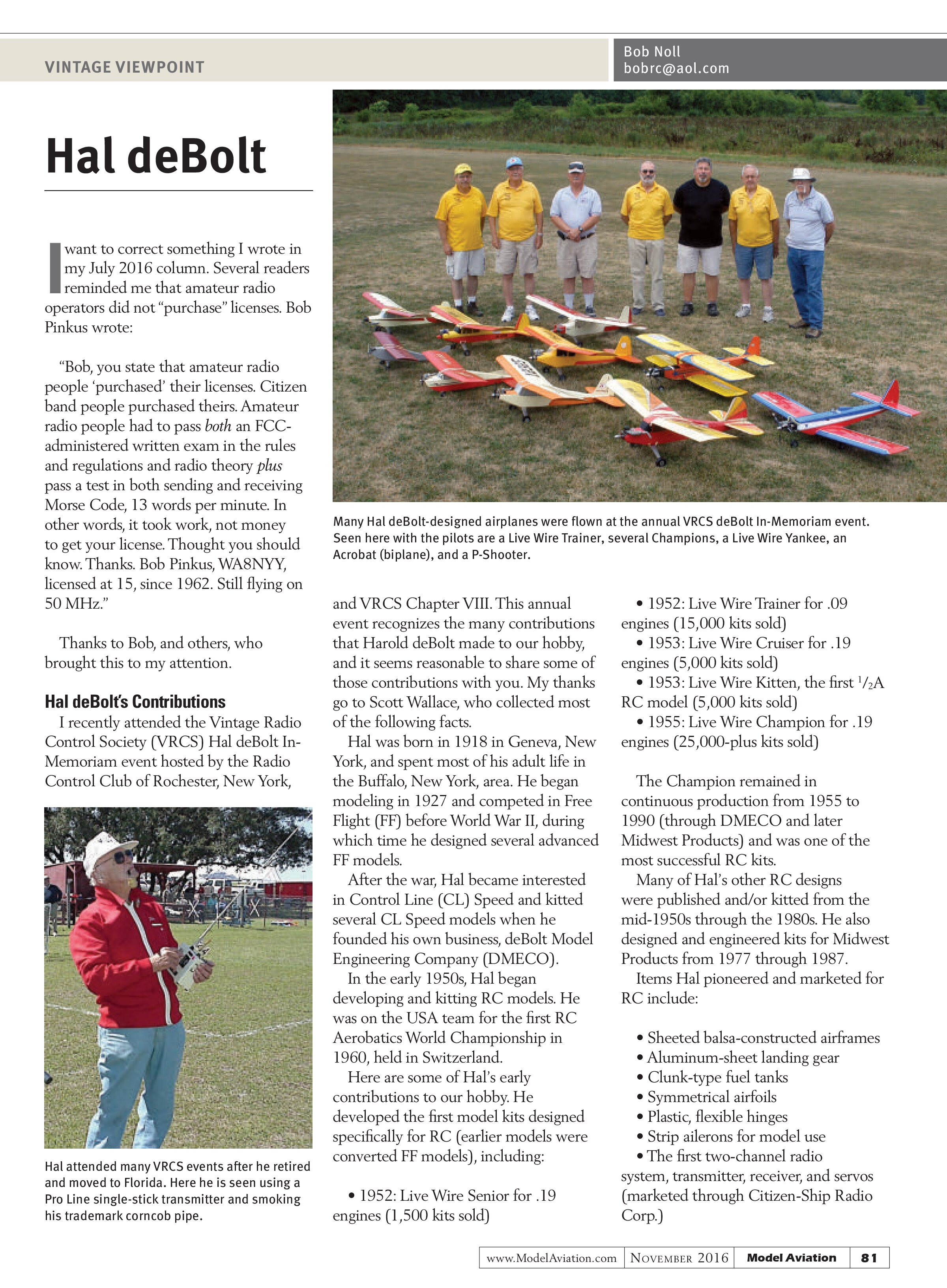
Hal deBolt
I want to correct something I wrote in my July 2016 column. Several readers reminded me that amateur radio operators did not “purchase” licenses. Bob Pinkus wrote:
“Bob, you state that amateur radio people ‘purchased’ their licenses. Citizen band people purchased theirs. Amateur radio people had to pass both an FCC-administered written exam in the rules and regulations and radio theory plus pass a test in both sending and receiving Morse Code, 13 words per minute. In other words, it took work, not money to get your license. Thought you should know. Thanks. Bob Pinkus, WA8NYY, licensed at 15, since 1962. Still flying on 50 MHz.”
Thanks to Bob, and others, who brought this to my attention.
Hal deBolt’s Contributions
I recently attended the Vintage Radio Control Society (VRCS) Hal deBolt In-Memoriam event hosted by the Radio Control Club of Rochester, New York,

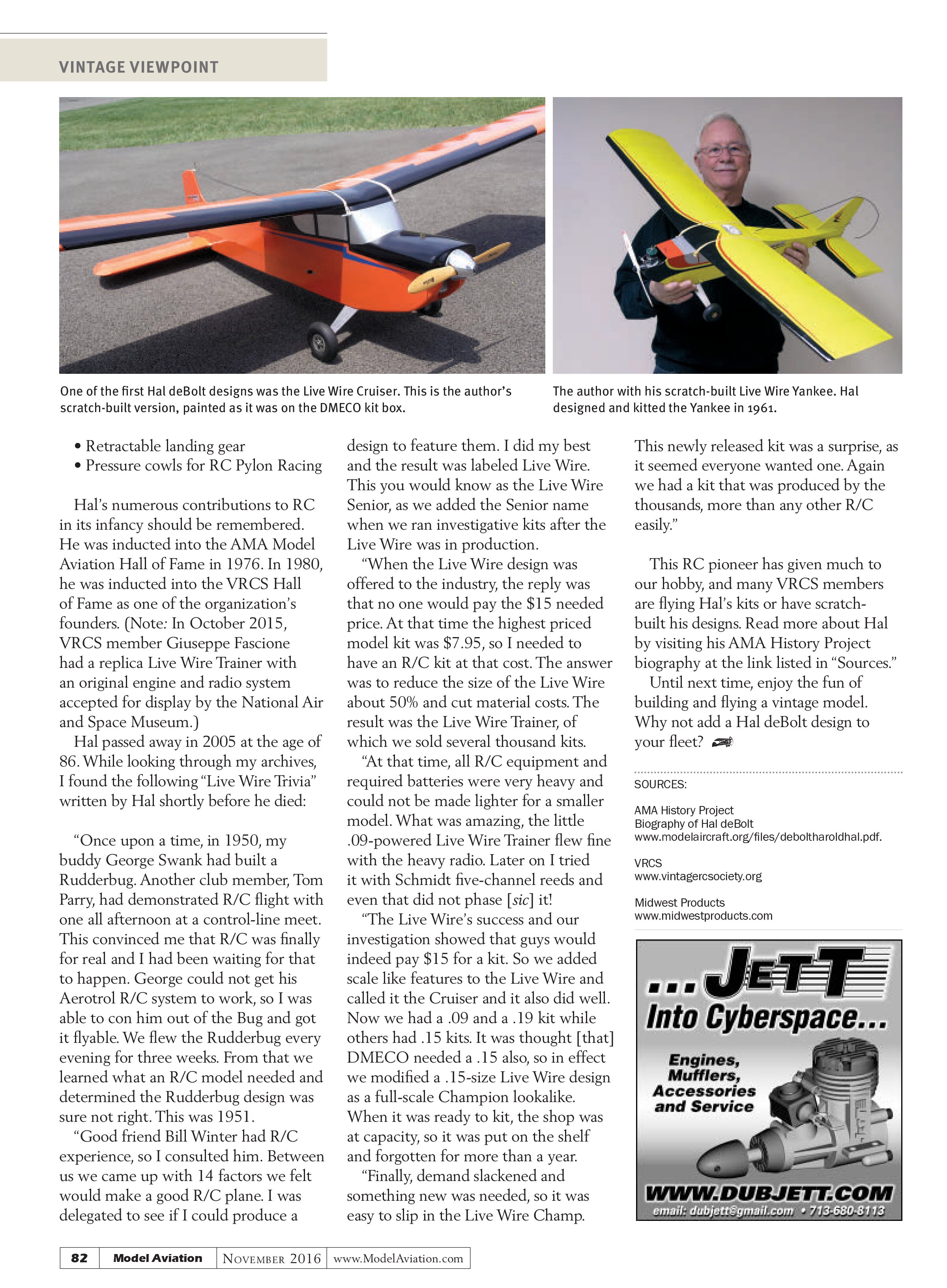
Hal attended many VRCS events after he retired and moved to Florida. Here he is seen using a Pro Line single-stick transmitter and smoking his trademark corncob pipe.
and VRCS Chapter VIII. This annual event recognizes the many contributions that Harold deBolt made to our hobby, and it seems reasonable to share some of those contributions with you. My thanks go to Scott Wallace, who collected most of the following facts.
Hal was born in 1918 in Geneva, New York, and spent most of his adult life in the Buffalo, New York, area. He began modeling in 1927 and competed in Free Flight (FF) before World War II, during which time he designed several advanced FF models.
After the war, Hal became interested in Control Line (CL) Speed and kitted several CL Speed models when he founded his own business, deBolt Model Engineering Company (DMECO).
In the early 1950s, Hal began developing and kitting RC models. He was on the USA team for the first RC Aerobatics World Championship in 1960, held in Switzerland.
Here are some of Hal’s early contributions to our hobby. He developed the first model kits designed specifically for RC (earlier models were converted FF models), including:
- 1952: Live Wire Senior for .19 engines (1,500 kits sold)
- 1952: Live Wire Trainer for .09 engines (15,000 kits sold)
- 1953: Live Wire Cruiser for .19 engines (5,000 kits sold)
- 1953: Live Wire Kitten, the first ½A RC model (5,000 kits sold)
- 1955: Live Wire Champion for .19 engines (25,000-plus kits sold)
The Champion remained in continuous production from 1955 to 1990 (through DMECO and later Midwest Products) and was one of the most successful RC kits.
Many of Hal’s other RC designs were published and/or kitted from the mid-1950s through the 1980s. He also designed and engineered kits for Midwest Products from 1977 through 1987.
Items Hal pioneered and marketed for RC include:
- Sheeted balsa-constructed airframes
- Aluminum-sheet landing gear
- Clunk-type fuel tanks
- Symmetrical airfoils
- Plastic, flexible hinges
- Strip ailerons for model use
- The first two-channel radio system, transmitter, receiver, and servos (marketed through Citizen-Ship Radio Corp.)


- Retractable landing gear
- Pressure cowls for RC Pylon Racing
Hal’s numerous contributions to RC in its infancy should be remembered. He was inducted into the AMA Model Aviation Hall of Fame in 1976. In 1980, he was inducted into the VRCS Hall of Fame as one of the organization’s founders. (Note: In October 2015, VRCS member Giuseppe Fascione had a replica Live Wire Trainer with an original engine and radio system accepted for display by the National Air and Space Museum.)
Hal passed away in 2005 at the age of 86. While looking through my archives, I found the following “Live Wire Trivia” written by Hal shortly before he died:
“Once upon a time, in 1950, my buddy George Swank had built a Rudderbug. Another club member, Tom Parry, had demonstrated R/C flight with one all afternoon at a control-line meet. This convinced me that R/C was finally for real and I had been waiting for that to happen. George could not get his Aerotrol R/C system to work, so I was able to con him out of the Bug and got it flyable. We flew the Rudderbug every evening for three weeks. From that we learned what an R/C model needed and determined the Rudderbug design was sure not right. This was 1951.
“Good friend Bill Winter had R/C experience, so I consulted him. Between us we came up with 14 factors we felt would make a good R/C plane. I was delegated to see if I could produce a design to feature them. I did my best and the result was labeled Live Wire. This you would know as the Live Wire Senior, as we added the Senior name when we ran investigative kits after the Live Wire was in production.
“When the Live Wire design was offered to the industry, the reply was that no one would pay the $15 needed price. At that time the highest priced model kit was $7.95, so I needed to have an R/C kit at that cost. The answer was to reduce the size of the Live Wire about 50% and cut material costs. The result was the Live Wire Trainer, of which we sold several thousand kits.
“At that time, all R/C equipment and required batteries were very heavy and could not be made lighter for a smaller model. What was amazing, the little .09-powered Live Wire Trainer flew fine with the heavy radio. Later on I tried it with Schmidt five-channel reeds and even that did not phase [sic] it!
“The Live Wire’s success and our investigation showed that guys would indeed pay $15 for a kit. So we added scale like features to the Live Wire and called it the Cruiser and it also did well. Now we had a .09 and a .19 kit while others had .15 kits. It was thought [that] DMECO needed a .15 also, so in effect we modified a .15-size Live Wire design as a full-scale Champion lookalike. When it was ready to kit, the shop was at capacity, so it was put on the shelf and forgotten for more than a year.
“Finally, demand slackened and something new was needed, so it was easy to slip in the Live Wire Champ. This newly released kit was a surprise, as it seemed everyone wanted one. Again we had a kit that was produced by the thousands, more than any other R/C easily.”
This RC pioneer has given much to our hobby, and many VRCS members are flying Hal’s kits or have scratch-built his designs. Read more about Hal by visiting his AMA History Project biography at the link listed in “Sources.”
Until next time, enjoy the fun of building and flying a vintage model. Why not add a Hal deBolt design to your fleet?
SOURCES:
AMA History Project
Biography of Hal deBolt
www.modelaircraft.org/files/deboltharoldhal.pdf.
Midwest Products
www.midwestproducts.com