Tom Brett’s Tbx-1
There’s nothing else like it
by Duane Wilson


I have always loved RC Precision Aerobatics, also called Pattern. I have a particular interest in vintage Pattern airplanes dating back to the early 1960s and ’70s. The grace and beauty of a well-executed aerobatic maneuver is timeless.
Vintage Pattern designs share one important characteristic with their modern two-meter counterparts: they are all designed to fly smoothly, precisely, and go exactly where they are pointed. Available as kits, or built from plans, vintage airplanes use straightforward balsa and plywood construction. They were intended as a natural step up from stable, high-wing trainers, much as our low-wing sport airplanes are today, only more capable of aerobatics.
The cost of flying or competing with vintage airplanes is within easy reach of nearly everyone. If you’re not a builder, a few vintage ARFs, such as the Tower Hobbies Kaos, World Models Intruder, or Sky Aviation’s Swiss Marabu, can get you in the air quickly. Organizations such as the Senior Pattern Association (SPA) and Vintage RC Society (VRCS) build, fly, and compete with these vintage airplanes. It’s a lot of fun!
A Very Special Airplane
This is the story of a unique model airplane design that is just as exciting and cool today as it was 50 years ago, in 1965 when it first appeared. Now, after five decades, a replica of
at the 1965 Nats, and became the new, smoother standard.
Even so, the early proportional radio systems were unwieldy compared with modern radios. The analog systems responded slower and less precisely, and they were very expensive, costing hundreds of 1960s dollars. Even if you had the latest thing back then, it didn’t have the niceties that we take for granted today such as exponential, dual rates, servo reversing, and throttle curves, yet nearly everyone gladly converted because nobody had even dreamed of these computerized features. Proportional systems proved to be a lifesaver for modelers struggling to fly with reeds, and it opened the door wide for newcomers.
Interestingly, one option available on early proportional transmitters that’s absent now was the choice of a single-stick transmitter. Eventually, the two-stick version became the standard we have today. Such was the state of RC Aerobatics 50 years ago.
The 1965 Nats
Was there ever a Nats event that you wished you could have attended? Well, if I could travel back in time, my choice would be the 1965 Nats at Naval Air Station Willow Grove in Pennsylvania.
Why the 1965 Nats? It has nothing to do with who won, or even the most popular airplanes that year. The 1965 Nats was special because of two sensational, unconventional designs that emerged!
A rare few airplane designs have that certain something, or “wow factor,” that reaches out and grabs your attention. Both of these airplanes had it in abundance.
Ed Kazmirski’s 8½-foot wingspan Simla blazed the trail for the large International Miniature Aerobatic Club and two-meter Pattern airplanes that would follow years later. (To learn more about Ed Kazmirski, his career, and designs, see the August 2010 and March 2011 issues of Model Aviation).
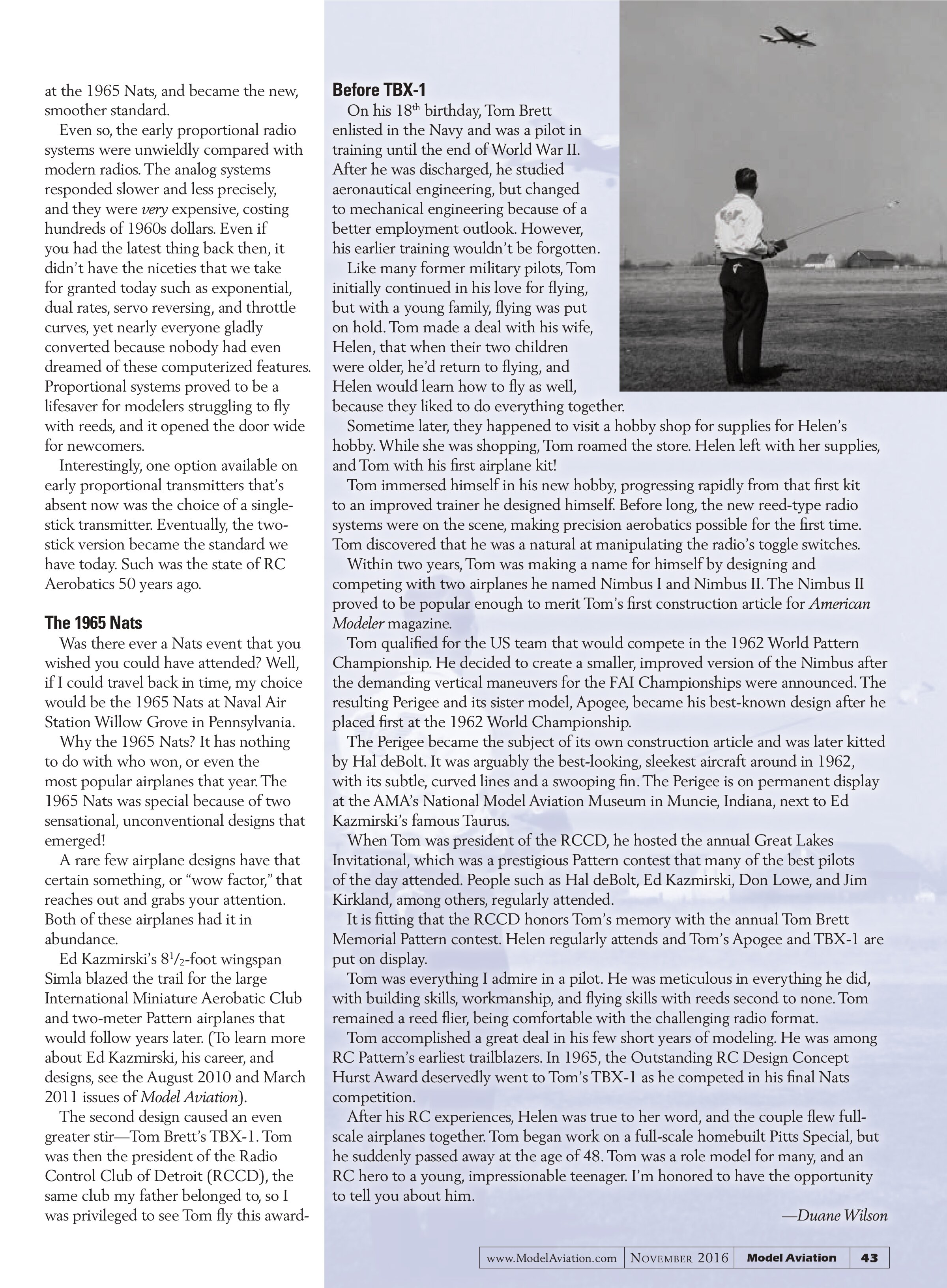
The second design caused an even greater stir—Tom Brett’s TBX-1. Tom was then the president of the Radio Control Club of Detroit (RCCD), the same club my father belonged to, so I was privileged to see Tom fly this award-
Before TBX-1
On his 18th birthday, Tom Brett enlisted in the Navy and was a pilot in training until the end of World War II. After he was discharged, he studied aeronautical engineering, but changed to mechanical engineering because of a better employment outlook. However, his earlier training wouldn’t be forgotten.
Like many former military pilots, Tom initially continued in his love for flying, but with a young family, flying was put on hold. Tom made a deal with his wife, Helen, that when their two children were older, he’d return to flying, and Helen would learn how to fly as well, because they liked to do everything together.

Sometime later, they happened to visit a hobby shop for supplies for Helen’s hobby. While she was shopping, Tom roamed the store. Helen left with her supplies, and Tom with his first airplane kit!
Tom immersed himself in his new hobby, progressing rapidly from that first kit to an improved trainer he designed himself. Before long, the new reed-type radio systems were on the scene, making precision aerobatics possible for the first time. Tom discovered that he was a natural at manipulating the radio’s toggle switches.
Within two years, Tom was making a name for himself by designing and competing with two airplanes he named Nimbus I and Nimbus II. The Nimbus II proved to be popular enough to merit Tom’s first construction article for American Modeler magazine.
Tom qualified for the US team that would compete in the 1962 World Pattern Championship. He decided to create a smaller, improved version of the Nimbus after the demanding vertical maneuvers for the FAI Championships were announced. The resulting Perigee and its sister model, Apogee, became his best-known design after he placed first at the 1962 World Championship.
The Perigee became the subject of its own construction article and was later kitted by Hal deBolt. It was arguably the best-looking, sleekest aircraft around in 1962, with its subtle, curved lines and a swooping fin. The Perigee is on permanent display at the AMA’s National Model Aviation Museum in Muncie, Indiana, next to Ed Kazmirski’s famous Taurus.
When Tom was president of the RCCD, he hosted the annual Great Lakes Invitational, which was a prestigious Pattern contest that many of the best pilots of the day attended. People such as Hal deBolt, Ed Kazmirski, Don Lowe, and Jim Kirkland, among others, regularly attended.
It is fitting that the RCCD honors Tom’s memory with the annual Tom Brett Memorial Pattern contest. Helen regularly attends and Tom’s Apogee and TBX-1 are put on display.
Tom was everything I admire in a pilot. He was meticulous in everything he did, with building skills, workmanship, and flying skills with reeds second to none. Tom remained a reed flier, being comfortable with the challenging radio format.
Tom accomplished a great deal in his few short years of modeling. He was among RC Pattern’s earliest trailblazers. In 1965, the Outstanding RC Design Concept Hurst Award deservedly went to Tom’s TBX-1 as he competed in his final Nats competition.
After his RC experiences, Helen was true to her word, and the couple flew full-scale airplanes together. Tom began work on a full-scale homebuilt Pitts Special, but he suddenly passed away at the age of 48. Tom was a role model for many, and an RC hero to a young, impressionable teenager. I’m honored to have the opportunity to tell you about him.
—Duane Wilson
axial rolls, she said his expression was “magical.” What an exhilarating feeling of accomplishment that first flight must have been!
When I first visited Helen in 2009 to see Tom’s collection of airplanes and memorabilia, we went through his design room and uncovered many of his original drawings. Toward the bottom of the rolls of plans, we found what I was hoping for: a single copy of the TBX-1.
My initial excitement was tempered when I reviewed the plans in detail. The plans we found weren’t the original, but instead a faint, dark, utility copy of the original, apparently used at the time to design the paint scheme. The plans were detailed, particularly the fuselage, and it would take a major effort to decipher and retrace them into something useful for building.
I later enlisted the help of Mike Denest, VRCS vice president, who has expertise in CAD design. Working from the utility copy proved to be difficult. To further complicate matters, the thin paper had distorted slightly throughout the years, so pieces didn’t fit together as expected. Faced with these difficulties, progress slowed to a crawl.
The Swiss TBX
At roughly that time, I received an email from a fellow vintage modeler. He had been asked by a Swiss friend of his if plans were available for the TBX. I replied that the plans were too poor in quality to distribute, and we were working to restore them. I then forgot the conversation.
Imagine my surprise a few months later when I received a second email indicating that his Swiss
winning, radically swept-wing airplane as a young teen, and I was captivated by it. The TBX-1 left a decades-long impression on me.
The TBX design was unconventional, especially for the time. Although it didn’t win any contests that I know of, nor was it kitted or its plans published, this model caused people to stop and stare. Like the Simla, Tom’s TBX-1 was not only singled out in Nats coverage, it was prominently displayed on the back cover of the September 1965 issue of RC Modeler magazine.
The model disappeared into history, yet the design proved memorable enough to be researched and recreated decades later by vintage modelers on both sides of the Atlantic Ocean in an effort to restore it. And like the Simla, the TBX replica was produced without the help of original plans, primarily by means of photos and calculations.
Imagining Tom Brett’s TBX-1
In one of my correspondences with Tom’s wife, Helen, I asked what he had in mind when he set out to design the TBX-1. Why design this new, radically different aircraft?
Helen replied that after winning the Internationals in 1962, he wanted to apply his aeronautical engineering background toward creating something new and different.
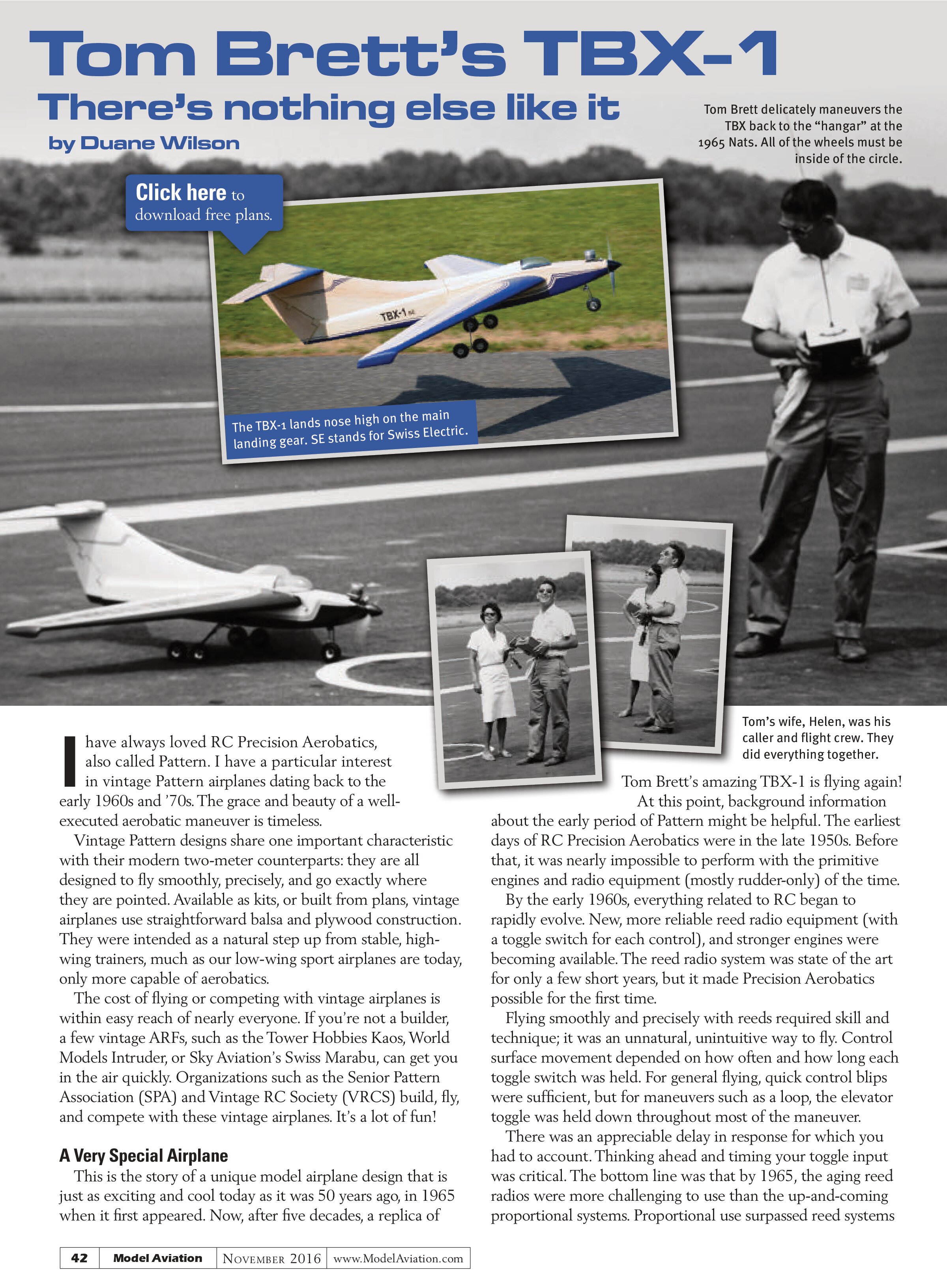
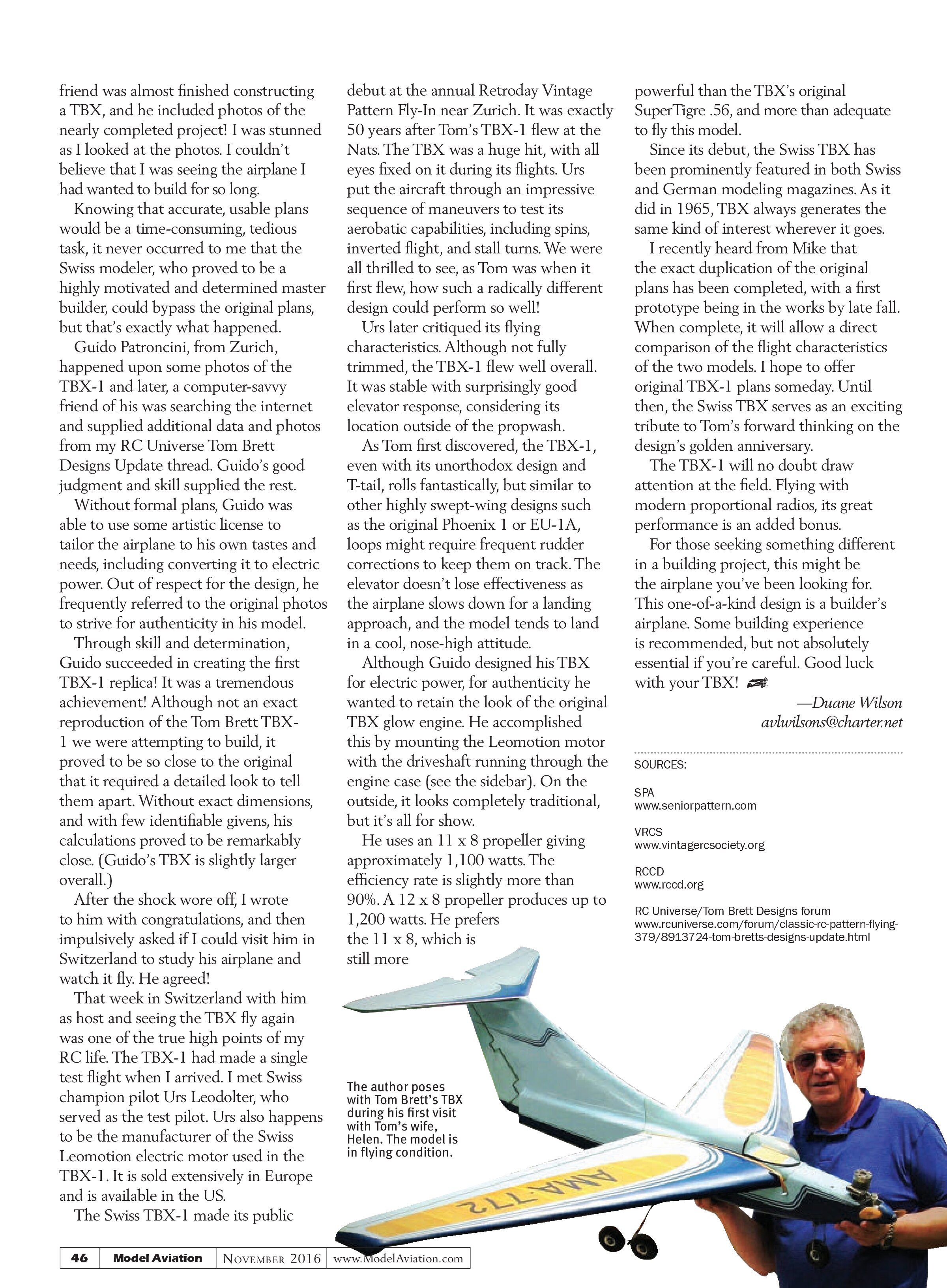
The TBX-1 didn’t follow traditional design conventions. At first glance, it looks like a sleek, swept-wing fighter jet, yet it contains some design elements, such as the four-wheel landing gear and shoulder wing, that would point toward something comparable to a cargo jet.
Whatever his intentions were, Tom accomplished his purpose. The TBX-1, nicknamed the “Lateral Area Special” because of its prominent vertical fin, was unlike anything else in the air—then or since. Although knowing it probably wouldn’t be a serious national contender, Tom still felt confident enough in its performance to take it to the Nats, and fly it on his trusty reed radio.
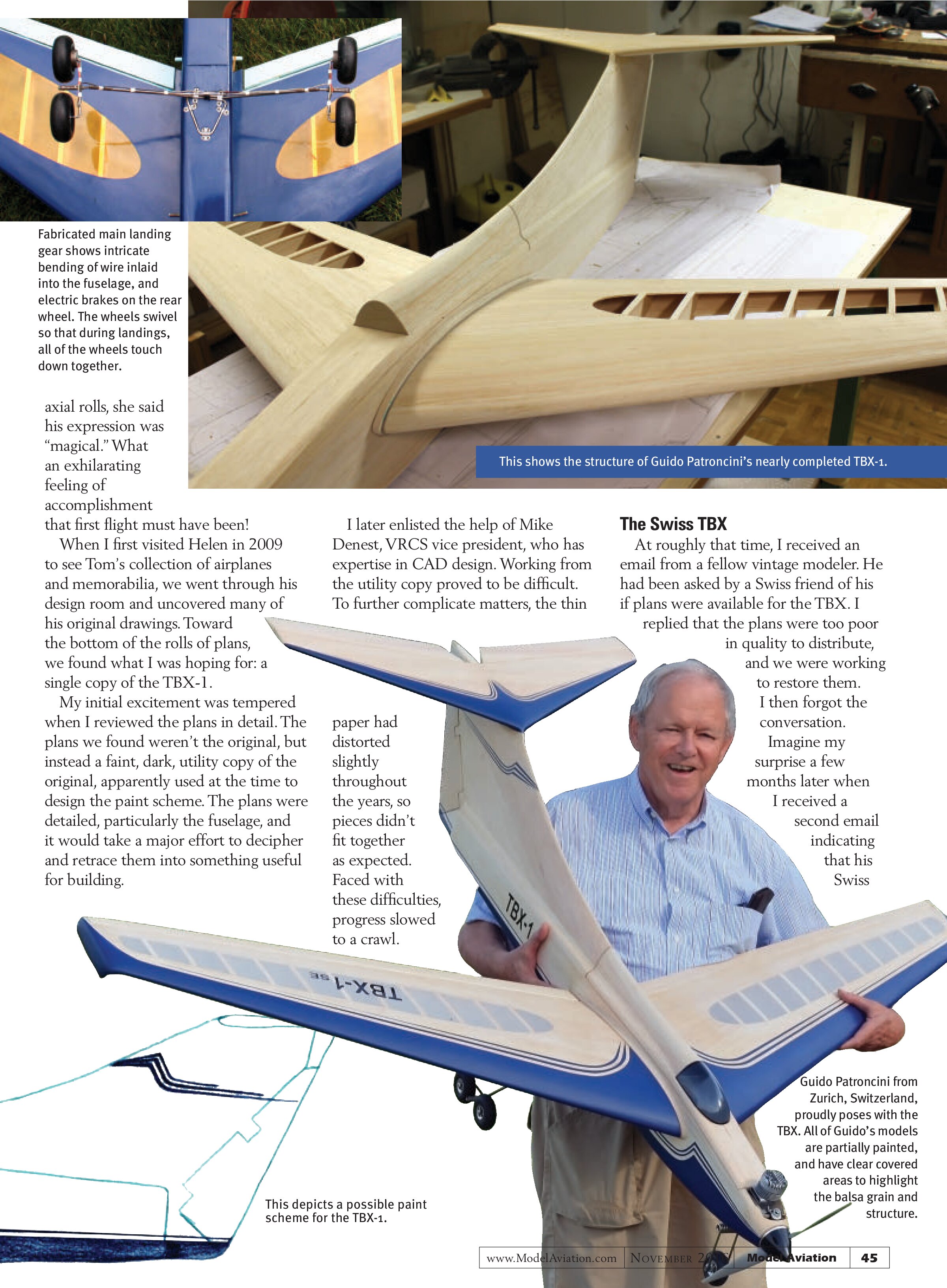
Early pencil sketches of the TBX-1 show that Tom knew exactly what he wanted from the beginning; these earliest drawings have the unmistakable look of the final design. Tom meticulously kept everything, even sheets of calculations. Like many of us do, there were sketches showing several versions of possible paint schemes before the model was even designed or built.
Extensive engineering went into the design—from its highly swept wings with modern contoured wingtips, to the variable semisymmetrical airfoil with washout, to the pressurized fuel system with a header tank (there were no pumps back then), and finally to the T-tail stabilizer.
Helen told me that she still remembers the look on his face when flying the TBX-1 for the first time. While putting it through its paces to see how well it flew, and particularly how well it performed


friend was almost finished constructing a TBX, and he included photos of the nearly completed project! I was stunned as I looked at the photos. I couldn’t believe that I was seeing the airplane I had wanted to build for so long.
Knowing that accurate, usable plans would be a time-consuming, tedious task, it never occurred to me that the Swiss modeler, who proved to be a highly motivated and determined master builder, could bypass the original plans, but that’s exactly what happened.
Guido Patroncini, from Zurich, happened upon some photos of the TBX-1 and later, a computer-savvy friend of his was searching the internet and supplied additional data and photos from my RC Universe Tom Brett Designs Update thread. Guido’s good judgment and skill supplied the rest.
Without formal plans, Guido was able to use some artistic license to tailor the airplane to his own tastes and needs, including converting it to electric power. Out of respect for the design, he frequently referred to the original photos to strive for authenticity in his model.
Through skill and determination, Guido succeeded in creating the first TBX-1 replica! It was a tremendous achievement! Although not an exact reproduction of the Tom Brett TBX-1 we were attempting to build, it proved to be so close to the original that it required a detailed look to tell them apart. Without exact dimensions, and with few identifiable givens, his calculations proved to be remarkably close. (Guido’s TBX is slightly larger overall.)
After the shock wore off, I wrote to him with congratulations, and then impulsively asked if I could visit him in Switzerland to study his airplane and watch it fly. He agreed!
That week in Switzerland with him as host and seeing the TBX fly again was one of the true high points of my RC life. The TBX-1 had made a single test flight when I arrived. I met Swiss champion pilot Urs Leodalter, who served as the test pilot. Urs also happens to be the manufacturer of the Swiss Leomotion electric motor used in the TBX-1. It is sold extensively in Europe and is available in the US.
The Swiss TBX-1 made its public debut at the annual Retroday Vintage Pattern Fly-In near Zurich. It was exactly 50 years after Tom’s TBX-1 flew at the Nats. The TBX was a huge hit, with all eyes fixed on it during its flights. Urs put the aircraft through an impressive sequence of maneuvers to test its aerobatic capabilities, including spins, inverted flight, and stall turns. We were all thrilled to see, as Tom was when it first flew, how such a radically different design could perform so well!
Urs later critiqued its flying characteristics. Although not fully trimmed, the TBX-1 flew well overall. It was stable with surprisingly good elevator response, considering its location outside of the propwash.
As Tom first discovered, the TBX-1, even with its unorthodox design and T-tail, rolls fantastically, but similar to other highly swept-wing designs such as the original Phoenix 1 or EU-1A, loops might require frequent rudder corrections to keep them on track. The elevator doesn’t lose effectiveness as the airplane slows down for a landing approach, and the model tends to land in a cool, nose-high attitude.
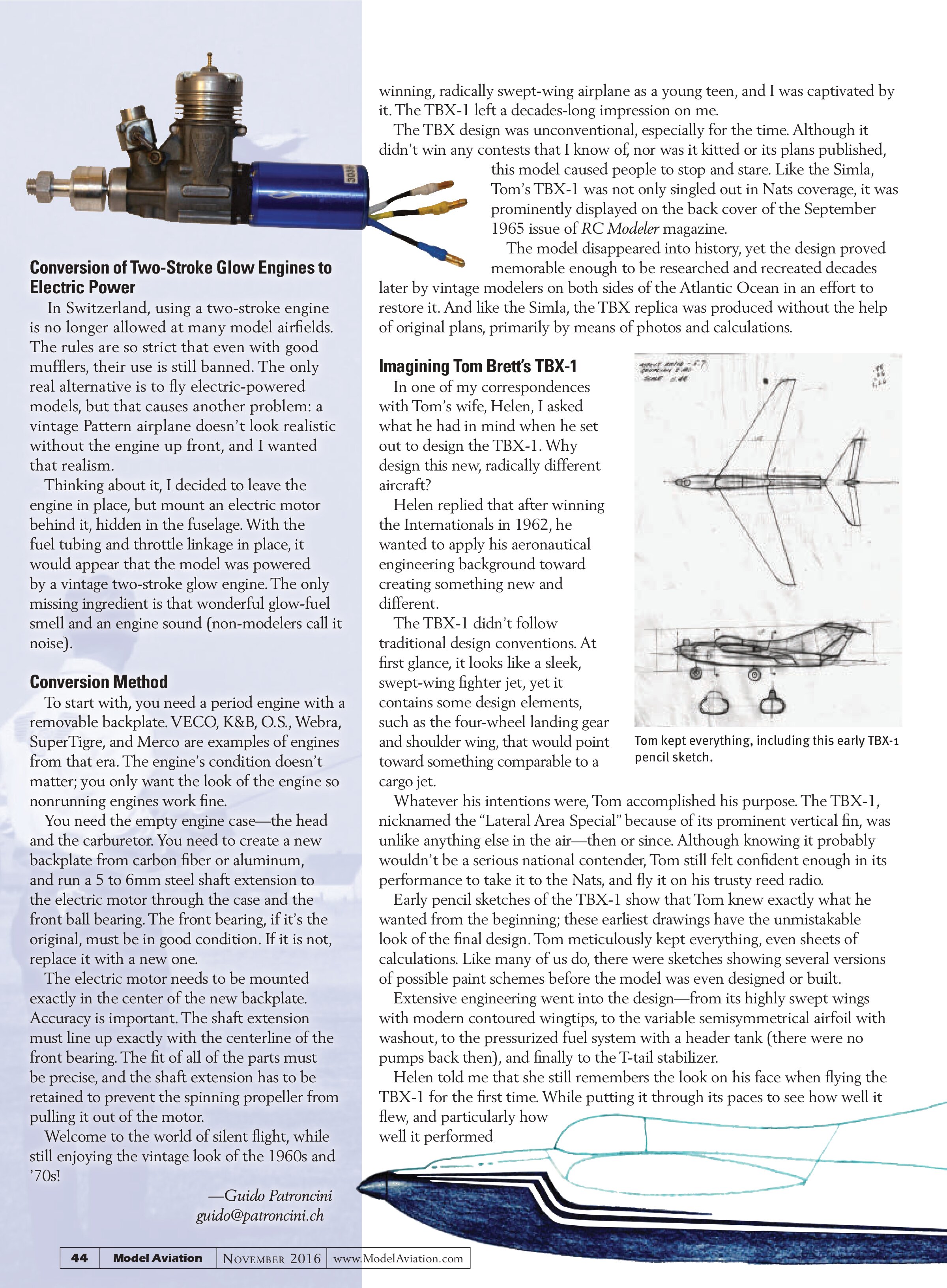
Although Guido designed his TBX for electric power, for authenticity he wanted to retain the look of the original TBX glow engine. He accomplished this by mounting the Leomotion motor with the driveshaft running through the engine case (see the sidebar). On the outside, it looks completely traditional, but it’s all for show.
He uses an 11 x 8 propeller giving approximately 1,100 watts. The efficiency rate is slightly more than 90%. A 12 x 8 propeller produces up to 1,200 watts. He prefers the 11 x 8, which is still more
powerful than the TBX’s original SuperTigre .56, and more than adequate to fly this model.
Since its debut, the Swiss TBX has been prominently featured in both Swiss and German modeling magazines. As it did in 1965, TBX always generates the same kind of interest wherever it goes.
I recently heard from Mike that the exact duplication of the original plans has been completed, with a first prototype being in the works by late fall. When complete, it will allow a direct comparison of the flight characteristics of the two models. I hope to offer original TBX-1 plans someday. Until then, the Swiss TBX serves as an exciting tribute to Tom’s forward thinking on the design’s golden anniversary.
The TBX-1 will no doubt draw attention at the field. Flying with modern proportional radios, its great performance is an added bonus.
For those seeking something different in a building project, this might be the airplane you’ve been looking for. This one-of-a-kind design is a builder’s airplane. Some building experience is recommended, but not absolutely essential if you’re careful. Good luck with your TBX!
—Duane Wilson
avlwilsons@charter.net
SOURCES:
RCCD
www.rccd.org
RC Universe/Tom Brett Designs forum
www.rcuniverse.com/forum/classic-rc-pattern-flying-379/8913724-tom-brett...