RC through the eyes of a newcomer
Dave Gee
safetycolumn@cs.com
An RC flying field must seem like a miraculous place to a first-time visitor—miniature airplanes and rotorcraft zooming around the skies under the perfect control of ground-bound pilots. There is often camaraderie and friendly joking about a not-so-smooth landing.
But above all, there are the models! A visitor quickly decides which one he or she wants to fly. “Hey, can I try that?” A good pilot makes it look easy, right?
New fliers sometimes don’t understand the level of skill required to operate an advanced aircraft. Many old-timers have had to explain the importance of starting with a trainer aircraft, and with the help of a good instructor.
Do You Know the Wind in San Jose?
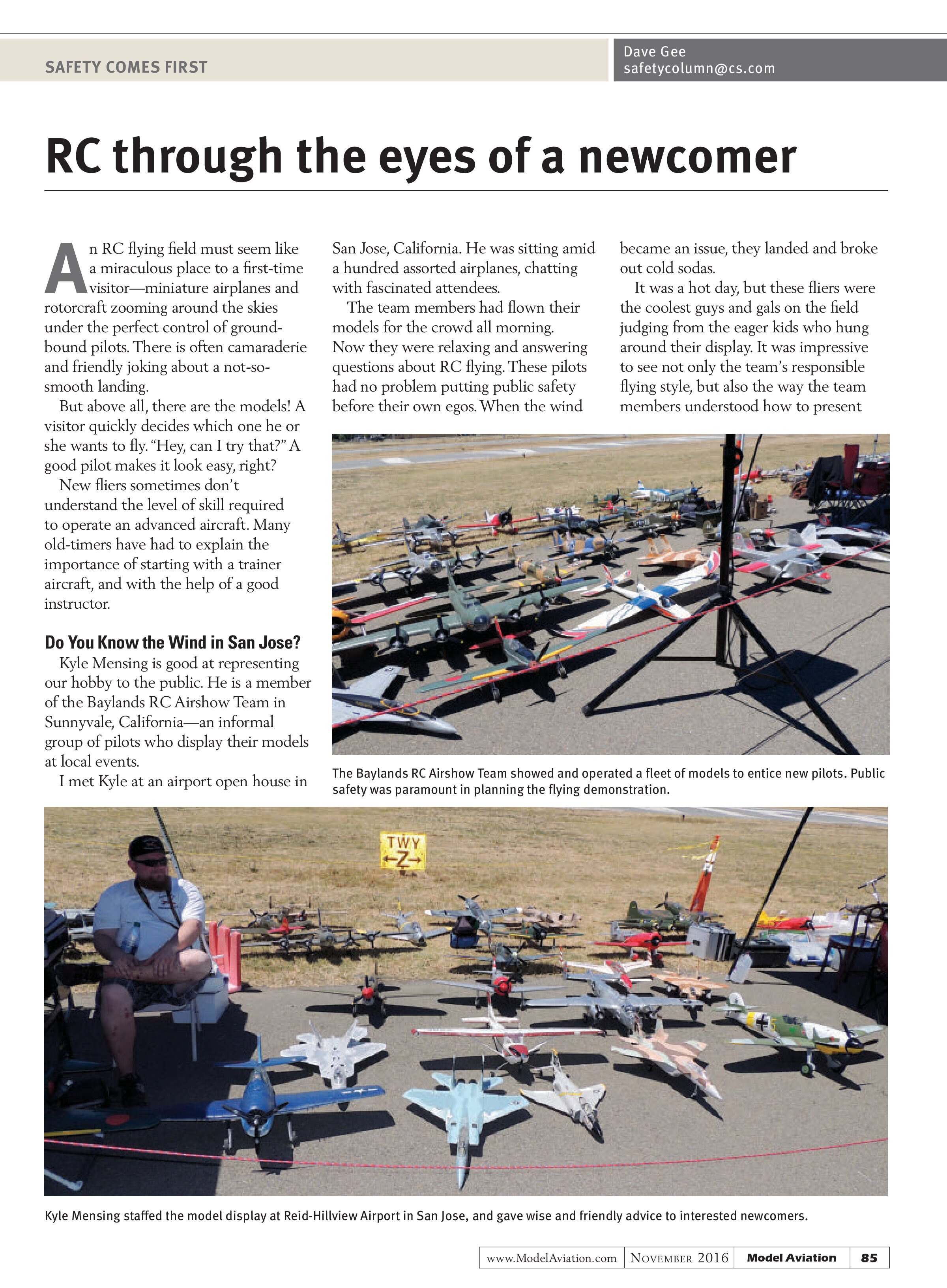
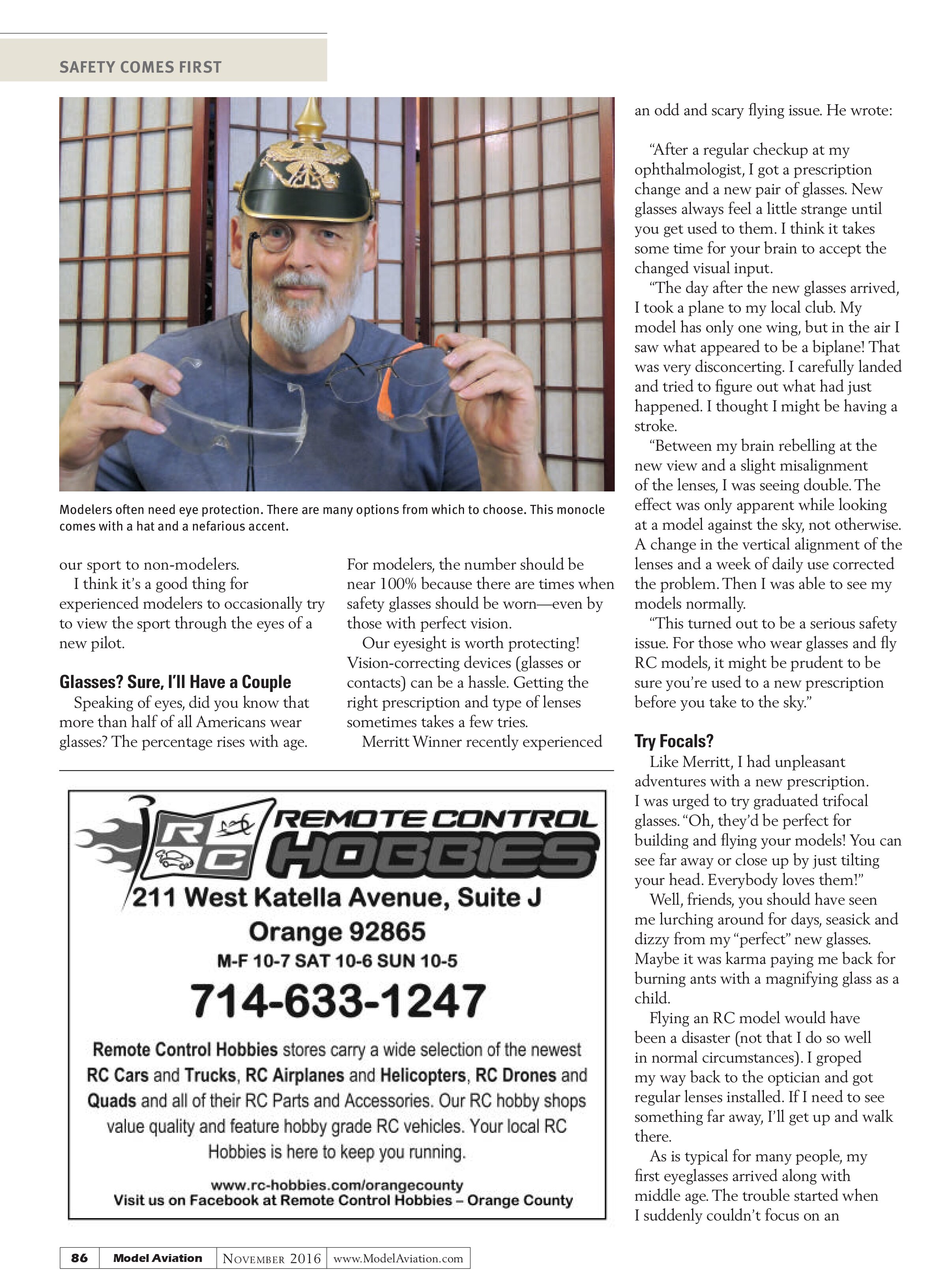
Kyle Mensing is good at representing our hobby to the public. He is a member of the Baylands RC Airshow Team in Sunnyvale, California—an informal group of pilots who display their models at local events.
I met Kyle at an airport open house in San Jose, California. He was sitting amid a hundred assorted airplanes, chatting with fascinated attendees.
The team members had flown their models for the crowd all morning. Now they were relaxing and answering questions about RC flying. These pilots had no problem putting public safety before their own egos. When the wind became an issue, they landed and broke out cold sodas.
It was a hot day, but these fliers were the coolest guys and gals on the field judging from the eager kids who hung around their display. It was impressive to see not only the team’s responsible flying style, but also the way the team members understood how to present


our sport to non-modelers.
I think it’s a good thing for experienced modelers to occasionally try to view the sport through the eyes of a new pilot.
Glasses? Sure, I’ll Have a Couple
Speaking of eyes, did you know that more than half of all Americans wear glasses? The percentage rises with age.

For modelers, the number should be near 100% because there are times when safety glasses should be worn—even by those with perfect vision.
Our eyesight is worth protecting! Vision-correcting devices (glasses or contacts) can be a hassle. Getting the right prescription and type of lenses sometimes takes a few tries.
Merritt Winner recently experienced an odd and scary flying issue. He wrote:
“After a regular checkup at my ophthalmologist, I got a prescription change and a new pair of glasses. New glasses always feel a little strange until you get used to them. I think it takes some time for your brain to accept the changed visual input.
“The day after the new glasses arrived, I took a plane to my local club. My model has only one wing, but in the air I saw what appeared to be a biplane! That was very disconcerting. I carefully landed and tried to figure out what had just happened. I thought I might be having a stroke.
“Between my brain rebelling at the new view and a slight misalignment of the lenses, I was seeing double. The effect was only apparent while looking at a model against the sky, not otherwise. A change in the vertical alignment of the lenses and a week of daily use corrected the problem. Then I was able to see my models normally.
“This turned out to be a serious safety issue. For those who wear glasses and fly RC models, it might be prudent to be sure you’re used to a new prescription before you take to the sky.”
Try Focals?
Like Merritt, I had unpleasant adventures with a new prescription. I was urged to try graduated trifocal glasses. “Oh, they’d be perfect for building and flying your models! You can see far away or close up by just tilting your head. Everybody loves them!”
Well, friends, you should have seen me lurching around for days, seasick and dizzy from my “perfect” new glasses. Maybe it was karma paying me back for burning ants with a magnifying glass as a child.
Flying an RC model would have been a disaster (not that I do so well in normal circumstances). I groped my way back to the optician and got regular lenses installed. If I need to see something far away, I’ll get up and walk there.
As is typical for many people, my first eyeglasses arrived along with middle age. The trouble started when I suddenly couldn’t focus on an airplane I was building. I went to the eye doctor, thinking something awful was happening. He asked my age and then chuckled. It seemed that I was going through what most people do at approximately age 50. My vision was slowly closing in, but until it reached the distance between my nose and the workbench surface, I hadn’t noticed it.
Instead of regular reading glasses, I ordered industrial safety lenses in sturdy frames. It was a trick to help me remember to wear safety glasses when using my rotary tool or drill. Now, whenever I reach for specs to see up close, I’m also putting on proper eye protection.
Saved in the Nick!
A while ago, I was wearing a new expensive pair of prescription safety glasses as I drilled some metal for a nose assembly. A shard of aluminum flew up and scratched my right lens. Boy was I mad that my new pair of pricey eyeglasses was ruined!
Only later did I realize that they had done their job to perfection—protecting my vision during an incident that could have resulted in the loss of an eye. What are a few bucks in exchange for being able to see? All I needed was replacement lenses put into the same frame, so it was a bargain price for continued ocular function.
Many moments in our sport call for eye protection. The hobby-size power tools in a workshop throw splinters and sparks just like big units.
Even if you don’t build your own model, the pit area at an RC field is strewn with hazards to your vision. These include spinning propellers, splashed fuel, or a goof by an adjacent pilot that sends debris zipping around.
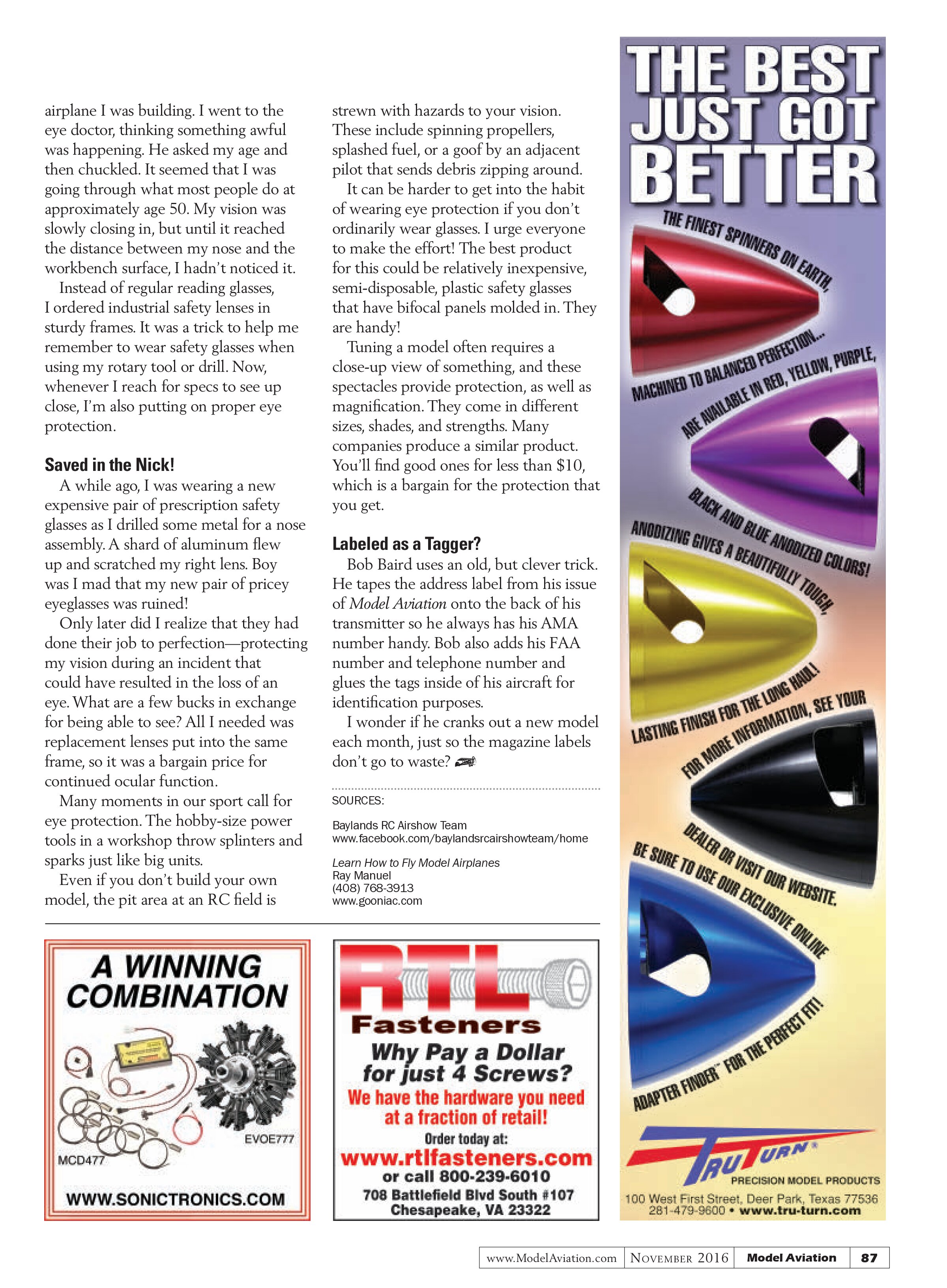
It can be harder to get into the habit of wearing eye protection if you don’t ordinarily wear glasses. I urge everyone to make the effort! The best product for this could be relatively inexpensive, semi-disposable, plastic safety glasses that have bifocal panels molded in. They are handy!
Tuning a model often requires a close-up view of something, and these spectacles provide protection, as well as magnification. They come in different sizes, shades, and strengths. Many companies produce a similar product. You’ll find good ones for less than $10, which is a bargain for the protection that you get.
Labeled as a Tagger?
Bob Baird uses an old, but clever trick. He tapes the address label from his issue of Model Aviation onto the back of his transmitter so he always has his AMA number handy. Bob also adds his FAA number and telephone number and glues the tags inside of his aircraft for identification purposes.
I wonder if he cranks out a new model each month, just so the magazine labels don’t go to waste?
SOURCES:
Baylands RC Airshow Team
www.facebook.com/baylandsrcairshowteam/home
Learn How to Fly Model Airplanes
Ray Manuel
(408) 768-3913
www.gooniac.com