2016 F3J Soaring World Championship
by Gordon Buckland
gordon@gatorf3b.com
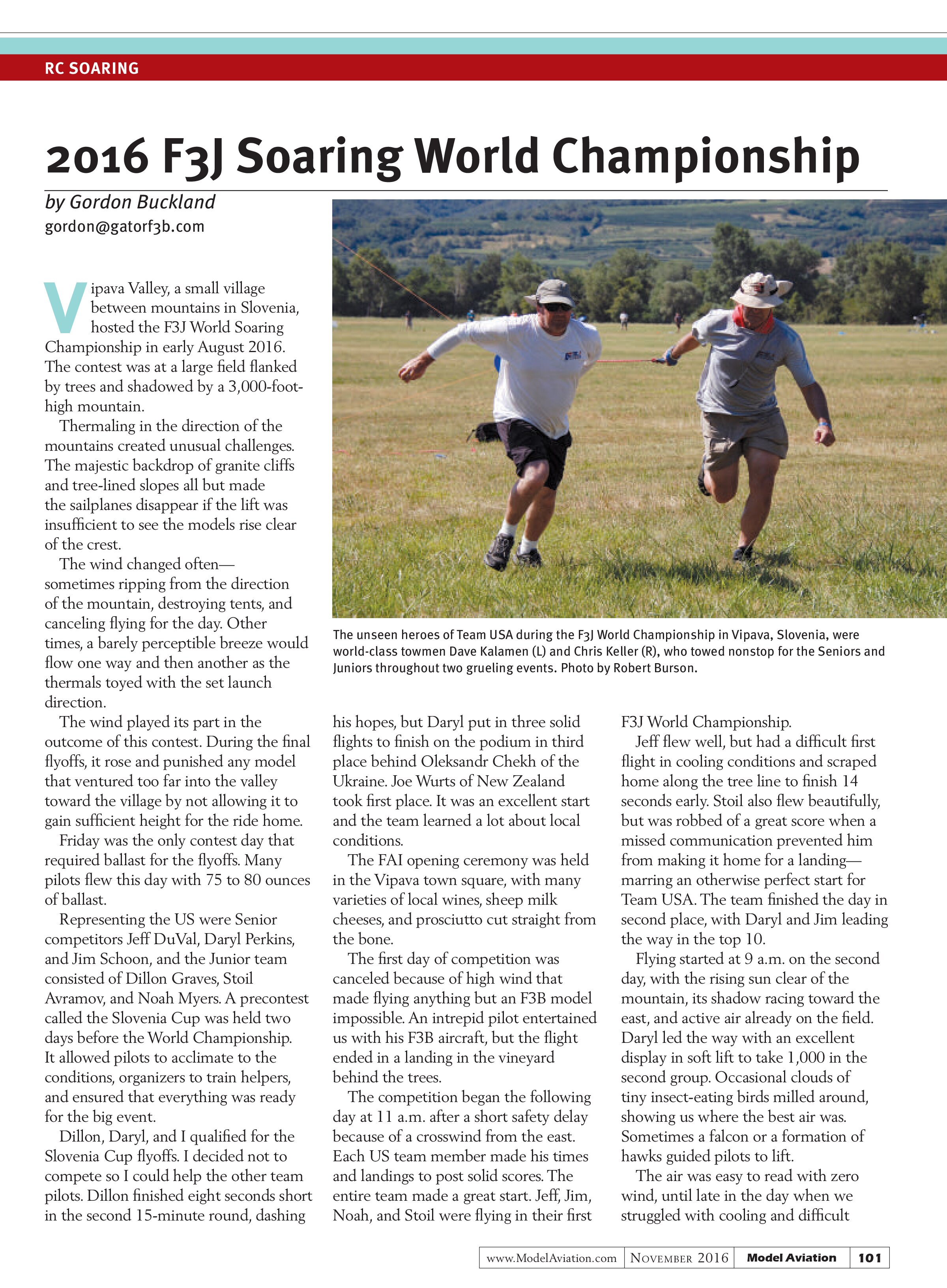
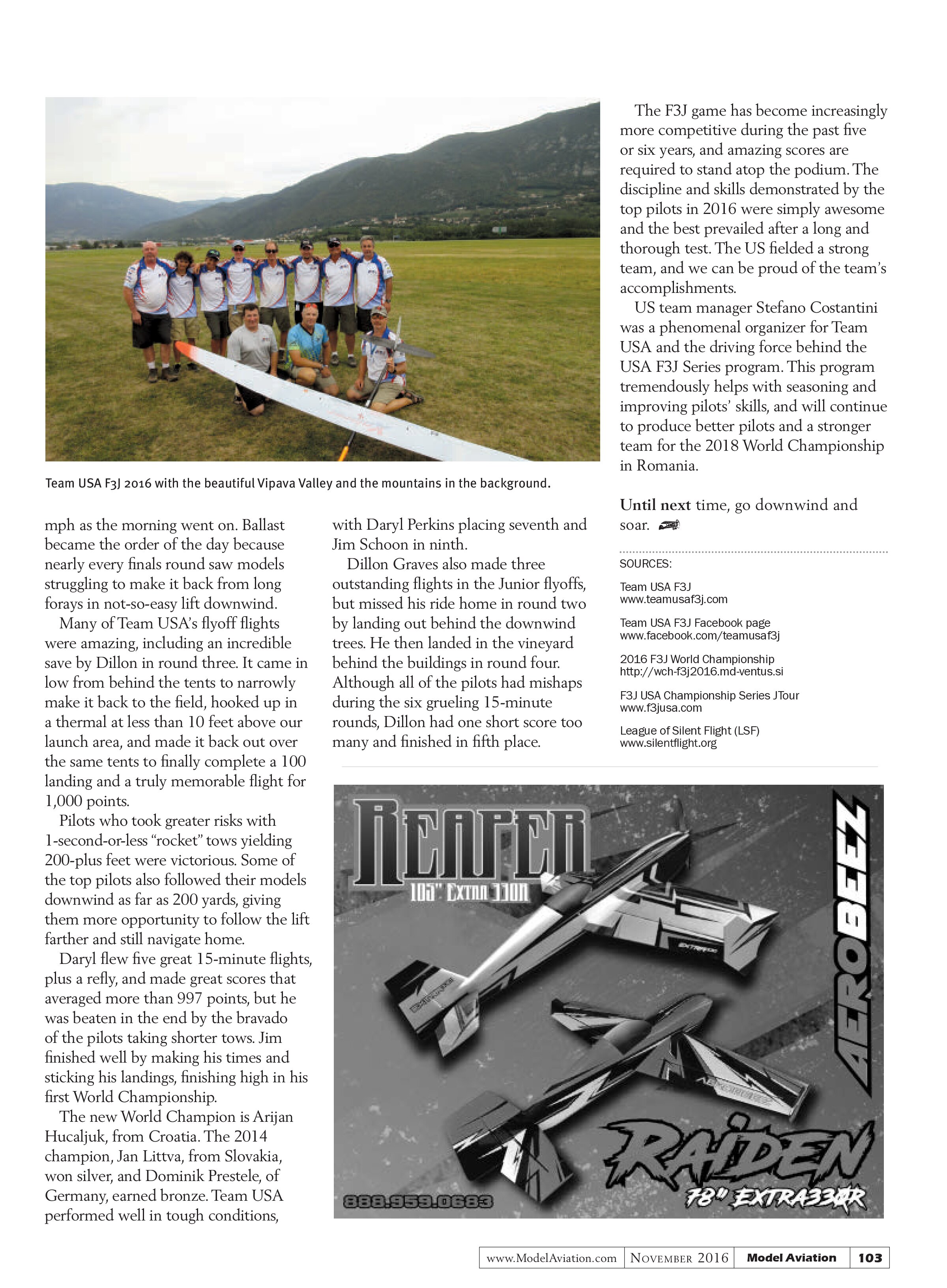
Vipava Valley, a small village between mountains in Slovenia, hosted the F3J World Soaring Championship in early August 2016. The contest was at a large field flanked by trees and shadowed by a 3,000-foot-high mountain.

Thermaling in the direction of the mountains created unusual challenges. The majestic backdrop of granite cliffs and tree-lined slopes all but made the sailplanes disappear if the lift was insufficient to see the models rise clear of the crest.
The wind changed often—sometimes ripping from the direction of the mountain, destroying tents, and canceling flying for the day. Other times, a barely perceptible breeze would flow one way and then another as the thermals toyed with the set launch direction.
The wind played its part in the outcome of this contest. During the final flyoffs, it rose and punished any model that ventured too far into the valley toward the village by not allowing it to gain sufficient height for the ride home. Friday was the only contest day that required ballast for the flyoffs. Many pilots flew this day with 75 to 80 ounces of ballast.
Representing the US were Senior competitors Jeff DuVal, Daryl Perkins, and Jim Schoon, and the Junior team consisted of Dillon Graves, Stoil Avramov, and Noah Myers. A precontest called the Slovenia Cup was held two days before the World Championship. It allowed pilots to acclimate to the conditions, organizers to train helpers, and ensured that everything was ready for the big event.
Dillon, Daryl, and I qualified for the Slovenia Cup flyoffs. I decided not to compete so I could help the other team pilots. Dillon finished eight seconds short in the second 15-minute round, dashing his hopes, but Daryl put in three solid flights to finish on the podium in third place behind Oleksandr Chekh of the Ukraine. Joe Wurts of New Zealand took first place. It was an excellent start and the team learned a lot about local conditions.
The FAI opening ceremony was held in the Vipava town square, with many varieties of local wines, sheep milk cheeses, and prosciutto cut straight from the bone.
The first day of competition was canceled because of high wind that made flying anything but an F3B model impossible. An intrepid pilot entertained us with his F3B aircraft, but the flight ended in a landing in the vineyard behind the trees.
The competition began the following day at 11 a.m. after a short safety delay because of a crosswind from the east. Each US team member made his times and landings to post solid scores. The entire team made a great start. Jeff, Jim, Noah, and Stoil were flying in their first F3J World Championship.
Jeff flew well, but had a difficult first flight in cooling conditions and scraped home along the tree line to finish 14 seconds early. Stoil also flew beautifully, but was robbed of a great score when a missed communication prevented him from making it home for a landing—marring an otherwise perfect start for Team USA. The team finished the day in second place, with Daryl and Jim leading the way in the top 10.
Flying started at 9 a.m. on the second day, with the rising sun clear of the mountain, its shadow racing toward the east, and active air already on the field. Daryl led the way with an excellent display in soft lift to take 1,000 in the second group. Occasional clouds of tiny insect-eating birds milled around, showing us where the best air was. Sometimes a falcon or a formation of hawks guided pilots to lift.
The air was easy to read with zero wind, until late in the day when we struggled with cooling and difficult
conditions during the last two Junior rounds. Noah tried valiantly for 6 minutes to hold his flight together downwind in two patches of light lift, but couldn’t get out or make it back, requiring a relaunch and resulting in a low score.
At the end of day two, with six rounds of excellent, solid flying completed, Jim moved to ninth place. Daryl was in 11th with some unlucky bounces in the landing zone, and Jeff advanced to 19th to keep the US team solidly in second place, 15 points behind the German competitors.
The third day on the field saw the “dropped round” kick in and some shuffling of places. The day was hot and sultry, with all of the US pilots posting great scores to keep us in the game. Daryl, Jim, and Jeff posted 1,000s.
Unfortunately, Jeff’s ninth-round flight became one we would remember for the wrong reasons. He failed to hook up with the group downwind in tough air toward the mountain, and although he tried desperately to make the light air work, he succumbed behind the tree line and squelched his hopes of making the flyoffs.
With one round to fly before the next day’s flyoffs, Daryl was on the cusp in 12th place and did what only he could for the best chance to make a 9:55.7–100 for the 1,000 in his final preliminary flight.
Jeff was next, knowing that two more solid scores would secure silver for Team USA. Jeff took a long, 3-second tow and flew a grinding, teeth-clenching thermal flight low and downwind to make the time and bring it home with a straight-in approach. He then inexplicably touched down a split second late to take a landing penalty.
That moment was hard to explain, but the gravity of what had happened was enormous. Our team’s silver position had instantly vaporized in a strange adrenaline-rush moment at the end of one of the most difficult flights one could imagine. The US team was silent as Jeff retrieved his model and we trudged back to the tent. There were few words to describe the frustration we experienced at that moment.
There was still work to do. Jim needed one more solid flight to secure his position in the final flyoff, and he was flying against Jiří Ducháň of Czech Republic—the only pilot who might keep Daryl from making the cut. Jim put in a pearler with a short tow, a great landing, and the points to ensure that we would have two Senior pilots in the flyoffs.
The Juniors completed the preliminaries in fine style with Dillon flying at the top of the scoreboard all week, finishing at the top in the preliminaries. Although our other two Juniors did not participate in the flyoffs, Stoil and Noah showed great skills. They will be back with a vengeance.
The flyoffs began at 8 a.m. on Friday because of forecasted wind and rain in the afternoon. A gentle breeze strengthened to approximately 10 to 15

mph as the morning went on. Ballast became the order of the day because nearly every finals round saw models struggling to make it back from long forays in not-so-easy lift downwind.
Many of Team USA’s flyoff flights were amazing, including an incredible save by Dillon in round three. It came in low from behind the tents to narrowly make it back to the field, hooked up in a thermal at less than 10 feet above our launch area, and made it back out over the same tents to finally complete a 100 landing and a truly memorable flight for 1,000 points.
Pilots who took greater risks with 1-second-or-less “rocket” tows yielding 200-plus feet were victorious. Some of the top pilots also followed their models downwind as far as 200 yards, giving them more opportunity to follow the lift farther and still navigate home.
Daryl flew five great 15-minute flights, plus a refly, and made great scores that averaged more than 997 points, but he was beaten in the end by the bravado of the pilots taking shorter tows. Jim finished well by making his times and sticking his landings, finishing high in his first World Championship.
The new World Champion is Arijan Hucaljuk, from Croatia. The 2014 champion, Jan Littva, from Slovakia, won silver, and Dominik Prestele, of Germany, earned bronze. Team USA performed well in tough conditions, with Daryl Perkins placing seventh and Jim Schoon in ninth.
Dillon Graves also made three outstanding flights in the Junior flyoffs, but missed his ride home in round two by landing out behind the downwind trees. He then landed in the vineyard behind the buildings in round four. Although all of the pilots had mishaps during the six grueling 15-minute rounds, Dillon had one short score too many and finished in fifth place.
The F3J game has become increasingly more competitive during the past five or six years, and amazing scores are required to stand atop the podium. The discipline and skills demonstrated by the top pilots in 2016 were simply awesome and the best prevailed after a long and thorough test. The US fielded a strong team, and we can be proud of the team’s accomplishments.
US team manager Stefano Costantini was a phenomenal organizer for Team USA and the driving force behind the USA F3J Series program. This program tremendously helps with seasoning and improving pilots’ skills, and will continue to produce better pilots and a stronger team for the 2018 World Championship in Romania.
Until next time, go downwind and soar.
SOURCES:
Team USA F3J
www.teamusaf3j.com
Team USA F3J Facebook page
www.facebook.com/teamusaf3j
2016 F3J World Championship
http://wch-f3j2016.md-ventus.si
F3J USA Championship Series JTour
www.f3jusa.com
League of Silent Flight (LSF)
www.silentflight.org