RC Aerobatics (Jim Quinn)
Celebrating 90 years of national competition and 20 years at AMA’s IAC, the airplanes and the piloting skills dazzle us all. What would those early model aviation pioneers think of us today? What would they think of maneuvers such as the Top Hat and Humpty Bump, or the Goldfish, and Eye Catcher? Our airplanes weigh less, but are bigger, more capable, and more reliable than those of our predecessors.
Why do we keep coming back? Certainly it is for the competition. Our top pilots keep pushing each other to higher and higher performance levels. That is for sure. Even more so, however, is the camaraderie and friendship that the pilots enjoy.
Each pilot has a personal goal, but for most that is not to be a national champion in his/her class. Each pilot is interested to see how he/she places with the other pilots from across the country and even among international competitors. Our Nats are open to pilots worldwide.
In 2016, the airplanes themselves could be the stars. Technological advances in design, construction, and electronics boggle the mind. The level of piloting skills in all classes is impressive to say the least.
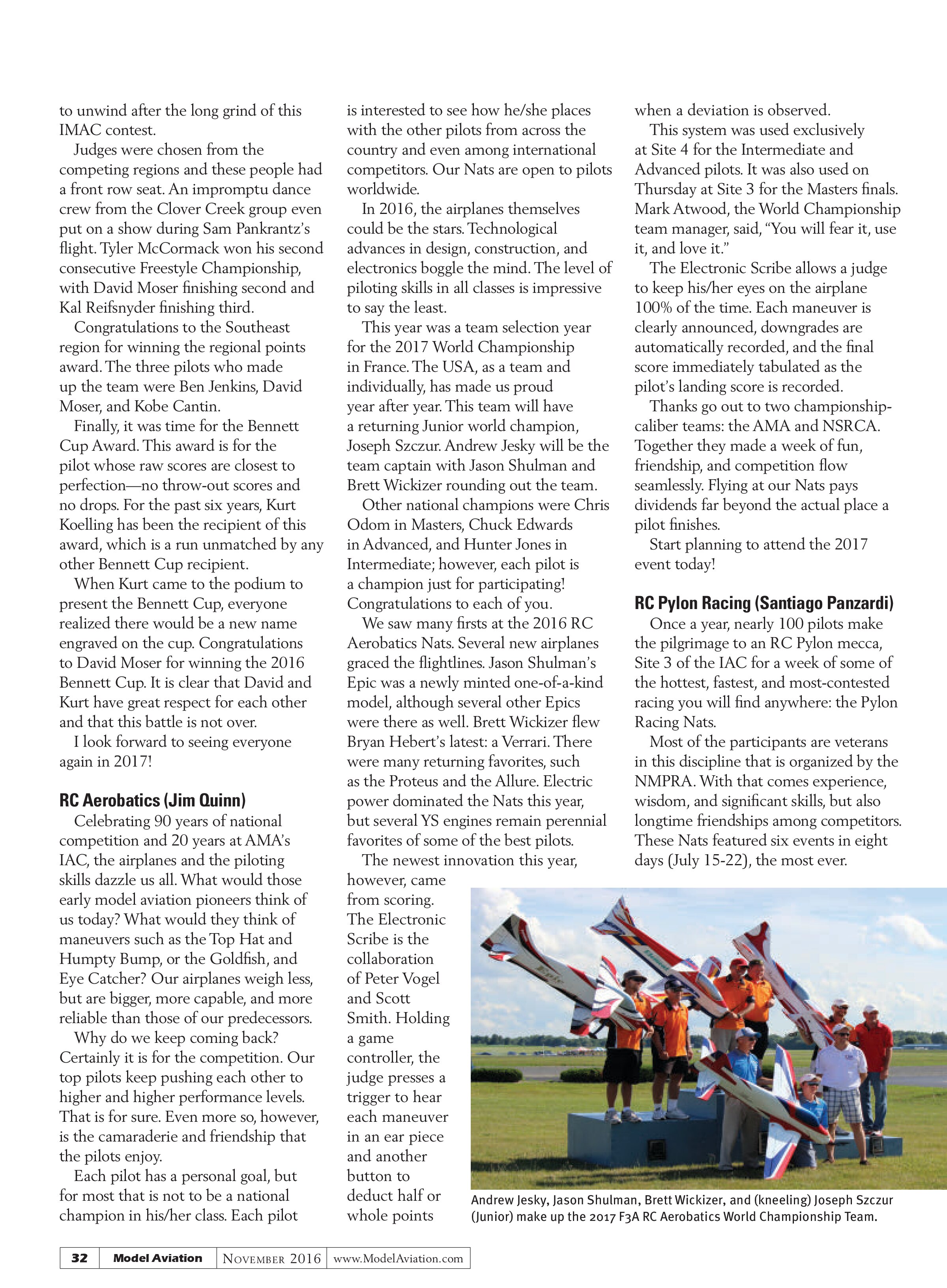
This year was a team selection year for the 2017 World Championship in France. The USA, as a team and individually, has made us proud year after year. This team will have a returning Junior world champion, Joseph Szczur. Andrew Jesky will be the team captain with Jason Shulman and Brett Wickizer rounding out the team.
Other national champions were Chris Odom in Masters, Chuck Edwards in Advanced, and Hunter Jones in Intermediate; however, each pilot is a champion just for participating! Congratulations to each of you.
We saw many firsts at the 2016 RC Aerobatics Nats. Several new airplanes graced the flightlines. Jason Shulman’s Epic was a newly minted one-of-a-kind model, although several other Epics were there as well. Brett Wickizer flew Bryan Hebert’s latest: a Verrari. There were many returning favorites, such as the Proteus and the Allure. Electric power dominated the Nats this year, but several YS engines remain perennial favorites of some of the best pilots.
The newest innovation this year, however, came from scoring. The Electronic Scribe is the collaboration of Peter Vogel and Scott Smith. Holding a game controller, the judge presses a trigger to hear each maneuver in an ear piece and another button to deduct half or whole points when a deviation is observed. This system was used exclusively at Site 4 for the Intermediate and Advanced pilots. It was also used on Thursday at Site 3 for the Masters finals. Mark Atwood, the World Championship team manager, said, “You will fear it, use it, and love it.”
The Electronic Scribe allows a judge to keep his/her eyes on the airplane 100% of the time. Each maneuver is clearly announced, downgrades are automatically recorded, and the final score immediately tabulated as the pilot’s landing score is recorded.
Thanks go out to two championship-caliber teams: the AMA and NSRCA. Together they made a week of fun, friendship, and competition flow seamlessly. Flying at our Nats pays dividends far beyond the actual place a pilot finishes.
Start planning to attend the 2017 event today!

RC Pylon Racing (Santiago Panzardi)
Once a year, nearly 100 pilots make the pilgrimage to an RC Pylon mecca, Site 3 of the IAC for a week of some of the hottest, fastest, and most-contested racing you will find anywhere: the Pylon Racing Nats.
Most of the participants are veterans in this discipline that is organized by the NMPRA. With that comes experience, wisdom, and significant skills, but also longtime friendships among competitors. These Nats featured six events in eight days (July 15-22), the most ever.

This was the first year for warbird competition at the Nats. More than 30 contestants entered this event based on semiscale warbirds with three Reno-like speed brackets—Bronze, Silver, and Gold—with the last one being the fastest with no breakout times. The course is raced from the side around two pylons, and incorporates a flying start. Richard Verano won Gold Class, Robert Holik won Silver, and Robert Hietkamp won the Bronze Class.
Club 40, another form of from-the-side, two-pole racing using sport airplanes, followed on Saturday with roughly 25 participants.
Traditional three-pole racing began on Sunday with AMA 424 Quickie racing. Non-composite-wing Q-500 models race with stock sport engines and stock APC 9 x 6 propellers, reaching more than 115 mph. Ken Van Tuyl bested all other contestants to become the 2016 AMA 424 Champion, and Daniel Troup was best Junior.
Electric Formula 1 (EF1) started with rain that caused a two-hour delay for the 40 anxious pilots. After five or six rounds of racing, Mark Parker was crowned the winner, followed by Dan Kane, second; Dennis Cranfill, third and Fast Time; Duane Gall, fourth; and Tim Sparks, fifth.
New to this year’s EF1 event was the Best of Show award, inspired by the former Formula 1 Racing class. Danny Kane was the winner with a gorgeous Kazi that resembled one of the last models built by Jim Shinohara.
The premier Quickie event, AMA 426, had a fantastic turnout of 71 pilots who were eager to try their racers and their luck. Better known as Super Sport Quickie, AMA 426 started on Tuesday with the traditional two-matrix format that allowed more-thorough competition among all of the contestants. From each matrix, 14 pilots qualified to make up the 28 going into the finals, through eight rounds of preliminaries. An additional five rounds are flown by the best of the best to declare a champion.
Richard Verano, who’s been away from the Nats many years, is considered a legend, having won countless national titles and a World Championship. Richard is back, and although he had to fight harder than ever, he took the Q-500 title once again.
The final order after the flyoffs was: Richard Verano, first; Mark Parker, second; Marcus Blanchard, third and Fast Time; Roy Andrassy, fourth; Robert Vess, fifth; Mike Langlois, sixth; Ray Brown, seventh; Dub Jett, eighth; Duane Hulen, ninth; and Doug Killebrew, 10th.
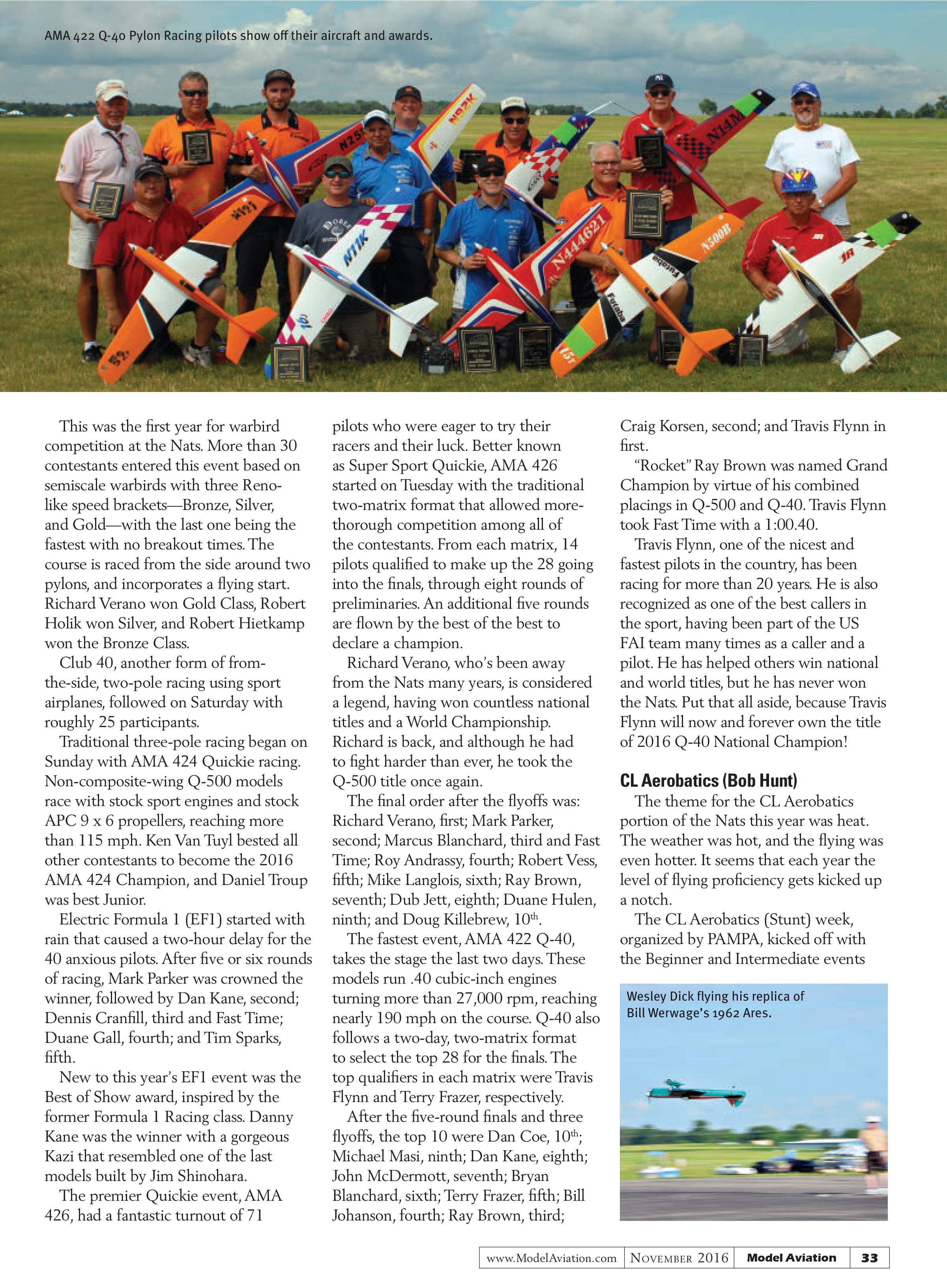
The fastest event, AMA 422 Q-40, takes the stage the last two days. These models run .40 cubic-inch engines turning more than 27,000 rpm, reaching nearly 190 mph on the course. Q-40 also follows a two-day, two-matrix format to select the top 28 for the finals. The top qualifiers in each matrix were Travis Flynn and Terry Frazer, respectively.
After the five-round finals and three flyoffs, the top 10 were Dan Coe, 10th; Michael Masi, ninth; Dan Kane, eighth; John McDermott, seventh; Bryan Blanchard, sixth; Terry Frazer, fifth; Bill Johanson, fourth; Ray Brown, third; Craig Korsen, second; and Travis Flynn in first.
“Rocket” Ray Brown was named Grand Champion by virtue of his combined placings in Q-500 and Q-40. Travis Flynn took Fast Time with a 1:00.40.
Travis Flynn, one of the nicest and fastest pilots in the country, has been racing for more than 20 years. He is also recognized as one of the best callers in the sport, having been part of the US FAI team many times as a caller and a pilot. He has helped others win national and world titles, but he has never won the Nats. Put that all aside, because Travis Flynn will now and forever own the title of 2016 Q-40 National Champion!
CL Aerobatics (Bob Hunt)
The theme for the CL Aerobatics portion of the Nats this year was heat. The weather was hot, and the flying was even hotter. It seems that each year the level of flying proficiency gets kicked up a notch.
The CL Aerobatics (Stunt) week, organized by PAMPA, kicked off with the Beginner and Intermediate events