Refinement of the Sportsman sequence
... we interrupt this program
by Peter Vogel
vogel.peter@gmail.com

In my past few “RC Aerobatics” columns, I examined the finer points of the Sportsman sequence. I plan to continue with that series in my January 2017 column, finishing in time for those of you who are interested in competing to have a chance to read the full Sportsman sequence before the first contests of the 2017 season.
This month, I’ll interrupt my originally scheduled coverage of the stall turn without rolls and the Double Immelmann without rolls to bring you special coverage of the 2016 RC Aerobatics (Pattern) Nats!
2016 Nats
I remember the Nats coverage in Model Aviation from the 1980s when I was first getting into flying R.C. At the time, although I had goals of improving my skills and moving beyond flying my .40-size trainer, I never imagined that I would someday be competing at the Nats!
This year was my first Nats and it was an incredibly challenging and rewarding experience. I went with low expectations for my performance—I was simply hoping to finish in the top half of the Intermediate class. To my pleasant surprise, at the end of day one I was in third place, slightly less than two points (out of 2,000) ahead of the fourth-place competitor and approximately 30 points out of second place.
At the end of day two, the gap narrowed as I held onto the third-place spot by a mere 0.11 points out of a possible 3,000 (four rounds, dropping the lowest score) and still roughly 30 points out of second place.
Finally, on day three and at the completion of the final two rounds, I managed to hold onto and cement my third-place position with a 60-point lead over fourth place!

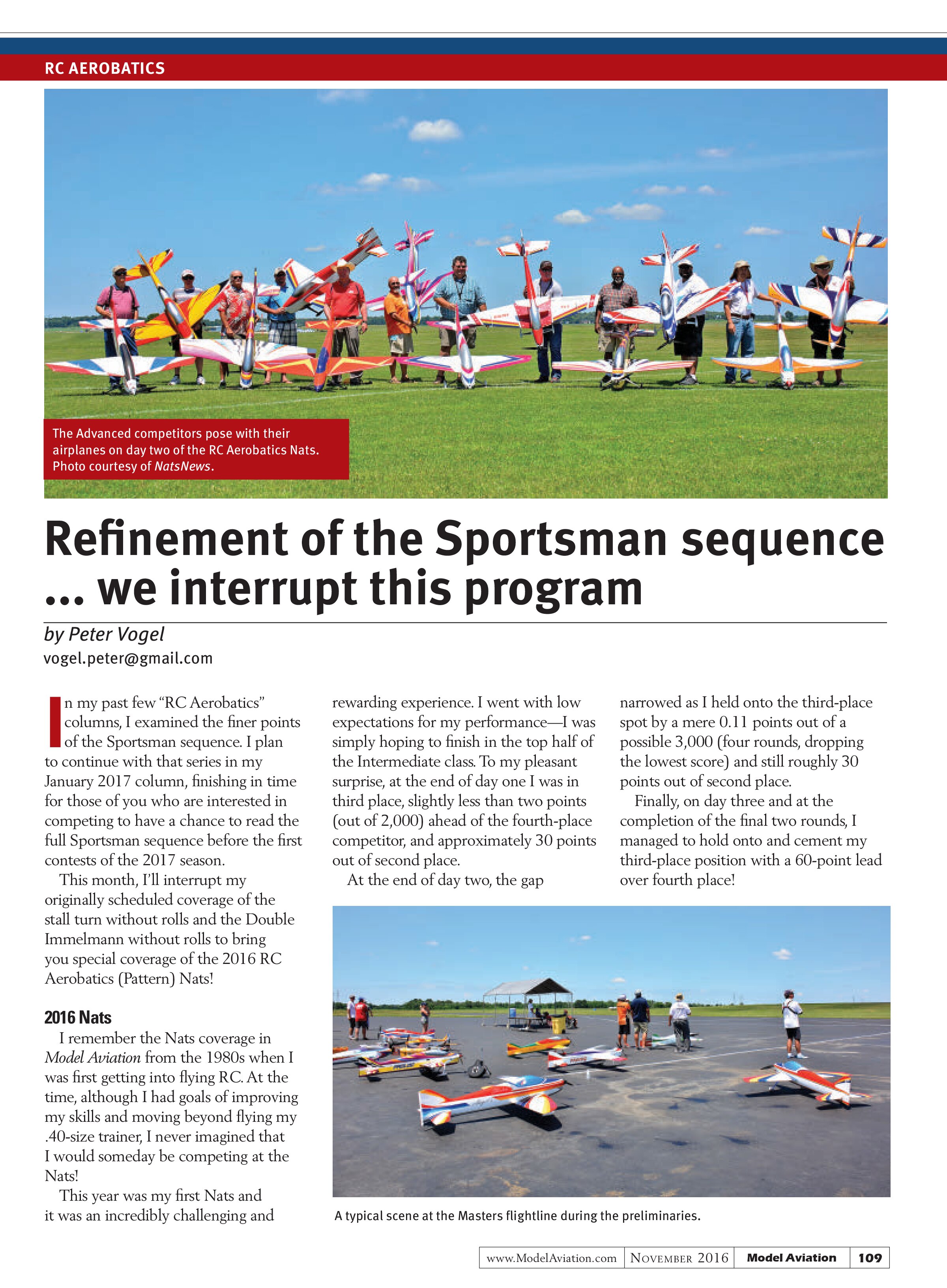
Approximately 76 pilots came together July 10-14, 2016, to compete in Intermediate, Advanced, and Masters classes, as well as the FAI F3A class. The F3A world championships take place every two years on odd-numbered years, making this a team selection year. The best of the best came together to compete in F3A, including competitors from Australia and Canada, who arrived to test their mettle against the best in the US.
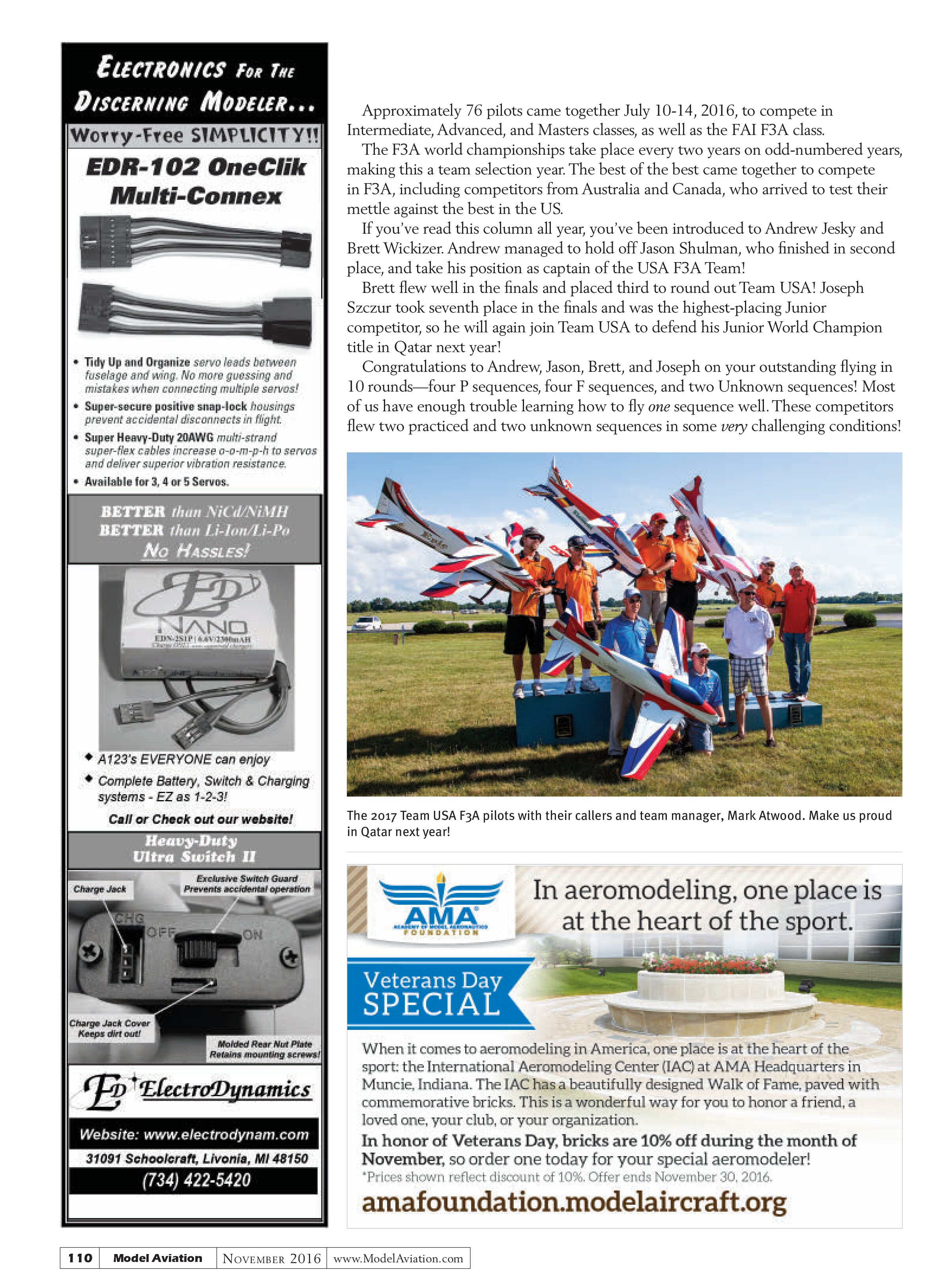
If you’ve read this column all year, you’ve been introduced to Andrew Jesky and Brett Wickizer. Andrew managed to hold off Jason Shulman, who finished in second place, and take his position as captain of the USA F3A Team!
Brett flew well in the finals and placed third to round out Team USA! Joseph Szczur took seventh place in the finals and was the highest-placing Junior competitor, so he will again join Team USA to defend his Junior World Champion title in Qatar next year!
Congratulations to Andrew, Jason, Brett, and Joseph on your outstanding flying in 10 rounds—four P sequences, four F sequences, and two Unknown sequences! Most of us have enough trouble learning how to fly one sequence well. These competitors flew two practiced and two unknown sequences in some very challenging conditions!

As is tradition, the winners of the Intermediate and Advanced classes, as well as the winners of the Masters and F3A preliminary competitions (those who advanced to the finals), were announced at the National Society of Radio Controlled Aerobatics (NSRCA) Wednesday night banquet. This was a great gathering and an awesome opportunity to bond with fellow RC Aerobatics pilots over a wonderful meal!
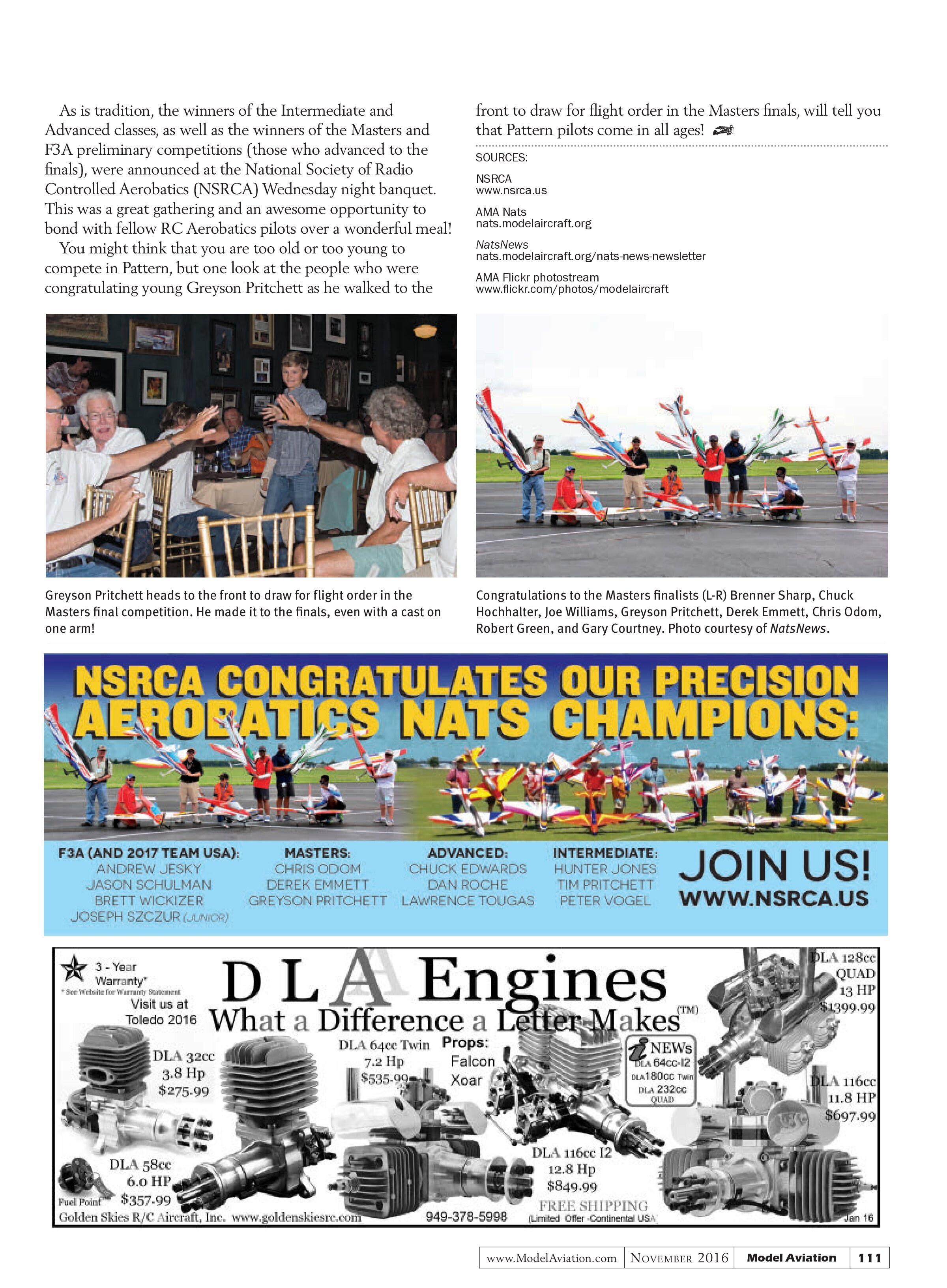
You might think that you are too old or too young to compete in Pattern, but one look at the people who were congratulating young Greyson Pritchett as he walked to the front to draw for flight order in the Masters finals, will tell you that Pattern pilots come in all ages!

Sources:
NSRCA
www.nsrca.us
AMA Nats
nats.modelaircraft.org
NatsNews
nats.modelaircraft.org/nats-news-newsletter
AMA Flickr photostream
www.flickr.com/photos/modelaircraft