Jumbo Scale FF model is consistent and satisfying to fly

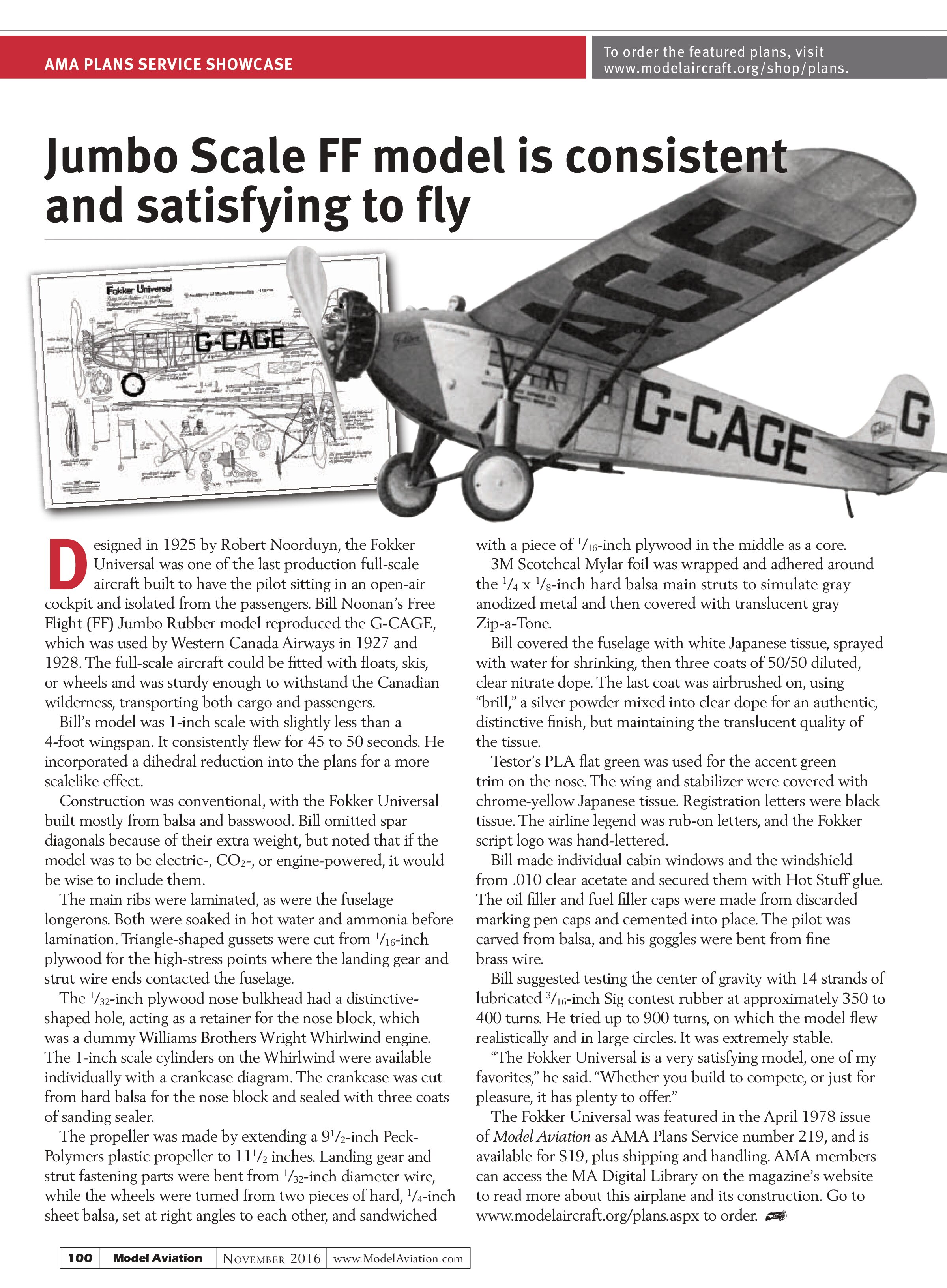
Designed in 1925 by Robert Noorduyn, the Fokker Universal was one of the last production full-scale aircraft built to have the pilot sitting in an open-air cockpit and isolated from the passengers. Bill Noonan’s Free Flight (FF) Jumbo Rubber model reproduced the G-CAGE, which was used by Western Canada Airways in 1927 and 1928. The full-scale aircraft could be fitted with floats, skis, or wheels and was sturdy enough to withstand the Canadian wilderness, transporting both cargo and passengers.
Bill’s model was 1-inch scale with slightly less than a 4-foot wingspan. It consistently flew for 45 to 50 seconds. He incorporated a dihedral reduction into the plans for a more scalelike effect.
Construction was conventional, with the Fokker Universal built mostly from balsa and basswood. Bill omitted spar diagonals because of their extra weight, but noted that if the model was to be electric-, CO₂-, or engine-powered, it would be wise to include them.
The main ribs were laminated, as were the fuselage longerons. Both were soaked in hot water and ammonia before lamination. Triangle-shaped gussets were cut from 1/16-inch plywood for the high-stress points where the landing gear and strut wire ends contacted the fuselage.
The 1/32-inch plywood nose bulkhead had a distinctive-shaped hole, acting as a retainer for the nose block, which was a dummy Williams Brothers Wright Whirlwind engine. The 1-inch scale cylinders on the Whirlwind were available individually with a crankcase diagram. The crankcase was cut from hard balsa for the nose block and sealed with three coats of sanding sealer.
The propeller was made by extending a 9½-inch Peck-Polymers plastic propeller to 11½ inches. Landing gear and strut fastening parts were bent from 1/32-inch diameter wire, while the wheels were turned from two pieces of hard, 1/4-inch sheet balsa, set at right angles to each other, and sandwiched with a piece of 1/16-inch plywood in the middle as a core.
3M Scotchcal Mylar foil was wrapped and adhered around the 1/4 x 1/8-inch hard balsa main struts to simulate gray anodized metal and then covered with translucent gray Zip-a-Tone.
Bill covered the fuselage with white Japanese tissue, sprayed with water for shrinking, then three coats of 50/50 diluted, clear nitrate dope. The last coat was airbrushed on, using “brill,” a silver powder mixed into clear dope for an authentic, distinctive finish, but maintaining the translucent quality of the tissue.
Testor’s PLA flat green was used for the accent green trim on the nose. The wing and stabilizer were covered with chrome-yellow Japanese tissue. Registration letters were black tissue. The airline legend was rub-on letters, and the Fokker script logo was hand-lettered.
Bill made individual cabin windows and the windshield from .010 clear acetate and secured them with Hot Stuff glue. The oil filler and fuel filler caps were made from discarded marking pen caps and cemented into place. The pilot was carved from balsa, and his goggles were bent from fine brass wire.
Bill suggested testing the center of gravity with 14 strands of lubricated 3/16-inch Sig contest rubber at approximately 350 to 400 turns. He tried up to 900 turns, on which the model flew realistically and in large circles. It was extremely stable.
“The Fokker Universal is a very satisfying model, one of my favorites,” he said. “Whether you build to compete, or just for pleasure, it has plenty to offer.”
The Fokker Universal was featured in the April 1978 issue of Model Aviation as AMA Plans Service number 219, and is available for $19, plus shipping and handling. AMA members can access the MA Digital Library on the magazine’s website to read more about this airplane and its construction. Go to www.modelaircraft.org/plans.aspx to order.