Recycled from rubber to electric
by Louis Joyner
joynerduration@gmail.com
The rules for the international electric-powered Free Flight (FF) event known as F1Q, limit the amount of energy used instead of the length of the motor run. The energy allowance is based upon the weight of the model. Four joules of energy are allowed per gram of model weight, up to a maximum weight of 500 grams. (The model can weigh more than 500 grams, but it only gets the maximum allowance of 4 joules x 500 grams = 2,000 joules.)
During the flight, the allotted energy is controlled by an electronic energy limiter, which shuts off power after the calculated amount is used. As an alternative, the motor run can be controlled by a timer that cuts power after a predetermined time, based on ground tests of the motor, propeller, and battery combination. In any case, the motor run can be no more than 40 seconds. There are no limits to the model area; flaps or folding wings are not allowed.
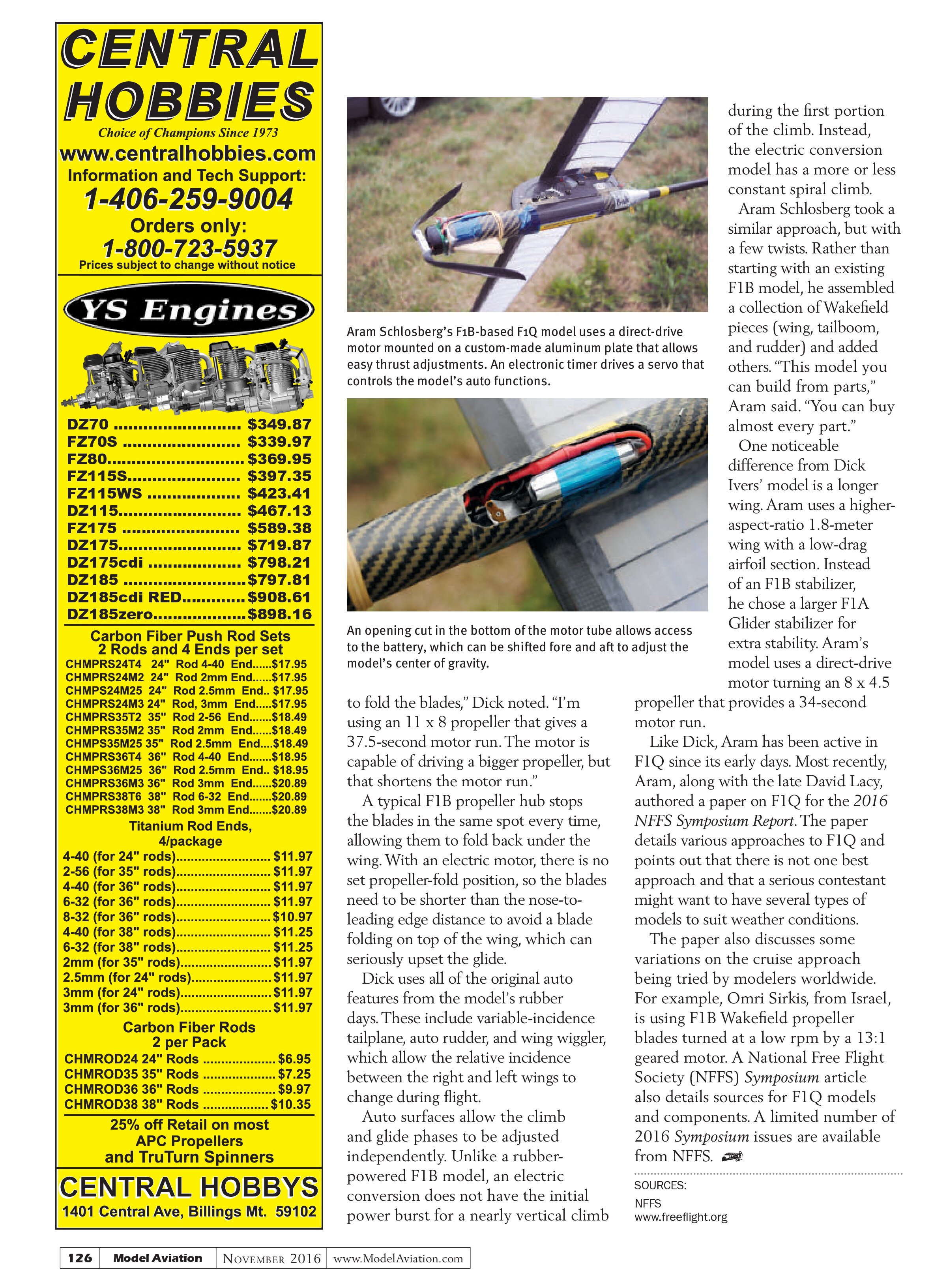
This energy allowance rule encourages a variety of approaches to how that energy is used. Some models use all of the energy in 4 or 5 seconds, producing a straight, nearly vertical climb with a bunt over to a glide, much like F1C Power models. Others use a slower spiral climb with a 10- to 15-second run, similar to an AMA Gas model. A third approach is to use a longer, slower cruise for 30 to 40 seconds, much like the cruise portion of a rubber-powered model’s flight.
The fast, straight-climb approach offers an advantage in windy conditions because it is less affected by ground turbulence. Typically, the straight climbers feature high-aspect-ratio carbon-fiber wings and auto surfaces. With its short motor run, the model has to glide for most of the 3-minute maximum flight. The spiral climb approach allows one to use a simpler, more compact model, often of all-balsa construction and usually without the auto functions of the straight-climb models.
The slower climb velocity of long-run cruisers reduces the effects of drag on a model, permitting the use of a deeper undercambered airfoil than what is used on the other two model types. That means that an F1B Wakefield Rubber wing could be used for improved glide performance over the lower-cambered airfoils of a straight-climb model or the thicker, flat-bottomed airfoils often used on the spiral-climb models.
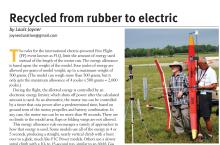
Several pilots flew converted F1B models in F1Q during the 2016 Nats. Dick Ivers had converted an Andriukov short-wing (1.5-meter wingspan) F1B that he had purchased from Eddie Vanlandingham. “The older 32mm-diameter motor tubes are better,” Dick said. “There is more room for electronics than in the newer 30mm tubes.”
The model’s modifications were relatively minor. The most obvious one was replacing the rubber model’s front end and propeller with a German-made Hacker 4:1 geared electric motor. “You can’t chop the motor tube off too much because you’ve got


to fold the blades,” Dick noted. “I’m using an 11 x 8 propeller that gives a 37.5-second motor run. The motor is capable of driving a bigger propeller, but that shortens the motor run.”
A typical F1B propeller hub stops the blades in the same spot every time, allowing them to fold back under the wing. With an electric motor, there is no set propeller-fold position, so the blades need to be shorter than the nose-to-leading edge distance to avoid a blade folding on top of the wing, which can seriously upset the glide.
Dick uses all of the original auto features from the model’s rubber days. These include variable-incidence tailplane, auto rudder, and wing wiggler, which allow the relative incidence between the right and left wings to change during flight.
Auto surfaces allow the climb and glide phases to be adjusted independently. Unlike a rubber-powered F1B model, an electric conversion does not have the initial power burst for a nearly vertical climb during the first portion of the climb. Instead, the electric conversion model has a more or less constant spiral climb.
Aram Schlosberg took a similar approach, but with a few twists. Rather than starting with an existing F1B model, he assembled a collection of Wakefield pieces (wing, tailboom, and rudder) and added others. “This model you can build from parts,” Aram said. “You can buy almost every part.”
One noticeable difference from Dick Ivers’ model is a longer wing. Aram uses a higher-aspect-ratio 1.8-meter wing with a low-drag airfoil section. Instead of an F1B stabilizer, he chose a larger F1A Glider stabilizer for extra stability. Aram’s model uses a direct-drive motor turning an 8 x 4.5 propeller that provides a 34-second motor run.
Like Dick, Aram has been active in F1Q since its early days. Most recently, Aram, along with the late David Lacy, authored a paper on F1Q for the 2016 NFFS Symposium Report. The paper details various approaches to F1Q and points out that there is not one best approach and that a serious contestant might want to have several types of models to suit weather conditions.
The paper also discusses some variations on the cruise approach being tried by modelers worldwide. For example, Omri Sirkis, from Israel, is using F1B Wakefield propeller blades turned at a low rpm by a 13:1 geared motor. A National Free Flight Society (NFFS) Symposium article also details sources for F1Q models and components. A limited number of 2016 Symposium issues are available from NFFS.


SOURCES:
NFFS
www.freeflight.org