Focal Point

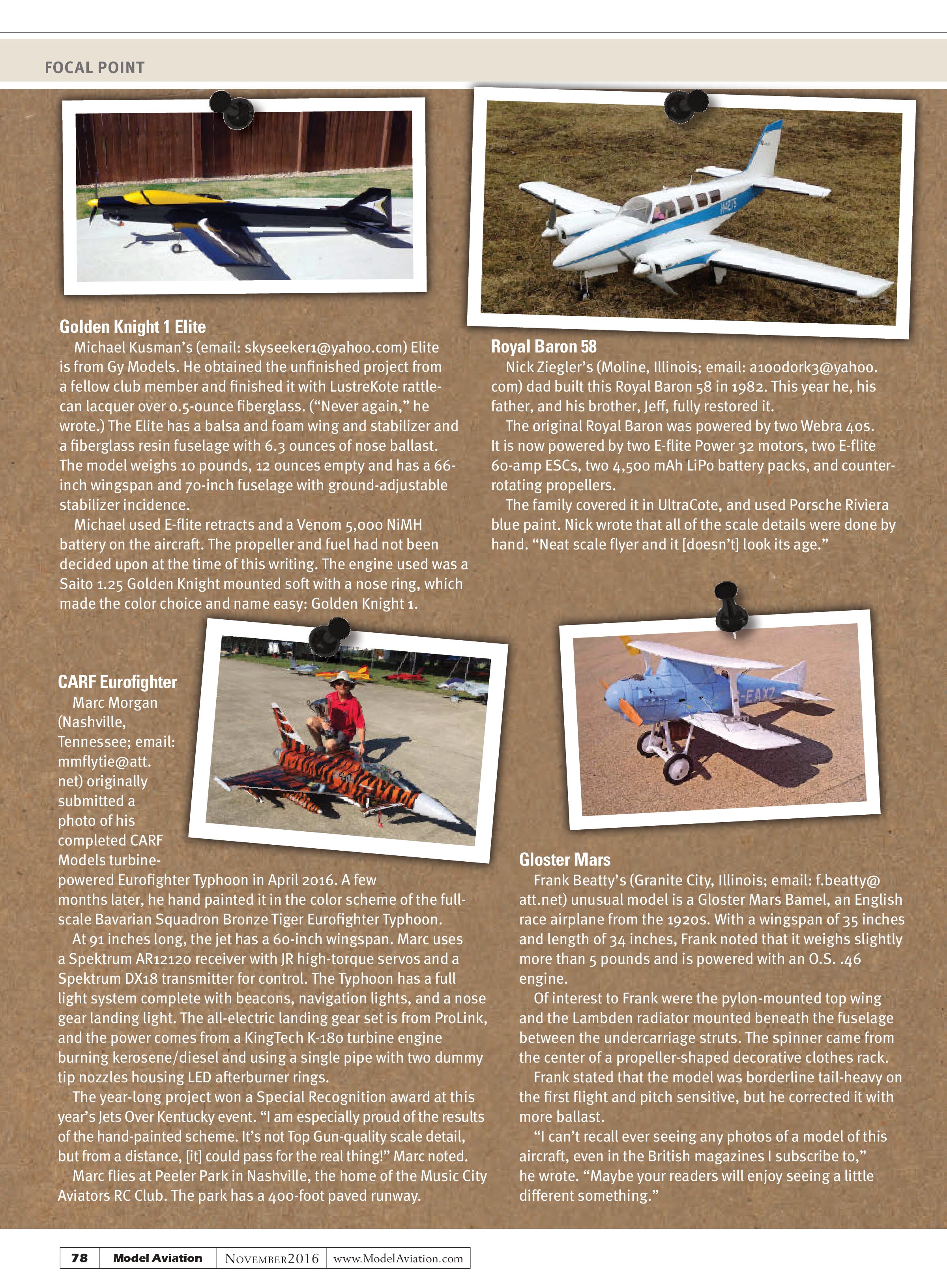
Golden Knight 1 Elite
Michael Kusman’s (email: skyseeker1@yahoo.com) Elite is from Gy Models. He obtained the unfinished project from a fellow club member and finished it with LustreKote rattle-can lacquer over 0.5-ounce fiberglass. (“Never again,” he wrote.) The Elite has a balsa and foam wing and stabilizer and a fiberglass resin fuselage with 6.3 ounces of nose ballast. The model weighs 10 pounds, 12 ounces empty and has a 66-inch wingspan and 70-inch fuselage with ground-adjustable stabilizer incidence.
Michael used E-flite retracts and a Venom 5,000 NiMH battery on the aircraft. The propeller and fuel had not been decided upon at the time of this writing. The engine used was a Saito 1.25 Golden Knight mounted soft with a nose ring, which made the color choice and name easy: Golden Knight 1.

CARF Eurofighter
Marc Morgan (Nashville, Tennessee; email: mmflytie@att.net) originally submitted a photo of his completed CARF Models turbine-powered Eurofighter Typhoon in April 2016. A few months later, he hand painted it in the color scheme of the full-scale Bavarian Squadron Bronze Tiger Eurofighter Typhoon.
At 91 inches long, the jet has a 60-inch wingspan. Marc uses a Spektrum AR12120 receiver with JR high-torque servos and a Spektrum DX18 transmitter for control. The Typhoon has a full light system complete with beacons, navigation lights, and a nose gear landing light. The all-electric landing gear set is from ProLink, and the power comes from a KingTech K-180 turbine engine burning kerosene/diesel and using a single pipe with two dummy tip nozzles housing LED afterburner rings.
The year-long project won a Special Recognition award at this year’s Jets Over Kentucky event. “I am especially proud of the results of the hand-painted scheme. It’s not Top Gun-quality scale detail, but from a distance, [it] could pass for the real thing!” Marc noted.
Marc flies at Peeler Park in Nashville, the home of the Music City Aviators RC Club. The park has a 400-foot paved runway.

Royal Baron 58
Nick Ziegler’s (Moline, Illinois; email: a100dork3@yahoo.com) dad built this Royal Baron 58 in 1982. This year he, his father, and his brother, Jeff, fully restored it.
The original Royal Baron was powered by two Webra 40s. It is now powered by two E-flite Power 32 motors, two E-flite 60-amp ESCs, two 4,500 mAh LiPo battery packs, and counter-rotating propellers.
The family covered it in UltraCote, and used Porsche Riviera blue paint. Nick wrote that all of the scale details were done by hand. “Neat scale flyer and it [doesn’t] look its age.”

Gloster Mars
Frank Beatty’s (Granite City, Illinois; email: f.beatty@att.net) unusual model is a Gloster Mars Bamel, an English race airplane from the 1920s. With a wingspan of 35 inches and length of 34 inches, Frank noted that it weighs slightly more than 5 pounds and is powered with an O.S. .46 engine.
Of interest to Frank were the pylon-mounted top wing and the Lambden radiator mounted beneath the fuselage between the undercarriage struts. The spinner came from the center of a propeller-shaped decorative clothes rack.
Frank stated that the model was borderline tail-heavy on the first flight and pitch sensitive, but he corrected it with more ballast.
“I can’t recall ever seeing any photos of a model of this aircraft, even in the British magazines I subscribe to,” he wrote. “Maybe your readers will enjoy seeing a little different something.”

Hangar 9 J-3 Cub
Terry Lamb (Sagle, Idaho; email: terrylamb8@gmail.com) built retractable landing gear into the floats on his Hangar 9 .40 Piper J-3 Cub that is powered by an O.S. .65AX glow engine.
Terry modified 38-inch Ralph Smith Plane Fun Floats to accept gear mechanisms for the nose and main gear. All are activated by Firgelli Linear servos that are built into each float. The floats include dual water rudders activated by the air rudder.
Terry wrote: “It was absolutely nerve-racking to get up the courage to hack into these Plane Fun Floats, which are magnificently crafted, foam-filled, and balsa sheathed of impeccable workmanship! But after devising a plan, hack away I did, and I got everything installed. Not the easiest thing I have done, but I benefitted from the experience of previous attempts with different floats.”

Corkscrew
The Corkscrew design, by Stu Richmond, was published in the January 1983 issue of RC Modeler magazine. Fred DiMaria (Newtown, Connecticut; email: md62100@aol.com) purchased the plans in 1983 and had intended to build it for several years. “This is my first scratch-build attempt and I was motivated to finish it when I heard of the recent passing of Mr. Richmond, who was a legend in the hobby.”
Fred made a few upgrades such as dual aileron servos, a split elevator, and a bolt-on wing, and uses a 2.4 GHz Futaba seven-channel radio, but the engine is an O.S. Max .25 FSR, which is a throwback to that era.
Fred is an active member and treasurer of the Mid-Hudson Radio Control Society in Poughkeepsie, New York, and a member of Fly R/C in Newtown.

Seversky P-35
Tom Weisgerber’s (Fishers, Indiana; email: tomweisgerber@gmail.com) photo shows his Seversky P-35 pursuit airplane that was built from a highly modified 22-inch wingspan Golden Age Reproductions kit. Modified for RC, it uses an Ares RC electronics brick for rudder, elevator, and motor control.
The fuselage was strengthened by the use of carbon-fiber sticks instead of 1/16-inch balsa, and a custom-molded canopy and cowl were created. The airplane was covered with Doculam and airbrushed with acrylic paint. Tom created homemade decals for more scalelike detail.

The Fantasy
Brian Leuthold (Lock Haven, Pennsylvania; email: mrstearman@gmail.com) sent in this photo of his son, Alec, with an airplane they call The Fantasy. Brian built the airplane during the winter of 2012-2013 from an old Skyshark RC kit. Powered by an O.S. .50SX engine, it uses Hitec servos throughout. Alec guides it with a Hitec Aurora 9. Vinyl graphics are by Callie Graphics.
Brian stated that the photo was taken at his club’s fall fun-fly in September 2013. The aircraft made its maiden flight on that day. “My son has been flying my Fantasy for several years and wanted his own,” Brian wrote. “He developed his own color scheme and picked the graphics. The plane is a phenomenal flier and is quite quick. It has lines reminiscent of older Pattern ships.
“[Alec] soloed when he was seven and enjoys the hobby very much.”