CL Combat (Phil Cartier)
This turned out to be a good year for Combat at the Nats. Entry numbers were the same or better in all events. Last year, following directly on the team trials, there were 29 entries with three dropouts in F2D. Even with no team trials to help pump up the entries, this year saw the same number of entries.
There were roughly 175 cuts in F2D. F2D Fast on Monday had 15, nearly the same as last year. Speed Limit Combat had a record 20 entries, High Performance ½A had a record 12, and AMA Fast on Thursday had 10—the highest numbers in at least the last 10 years.
It was one of the best showings in many years. In F2D, I think this was the first time that the winner, Igor Dementiev, had a clean record, with no losses in eight flights. For the first time in years and years of Nats, Chuck Rudner won a first place in ½A Combat, and as a bonus, he placed second in Speed Limit, and third in Fast Combat. Ron Colombo won Fast Combat, his favorite event, for the third straight year.
F2D was a long affair with roughly 85 matches during two days. When the rain started shortly after the eighth round on Sunday, the event director and the remaining fliers agreed to call it quits and skip the last five or six matches.
Igor Dementiev handily won first with eight wins. A coin toss put Vitaly Kochunts in second, and Alex Prokofiev in third. Mike Willcox ended up in fourth and Greg Wornell in fifth. Rylan Ritch managed a couple of wins in the first two rounds and was awarded the Best Junior trophy.
F2D Fast Combat is fun! F2D-legal airplanes meeting the rules from 2008 (8mm mufflers) and later (6mm mufflers) cleared the air on Monday. A larger muffler doesn’t offer much, if any, advantage compared with a 6mm muffler. The newer motors and propellers run much the same, so the wins are at the handle and in the hands of the pit crew.
There were a fair number of kills to win a match. The 15 fliers had 15 matches to fly, so many of the matches were short, which moved things along. Using two circles, the judges could switch to the next match as fast as they could tote up the score. Toward the end, the fliers were starting to drag because there were few dedicated pitmen. In the end, Neil Simpson won, Jim Ehlen was second, Brian Stas third, and Bill Maywald placed fourth.
Speed Limit Combat on Thursday tames flight down to less than 75 mph and eliminates the kill. Cutting the string is just another cut, which can bring out a lot of difference of opinion in after-hours conversation.
A big advantage is less equipment. Old F2D airplanes and most foam models are strong enough that most crashes often result in no damage or only minor repairs. Any nonfatal damage can usually be patched well enough to fly in an hour or so.
The 20 fliers flew the same double-elimination first round in approximately 15 matches. Rylan Ritch was the best in the Junior category. Finishing first was Bill Maywald; Chuck Rudner was second; third was Ed Bryzs; and in fourth place was Greg Hill.
There were 12 entries in ½A Combat and the action was fast and furious. The shorter lines make up for the lower speed, and make for a dizzying effect. There were a number of midairs and crashes. The little airplanes aren’t as strong as the bigger ones.
The foam airplanes held up better with little, if any, loss in performance. Finishing first was Chuck Rudner; in second place was Greg Hill; Brian Stas placed third; and Rod Christie finished fourth.
Fast Combat was flown on Thursday, and it was fast for the nine fliers. In addition to the speed, these airplanes pull hard—something like 15 or 20 pounds. It gives the pilot a real workout. The flying was great with few up-and-down matches, a number of cuts, and the final match. It ended with first going to Ron Colombo; second to Don Jensen; and third place to Chuck Rudner.
I want to thank MACA and the people who ran the CL Combat events. Event director Dave Edwards did cut judging, along with Tom Reuben King and Bob Nelson. Arlene Pyles ran the matching and scoreboard with some volunteer help.
Bob Mears helped as an alternate circle marshal and cut counter. He and Arlene, along with Jan and Andy Mears, came up with the “flow-through” processing that streamlined airplane checks and the pull test. They also built the simplified, fixed pull testers.
Chris Gay spent two full days in the sun as circle marshal for F2D and did an excellent job. Brenda Schuette was CL liaison with the AMA and coordinated water, mowing, and trophies.
Countless others pitched in to help with cut counting, pull tests, circle marshal duties, getting airplanes on the circle, and pitting if necessary. Helpers kept things moving the whole week and deserve some thanks and recognition.

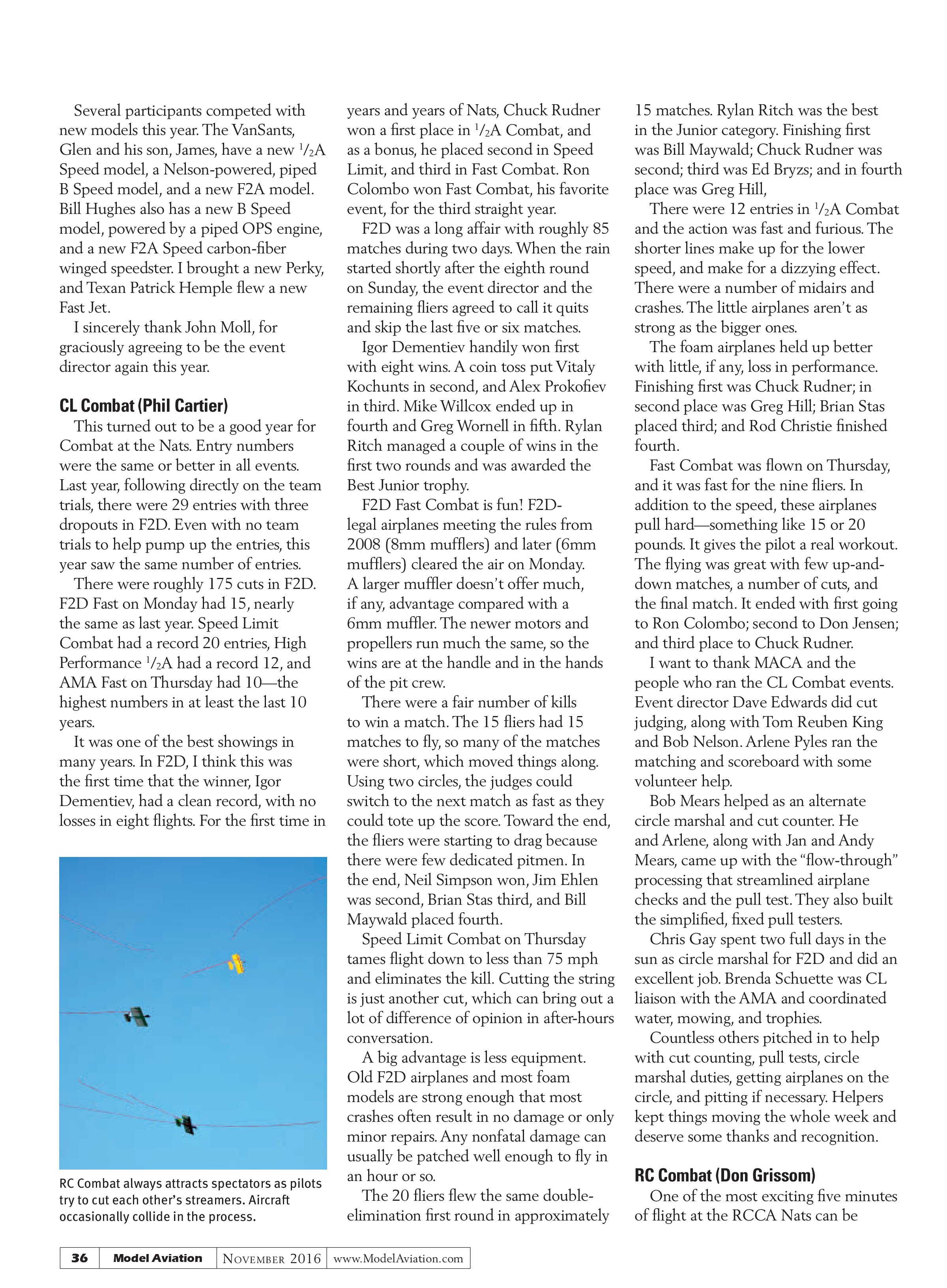
RC Combat always attracts spectators as pilots try to cut each other’s streamers. Aircraft occasionally collide in the process.
One of the most exciting five minutes of flight at the RCCA Nats can be found at the RC Combat site every year. Each airplane launches with a 30-foot crepe paper streamer. As many as 10 airplanes are in the air at one time, maneuvering around each other, trying to cut opponents’ streamers as well as safeguard their own.
RC Combat airplanes, unlike most models, are generally homebuilt or built from basic kits. Most are made from material you can purchase at a local hardware store. This makes them easy to set up, but they are durable because they have to withstand the midair collisions and crashes that happen during each flight.
During RC Combat week at the Nats, we fly five types of Combat, including 2948 Scale, Slow Survivable Combat, Open, Limited B, and Gnat. This year, 16 pilots signed up for the events. Some were newcomers and many have been coming for years.
Among the winners this year was Eric Gilkey, who placed first in three events—Gnat, Limited B, and 2948. These happened to be the only events he participated in because he missed the first two days of Combat! Andy Runte won SSC Combat, and Heath Bartel placed first in Limited B.
If you really want to see some action and crashes, then there is no better place to visit than RC Combat during the Nats.
Indoor FF (Mike Kirda)

This year’s Indoor Free Flight (FF) Nats, July 19-24, was in a “new” location—Hangar 3 located on the now-shuttered Chanute Air Force Base in Rantoul, Illinois. Several Category 2 records were set there 30 years ago. I believe one still stands, so we knew going in that it was a records-capable site.
This year’s Indoor Nats, organized by the NFFS, ran concurrent with the Outdoor Nats, with the hope that we could boost attendance. We did gain a few attendees, particularly on the glider side, but few Scale modelers attended.
The weather was forecast to be hot and humid with light wind, with the temperatures peaking in the mid-90s. Unfortunately, it was quite accurate, with humidity inside the hangar between 80% and 99%. It was brutal, and everyone looked as though they had just crawled out of the shower.
The building has a pretty predictable pattern to it. With any significant directional wind outside, there was drift in that general direction. The air temperature is remarkably homogenous, with little difference between the ceiling and the floor and almost no turbulence.
In the morning, a convection current caused by sunlight along the hangar doors led to drift near the ceiling away from the doors. A few feet below this, there was a less-intense return current.
You could often see a model launched near the doors climb up to the ceiling, then drift nearly across the hangar, lose a few feet, and then come most of the way back before landing. Models with a tight enough circle could take advantage of this morning lift.
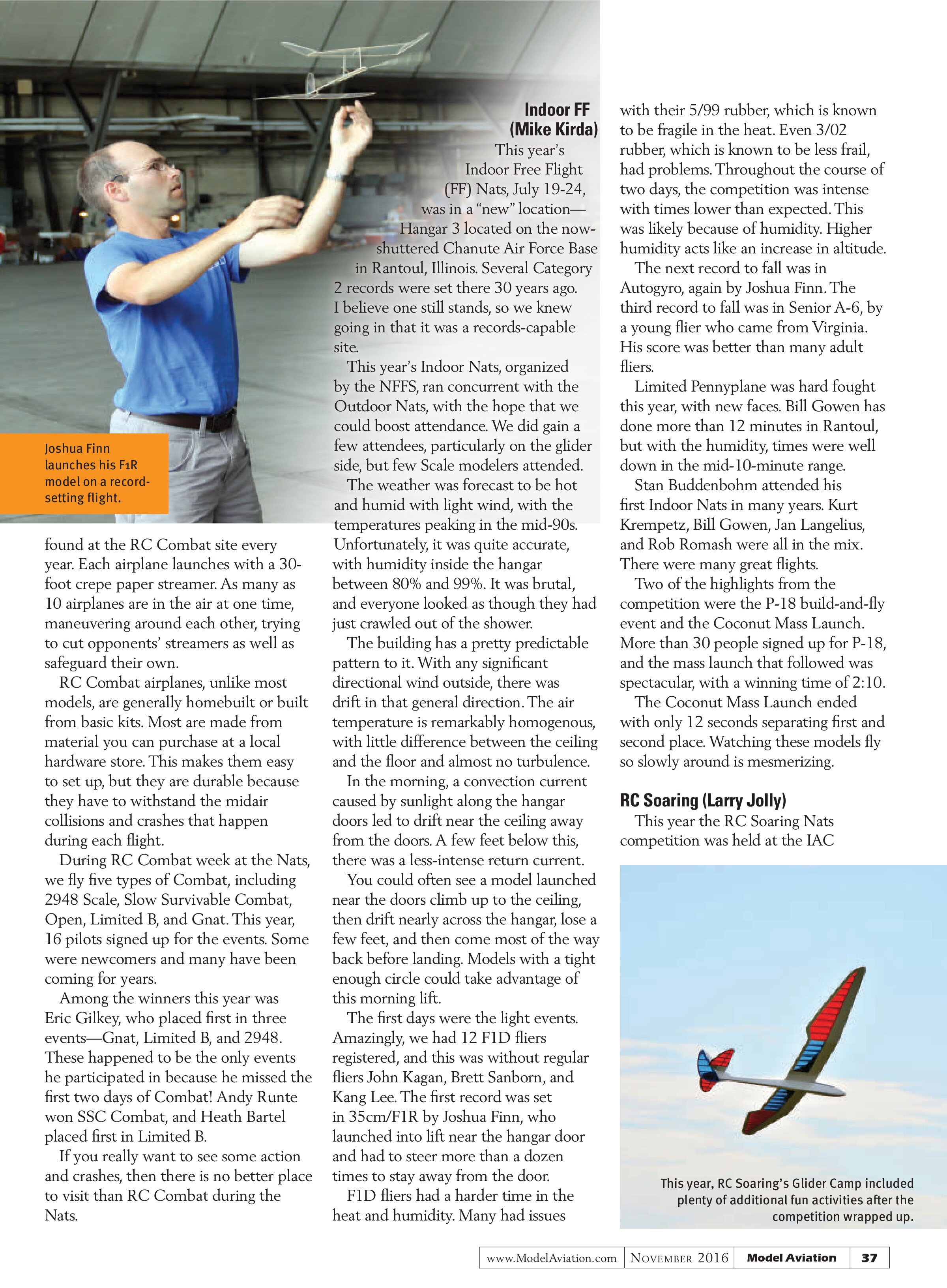
The first days were the light events. Amazingly, we had 12 F1D fliers registered, and this was without regular fliers John Kagan, Brett Sanborn, and Kang Lee. The first record was set in 35cm/F1R by Joshua Finn, who launched into lift near the hangar door and had to steer more than a dozen times to stay away from the door.
F1D fliers had a harder time in the heat and humidity. Many had issues with their 5/99 rubber, which is known to be fragile in the heat. Even 3/02 rubber, which is known to be less frail, had problems. Throughout the course of two days, the competition was intense with times lower than expected. This was likely because of humidity. Higher humidity acts like an increase in altitude.
The next record to fall was in Autogyro, again by Joshua Finn. The third record to fall was in Senior A-6, by a young flier who came from Virginia. His score was better than many adult fliers.
Limited Pennyplane was hard fought this year, with new faces. Bill Gowen has done more than 12 minutes in Rantoul, but with the humidity, times were well down in the mid-10-minute range.
Stan Buddenbohm attended his first Indoor Nats in many years. Kurt Krempetz, Bill Gowen, Jan Langelius, and Rob Romash were all in the mix. There were many great flights.
Two of the highlights from the competition were the P-18 build-and-fly event and the Coconut Mass Launch. More than 30 people signed up for P-18, and the mass launch that followed was spectacular, with a winning time of 2:10.
The Coconut Mass Launch ended with only 12 seconds separating first and second place. Watching these models fly so slowly around is mesmerizing.
RC Soaring (Larry Jolly)
This year the RC Soaring Nats competition was held at the IAC

This year, RC Soaring’s Glider Camp included plenty of additional fun activities after the competition wrapped up.