Fly right, fly light
We are no doubt all more than familiar with how quickly time can pass, yet I still find myself surprised at times when reflecting upon its endless march. As a case in point, this is my 20th column, and although not really a large number, it did come much faster than I expected.
I want to offer my sincere thanks for your feedback, as well as the support and enduring patience of the Model Aviation team.
Loose Special Racer
A couple of months ago, I described my technique for making multiple, similar balsa pieces as I progressed with the cowl for my version of the 1937 Loose Special air racer. Although my model remains unfinished, I was able to get it done well enough—and seemingly airworthy—for the start of the Thompson Trophy Race mass launch at the Flying Aces Club (FAC) Nationals, held in Geneseo, New York, in mid-July. No, I didn’t make it to the second round, but it was thrilling enough to just step up to the starting line with the other pilots and join in that initial fray.
The Thompson Trophy Race was only the fourth trim flight for the Loose Special and, with short winds on an untested motor, it was not
surprising that its performance didn’t quite match my dreams. I think only one other model preceded mine into the grass, so there is plenty of room for improvement. I guess there actually is something to finishing a model in time for a few trimming sessions before a big contest …
Despite not winning the Thompson trophy, and a bit more wind than anyone wanted, this year’s FAC Nats was a fantastic experience. My son, Gryffin, made our family’s first appearance on the podium, placing third in Jet Catapult. He was flying a de Havilland Venom from the new Retro RC kit, and did well in a strong field.
How strong, you ask? Well, the fourth- and fifth-place finishers have both taken home the FAC Grand Champion award, and have combined for nearly 400 Kanones (FAC event wins) during their careers. Yes, Jet Catapult is quite a crapshoot, where one lucky bubble can make anyone a hero, but Gryffin’s first trophy still looks good on the wall.
Another highlight was having an old friend come from California to finally join the fun. Jason McGuire has been dreaming about attending the FAC Nats for more than 25 years, since he saw event coverage in a copy of Model Builder magazine. Jason normally sticks close to home, but he decided that it was finally time to make the trek.
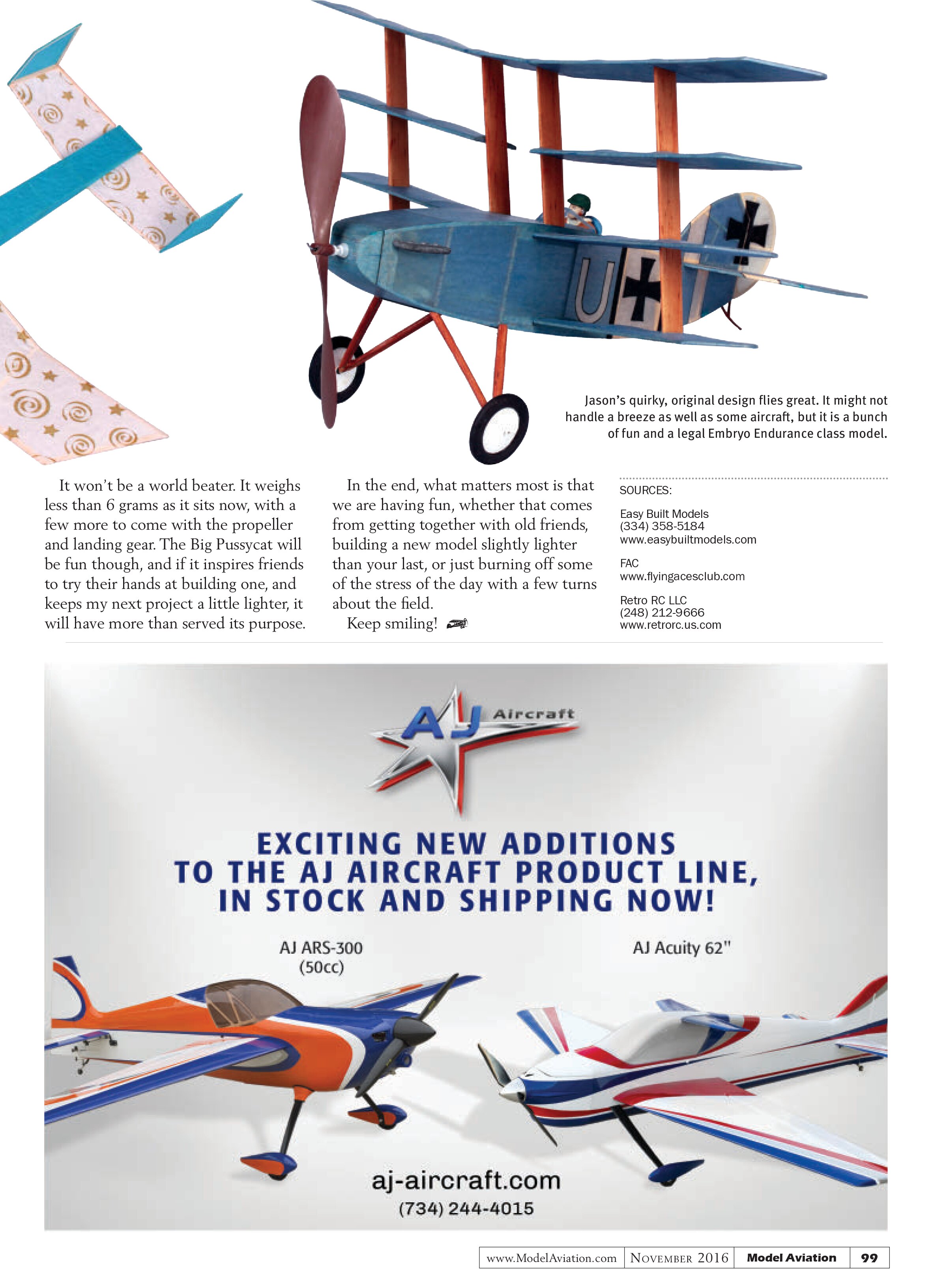
We flew together years ago when I lived in San Francisco, and he has provided much inspiration throughout the years. Both my Daddy-O racer and more recent Quadruplane sport airplane are based on two of his original Embryo-class Free Flight (FF) designs.
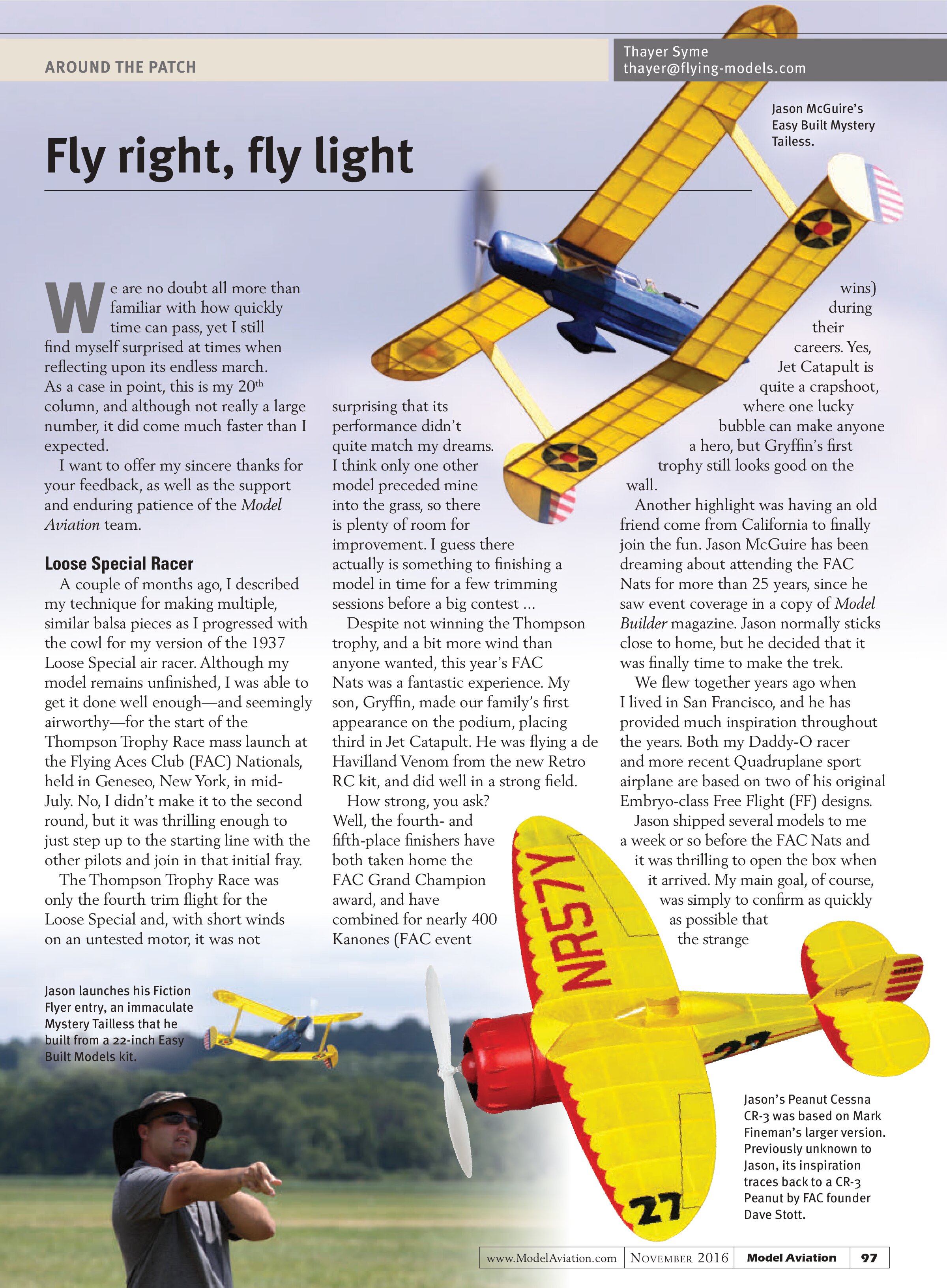
Jason shipped several models to me a week or so before the FAC Nats and it was thrilling to open the box when it arrived. My main goal, of course, was simply to confirm as quickly as possible that the strange

Jason launches his Fiction Flyer entry, an immaculate Mystery Tailless that he built from a 22-inch Easy Built Models kit.

Jason’s Peanut Cessna CR-3 was based on Mark Fineman’s larger version. Previously unknown to Jason, its inspiration traces back to a CR-3 Peanut by FAC founder Dave Stott.


rattling sounds were only minor bumps and bruises. Once done with that task, Gryffin and I were spellbound by what we found. Nearly flawless covering on numerous featherweight airframes made it clear that practice does make perfect. Hopefully, Jason’s craftsmanship will grace our home and the field at Geneseo again soon.
Recalibrating the Feel
On the subject of lightweight models, we all know that keeping off the ounces and pounds is one key ingredient for a successful model of any size. Conversations with a number of experienced Giant Scale RC modelers throughout the years has revealed that many of them also occasionally build small stick-and-tissue FF models.
In addition to simply being fun—and reinforcing the need for a straight, accurately built airframe—working with small sticks will help recalibrate your hands and mind, reminding you what lightweight really means. I am much less inclined to unnecessarily increase the size of wood or add reinforcement “just because” on larger models if I have recently been building and flying my FF models.
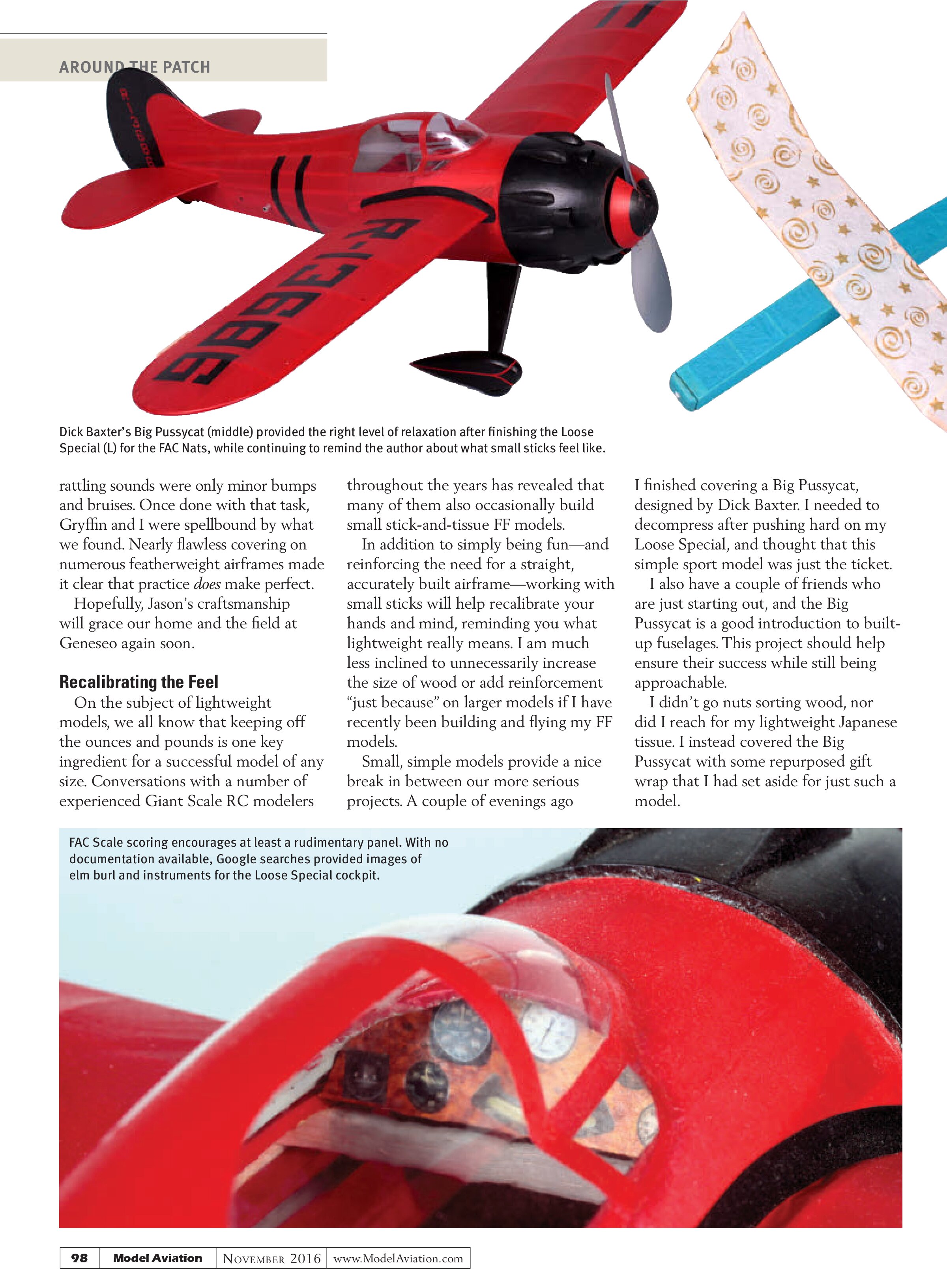
Small, simple models provide a nice break in between our more serious projects. A couple of evenings ago I finished covering a Big Pussycat, designed by Dick Baxter. I needed to decompress after pushing hard on my Loose Special, and thought that this simple sport model was just the ticket.
I also have a couple of friends who are just starting out, and the Big Pussycat is a good introduction to built-up fuselages. This project should help ensure their success while still being approachable.
I didn’t go nuts sorting wood, nor did I reach for my lightweight Japanese tissue. I instead covered the Big Pussycat with some repurposed gift wrap that I had set aside for just such a model.


It won’t be a world beater. It weighs less than 6 grams as it sits now, with a few more to come with the propeller and landing gear. The Big Pussycat will be fun though, and if it inspires friends to try their hands at building one, and keeps my next project a little lighter, it will have more than served its purpose.
In the end, what matters most is that we are having fun, whether that comes from getting together with old friends, building a new model slightly lighter than your last, or just burning off some of the stress of the day with a few turns about the field.
Keep smiling!
SOURCES:
Easy Built Models
(334) 358-5184
www.easybuiltmodels.com
Retro RC LLC
(248) 212-9666
www.retrorc.us.com