In the Air
Membership news and updates
from AMA Headquarters
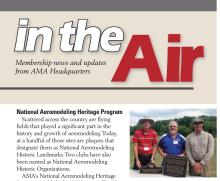
National Aeromodeling Heritage Program
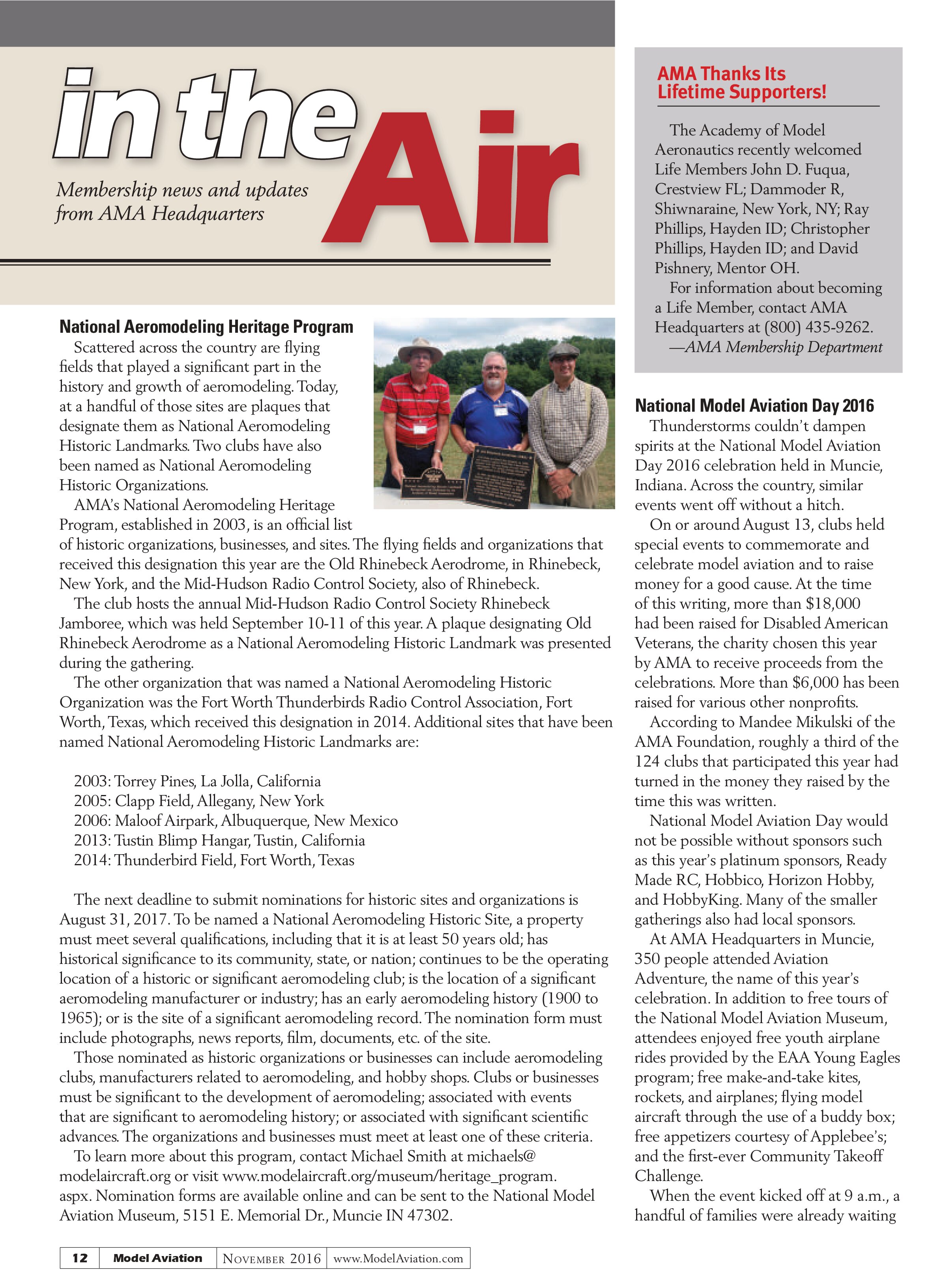
Scattered across the country are flying fields that played a significant part in the history and growth of aeromodeling. Today, at a handful of those sites are plaques that designate them as National Aeromodeling Historic Landmarks. Two clubs have also been named as National Aeromodeling Historic Organizations.
AMA’s National Aeromodeling Heritage Program, established in 2003, is an official list of historic organizations, businesses, and sites. The flying fields and organizations that received this designation this year are the Old Rhinebeck Aerodrome, in Rhinebeck, New York, and the Mid-Hudson Radio Control Society, also of Rhinebeck.
The club hosts the annual Mid-Hudson Radio Control Society Rhinebeck Jamboree, which was held September 10-11 of this year. A plaque designating Old Rhinebeck Aerodrome as a National Aeromodeling Historic Landmark was presented during the gathering.
The other organization that was named a National Aeromodeling Historic Organization was the Fort Worth Thunderbirds Radio Control Association, Fort Worth, Texas, which received this designation in 2014. Additional sites that have been named National Aeromodeling Historic Landmarks are:
- 2003: Torrey Pines, La Jolla, California
- 2005: Clapp Field, Allegany, New York
- 2006: Maloof Airpark, Albuquerque, New Mexico
- 2013: Tustin Blimp Hangar, Tustin, California
- 2014: Thunderbird Field, Fort Worth, Texas
The next deadline to submit nominations for historic sites and organizations is August 31, 2017. To be named a National Aeromodeling Historic Site, a property must meet several qualifications, including that it is at least 50 years old; has historical significance to its community, state, or nation; continues to be the operating location of a historic or significant aeromodeling club; is the location of a significant aeromodeling manufacturer or industry; has an early aeromodeling history (1900 to 1965); or is the site of a significant aeromodeling record. The nomination form must include photographs, news reports, film, documents, etc. of the site.
Those nominated as historic organizations or businesses can include aeromodeling clubs, manufacturers related to aeromodeling, and hobby shops. Clubs or businesses must be significant to the development of aeromodeling; associated with events that are significant to aeromodeling history; or associated with significant scientific advances. The organizations and businesses must meet at least one of these criteria.
To learn more about this program, contact Michael Smith at michaels@modelaircraft.org or visit www.modelaircraft.org/museum/heritage_program.aspx. Nomination forms are available online and can be sent to the National Model Aviation Museum, 5151 E. Memorial Dr., Muncie IN 47302.

AMA Thanks Its Lifetime Supporters!
The Academy of Model Aeronautics recently welcomed Life Members John D. Fuqua, Crestview FL; Dammoder R, Shiwnaraine, New York, NY; Ray Phillips, Hayden ID; Christopher Phillips, Hayden ID; and David Pishnery, Mentor OH.
For information about becoming a Life Member, contact AMA Headquarters at (800) 435-9262.
—AMA Membership Department
National Model Aviation Day 2016
Thunderstorms couldn’t dampen spirits at the National Model Aviation Day 2016 celebration held in Muncie, Indiana. Across the country, similar events went off without a hitch.
On or around August 13, clubs held special events to commemorate and celebrate model aviation and to raise money for a good cause. At the time of this writing, more than $18,000 had been raised for Disabled American Veterans, the charity chosen this year by AMA to receive proceeds from the celebrations. More than $6,000 has been raised for various other nonprofits.
According to Mandee Mikulski of the AMA Foundation, roughly a third of the 124 clubs that participated this year had turned in the money they raised by the time this was written.
National Model Aviation Day would not be possible without sponsors such as this year’s platinum sponsors, Ready Made RC, Hobbico, Horizon Hobby, and HobbyKing. Many of the smaller gatherings also had local sponsors.
At AMA Headquarters in Muncie, 350 people attended Aviation Adventure, the name of this year’s celebration. In addition to free tours of the National Model Aviation Museum, attendees enjoyed free youth airplane rides provided by the EAA Young Eagles program; free make-and-take kites, rockets, and airplanes; flying model aircraft through the use of a buddy box; free appetizers courtesy of Applebee’s; and the first-ever Community Takeoff Challenge.

When the event kicked off at 9 a.m., a handful of families were already waiting to board the shuttle vans to head to Reese Airport for the youth airplane rides. Near the museum, many of the youngsters who built kites and foam airplanes didn’t hesitate to try them out while the weather was pleasant.
Shortly after the celebration began, dark clouds collected over the International Aeromodeling Center, threatening to halt activities several times. It wasn’t until roughly noon that lightning, thunder, and heavy downpours ended the outdoor activities. The fun was moved indoors and the crowds followed.
Make sure to watch nationalmodelaviationday.org for updates on the total raised and reports about other National Model Aviation Day celebrations.

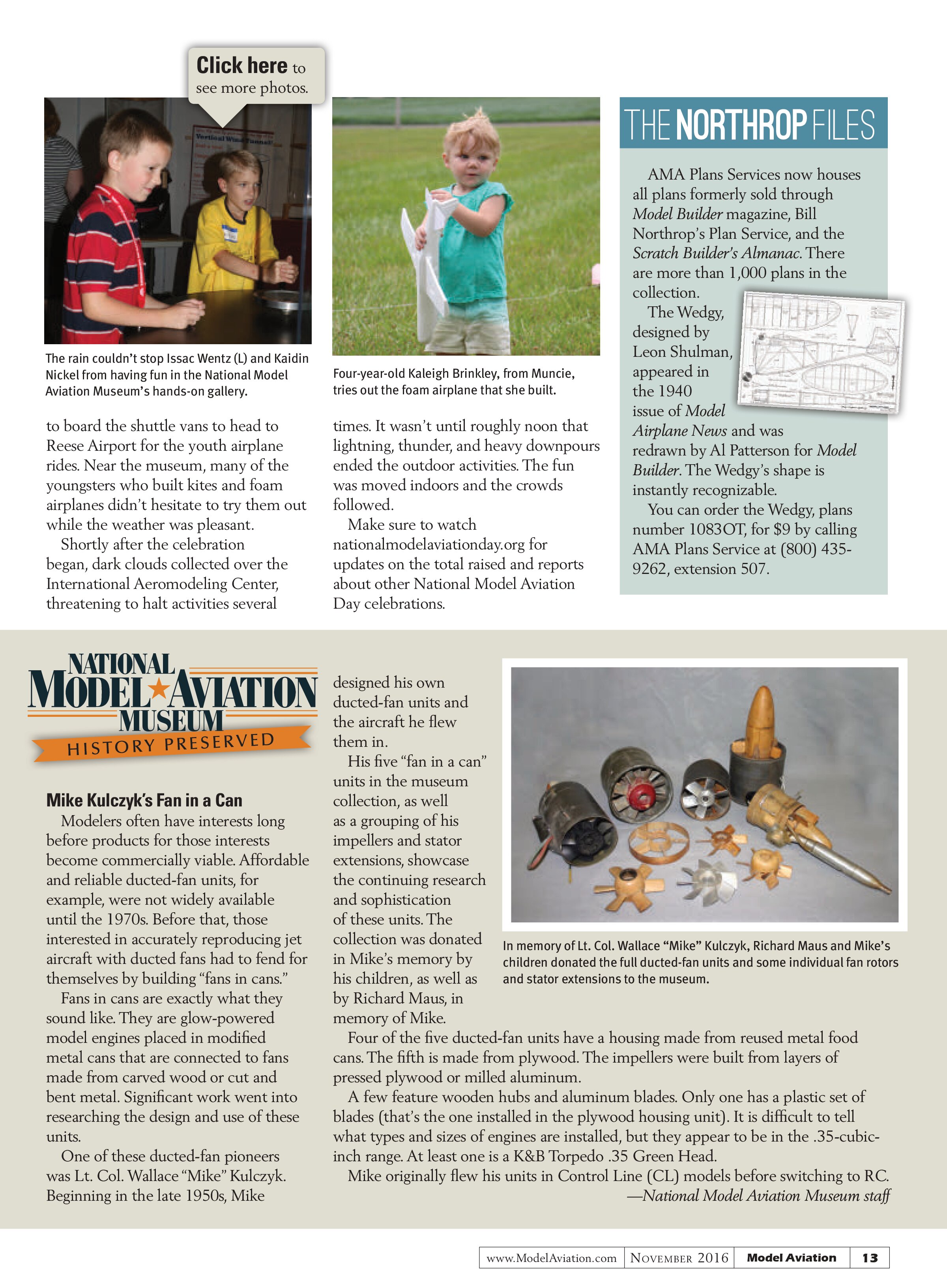
The rain couldn’t stop Issac Wentz (L) and Kaidin Nickel from having fun in the National Model Aviation Museum’s hands-on gallery.

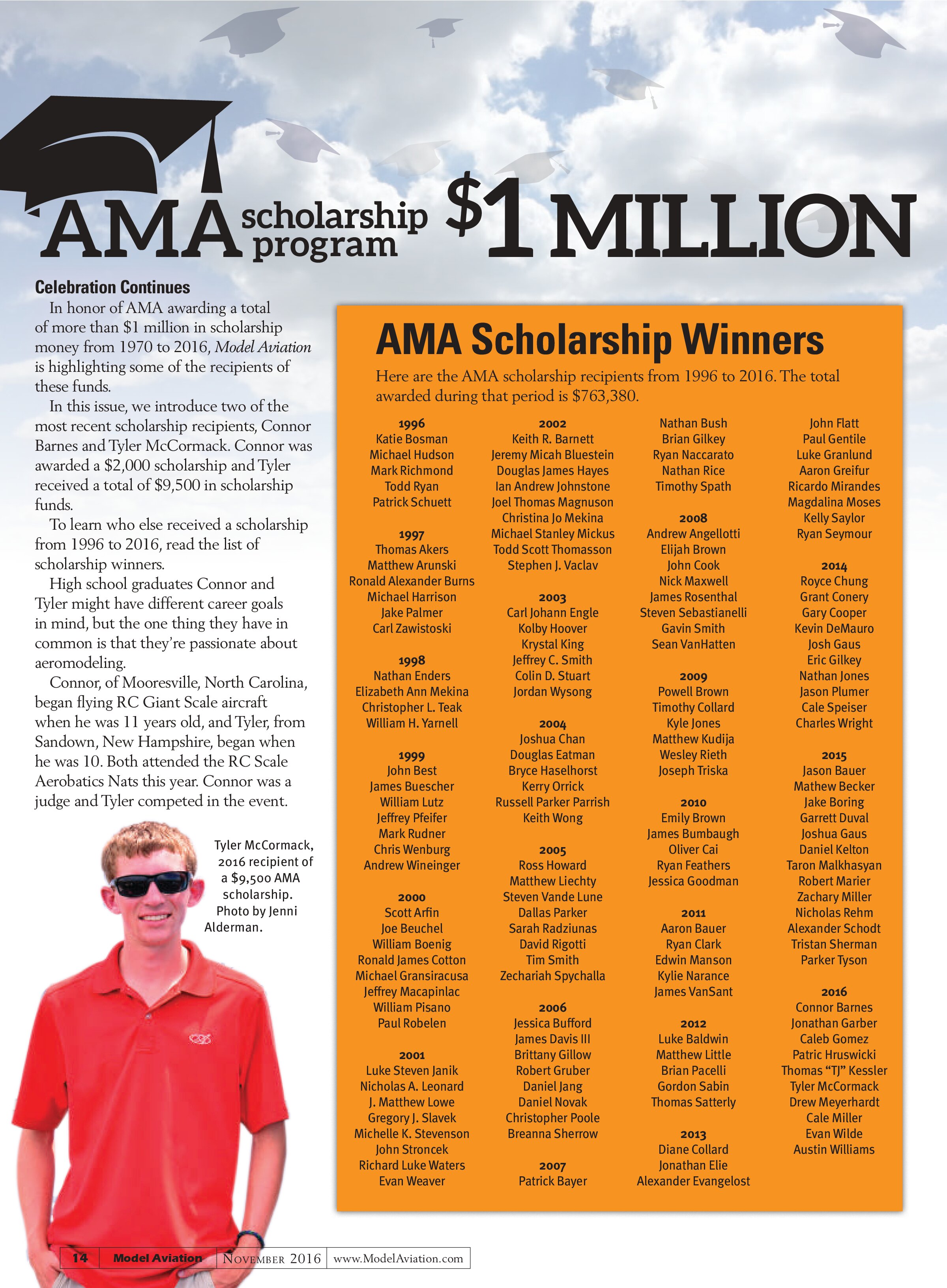
Four-year-old Kaleigh Brinkley, from Muncie, tries out the foam airplane that she built.
THE NORTHROP FILES
AMA Plans Services now houses all plans formerly sold through Model Builder magazine, Bill Northrop’s Plan Service, and the Scratch Builder’s Almanac. There are more than 1,000 plans in the collection.
The Wedgy, designed by Leon Shulman, appeared in the 1940 issue of Model Airplane News and was redrawn by Al Patterson for Model Builder. The Wedgy’s shape is instantly recognizable.

You can order the Wedgy, plans number 1083OT, for $9 by calling AMA Plans Service at (800) 435-9262, extension 507.
Mike Kulczyk’s Fan in a Can
Modelers often have interests long before products for those interests become commercially viable. Affordable and reliable ducted-fan units, for example, were not widely available until the 1970s. Before that, those interested in accurately reproducing jet aircraft with ducted fans had to fend for themselves by building “fans in cans.”
Fans in cans are exactly what they sound like. They are glow-powered model engines placed in modified metal cans that are connected to fans made from carved wood or cut and bent metal. Significant work went into researching the design and use of these units.
One of these ducted-fan pioneers was Lt. Col. Wallace “Mike” Kulczyk. Beginning in the late 1950s, Mike designed his own ducted-fan units and the aircraft he flew them in.
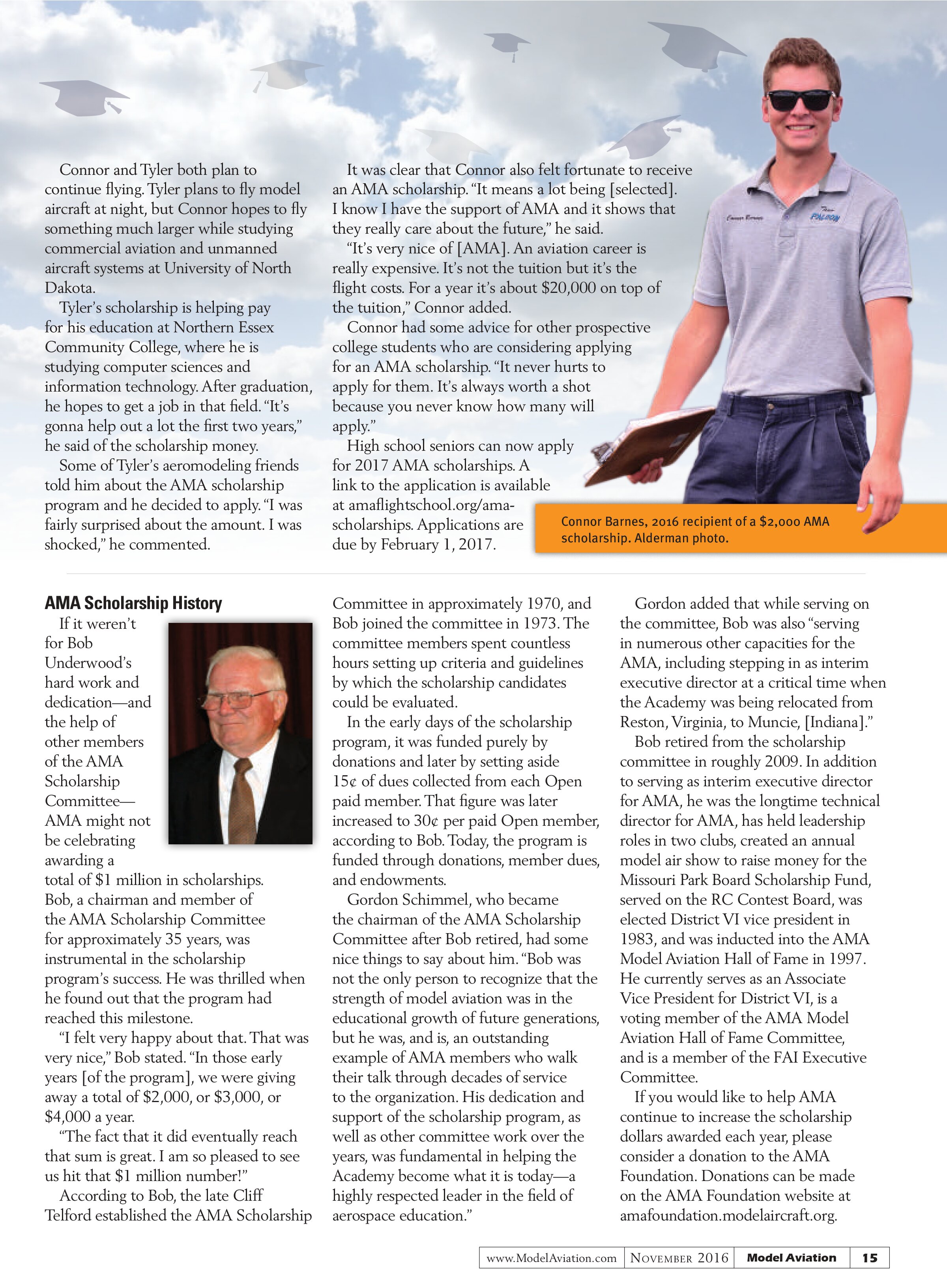
His five “fan in a can” units in the museum collection, as well as a grouping of his impellers and stator extensions, showcase the continuing research and sophistication of these units. The collection was donated in Mike’s memory by his children, as well as by Richard Maus, in memory of Mike.
Four of the five ducted-fan units have a housing made from reused metal food cans. The fifth is made from plywood. The impellers were built from layers of pressed plywood or milled aluminum.
A few feature wooden hubs and aluminum blades. Only one has a plastic set of blades (that’s the one installed in the plywood housing unit). It is difficult to tell what types and sizes of engines are installed, but they appear to be in the .35-cubic-inch range. At least one is a K&B Torpedo .35 Green Head.
Mike originally flew his units in Control Line (CL) models before switching to RC.
—National Model Aviation Museum staff
Connor and Tyler both plan to continue flying. Tyler plans to fly model aircraft at night, but Connor hopes to fly something much larger while studying commercial aviation and unmanned aircraft systems at University of North Dakota.
Tyler’s scholarship is helping pay for his education at Northern Essex Community College, where he is studying computer sciences and information technology. After graduation, he hopes to get a job in that field. “It’s gonna help out a lot the first two years,” he said of the scholarship money.
Some of Tyler’s aeromodeling friends told him about the AMA scholarship program and he decided to apply. “I was fairly surprised about the amount. I was shocked,” he commented.
It was clear that Connor also felt fortunate to receive an AMA scholarship. “It means a lot being [selected]. I know I have the support of AMA and it shows that they really care about the future,” he said.
“It’s very nice of [AMA]. An aviation career is really expensive. It’s not the tuition but it’s the flight costs. For a year it’s about $20,000 on top of the tuition,” Connor added.
Connor had some advice for other prospective college students who are considering applying for an AMA scholarship. “It never hurts to apply for them. It’s always worth a shot because you never know how many will apply.”
High school seniors can now apply for 2017 AMA scholarships. A link to the application is available at amaflightschool.org/ama-scholarships. Applications are due by February 1, 2017.

AMA Scholarship History
If it weren’t for Bob Underwood’s hard work and dedication—and the help of other members of the AMA Scholarship Committee—AMA might not be celebrating awarding a total of $1 million in scholarships. Bob, a chairman and member of the AMA Scholarship Committee for approximately 35 years, was instrumental in the scholarship program’s success. He was thrilled when he found out that the program had reached this milestone.
“I felt very happy about that. That was very nice,” Bob stated. “In those early years [of the program], we were giving away a total of $2,000, or $3,000, or $4,000 a year.
“The fact that it did eventually reach that sum is great. I am so pleased to see us hit that $1 million number!”
According to Bob, the late Cliff Telford established the AMA Scholarship Committee in approximately 1970, and Bob joined the committee in 1973. The committee members spent countless hours setting up criteria and guidelines by which the scholarship candidates could be evaluated.
In the early days of the scholarship program, it was funded purely by donations and later by setting aside 15¢ of dues collected from each Open paid member. That figure was later increased to 30¢ per paid Open member, according to Bob. Today, the program is funded through donations, member dues, and endowments.
Gordon Schimmel, who became the chairman of the AMA Scholarship Committee after Bob retired, had some nice things to say about him. “Bob was not the only person to recognize that the strength of model aviation was in the educational growth of future generations, but he was, and is, an outstanding example of AMA members who walk their talk through decades of service to the organization. His dedication and support of the scholarship program, as well as other committee work over the years, was fundamental in helping the Academy become what it is today—a highly respected leader in the field of aerospace education.”
Gordon added that while serving on the committee, Bob was also “serving in numerous other capacities for the AMA, including stepping in as interim executive director at a critical time when the Academy was being relocated from Reston, Virginia, to Muncie, [Indiana].”
Bob retired from the scholarship committee in roughly 2009. In addition to serving as interim executive director for AMA, he was the longtime technical director for AMA, has held leadership roles in two clubs, created an annual model air show to raise money for the Missouri Park Board Scholarship Fund, served on the RC Contest Board, was elected District VI vice president in 1983, and was inducted into the AMA Model Aviation Hall of Fame in 1997. He currently serves as an Associate Vice President for District VI, is a voting member of the AMA Model Aviation Hall of Fame Committee, and is a member of the FAI Executive Committee.
If you would like to help AMA continue to increase the scholarship dollars awarded each year, please consider a donation to the AMA Foundation. Donations can be made on the AMA Foundation website at amafoundation.modelaircraft.org.