Well-done flying makes accidents rare
Dave Gee
safetycolumn@cs.com
Okay, I’ll admit it: Model aircraft with powered propellers or rotors can be dangerous. It’s obvious, right? A spinning propeller blade could hurt someone if he or she doesn’t stay clear of it. With so many pilots enjoying this hobby, why are propeller injuries rare?
Sure, this column often contains stories of close calls or accidents involving model aircraft, but the amazing thing is how safe our hobby really is. Think of how many flights (more than a million?) are made each year that only result in a smile on a pilot’s face, and then imagine the countless hours that AMA members spend building, adjusting, and repairing powered models without incident. It’s exceptionally rare for anything to go wrong. I think it is because we have decades of shared experiences with how to do things right.
The stories that are told in this column are part of that process. A personal anecdote sticks in my mind better than a rule, and when the same situation arises, I think back to someone else’s tale of how not to do it.
Not Propeller Strikes Again!
Sometimes I receive emails telling me that I print too much about propeller strikes. Other readers state that it doesn’t get discussed often enough. Sure, such incidents are statistically rare, but the danger is constantly lurking. We need to keep this hazard in mind whenever we are near a rotor or a propeller.
The stories that I share here are noteworthy partly because having an accident is unusual. The problem is that every single propeller hit is completely avoidable—the result of a moment of inattention or some other mistake by the victim. It’s a simple rule, right? Keep your hand out of the propeller when it’s rotating.
So here’s the deal I’ll offer: If all pilots everywhere will quit having these little hand-in-the-propeller mishaps, I’ll never mention the subject again. It will be a win-win situation for everyone but the bandage companies.
While I wait for confirmation of our agreement, here is an account that came in from Steve Tinsley. Steve has been a modeler for more than five decades and has been flying RC for 20 years. He’s not a beginner, for sure! Steve wrote:
“I had an encounter with an 18 x 8 wooden propeller attached to a 30cc engine. I was starting the engine with the plane on a stand. The stand was not tied down. The engine started at high throttle and started dragging the stand across the floor. I pulled the throttle to idle, but it was already there.
“Apparently, the radio was not responding properly or the throttle fitting had detached. I had ahold of the stand with both hands, but to turn off the ignition, I reached in with my left hand behind the prop. The stand ground-looped and I got hit inside of my left arm above the elbow.
“It seemed like lots of blood at the time. My wife and I got the injury stabilized with basic first aid, and then we called 911.
At the emergency room, they found that there was no major arterial damage, no major nerve damage, and a nicked—but not cut—tendon. Twelve stitches and two staples were installed. [I was] pretty darn lucky. It could have been much worse!
“Lessons learned include securing the stand and airplane much better, carefully checking everything under the cowl before a first start, and thinking the process through before doing anything.”
And this, dear readers, is where I had to make a decision. Steve included several photographs of his workshop. Crisply focused and well lit, these pictures clearly showed the crime scene cleanup situation that he faced upon returning from his medical treatment. I would describe it as super-turbo-yucky, therefore, none of Steve’s photos appear in this column.
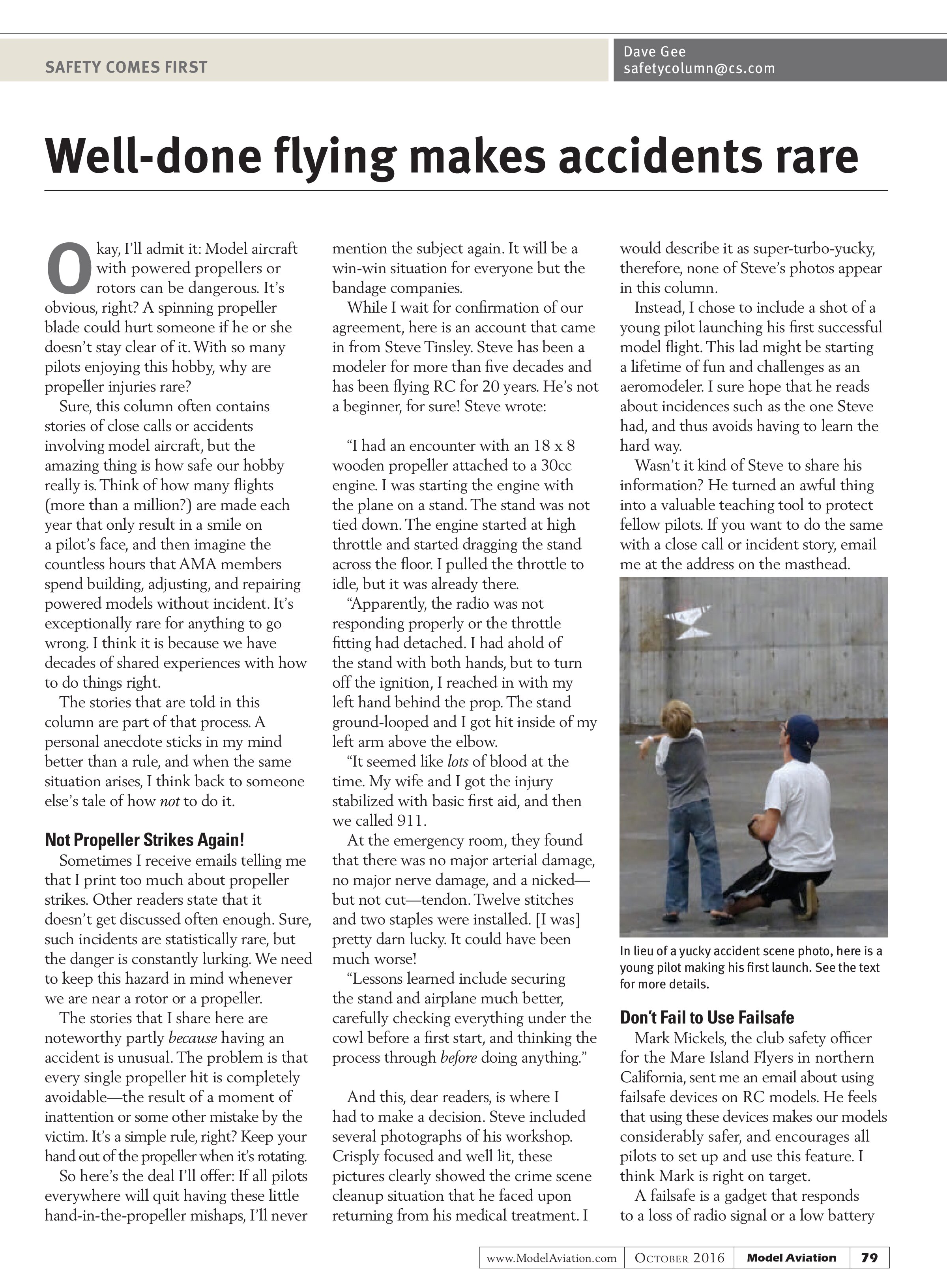
Instead, I chose to include a shot of a young pilot launching his first successful model flight. This lad might be starting a lifetime of fun and challenges as an aeromodeler. I sure hope that he reads about incidences such as the one Steve had, and thus avoids having to learn the hard way.
Wasn’t it kind of Steve to share his information? He turned an awful thing into a valuable teaching tool to protect fellow pilots. If you want to do the same with a close call or incident story, email me at the address on the masthead.

Don’t Fail to Use Failsafe
Mark Mickels, the club safety officer for the Mare Island Flyers in northern California, sent me an email about using failsafe devices on RC models. He feels that using these devices makes our models considerably safer, and encourages all pilots to set up and use this feature. I think Mark is right on target.
A failsafe is a gadget that responds to a loss of radio signal or a low battery
by moving servos to a predetermined setting. This means that the model can be programmed to respond to an emergency by going to low throttle and a gentle circle, or however you want, instead of keeping whatever control inputs were in the last signals to arrive.
Not long ago, this was an expensive and rare accessory that was plugged into the onboard control system. These days, many radio systems have this feature built in and waiting to be programmed. How you set it up depends on your individual model and radio brand, but I’m with Mark in urging everyone to make use of this backup tool.
Many airplanes have been saved from destruction by a properly programmed failsafe device, but a surprising percentage of pilots still don’t activate the built-in failsafe feature on their radios. Even more perplexing are the pilots who (for whatever reason) set it up wrong or randomly.
I’ve heard of a few situations where the failsafe activated, but was programmed for a different model or

had such odd settings that the crisis became worse than before. Sure, it’s a new computer thing to learn, but the payoff is big, and I think it’s worth either mastering the instructions or getting some assistance.
The Tail Tells a Tale
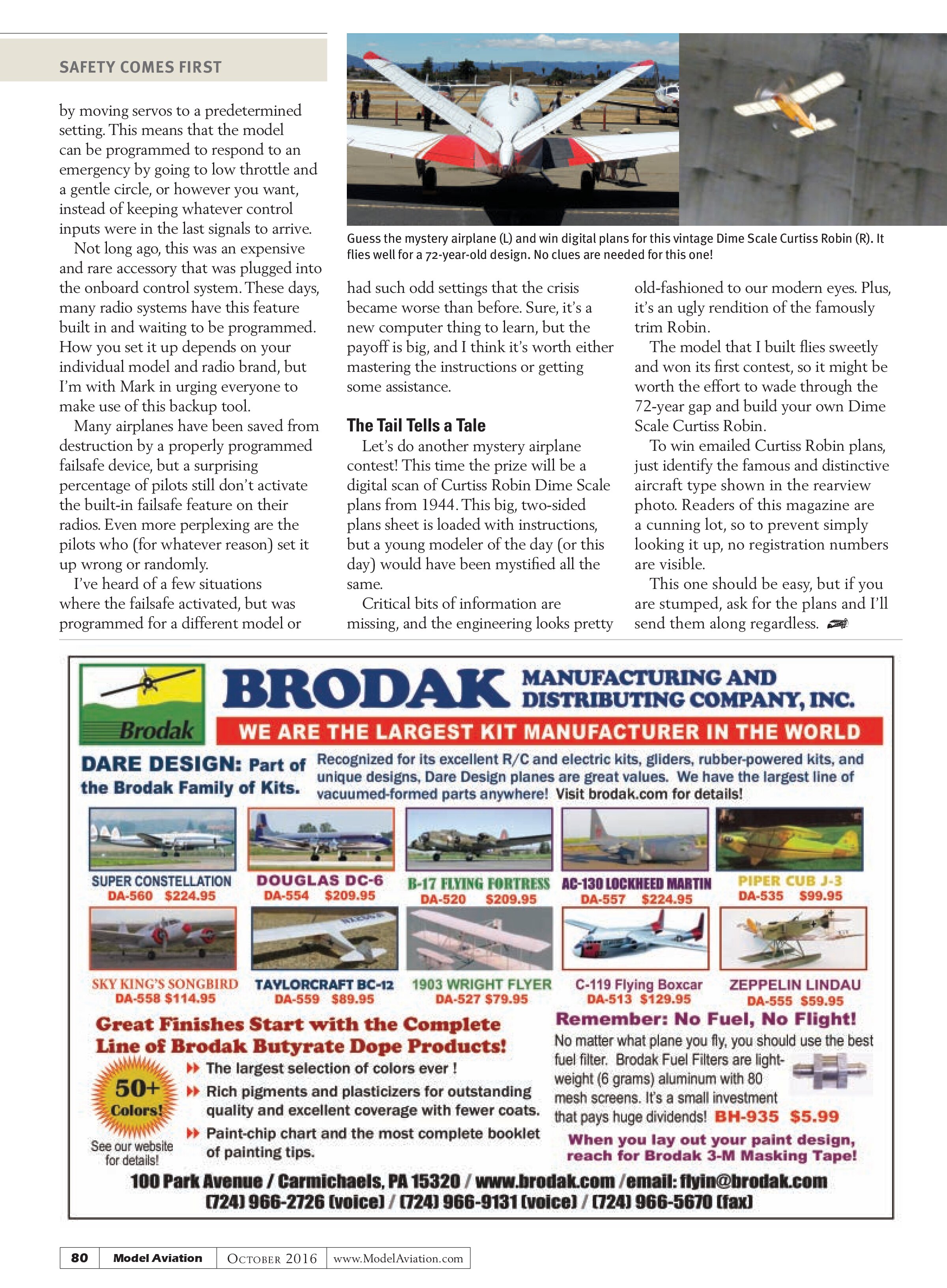
Let’s do another mystery airplane contest! This time the prize will be a digital scan of Curtiss Robin Dime Scale plans from 1944. This big, two-sided plans sheet is loaded with instructions, but a young modeler of the day (or this day) would have been mystified all the same.
Critical bits of information are missing, and the engineering looks pretty old-fashioned to our modern eyes. Plus, it’s an ugly rendition of the famously trim Robin.
The model that I built flies sweetly and won its first contest, so it might be worth the effort to wade through the 72-year gap and build your own Dime Scale Curtiss Robin.
To win emailed Curtiss Robin plans, just identify the famous and distinctive aircraft type shown in the rearview photo. Readers of this magazine are a cunning lot, so to prevent simply looking it up, no registration numbers are visible.
This one should be easy, but if you are stumped, ask for the plans and I’ll send them along regardless.