Bearing choices and proper installation
Chris Mulcahy
cspaced@gmail.com

I’m always excited to feature guest writers in my column. It’s great to learn new things from other people, so if you have something you’d like to share, please feel free to send it to me. This month, I have a great article from my friend, Robert Montee. Enjoy!
We have likely all experienced it: worn-out or trashed bearings on our models. Without bearings, our helicopters would be much different. Sometimes we experience bearing failures during crashes; other times it is because of wear. Sometimes bearings mechanically fail.
What if there was a way to alleviate the constant need for replacement and allow you to have many great flying sessions without annoying sounds from failing bearings? I will provide some guidance on proper choices and installation of bearings on your model.
Issues
Today’s model helicopters use thrust bearings and radial bearings. The sizes vary, along with the revolutions that the bearings will see during typical flights. Some of these bearings introduce unwanted vibrations for a model with little flying time. Sometimes these vibrations upset flybarless controllers, which would be visualized as drift. The following is a list of common issues.
- Improper installation
- Preloading issues
- Wrong ABEC rating
Improper physical installation can often be attributed to the mechanics. Using whatever we have available to force the bearing into place is a sure way to put dents in the ball bearings and cause premature failure. Further pushing on the inside diameter of the bearing during installation is another poor choice.
Multiple sources can cause preloading issues. One is the use of too few or too many shims. Other issues are changes in the bearing thickness when using different manufacturers, and a lack of shims from the airframe manufacturer. The final cause is the lack of knowledge about shims and how they help.
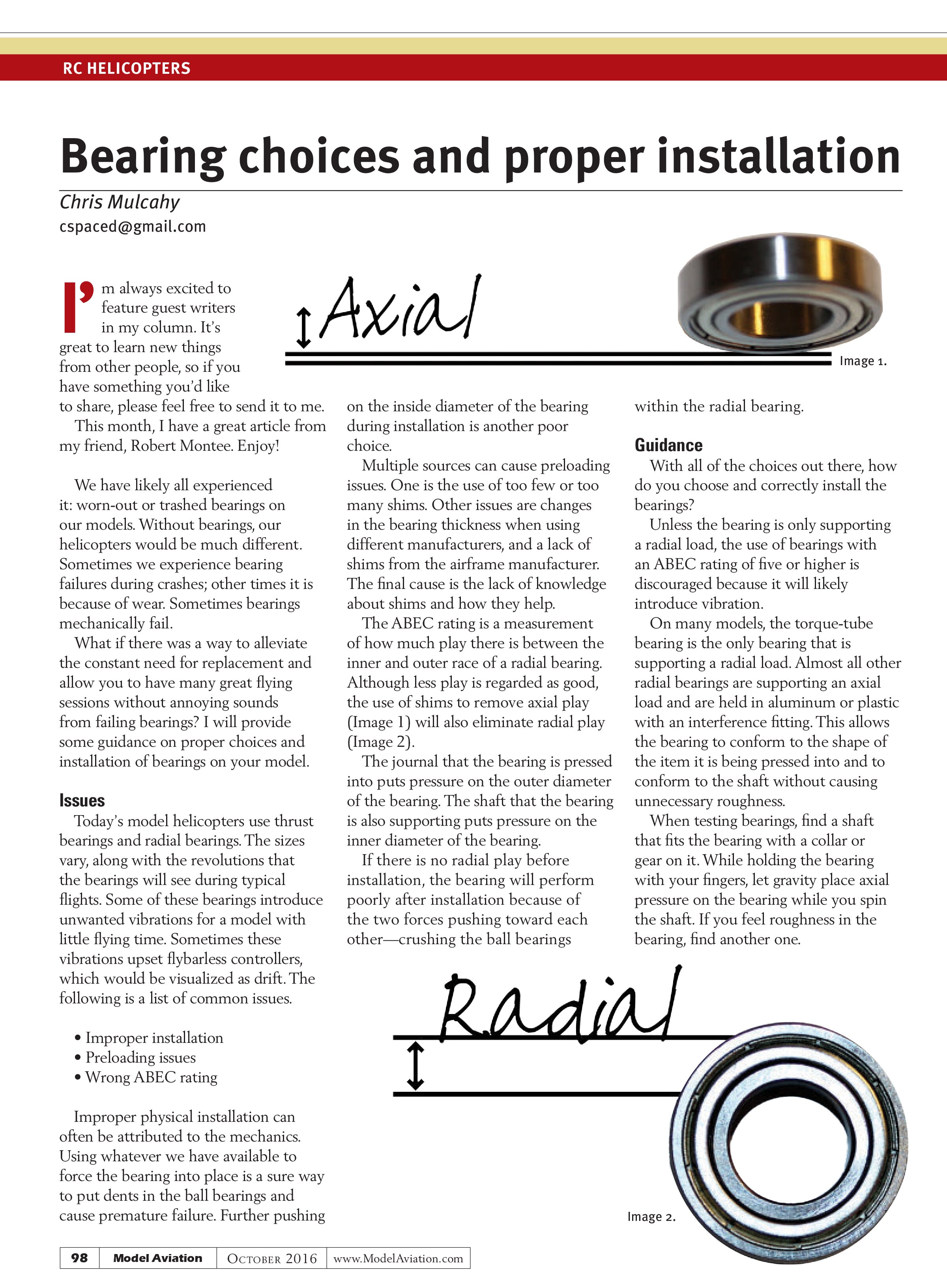
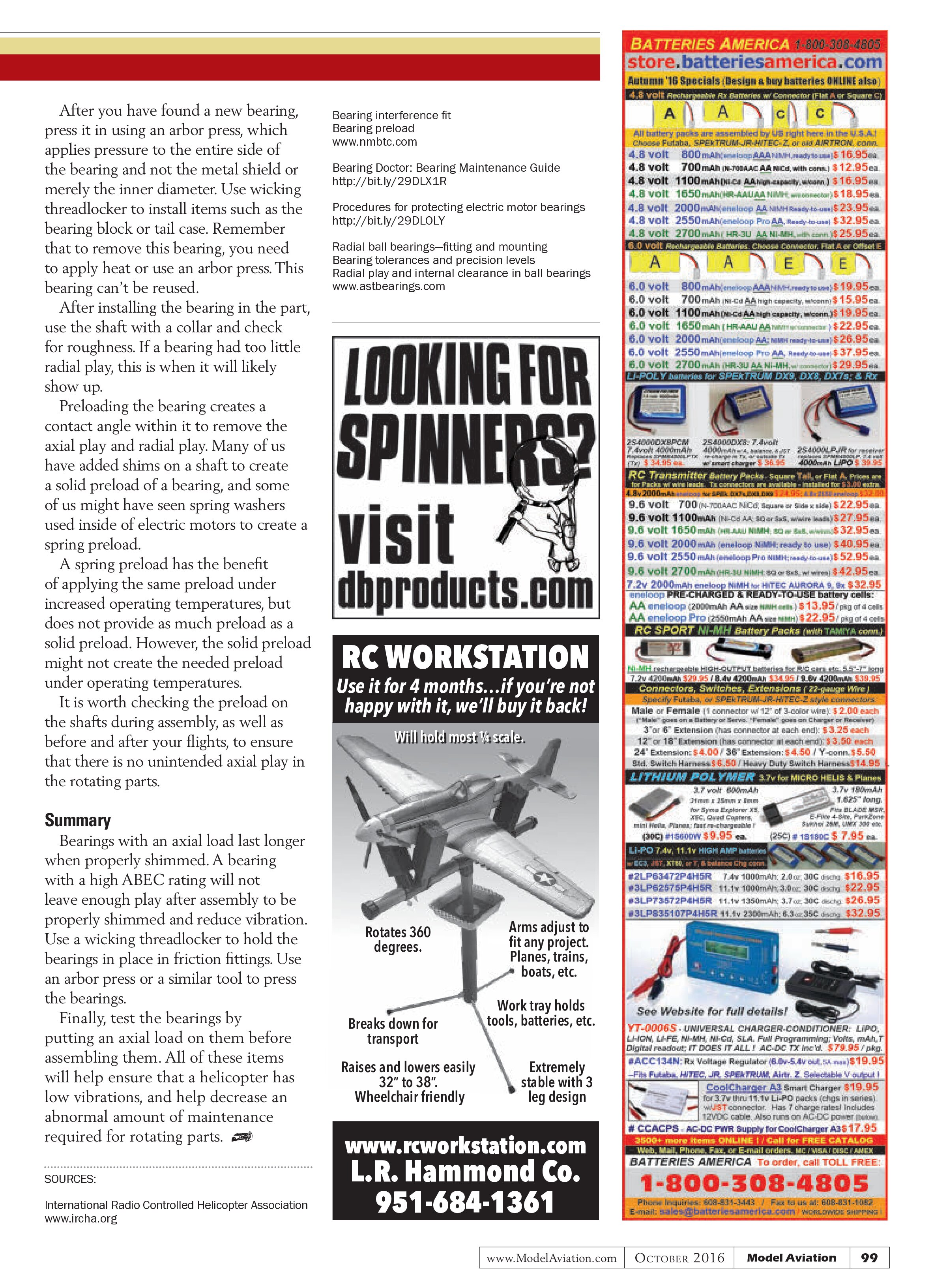
The ABEC rating is a measurement of how much play there is between the inner and outer race of a radial bearing. Although less play is regarded as good, the use of shims to remove axial play (Image 1) will also eliminate radial play (Image 2).
The journal that the bearing is pressed into puts pressure on the outer diameter of the bearing. The shaft that the bearing is also supporting puts pressure on the inner diameter of the bearing.
If there is no radial play before installation, the bearing will perform poorly after installation because of the two forces pushing toward each other—crushing the ball bearings

within the radial bearing.
Guidance
With all of the choices out there, how do you choose and correctly install the bearings?
Unless the bearing is only supporting a radial load, the use of bearings with an ABEC rating of five or higher is discouraged because it will likely introduce vibration.
On many models, the torque-tube bearing is the only bearing that is supporting a radial load. Almost all other radial bearings are supporting an axial load and are held in aluminum or plastic with an interference fitting. This allows the bearing to conform to the shape of the item it is being pressed into and to conform to the shaft without causing unnecessary roughness.
When testing bearings, find a shaft that fits the bearing with a collar or gear on it. While holding the bearing with your fingers, let gravity place axial pressure on the bearing while you spin the shaft. If you feel roughness in the bearing, find another one.
After you have found a new bearing, press it in using an arbor press, which applies pressure to the entire side of the bearing and not the metal shield or merely the inner diameter. Use wicking threadlocker to install items such as the bearing block or tail case. Remember that to remove this bearing, you need to apply heat or use an arbor press. This bearing can’t be reused.
After installing the bearing in the part, use the shaft with a collar and check for roughness. If a bearing had too little radial play, this is when it will likely show up.
Preloading the bearing creates a contact angle within it to remove the axial play and radial play. Many of us have added shims on a shaft to create a solid preload of a bearing, and some of us might have seen spring washers used inside of electric motors to create a spring preload.
A spring preload has the benefit of applying the same preload under increased operating temperatures, but does not provide as much preload as a solid preload. However, the solid preload might not create the needed preload under operating temperatures.
It is worth checking the preload on the shafts during assembly, as well as before and after your flights, to ensure that there is no unintended axial play in the rotating parts.
Summary
Bearings with an axial load last longer when properly shimmed. A bearing with a high ABEC rating will not leave enough play after assembly to be properly shimmed and reduce vibration. Use a wicking threadlocker to hold the bearings in place in friction fittings. Use an arbor press or a similar tool to press the bearings.
Finally, test the bearings by putting an axial load on them before assembling them. All of these items will help ensure that a helicopter has low vibrations, and help decrease an abnormal amount of maintenance required for rotating parts.
SOURCES:
International Radio Controlled Helicopter Association
www.ircha.org